Book
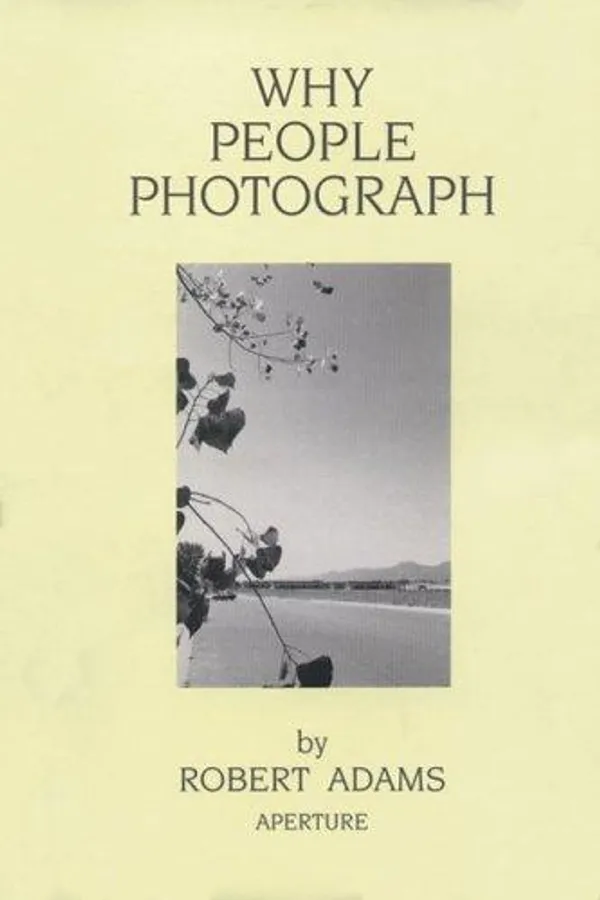
Why People Photograph
Robert Adams
Photography is defensible as a life only if it is practiced as a form of care, attention paid to the world because the world is worth it.
- TYPE
- Book
- SHELF
- Photography & Visual Culture
- TIME
- 11 min read
- ADDED
- 2026 · 07 · 07
- STATUS
- Completed
- IDEAS
Photography · Art · Philosophy
Why it matters
Adams is the conscience I check my practice against; he asks the one question the craft books skip, which is why the work deserves a life.
A working photographer's essays on the people who practice the medium and the reasons that survive scrutiny. Adams writes about colleagues, Strand, Weston, Lange, about money, teaching, and the humiliations of the trade, and about dogs, highways, and the ruined and beautiful American West he spent his life recording. The title question gets its answer early and quietly: people photograph to try to keep what they love, and the ones who last convert that private motive into a public act of attention. The essays circle a hard center, that the photographer's real subject is the tension between what the world is and what it ought to be, and that the honest picture holds both without flinching into either cynicism or decoration. Adams demands what he calls form out of the medium, coherence that persuades the eye that meaning is possible, and he is severe about every substitute: novelty, irony, technical display, careerism. It is the least glamorous book about art I know, and the most sustaining. It reads like advice from a man who assumed you were serious and would not insult you by pretending it was easy.
- People photograph to keep what they love, and the discipline of the medium is converting that private affection into public, defensible form.
- The artist's subject is the discrepancy between the world as it is and as it should be; honest work holds the tension rather than resolving it into cynicism or prettiness.
- Form is not decoration but evidence: a coherent picture argues, wordlessly, that coherence is possible, which is why beauty is a moral claim and not a luxury.
- The working life is mostly unglamorous maintenance, money, teaching, rejection, and a vocation survives on habits, not inspiration.
- Photographers belong to a tradition whether they acknowledge it or not; studying predecessors is not homage but navigation.
- The medium's mechanical ease is its trap: because anyone can make a picture, the photographer must justify each one, and volume is not justification.
The argument
The title is a question, and Adams answers it on the first page with a list that looks casual and is not: people photograph in the hope of keeping what they love, in the hope of finding what is beyond them, and in the hope of making sense of what frightens them. Everything that follows tests those hopes against a working life. The book collects essays written between assignments and darkroom sessions, on money, on teaching, on colleagues living and dead, and its authority comes from that placement: this is not theory descending on practice but practice pausing, briefly, to defend itself.
The defense has a structure. Adams begins with the practitioners, and his essays on Strand, Weston, Lange, and the rest are not appreciations but depositions: what each one saw, what it cost, where the work held and where it went soft. He reads photographs the way a builder reads another builder’s joinery, with professional gratitude and no reverence. From the predecessors he draws the book’s quiet insistence that photography is a tradition, a long conversation about how to pay attention, and that the photographer who ignores it is not free but merely lost, condemned to rediscover its solved problems one failure at a time.
Then the center of the book, stated across several essays because it cannot be said once: the artist’s permanent subject is the gap between the world as it is and the world as it ought to be. The documentarian who shows only the ruin lies by omission about why the ruin matters; the formalist who shows only beauty lies about what beauty is surrounded by. The honest photograph holds both, and the instrument that holds them is form. Form, for Adams, is not composition as taught in workshops but coherence achieved under pressure, the persuasive arrangement that lets a viewer believe, for the duration of one looking, that meaning is possible. This is why he can say that beauty is not a luxury or an evasion: a coherent picture of a strip mall at dusk is an argument, wordless and therefore unanswerable, that the world still permits order. The stakes of a photograph are metaphysical even when the subject is a parking lot. Especially then.
The rest of the book keeps the vocation honest about its economics. There are essays on making a living that no MFA program would assign: the arithmetic of prints and teaching, the compromises of commissions, the long stretches where the work sells nothing and must be continued anyway. Adams refuses both available consolations, the bohemian pose that poverty proves purity, and the market’s pose that sales prove merit. What sustains a photographic life, on his account, is neither, but a set of habits, walking, working, printing, looking, maintained the way a farmer maintains fences, because the vocation is a form of care and care is proven by maintenance, not by feeling. The book ends where it began, with love, now audited: the photographer who lasts is the one whose attention to the world survived his illusions about it.
Working notes
Adams and Sontag are the two poles I keep in tension. On Photography is the prosecution: the camera as acquisitive, aggressive, anesthetic. Adams never argues with her directly, but this book is the defense, conducted not in theory but in evidence: here is a life of practice that made attention more moral, not less. Both are right about different photographers. The question a working photographer must answer is simply which one he is becoming, and the answer shows up in the contact sheets before it shows up in the conscience.
The discrepancy thesis, the world as it is against the world as it ought to be, is the most useful sentence about art I have ever taken from a book, because it converts taste disputes into diagnoses. Work that fails usually fails by resolving the tension: pure ought produces decoration, greeting-card light; pure is produces the sophisticated despair that mistakes bleakness for honesty. The strong picture refuses both comforts. I now recognize the refusal physically, a kind of held breath in the frame, and I look for it in my own work with a colder eye than any critic would bother to bring.
His insistence on tradition rearranged my reading. I had treated photography books as inspiration, a vice the medium encourages; Adams reframes them as navigation, the record of solved problems. Studying Szarkowski’s hundred pictures or Shore’s four levels is not homage, it is inheriting surveyed ground so you can fail somewhere new. The amateur photographs as if he were the first person to see; the professional knows he is the latest, and that the difference between those two conditions is the entire content of craft.
Adams is also the writer who taught me the difference between hope and optimism, a distinction that runs under every essay without ever getting a chapter. Optimism is a forecast, and photography gives no grounds for one; his own subjects, the tract houses, the cut hillsides, the light industrial fringe, argue the other way. Hope is a discipline of attention: the decision to keep looking at a compromised world as if coherence were still possible, and to make frames that prove it locally, one picture at a time. That reframing matters practically, because optimism breaks on contact with the contact sheet and hope does not. A photographer who needs the world to improve will stop working; one who needs only the next honest frame can continue indefinitely.
And the essays on money deserve their obscure fame. Nothing in the art world is more sentimentalized than the artist’s economics, and Adams writes about them the way Grove writes about meetings, as infrastructure that either serves the output or corrupts it. A practice that depends on the market’s mood will be edited by the market’s mood; a practice funded otherwise can afford honesty. He does not say which to choose. He says know which one you have chosen, and stop lying to yourself about the edit.
Where I push back
Adams’s canon is a region wearing the costume of a universe. The photographers who populate his defense are American, documentary-descended, and almost uniformly workers in black and white silver; the implicit standard, patient attention to the given world, quietly demotes everything staged, constructed, commercial, or chromatically exuberant. A photographer can pass every one of Adams’s tests inside registers he barely acknowledges, and a young reader who takes this book as a map will inherit its borders as if they were the medium’s. They are one tradition’s borders, magnificently surveyed.
The severity also has a failure mode the book cannot see, because the book is its antidote only when read whole. Adams earns his moral register through decades of unglamorous labor, and the tenderness under the severity is everywhere in his own pictures. Detached from that labor, the register becomes a style, photography as sermon, the practitioner as the last honest man, and I have met the borrowers. The book hands you a conscience; it cannot hand you the humility that keeps a conscience from becoming a pulpit.
And there is a strategic silence: Adams mostly declines to reckon with photography’s sheer volume, the billions of frames that are not trying to be form and never will be. He wrote before the flood crested, and his answer, justify each picture, is right for the artist and useless as an account of the medium, which now functions mostly as speech, memory, and commerce. A defense of photography that covers only its most serious two percent is a defense of something, but the title promises more than the borders deliver.
How it enters the work
Fineara exists inside Adams’s question. A fine-art photography practice that sells prints must answer, print by print, whether the work is attention or product, and the strip-mall test travels intact to my subjects: an architectural long exposure can hold the tension between what a city is and what it ought to be, or it can flatter steel into advertising. When I edit a series for the galleries, Adams’s one-sentence audit runs on every frame, what do I love here, and does the frame keep it, and frames with no answer leave the edit no matter how well they perform technically. The eight galleries were built on subtraction his conscience supervised.
His economics essays read, to a founder, like a risk memo. I fund the photography from the systems and capital work precisely so the market’s mood never edits the pictures, and I made that arrangement deliberately after understanding his warning: know which practice you have chosen. Mine is the funded kind, and the obligation that comes with the privilege is that the work has no excuse to lie.
The maintenance doctrine crossed into everything. The vocation runs on habits, not inspiration, is Adams agreeing with every serious discipline in this archive, Grove’s calendar, the trader’s journal, and in photography it cashes out as the standing schedule: locations scouted in advance, the same hours at dusk defended weekly, the printing done whether or not belief showed up that morning. The nights the light does nothing are fence-mending. Adams taught me to count them as the practice rather than its failure, and that single accounting change is why the practice is still alive.
- Before releasing a picture, answer Adams's question in one sentence: what do I love here, and does the frame keep it?
- Hold the tension: neither document despair without form nor compose beauty that lies about the subject.
- Study three predecessors deliberately for every project; the tradition already solved problems you are about to fail at.
- Protect the working habits, the unglamorous schedule; the vocation runs on them when belief is unavailable.
- Justify each released frame; the medium's ease makes volume the enemy of meaning.
Adams's moral seriousness can curdle into piety if you inherit the severity without his tenderness; he earns the sermon with decades of work, and a reader who borrows the tone without the labor becomes insufferable. His canon is also narrow, American, documentary, black and white, and a photographer working in other registers, commercial, staged, digital, will find the book quietly suggesting his register is lesser. It is a conscience, not a curriculum; treat it as complete and it will make your seeing provincial.