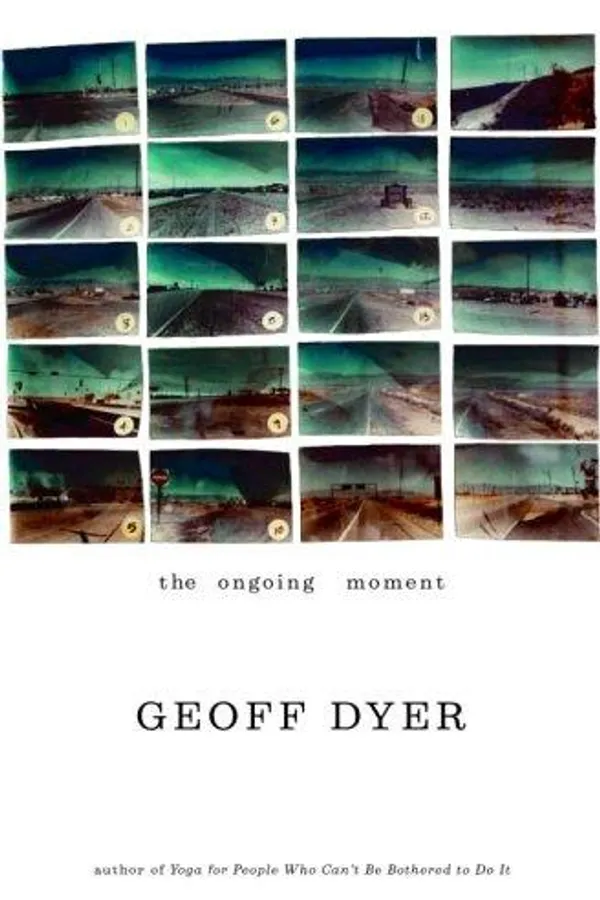
Book
The Ongoing Moment
Geoff Dyer
Photography's history is kept by its subjects: assemble every serious photograph of one thing and you find a conversation among photographers who never met.
- TYPE
- Book
- SHELF
- Photography & Visual Culture
- TIME
- 12 min read
- ADDED
- 2026 · 07 · 07
- STATUS
- Completed
- IDEAS
Photography · Art · History
Why it matters
Everything I photograph has been photographed before; Dyer turned that from a discouragement into an assignment, the record as a conversation entered deliberately.
Dyer admits at the outset that he does not photograph, then writes a history of the medium that no photographer would have dared: organized not by names or decades but by recurring things. Blind street musicians, hats, benches, barbershops, gas stations, empty roads: gather the serious photographs of any one of them and the sequence reads as a single conversation conducted across generations, Stieglitz answering nobody, Strand answering Stieglitz, Evans answered by everyone who ever framed a storefront since. Influence, the book shows, travels through objects: photograph a gas station after Evans and you are quoting him whether you know it or not. The text runs as one continuous essay, no chapters, moving by association the way influence itself moves, sideways, through resemblance. Against Cartier-Bresson's decisive moment it sets the ongoing one: a subject's long exposure to the medium's attention, decades wide, in which each new frame slightly develops all the earlier ones. The result is the most original structure any history of photography has been given, written by the man with the least standing to give it, which turns out to be why he could.
- History by noun instead of name: hold the subject constant across decades and the sequence of photographs reads as one conversation among people who never met.
- Influence travels through things. To photograph a bench, a hat, a gas station is to answer everyone who photographed it before you, whether or not you know their names.
- The decisive moment names an instant one photographer seized; the ongoing moment names the decades a subject spends under the medium's attention, each frame developing the others.
- A motif is a test bench: with the subject held constant, what differs between two photographers is temperament, and nothing isolates temperament faster.
- The blind are the medium's conscience: a camera takes from those who cannot look back, and how a photographer settles that account is a signature.
- The outsider's advantage is real: Dyer maps the medium's memory precisely because he has no position in it to defend.
The argument
The book begins with a disqualification worn as a credential: Dyer does not photograph. No camera, no darkroom hours, no stake in any school’s victory. From that position he does what no working photographer and no career historian had done: he writes the medium’s history with the names demoted and the nouns promoted. Not Stieglitz, then Strand, then Evans, marching by decade, but the blind, hats, benches, barbershops, gas stations, roads; the things themselves, each one trailing every photograph ever made of it.
The mechanism is simple and the yield is not. Choose a subject; assemble the serious photographs of it across a century; read the sequence as one conversation. Held constant, the subject becomes an instrument: everything that varies between the frames is the photographers, their distances, their appetites, their politics, their nerve. Two pictures of the same bench forty years apart measure the two men more exactly than their biographies do, because the bench did not move. Dyer runs this experiment again and again, and the recurring discovery is that photographers answer each other across decades without meeting, often without knowing; the medium conducts its arguments through objects.
The cast assembles itself because the subjects summon it: Stieglitz, Strand, Weston, Evans, Lange, Kertész, Arbus, Eggleston, the same names returning thread after thread, but never as chapter headings. They enter when their pictures answer the subject at hand and leave when the subject moves on. Evans and Lange photographed the same ruined decade, sometimes the same kinds of rooms and roads, and the distance between their frames, his withheld, hers grieving, is the kind of finding the method produces: not a ranking, a diagnosis.
The thread on the blind carries the book’s moral weight. It reaches back to Strand’s Blind Woman of 1916, made with a camera rigged to look elsewhere so the subject could not know she was being taken, and the word is exact: taken. A camera receives from those who cannot look back, and every photographer who has since turned to blind subjects, beggars, accordionists, pianists, has had to settle the same account: what is owed to a person who cannot return the look. Dyer reads each settlement as a signature. The motif is photography’s ethics in miniature, the medium confessing what it does in the act of doing it.
The lighter threads teach the same lesson at lower stakes. The hat: for half a century it sat on nearly every male head in the street, so it sits in every street photograph, dating the frames like tree rings, until it vanishes from heads and therefore from the medium. The gas station, the barbershop, the empty road: the American vernacular inventory, photographed and rephotographed until each object became one of the medium’s fixed stations, a place where a photographer stops to declare who he is. To frame a gas station at all is to quote Evans, willingly or not; the quotation is in the subject before the photographer arrives.
The title states the theory. Cartier-Bresson’s decisive moment names an instant seized by one man; Dyer’s ongoing moment names the decades a subject spends under the medium’s attention. The photographs of one thing, gathered, form a single long exposure spread across generations, and each new frame develops all the earlier ones a little further: Strand’s blind woman looks different after Arbus, the road looks different after Eggleston’s color, and none of the earlier photographers can prevent it. Meaning in photography, on this account, is retroactive and collective; no frame owns itself completely.
The form performs the thesis. There are no chapters; the text moves by association, subject to subject, the way influence itself moves, sideways, through resemblance rather than instruction. And the outsider’s position pays exactly where it should: because Dyer defends no practice, he can follow the medium’s memory wherever it leads, into the minor and the unfashionable, without needing any of it to justify his own pictures. He has none. That is the book’s method, not its deficiency. What it finally proves is modest and permanent: influence in photography is mostly unwilled, the tradition is transmitted through subjects as much as through teachers, and a medium drowning in its own volume still keeps an exact memory, object by object.
Working notes
Szarkowski and Dyer are one discipline practiced in opposite directions. Looking at Photographs isolates the single frame and reads it to the bottom; The Ongoing Moment strings frames on a subject and reads the necklace. Depth of attention, breadth of memory: a photographic education is mostly these two exercises alternated for years, and each corrects the other’s failure mode. Szarkowski alone breeds connoisseurship without history; Dyer alone breeds pattern hunting without weight.
Adams says the tradition has already solved problems you are about to fail at. Dyer shows the solving happening inside the objects: the tradition is not a library you visit but a conversation already in progress around every subject you point a lens at. The two books agree on the humbling part: the photographer who believes he is first is merely uninformed.
Second reading made the real subject visible: belatedness, and its cure. The book is written under the condition every photographer now works in, that everything has been photographed, and its answer is neither despair nor the pretense of innocence but deliberate entry: know the record, take a position in it, answer the frames worth answering. Freedom in a crowded medium begins after you concede the crowd. That concession cost me something the first time; it has paid daily since.
Sontag prosecutes photography for taking; Dyer, on the same evidence, finds a benign verdict available: the taking accumulates into a commons, and the commons is where the medium thinks. Both are right, which is uncomfortable. The blind woman was still taken. The conversation her image started is still worth having. A photographer holds both or hardens into either a cynic or a thief.
The test bench idea is the book’s most portable tool. Hold the subject constant and temperament becomes measurable, including your own: photograph what a master photographed, put the frames side by side, and the difference that remains after you subtract equipment and era is you. It is an unforgiving mirror; most of what I believed was style turned out to be habit, and the remainder, small and stubborn, was worth keeping.
It also explains why the medium’s memory survives its volume. Billions of exposures ought to have drowned the conversation; instead the motifs act as channels, sorting the flood by subject, so that a serious new photograph of a lighthouse or a bench still lands among its ancestors and is read against them. The archive is self organizing. Dyer found the index.
A craftsman’s note on the prose: the connections are made of arrangement, adjacency, timing, the essayist’s cut from one picture to the next, and at his best the arrangement does the work of argument. At his weakest it does the work of seeming to. I read him twice now: once for pleasure, once with the question a trader asks a good chart: is the pattern in the data or in the drawing?
Where I push back
The weightlessness is real and it costs. Dyer reads photographs the way he reads sentences, and much of what matters in a photograph is not sentence like: it is physics and labor, the lens that had to be carried, the hour of light that had to be waited for, wind on a tripod, the two hundred failures around the surviving frame. None of that enters the book, because none of it has ever cost him anything. The result is criticism of outcomes with no feel for the odds: he can tell you what a picture means and cannot tell you what it took, and sometimes what it took is what it means.
The method’s other failure is native to it: coincidence dressed as inheritance. Two benches forty years apart are sometimes two benches. Real influence exists, and Dyer documents plenty; but the book’s engine runs on resemblance, and resemblance is cheap in a medium of billions of frames. When the chain is thin the prose thickens to cover it, and the reader is charmed past the gap. My rule now: the more delightful the connection, the harder it should be interrogated. Delight is the con’s currency in criticism as in markets.
And the guest list betrays the form. The structure is radical; the names are the same canonized, mostly American, mid century company Szarkowski hung a generation earlier. New doors, familiar rooms. A method this portable begged to be run on the vernacular flood, on other continents, on the anonymous; the book that claims influence travels through objects mostly tracks it through celebrities of the medium. Dyer built an instrument bigger than the sample he ran it on, and it is fair to say so while being grateful for the instrument.
How it enters the work
My subjects are among the most photographed on earth. Lower Manhattan, lighthouses, mountain ranges: each arrives loaded with a century of other men’s frames, and before this book I treated that record as noise to be ignored, a threat to whatever originality I imagined I had. Dyer converted it into an assignment. Now the record is studied before the tripod travels: what has been done with this subject, which frames are strong enough to demand an answer, which are so worn that repeating them would be recitation. The conversation is crowded; the entry had better be exact.
The practice is concrete. Before a long exposure of a harbor light or a skyline, I read the subject’s photographic history the way I would read a chart before taking a position: not for instructions but for the shape of the crowd, where agreement has hardened into cliché, where the unanswered frames are. A cliché is another man’s photograph remade unknowingly; the record is how you find out. Some frames I have wanted for years remain unmade because the record shows them already made, better, by someone with more right to them. That refusal is Dyer’s gift in negative.
The test bench runs on me as well. Set my frame of a subject beside its ancestors and subtract what the equipment and the era explain: what remains is either temperament or nothing. Where it is nothing, the frame goes. Where it is temperament, the long exposures, the weight given to black, the preference for structure over incident, that difference gets protected and repeated on purpose. Taste, I have come to think, is exactly this: the residue that survives comparison with the dead, cultivated deliberately.
And the ongoing moment reframed what a returning subject means. Going back to the same light, the same skyline, in different weather and different years is not repetition; it is one exposure still open. Dyer taught me that the frames are not competing with each other, they are developing each other, and that the honest unit of the work is not the picture but the sustained attention the pictures are evidence of.
- Study a subject's photographic record before raising the camera; you are entering a conversation either way, so enter it deliberately.
- Hold the subject constant to see temperament, your own included; photograph what the masters photographed and read the difference honestly.
- Originality is a position taken inside the conversation, not an exit from it.
- Read pictures in series across photographers, not only within one body of work; the motif teaches what the monograph hides.
- Distrust connections that merely delight; ask whether the influence is in the pictures or only in the telling.
The method cannot always tell inheritance from coincidence: two benches forty years apart are sometimes just two benches, and Dyer's charm blurs the line between influence demonstrated and resemblance curated. The reading is also weightless about craft; nothing in it costs an hour of light. Enjoy the book as a way of seeing the tradition, and go elsewhere for evidence.