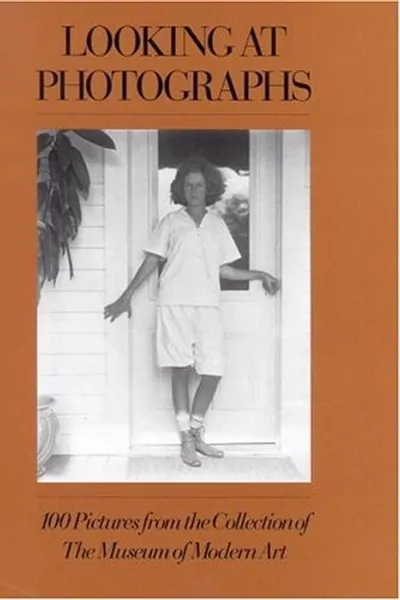
Book
Looking at Photographs
John Szarkowski
Photography is understood one picture at a time, and criticism worth the name is attention demonstrated on a specific frame, not theory applied to a medium.
- TYPE
- Book
- SHELF
- Photography & Visual Culture
- TIME
- 12 min read
- ADDED
- 2026 · 07 · 07
- STATUS
- Completed
- IDEAS
Photography · Art · History
Why it matters
It is the standing drill for my editing eye: a hundred proofs that one page of exact description does more work than a shelf of theory.
In 1973 Szarkowski, who ran the photography department at the Museum of Modern Art for three decades, chose one hundred photographs from the museum's collection and wrote one page about each, facing the plate. The span runs from the medium's first decades to his own contemporaries, masters beside journeymen and unknowns, because his history of photography is a history of pictures, not of names. The method is the argument: each essay begins with what is actually in the frame, moves to how the frame is organized, arrives at what the picture implies, and stops. No system is announced. The framework he had built earlier in The Photographer's Eye, the thing itself, the detail, the frame, time, vantage point, is present everywhere and named nowhere, dissolved into practice. The book is also a canon issued as an album: a hundred choices from one collection are an argument about what the medium is, made by the man with the institutional power to enforce it. It remains the best sustained demonstration in print of how to look at a photograph, which is a different and rarer thing than knowing about photography.
- The unit of understanding is the single picture; movements, periods, and theories are conveniences that dissolve on contact with a specific frame.
- Criticism is demonstrated attention: describe what is in the frame precisely enough and the judgment arrives without being announced.
- Photography taught itself: its tradition includes the functional, the commercial, and the anonymous, and its masters learned from the whole flood of pictures, not only from art.
- The photographer's decisions are few: where to stand, what to include, when to release. Greatness is those three questions answered exactly, under conditions that do not wait.
- Accident is a collaborator: a photograph can know things its maker did not, and honest criticism credits the luck while showing why it favored this eye.
- A collection is an argument: a hundred choices define what the medium is, and the calm of connoisseurship can be power stating its conclusions as taste.
The argument
The form carries the whole claim. One hundred photographs from one museum’s collection, each given a single page of prose and not a word more: no survey chapters, no march of movements, no time line asking to be memorized. The arrangement says what Szarkowski believed before the first essay begins: that photography is not understood in the aggregate, by period or school or theory, but one picture at a time, the way it was made. A history of the medium assembled this way stops being a history of names and becomes what he thought it actually was, a history of pictures, some by masters, some by journeymen, some by nobody anyone can identify.
He had earned the right to the modesty. Szarkowski took over the photography department at the Museum of Modern Art in 1962, in the chair Steichen had held, and ran it for three decades; in 1966 he had published The Photographer’s Eye, which reduced the medium’s formal problems to five terms: the thing itself, the detail, the frame, time, vantage point. That book is the theory. This one is the theory dissolved so completely into practice that it is never named once. You watch the five terms working in essay after essay, the way you watch load paths working in a finished building, and the absence of scaffolding is the point: a framework matters only when it disappears into seeing.
The essays share a discipline. Each begins with what is actually in the frame, stated in exact nouns: the street, the light, the gesture caught at the edge. Then how the frame is organized: what the edge cuts, where the weight sits, what the vantage point concedes and what it refuses. Only then, and briefly, what the picture implies; and then he stops, one page, always, before the meaning is exhausted. The wit is constant but never decorative; it is the wit of a man enjoying precision. What the format enforces is the rarest discipline in writing about art: description before judgment, and judgment only in the amount the description has paid for.
Under the essays runs a doctrine about the medium itself. Photography, in Szarkowski’s telling, taught itself: its problems were worked out not in academies but in the flood of exposures made for every purpose, commerce, science, records, love, and its masters learned from that whole flood, not merely from the small tributary called art. So the hundred include the anonymous and the accidental alongside the acknowledged masters, and the essays honor luck without surrendering to it: a photograph can know things its maker did not, and the critic’s job is to credit the accident while showing why accident favored this eye at this corner on this morning. Few writers have ever held that balance; most either mystify the photographer or reduce him to a lottery winner.
The range is the medium’s entire life to that point, from pictures made before photography was sure it was an art to frames made shortly before the book went to press, and the same discipline of looking holds across the century. Masters sit beside unidentified workers without a change in the prose’s respect, because the page is addressed to the picture, not the reputation.
And the book is a canon, whatever its manners suggest. A hundred choices from one collection, made by the man who also directed the acquisitions and the exhibitions, and thereby much of the medium’s official memory, are not an album; they are an argument about what photography is, enforced by wall space. Szarkowski’s loyalties are legible: the found world over the constructed one, the specific over the rhetorical, Atget’s patient inventory of Paris standing somewhere near the center of the faith. He knew exactly what he was doing. The calm of the prose is the calm of a man whose conclusions had an institution behind them.
What survives all of this, and what makes the book permanent, is transferable: a demonstration that attention is a method. Anyone can hold an opinion about a photograph; the book shows what it costs to earn one. It teaches by repetition, a hundred times, the same movement of mind: look first, name what is there, resist meaning until it forces itself, stop while the picture is still larger than the page. That movement, once learned, does not stay inside photography.
Working notes
Shore’s The Nature of Photographs is the grammar book; this is the literature class, taught entirely by demonstration. Shore names the levels on which a photograph exists; Szarkowski never names anything, and you finish his hundred pages knowing the levels better than any nomenclature could teach them. I keep both within reach and use them in that order: grammar once, demonstration forever.
Barthes is the opposite pole. Camera Lucida hunts the wound, the detail that pierces one particular grieving man; Szarkowski attends to the craft, what the photographer did to the world and how the frame holds it. Barthes cannot be imitated, only envied; his reading died with him, as he knew it would. Szarkowski can be trained for, which is why this book is a manual in a way no book of theory can be. One tells you what a photograph did to a man; the other shows you what a man did with a photograph. A working photographer needs the second daily and the first at intervals, like fasting.
Dyer strings pictures on a subject and reads the sequence; Szarkowski isolates one picture and reads it to the bottom. The two drills train opposite muscles, breadth of memory and depth of attention, and I have come to think a photographic education is mostly those two exercises alternated for years.
Adams asks whether the work deserves a life; Szarkowski asks whether this frame deserves a page. The second question is asked more often, which is why it does more editing.
The drill I actually copied: write one page on one of your own frames, exact nouns, no theory, stop at the page. Most frames cannot support a page. That is the finding, and it is brutal, and it is the fastest editor I know. A picture that gives you three honest sentences is a picture; a picture that needs borrowed language is a deletion.
What the book diagnoses without ever saying so: premature meaning is the characteristic vice of writing about art, and of editing one’s own work. The eye leaps to significance because significance is flattering and description is labor. Szarkowski’s hundred pages are a hundred refusals of that leap. Description delays judgment until judgment is earned; delayed judgment is the only kind worth having, in pictures and, I have found, in most things.
One warning I wrote in the margin years ago: his sentences are good enough to carry a weak plate. More than once the page persuades and the picture, revisited alone, does not. Keep the exercise honest by reversing it: cover the prose, look, then read. When the essay is better than the photograph, note it. It happens; he was human; the lesson is that criticism this good is a power, and power flatters its objects.
Where I push back
The neutrality is a costume. Photographic seeing, as this book practices it, is a theory with borders: it favors the found over the staged, the descriptive over the conceptual, the modernist print over the act or the sequence, and, overwhelmingly, the American over nearly everyone else. Work made against those preferences, constructed, directed, theatrical, does not get refuted; it simply cannot appear, and a hundred choices that exclude are legislation, not observation. A young photographer who takes the hundred as a map inherits its exclusions as instincts, which is how institutional taste reproduces itself: not by argument but by furniture. The book’s calm is institutional calm; it is easy to speak quietly when your museum owns the definitions.
The prose itself is a hazard. Szarkowski writes so well that the writing can settle questions the pictures should be left to contest; taste laundered through sentences that good comes out looking like law. Generations of curators inherited the conclusions without the eye that reached them, and the medium’s official history still carries his borders as if they were natural features. They are one man’s borders, drawn with genius, defended by an institution.
And there is a narrowness about pleasure. His register runs to intelligence, irony, the well made observation; work that is ecstatic, devotional, or unashamedly beautiful sits awkwardly on these pages, handled with tongs. The dimension of photography that aims past wit toward awe, the dimension Tanizaki or Kandinsky would recognize instantly, is mostly outside the book’s temperament. A reader formed entirely here will look brilliantly and feel narrowly, and will mistake that narrowness for rigor. It is not rigor. It is one great curator’s temperature, and the medium runs both hotter and colder than he does.
How it enters the work
Every Fineara edit runs on the one page test. Before a print is considered for the galleries, it has to survive description: what is in the frame, in exact nouns, where the weight sits, what the edge refuses; if the page cannot be written without borrowing significance, the print waits, whatever its technical merits. The test has killed frames I loved. It has never killed one I missed later, which is the entire case for it.
Szarkowski’s deeper lesson for a working photographer is that a collection is an argument, and I hold my own archive to it. Eight galleries hang the work now, and each submission set is a hundred choices problem at smaller scale: the frames chosen declare what I think the medium is for, and a weak inclusion does not merely dilute, it testifies falsely. Sequencing an exhibition after reading this book feels like writing sentences: the pictures are the nouns, the adjacencies are the syntax, and filler is visible immediately to anyone who has watched him choose a hundred times.
The description drill rebuilt my contact sheet habits. I describe before I judge: not whether the frame works but what the light is doing on the tower’s west face, where the black mass of the foreground sits, what the long exposure made of the water plane. Judgment delayed by one minute of exact nouns is judgment improved; the frames that survive that minute are the ones that go to print. This is his method turned inward, and it transfers because it was never really about writing; it was about refusing to see approximately.
And the instinct I already trusted, find the structure, then remove everything that isn’t it, turns out to be his critical method stated as an operating rule. Each of his essays finds the one structure that makes the picture necessary and declines to say anything else. An edit, a portfolio, an exhibition, a page of criticism: the same act at different scales, locating the load bearing frame and clearing the site around it. Szarkowski demonstrated it a hundred consecutive times without once raising his voice, which is why this book, the least theoretical on the photography shelf, is the one that changed the most decisions.
- Write the page before the verdict: describe what is in the frame until the judgment arrives on its own.
- Edit one picture at a time; a portfolio defended in aggregate hides weak frames behind strong neighbors.
- Treat your archive as an argument: every selection declares what you think the medium is.
- Ask what the picture knows that the photographer did not; credit the accident honestly.
- One page, then stop. The constraint is the criticism.
The book was assembling the canon it appears merely to describe: its idea of seeing keeps the staged, the directed, and most photography made beyond America at arm's length, and a hundred authoritative choices teach those exclusions as if they were observations. Some essays are better than their plates. Read it as the finest demonstration of looking we have, not as the medium's constitution.