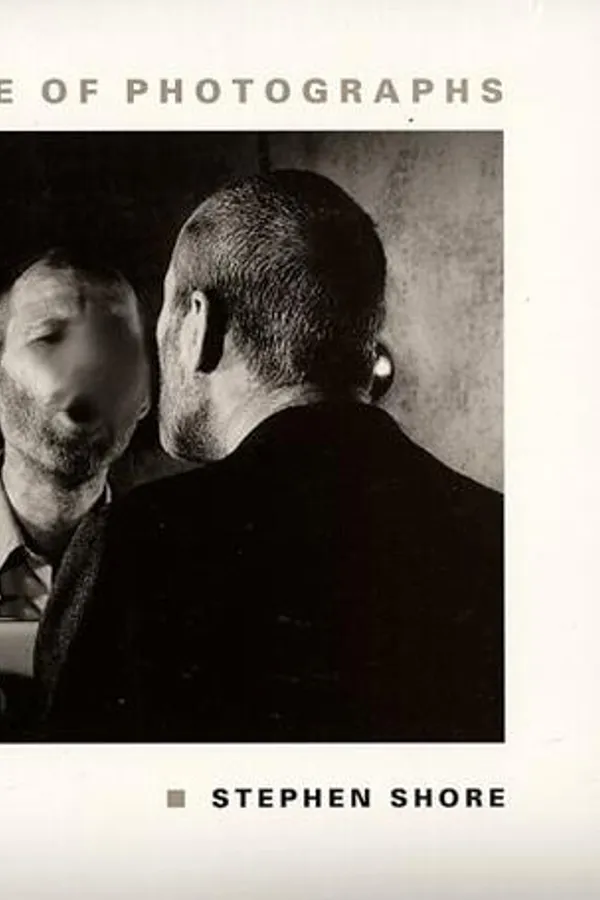
Book
The Nature of Photographs
Stephen Shore
A photograph is not a window but an object: flat, framed, timed, and focused, and every meaning it carries is built from those four transformations.
- TYPE
- Book
- SHELF
- Photography & Visual Culture
- TIME
- 12 min read
- ADDED
- 2026 · 07 · 07
- STATUS
- Completed
- IDEAS
Photography · Art
Why it matters
Shore wrote the grammar under every frame I expose; when a picture of mine fails, this book tells me at which level it failed.
A primer that grew out of Shore's teaching, and it does what primers almost never do: it stops. Not how to make photographs, not what they mean; how they work. A photograph exists on three levels. The physical: a print is a thing, base and image, flat, bounded, static, with a tonal range that sets the terms for everything shown on it. The depictive: the world becomes a picture through four transformations. Flatness collapses depth and invents adjacencies that never existed in space. The frame imposes edges on an edgeless world, and the edges either merely end the picture or actively build it. Exposure manufactures kinds of time no eye experiences: the frozen instant, duration accumulated as blur, the stillness of what never moved. Focus ranks the contents of the frame into a hierarchy of attention. The mental level: the picture is completed in the viewer, whose focus need not coincide with the lens. A closing section on mental modeling names the craft: the photographer carries a model of how the world looks photographed and revises it against results. The text is spare; pictures from the tradition face it and do the demonstrating. A grammar book, severe and complete.
- A photograph exists on three levels at once, physical object, depiction, and mental image, and most bad reading of pictures comes from confusing the levels.
- Flatness is the first transformation: collapsing three dimensions onto a plane creates relationships between things that never existed in space, and those invented adjacencies are content.
- The frame is an instrument, not a border: edges can merely end a picture or actively generate its structure, and everything inside means what it means in relation to them.
- Exposure manufactures kinds of time no eye experiences: the frozen instant, duration accumulated into blur, and the stillness of the unmoving. A shutter speed is a choice of tense.
- Focus builds a hierarchy of attention inside the frame; the plane of focus is the photographer's emphasis made physical.
- Craft is a feedback loop: the photographer works from a mental model of how the world looks photographed, and every print either confirms the model or corrects it.
The argument
The book’s first argument is its size. Shore set out to say how photographs work, said it, and stopped; the text runs to a few spare pages of prose facing reproductions from the tradition, and the reader is asked to move between sentence and picture until each verifies the other. Nothing can be skimmed because nothing is spare. It grew out of his teaching, and it keeps the teacher’s discipline: no theory of art, no history of the medium, no advice. One question, pursued to its floor: what is this object, and by what means does it show a world?
The floor is physical. Before a photograph depicts anything it is a thing: a flat, bounded, static object, an image carried on a base, with a tonal range that runs from its deepest black to its palest highlight. Shore refuses to treat these facts as packaging. The size of a print, the color of its base, the compression of its tones are not containers for the picture; they are conditions of it, and two prints from one negative are two different photographs. The physical level is where most viewers have stopped looking by habit, and Shore starts there precisely because it is the level the mind edits out.
Then the depictive level, the book’s center, where the world is transformed into a picture by four means. Flatness comes first. The world has depth; the photograph has none; and the collapse is not a loss but a manufacture. A lamppost across the street and a tower a mile behind it become neighbors on the plane, touching, stacked, aligned; relationships that never existed in space exist in the picture, and they carry meaning whether or not the photographer intended them. Depth cues survive as depiction, but the picture’s actual structure is flat, and the photographer who does not govern the flat structure is being composed by accident.
The frame is the second transformation. The world has no edges; a photograph is nothing but a piece of the world with edges imposed, and the edges work. They can sit quietly, merely ending a picture whose order is internal, or they can act, cutting forms, generating tension, making the rectangle itself the source of the picture’s structure. Either way, everything inside the frame acquires meaning partly through its relation to the boundary: what is centered, what is bisected, what is let in whole and what is amputated. The frame is a claim about where the world stops mattering, and Shore treats it as the photographer’s most consequential instrument.
Time is the third, and here the book is at its most exact. A photograph does not show time as anyone lives it; exposure manufactures kinds of time that exist nowhere else. A brief exposure produces the frozen instant, a state of the world sliced thinner than perception, showing arrangements no eye ever saw. A long exposure accumulates duration into a single image, movement recorded as its own path, the river as ribbon. And when nothing in front of the camera moves, the exposure’s length becomes moot and the picture reads as pure stillness, a third tense that belongs to neither of the others. Choosing a shutter speed is choosing which of these tenses the picture speaks in, and the choice is grammatical before it is technical.
Focus is the last. The lens renders one plane sharply and everything else in degrees of dissolution, and that gradient is a hierarchy: it ranks the contents of the frame, tells the viewer where the photographer’s attention was, and assigns the rest to context. Depth of field widens or narrows the aristocracy. Focus is emphasis made physical, the one transformation that points.
Above the depictive sits the mental level. The photograph is completed in the viewer, whose attention moves through the picture along paths the four transformations laid down, and whose mental focus need not coincide with the optical one; a picture can be sharp everywhere and pointed at one thing. The closing section, on mental modeling, quietly names the whole craft: a photographer carries an internal model of how the world will look photographed, exposes against it, and lets the print confirm or correct the model. The loop between model and result is where a photographer improves, and everything the book has described is the vocabulary of that loop. Grammar is not what you say. It is what lets you say it and know why it held.
Working notes
The book’s nearest neighbor in this archive is Szarkowski, and the two teach by opposite methods. Looking at Photographs is an anthology: one educated voice walking through a hundred pictures, taste demonstrated at length. Shore is axiomatic: a handful of terms that apply to every photograph ever made, including the ones not yet exposed. Szarkowski trains judgment by example; Shore hands over the instrument panel. Read in the wrong order they mislead; the axioms without the taste produce diagram makers, and the taste without the axioms produces connoisseurs who cannot say why a picture works. The order that built my eye was Shore first, Szarkowski forever after.
Behind both stands Arnheim, and the lineage matters. Art and Visual Perception is the general science of how the eye organizes a field; Shore reads like that science distilled to one medium and stripped of citation, perception theory compressed into a working photographer’s four levers. The compression is the achievement. Anyone can be exhaustive. Completeness at this length means every sentence survived a killing edit, and the book’s authority with photographers comes from that felt severity: it practices the subtraction it never once preaches.
The four transformations turned out to be a diagnostic instrument, which I doubt was the design. A failed picture fails somewhere, and the levels localize the fault. In my own contact sheets the failures cluster stubbornly at two of the four: the frame, edges arrived at by accident, doing work I never assigned them; and time, the wrong tense, an instant frozen where duration was the subject. Almost never flatness, almost never focus. Knowing one’s habitual failure levels is worth more than a decade of general self-criticism, because it converts disappointment into a checklist. The instrument polices praise as well. When a frame works I run the question in reverse, which transformation earned it, because luck at the depictive level is not a style, and I want to know the difference before the next exposure rather than after the next hundred.
And the chapter on time did something quiet and permanent: it made the kinds of time real to me as different pictures, not stylistic variants of one picture. The frozen instant and the accumulated duration do not show the same world faster or slower; they show different worlds, neither of which any eye has seen. A photographer who grasps that stops asking which shutter speed captures the scene and starts asking which tense tells the truth about it. That single reframe is the book’s deepest gift, and it is characteristic of Shore that he spends no rhetoric on it. He states it and moves on, trusting the reader who is ready. A short book that is complete outranks a long one that is thorough.
Where I push back
The grammar has no ethics and no subject. Shore tells you how photographs mean and never what is worth meaning; the book is complete as syntax and silent as counsel, and the silence is a hazard for exactly the serious students who take it most to heart. Fluency in the four transformations, unattached to any reason for photographing, produces pictures that parse beautifully and say nothing: the visual equivalent of grammatically perfect sentences about nothing at all. The book needs a companion that supplies the why, Adams or someone like him, and it does not say so. A grammar that does not admit it is only a grammar lets students mistake it for an education.
The universality is also quieter than it looks. The axioms are stated as properties of all photographs, and the illustrations are drawn overwhelmingly from one American line, the documentary tradition Shore himself descends from. The terms do apply everywhere; flatness and frame and time and focus operate in a fashion editorial and a wedding album alike. But the examples teach a sensibility while the text teaches a grammar, and the reader absorbs both without noticing that only one was argued. What arrives as neutral instruction is partly a canon smuggled in as physics.
And the mental level is the thin chapter. The physical and depictive levels are demonstrable; you can point at a print and show the edge cutting a figure. The mental level gestures at attention, at the picture completed in the mind, without anything like a theory of it, and the section on mental modeling, the book’s most valuable idea for a working photographer, gets a few paragraphs where it deserves a book. Shore’s brevity is elsewhere a discipline; here it is a door opened and not walked through.
How it enters the work
The four questions run before the shutter on every Fineara exposure, in order, as a physical habit: what does flatness juxtapose, what do the edges do, what tense is this exposure, where does focus rank attention. Architecture makes the second question the whole game. A building is already a made structure of edges; my frame negotiates with the architect’s, and the picture succeeds or dies by whether that negotiation is governed or accidental. In cityscape work the first question dominates instead: the plane invents adjacencies, a crane laid against a spire, a bridge cable slicing a tower, and Shore taught me to treat those inventions as content I am responsible for, not coincidences the scene imposed.
The tense question is the one I answer most deliberately, because long exposure is my native grammar. Water planed to smoothness, cloud pulled into streaks, a harbor emptied of every moving person: that is duration accumulated, Shore’s manufactured time, chosen because the subjects I care about, structures, coastlines, light itself, tell the truth in that tense and lie in the frozen instant. Before this book the choice was instinct. After it the choice was a decision I could defend, and the defense sharpened the instinct rather than replacing it.
In the edit the book works as a diagnostic bench. A frame that feels wrong gets located before it gets judged: physical, depictive, or mental; and if depictive, which transformation failed. Most of my rejections are frame failures, edges doing unassigned work, and knowing that has changed how I stand at the tripod more than any workshop could: I now walk the edges of the ground glass corner by corner before anything else, the way a builder checks a foundation before admiring the house. And when a collector at a gallery asks why one print holds a wall and its neighbor never could, the honest answer is Shore’s: the difference lives at a level, not in the subject. Find the structure, then remove everything that isn’t it: this book is that instinct written out for one medium, which is why it stays within reach of the enlarger and not on the shelf.
- Before the shutter, run the four questions: what does flatness juxtapose, what do the edges do, what tense is this exposure, where does focus rank attention.
- Diagnose a failed picture by level, physical, depictive, or mental, before touching anything in it.
- Treat shutter speed as a choice of tense, not a technical setting; the kind of time in the frame is a decision.
- Study the edges of every picture you admire; the frame is doing more work than the subject.
- Keep the grammar under the work, not in front of it; analysis belongs to the edit, attention to the looking.
This is a grammar, not an aesthetics: it tells you how photographs mean and stays silent about what is worth meaning, and a photographer who studies only Shore becomes fluent and empty. Its examples come overwhelmingly from one American lineage, so the grammar quietly universalizes a tradition. And the analytic eye it trains can sterilize; dissect every picture into its transformations and you can stop being moved by any of them.