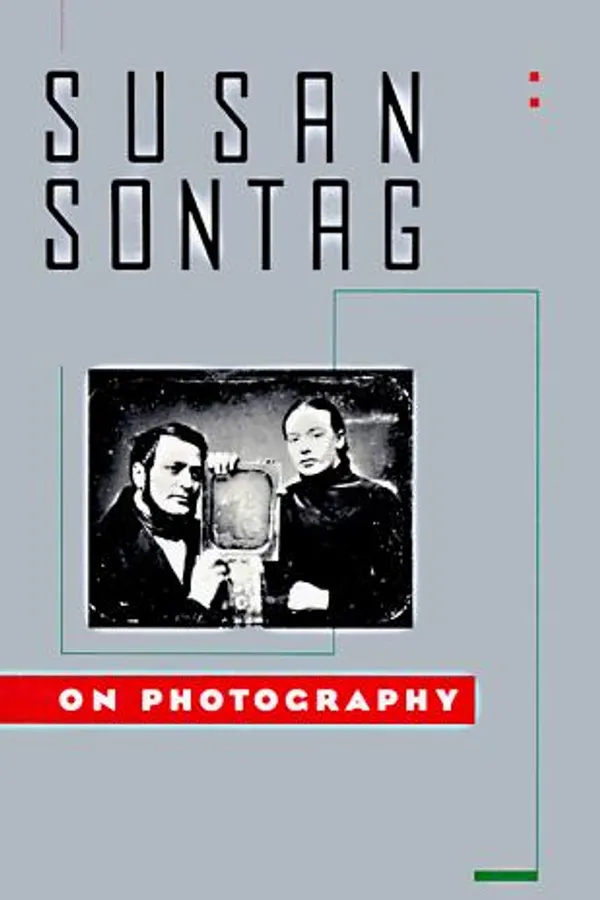
Book
On Photography
Susan Sontag
To photograph is to acquire; a culture that consumes the world as images comes to prefer the images, and Sontag refuses to let that preference stay comfortable.
- TYPE
- Book
- SHELF
- Photography & Visual Culture
- TIME
- 15 min read
- ADDED
- 2026 · 07 · 07
- STATUS
- Completed
- IDEAS
Photography · Art · Philosophy
Why it matters
It is the strongest case ever made against my own practice; a photographer who cannot answer Sontag is not making pictures, he is collecting them.
Six essays, published in the 1970s and containing not a single photograph, that put the camera on trial. The charges accumulate rather than conclude. To photograph is to appropriate the thing photographed; the picture gives the feel of knowledge while withholding understanding, which only narrative supplies. The camera borrows the grammar of the gun: we load, aim, shoot, and the tourist stalks experience the way hunters once stalked game, certifying the trip instead of living it. Images of suffering sear on first contact and numb with repetition, so a civilization awash in them grows more informed and less able to feel. Photography beautifies whatever it touches, including misery; it is the one art that is natively surreal, feeding on the discarded, the freakish, and the past, which time converts into pathos. By the final essay the argument has widened into ontology: the real now needs images to certify it, events are staged to be photographed, and Plato's cave has been wallpapered with prints. Her closing proposal, an ecology of images, is offered without much hope, and she later withdrew parts of the case herself. The prosecution stands anyway.
- To photograph is to appropriate: the image converts the world into something ownable, and collecting pictures becomes a way of collecting the world without touching it.
- Photographs give the semblance of knowledge at a discount; they certify that something existed but cannot explain it, and explanation is the part conscience needs.
- The camera has the grammar of a weapon, and tourism completes the logic: photography turns experience into a hunt and the trip into something to be certified rather than lived.
- Repeated images of suffering anesthetize; the first photograph of an atrocity wounds, the thousandth furnishes the room.
- Photography beautifies whatever it frames, so the medium's most honest documents are always one exposure away from decoration.
- Photography, not painting, is surrealism's true heir: it traffics in found objects, doubles, and the pathos that time confers on every image.
- A society becomes modern when producing and consuming images is one of its principal activities; at that point images stop deferring to reality and reality starts auditioning for images.
The argument
The book contains no photographs. That is the first argument, made by design before a sentence is read: Sontag will discuss the flood without adding to it. What follows is six essays written across the 1970s, and they do not build a system; they circle, strike, and return, which is why the book is remembered in sentences rather than chapters. But the sentences share one spine, announced in the first essay’s title: we still live in Plato’s cave, and photography has not led us out of it, it has redecorated the walls.
The founding transaction, for Sontag, is acquisitive. To photograph something is to put oneself in a relation to it that feels like knowledge and therefore like power: the thing is framed, taken, kept. The vocabulary the medium chose for itself confesses everything: we load, we aim, we shoot, we capture. The camera is a sublimation of the gun, and she notices that on the modern safari the metamorphosis is literal: tourists who once shot animals now shoot pictures of them, the appetite intact, the trophy dematerialized. Photographing people is a gentler violation, but a violation: it sees them as they never see themselves, fixes them at a moment they cannot contest, and turns them into objects that can be symbolically possessed.
From acquisition she moves to epistemology. Photographs feel like knowledge, and this feeling is the medium’s great fraud. A photograph certifies: this existed, this happened, this looked like this. It cannot say why, what preceded, what follows, what it cost. Understanding runs on narrative and time; the photograph abolishes both and hands you the residue. So a culture that learns the world chiefly through images knows more and understands less, holds an enormous inventory of certified facts and no account of them. The camera’s reputation for objectivity compounds the fraud: every photograph is a selection made by someone standing somewhere, an interpretation wearing the costume of a record.
Between the epistemology and the ethics sits her sociology of tourism, the most quietly damning pages in the book. Photography grows up alongside the modern holiday and cures its central anxiety: people trained to work do not know how to be idle, and the camera converts leisure back into production, a friendly imitation of diligence. The tour exists so that it can be photographed; the photograph certifies that the trip was made, the sight seen, the money not wasted. Experience becomes a hunt for the photographable, and the appetite migrates: not to see the thing but to have seen it, with proof. She notices that the nations most devoted to work photograph most compulsively, and the observation has not aged a day.
The ethics follow. The photographer at the scene of suffering has made a choice that the picture conceals: to record is to decline to intervene, and to intervene is to lose the picture. She does not say the choice is always wrong; she says it is always a choice, and that the medium trains its practitioners to prefer the picture with a smoothness that should frighten them. Then the viewer’s side, the claim the book is most quoted for: images of agony sear on first contact and anesthetize on repetition. She dates her own education to a set of camp photographs encountered in a bookstore as a child, an event she describes as cutting her life in two; and she reasons from that wound that the wound cannot be administered twice. What shocked once becomes familiar, then formal, then furniture. Conscience needs context; photography strips the context and multiplies the copies.
The middle essays test the thesis on cases. American photography she reads as Whitman’s inheritance curdling: the democratic embrace of every subject flattening into a leveling where nothing ranks above anything else, and Diane Arbus stands as the terminus, a photographer who treated the anguished and the ordinary with the same immaculate equanimity. Sontag does not accuse Arbus of cruelty; she accuses the medium of making Arbus’s neutrality feel like honesty. The essay on beautification runs the complementary charge: the camera prettifies whatever it frames, and nobody has ever photographed anything into an ugliness the culture could not learn to relish. Misery composed well becomes consumable; the slum photographed at the right hour is one exhibition away from décor.
Her most original stroke hands photography to surrealism. Painting attempted the surreal and produced doctrine; photography achieves it by existing. The medium’s native products are the found object, the accidental double, the freak, the discard; and its deepest surrealist instrument is time itself, since every photograph ages into strangeness and pathos, the past made portable and touching regardless of subject. What the surrealists labored to manufacture, the drugstore develops nightly.
The last essay widens to ontology. She borrows Feuerbach’s old complaint, that the age prefers the image to the thing, and shows it graduated from complaint to infrastructure: events staged for cameras, experiences validated by their images, reality auditioning for its own documentation. A society becomes modern, on her account, when the production and consumption of images becomes one of its principal activities; images then no longer report reality but replace the criteria for it. Consumer capitalism requires exactly this: a citizenry stimulated by images into appetite and sedated by them into spectatorship. The cave again, now with a gift shop. Her remedy arrives in the final pages, thin and knowingly so: an ecology of images, a conservationist ethics that would ration the flood as we ration other exploitations of the real. She offers it in the tone of someone proposing a treaty she expects no one to sign. The book then closes with an anthology of quotations offered in homage to Walter Benjamin, a bow to the one predecessor whose questions about reproduction she had spent two hundred pages sharpening into charges.
Working notes
In this archive Sontag is the prosecution, Adams the defense, and Barthes the coroner. Reading them in that order is the closest thing photography has to due process. What surprises on rereading is how much of her case Adams quietly concedes: the acquisitive shutter, the certifying tourist, the flood. His defense never denies the charges; it argues that a different practice is possible, which is the only defense that was ever available.
The book has aged into prophecy, and the prophecy is unkind to her critics. She described the image-world decades before the infrastructure arrived to build it: the phone that made every citizen an operator, the feed that made every meal an event staged for its documentation, the metrics that pay reality for auditioning well. The certification thesis now reads less like cultural criticism than like a product specification someone later implemented. When a critic’s exaggerations become descriptions, the exaggeration was foresight.
Her method deserves its own note. The book argues by aphorism: verdict-shaped sentences arriving without their trials. This is why it is the most quoted book in the literature and the least tested; an aphorism can be admired or repeated but not audited, and the prose is so good that admiration feels like agreement. I keep two lists from books like this: the sentences that survived contact with practice and the ones that dissolved. Her sentences about certification, beautification, and the image-world survived. The sentences about what photographers feel dissolved on the first morning of real work, because she is describing a hunger she watched, not one she carried.
The recantation matters more than it is given credit for. A quarter century later, writing about war photography again, she reopened her own strongest claim and found it wanting: images of atrocity, she conceded, do not simply numb; they can also keep a wound usable. I hold the two books together as a single lesson that has nothing to do with photography: the strongest aphorist of her generation was willing to reverse herself in public, and the reversal made the original stronger, not weaker, because it converted doctrine back into inquiry.
The anesthesia thesis, wherever it finally settles, transfers out of photography intact. Any instrument that renders suffering legible at volume will eventually render it ambient: the dashboard, the casualty figure, the risk report. Seeing more is not caring more; past a threshold it is how caring ends. Sontag found this in pictures because pictures got there first.
Her Arbus essay I reread as a warning about equanimity in any discipline of looking. The eye that ranks nothing is not humble; it has abdicated. Curation is judgment made visible, and a portfolio, a fund, an archive that embraces everything with the same warmth has stopped meaning anything. Leveling is not generosity. It is the death of the standard wearing generosity’s coat.
And the imageless design keeps teaching. She wrote a book about photographs that refuses to show one, and the refusal is the argument in miniature: description restores the narrative and context that the image amputates. Every time I describe a photograph in these notes instead of reproducing it, I am conceding her point about what the medium cannot carry.
Where I push back
She generalized the snapshot into the medium. The photography she indicts is the photography she watched: the tourist’s certification, the photojournalist’s harvest, the collector’s appetite. There is another practice she barely registers, the photography of patience: the tripod carried to the same coastline for a decade, the exposure that runs eight minutes and requires the photographer to stand in the dark doing nothing but attending. Acquisition describes an instant seized from the world; it describes poorly a frame that must be inhabited. Her theory of the shutter is a theory of one shutter speed.
The deeper limit is that she never made anything with the instrument she indicted. This is not a credential objection; critics need not practice. But her account has no slot for what practice is: the discipline, the failure rate, the years of looking that precede one adequate frame. A theory of photography built entirely from viewing will conclude that photographs are things that happen to viewers. Ask a maker and the medium reverses: photographs are mostly things that refuse to happen, and the refusal is where the ethics live.
The moralism also has no exit. If photographing appropriates, viewing anesthetizes, and beautification is inevitable, what should anyone do? The book will not say. It refuses counsel with an aristocratic completeness, and criticism that cannot describe a better practice curdles into elegant despair. Adams, holding a weaker hand rhetorically, answers the question she will not touch: photograph as a form of care, and let the frame prove it. That the answer exists convicts the prosecution of resting early.
The anesthesia claim, finally, was an intuition dressed as a finding. She asserted a dose-response curve for conscience with no case beyond her own biography, and the culture repeated it as settled science for decades. She corrected herself later, with more honesty than her imitators ever showed; the correction belongs in the margin of every copy.
And her charge against Arbus rebounds. She accuses the medium of leveling, of consuming every subject with the same equanimity; her method does the same to photographers. Individual practices dissolve into one defendant assembled from a century of unlike intentions, and the verdict lands on all of them equally, which is to say unjustly. None of this retires the book. It survives its unfairness the way strong prosecutions do, by forcing the defense to become better than it would otherwise have needed to be.
How it enters the work
Fineara operates under her indictment, and I prefer it that way. Every series that leaves the studio has to answer the acquisitive charge, and the answer is in the method before it is in the mind. A long exposure is the slowest possible pull of the trigger: minutes of standing with a building or a coastline while the light accumulates, nothing seized, nothing stalked. I will not claim the practice refutes her; I claim it is the discipline her book demands and declines to imagine. The frame that comes back from eight minutes of attention has a different moral texture than the frame snatched in passing, and the difference is visible in the print.
Her tourist is my occupational hazard. A photographer who travels to lighthouses and mountain ranges is one lazy season away from certification, from bringing home proof of visit dressed as work. The test I run against every location now is hers: would I stand here without the camera? If the place matters only as its own picture, the picture will say so, and the galleries do not need another certificate of travel. The trip has to be survivable without the trophy or the trophy is all it was.
Beautification is the standing danger of architectural work in particular. A tower photographed at the right hour flatters power effortlessly; the medium wants to turn steel into a brochure, and a fine print of Lower Manhattan can slide from testimony to décor in one flattering exposure. Sontag named the mechanism, and the naming is protection: when a frame comes out too pleasing, I ask what the pleasure is concealing, and some handsome frames do not survive the question.
The ecology of images she proposed as policy I run as practice, because the edit is the one jurisdiction where I govern. The archive releases few pictures; the ratio of frames exposed to frames shown is the quietest number in the practice and the most important one. Scarcity here is not marketing. It is the only answer to the flood that a single photographer controls, and every withheld frame is a small enforcement of the treaty she knew no one would sign.
She wrote the questions in the field notebook: possession or attention, certification or experience, decoration or testimony. Thirty pages of her contempt are worth more to the practice than a shelf of encouragement, because the contempt is accurate about the failure modes. I photograph with the prosecutor present. The pictures are better for the surveillance.
- Before raising the camera, decide whether you are paying attention or taking possession; the picture will show which.
- Never confuse the certified trip with the lived one; if the photograph is the purpose, the experience is already gone.
- Assume the camera beautifies; when the subject is grim, the form must earn the right to be pleasing.
- Ration your own output: an ecology of images begins in the edit, with the frames you refuse to release.
- Answer her charge in practice, not in argument; the only rebuttal to the acquisitive shutter is a discipline of attention it cannot describe.
Sontag argues by aphorism, and aphorisms cannot be tested, only admired; the book's most influential claim, that images numb us, was asserted without evidence and partly withdrawn by Sontag herself a quarter century later. Read it as prosecution, not verdict. Because she writes as a viewer who never worked a camera, she mistakes the habits of the snapshot for the whole of the medium; a reader who believes her completely will stop photographing, which is not the same as photographing well.