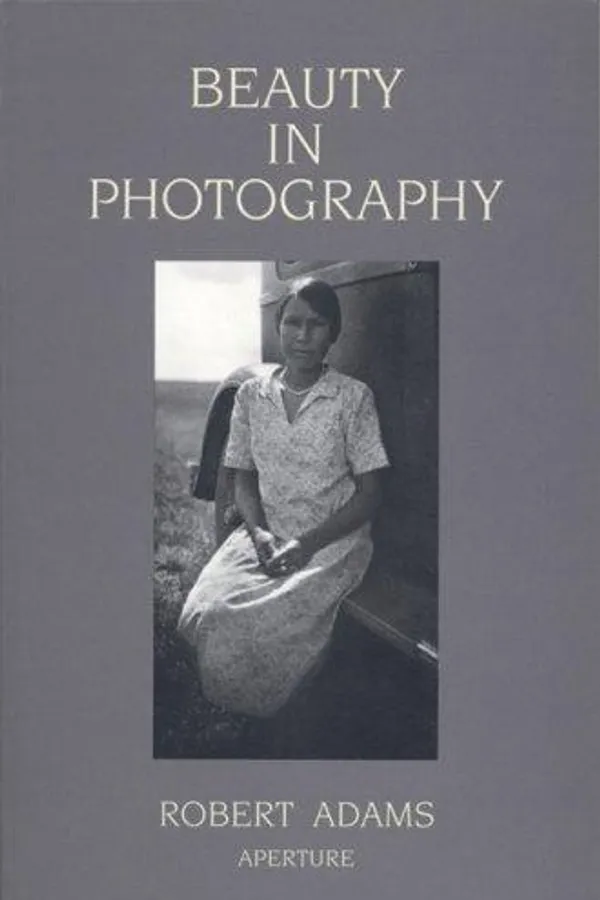
Book
Beauty in Photography
Robert Adams
Art's proper goal is Beauty, and Beauty is the evidence of Form: a coherent picture answers, locally and briefly, the fear that life is chaos.
- TYPE
- Book
- SHELF
- Photography & Visual Culture
- TIME
- 12 min read
- ADDED
- 2026 · 07 · 07
- STATUS
- Completed
- IDEAS
Photography · Art · Philosophy
Why it matters
This is the working defense of beauty I reach for when the word embarrasses the art world; my landscape edit runs on his three verities.
Short essays by a photographer of tract houses and cut hillsides, written in defense of a word his era had made embarrassing. The argument holds one line throughout: the proper goal of art is Beauty, and Beauty means Form, coherence, the rightness of shape, not prettiness. Form matters because it answers the fear beneath all others, that life is chaos and suffering without meaning; a coherent picture is small, local, temporary evidence that order is possible, which is why beauty is a serious claim and not a luxury. Around that center the essays fan out. Landscape photography offers three verities, geography, autobiography, and metaphor: each weak alone, a record, a diary, a stunt; strong pictures hold all three. On photographing evil, Adams refuses both exits: omit the darkness and the picture lies, surrender to it and the picture joins the wreckage; form is the discipline that admits damage without conceding the world to it. Criticism, he argues, should be civil and useful, in service of seeing rather than of the critic. And tradition is defended not as nostalgia but as evidence, the accumulated record of what has been shown to work. Plain prose, morally serious, earned by the pictures behind it.
- The proper goal of art is Beauty, and by Beauty Adams means Form: coherence, the rightness of shape. The definition does all the work, and skipping it produces every misreading of the book.
- Form matters because it answers the fear underneath all others, that life is chaos; a coherent picture is local evidence that order is possible, which makes beauty a claim about the world, not a decoration on it.
- Landscape photographs can offer three verities, geography, autobiography, and metaphor; each alone is weak, and the picture that lasts holds all three at once.
- Evil belongs in the frame but not in charge of it: omit the darkness and the picture lies; transmit it raw and the picture adds to the debris it records.
- Tradition is evidence, not nostalgia: the record of what has already worked, and the standard a new picture must meet or beat rather than merely evade.
- Criticism earns its place by helping people see; writing that performs its own cleverness across the top of the pictures is decoration wearing the costume of judgment.
The argument
The subtitle announces essays in defense of traditional values, and the phrase measures the room the book walked into: an art discourse in which beauty had become an embarrassment, a word for calendars and camera clubs, while seriousness was presumed to live with irony, theory, and the deadpan. Adams mounts the defense from the least defensible ground in American photography. His own subjects were tract houses, cut hillsides, and the raw edges of Colorado suburbia; nobody can accuse the man of decorating, and the whole book borrows its authority from that fact. When a photographer of damaged land argues that Beauty is the point, the argument cannot be dismissed as a taste for the pretty. It has to be met.
The center is a definition, and the definition carries everything. By Beauty Adams does not mean prettiness, pleasantness, or the sublime delivered on schedule; he means Form, coherence, the rightness of shape that holds a picture’s parts in one order. And Form matters, he argues, for a reason that has nothing to do with connoisseurship: it answers the fear underneath all the others, the suspicion that life is chaos and that suffering has no meaning. A coherent picture is a small, local, temporary demonstration that order is possible; it does not prove the world is ordered, but it witnesses that order can be found in it, and that witness is what we are actually valuing when we call a picture beautiful. This is why he can put Beauty at the top of art’s purposes without blushing. The claim is not aesthetic self-indulgence; it is close to theology conducted with a view camera, and Adams states it in prose so plain it takes a second reading to notice how large the claim is.
From the center, the essays fan out into working questions. On landscape, he offers the trio that has outlived the book’s occasion: a landscape photograph can give us geography, autobiography, and metaphor. Each alone is feeble. Geography by itself is a record, the postcard’s accuracy about a place nobody is made to care about; autobiography by itself is a diary, feeling wearing scenery; metaphor by itself is a stunt, significance asserted without ground. The pictures that last hold all three at once: true to the place, honest about the person standing in it, and open onto something more than either. The trio is a standard disguised as an observation, and it cuts most landscape work, including celebrated work, off at the knees. It is also generous in a way standards rarely are: it tells the failed picture exactly which of the three it lacks.
Then the hardest question for his thesis: what does a photographer committed to Beauty do with evil? Adams refuses both easy exits. The picture that omits the darkness, that crops the world down to its consolations, lies, and forfeits the authority that truth alone confers; but the picture that merely transmits horror, unshaped, joins the debris it records, adding one more piece of wreckage to the pile. Form is the third term. A frame that admits the damage and still coheres has done something a document cannot: acknowledged what is broken without conceding the world to it. The affirmation is not painted over the evidence; it survives the evidence, and only that kind of affirmation is worth anything.
The remaining essays defend the ecosystem the work lives in. Criticism, Adams argues, should be civil and useful: its job is to help people see, to stand between the picture and the viewer as a servant of both, and criticism that performs its own sophistication across the top of the pictures is decoration in the costume of judgment. Tradition he defends the same way, not as nostalgia but as evidence: the accumulated record of what has been shown to work, the standard a new picture must meet or beat rather than sidestep by being merely new. Novelty, on his account, is a byproduct of accuracy, not a goal; the photographer trying to be original produces fashion, and the photographer trying to be true produces, occasionally, something no one has seen. The book ends as it proceeds, without a crescendo: a credo in working prose, each claim sized to what the pictures behind it can carry.
Working notes
The two Adams books in this archive divide one labor. Beauty in Photography states what the work is for; Why People Photograph audits what it costs. This is the metaphysics and that is the working life, and they should be read in that order, because the doctrine of Form is what makes the later book’s severity about money, habits, and predecessors intelligible. A man maintains unglamorous discipline for decades only if he believes the output testifies to something; this book is the testimony clause.
Read against Sontag, the book becomes one half of the best argument in the medium. Her charge is that the camera beautifies whatever it frames and thereby divorces beauty from truth; the composed image of misery is her standing exhibit. Adams concedes the mechanism and refuses the verdict, because beauty that lies fails his definition before it fails her indictment: form that conceals the truth of its subject is not coherence but cosmetics, and the book’s whole force is that it holds beauty and truth to a single standard rather than trading one for the other. Sontag documents the divorce. Adams writes the terms of remarriage, and the terms are severe enough that most pretty pictures cannot meet them.
The three verities travel beyond photography, which is how I know they are structural. A trading thesis fails the same three ways a landscape does: only geography, data with no one standing in it; only autobiography, conviction wearing a chart; only metaphor, narrative without ground. The positions that survive a cycle hold fact, witness, and significance at once. I did not learn that from Adams, but he gave it the cleanest formulation I have, and a formulation that compresses a discipline is worth years inside it. That is what a strong definition does: it stops being about its subject and becomes an instrument you catch yourself using elsewhere.
What a second reading surfaces is how much weight the capital B carries and how little the prose leans on it. Adams means coherence; nearly every attack on the book attacks the word instead of the definition, and nearly every abuse of the book borrows the word while discarding the definition. The sentence I keep: beauty is what coherence looks like from the outside. Hold that, and the book’s most quoted claims stop sounding like comfort and start sounding like the demands they are. The definition also explains why his pictures of ruined ground do not depress: coherence found in damaged places is a stronger witness than coherence found in Eden, because it was won against the evidence. Form is not the reward for looking away from what is broken. It is the discipline of not looking away, held long enough that the shape of the thing emerges anyway, and it is rarer in practice than despair, which requires no craft.
Where I push back
The subtitle dates the book, and the dating is not cosmetic. In defense of traditional values concedes the frame to the fight of its decade: it ties a permanent principle, form as the answer to chaos, to a particular canon, quiet, descriptive, mostly monochrome, and invites the reader to accept them as one package. They are not one package. A photographer can hold the principle entire and work in registers Adams never blessed, staged, chromatic, constructed, and the book gives that photographer no help and some quiet discouragement. The principle deserved a defense that did not enlist it in a period argument; bound to the canon, it ages with the canon, and the book’s truest claim gets carried out of fashion by its packaging.
The metaphysics, pressed, is a confession of faith. Why should coherence inside a rectangle testify to order outside it? The skeptic’s reading is available and undefeated: form consoles because we are pattern-hungry animals, and the consolation proves nothing about the world, only about our appetites. Adams never answers this; he outworks it, decade after decade, and lets the pictures argue. I share the faith, my practice depends on it, and I decline to call it a proof. A book this honest about everything else should have been honest that its foundation is a wager, because readers who mistake the wager for a demonstration will lose the faith the first time a coherent picture fails to console them.
And the civility doctrine has a cost he does not count. Some work deserves demolition, and a criticism sworn to usefulness and courtesy can lack the nerve for it. Adams’s own gentleness is earned and armed; as doctrine, handed to critics without his eye, it disarms judgment exactly where judgment is the service. The gap between a virtue practiced and a virtue prescribed is the one distance this book never measures.
How it enters the work
The three verities run as an audit on every landscape edit at Fineara. Mountain ranges and lighthouses are the terrain where the trio bites hardest, because those subjects come pre-loaded with borrowed significance: the frame is only geography, a postcard with better tonality; or only autobiography, a mood wearing scenery; or only metaphor, a symbol reaching past what the place actually gave. The frames that make it to the galleries answer all three, and I can now name which verity a rejected frame lacked, which turns the edit from preference into diagnosis. Most of what the audit kills is metaphor without ground, the picture that wants to mean more than it saw. Adams taught me to distrust that frame most, because it flatters the photographer while it lies about the place.
The doctrine of Form is also the closest thing I have to an account of my own black-and-white instinct. Monochrome strips a scene of the prettiness that color hands out free and leaves structure to carry everything; it is the register in which coherence either exists or visibly does not, with nowhere to hide. When a collector asks why a photograph of bare structure, a pier, a ridge line, a stairwell of steel, is beautiful, the answer is the book’s: because it holds. Form is the whole content of the answer, and since reading Adams I give it without apology.
His terms for photographing damage govern the city work. To photograph Lower Manhattan honestly is to photograph a place where loss is part of the record, and some of my subjects stand on ground that grief built; the frame has to admit that weight without trading on it, cohere without prettifying, exactly the double requirement he sets. And when the word beauty embarrasses a room, which in the art world is often, I have stopped arguing the word. I say Form, state the definition, and let the prints take the question. The embarrassment, Adams convinced me, belongs to the culture and not to the picture, and a practice that apologizes for its central aim will shortly not have one.
- Run the three verities on every landscape frame: geography alone is a postcard, autobiography alone is a diary, metaphor alone is a stunt; keep the frames that hold all three.
- Define beauty as coherence before defending it; the argument changes entirely once the word stops meaning decoration.
- Let the darkness into the frame, but make form hold it; a picture that only documents despair has enlisted in it.
- Judge new work against the tradition's evidence, not against its fashion; what has worked is data.
- When the word beauty embarrasses the room, say Form and keep working; the embarrassment belongs to the culture, not to the picture.
The capital B invites the misreading that has followed the book for decades: Adams is not licensing prettiness, and a reader who skips his definition of Form comes away with permission to decorate. The metaphysical weight he rests on coherence is a faith, not a proof; a skeptic can call it consolation, and the book answers with pictures rather than argument. And a defense of tradition is easily borrowed by mere conservatism, which is not what he practiced but is what some readers take home.