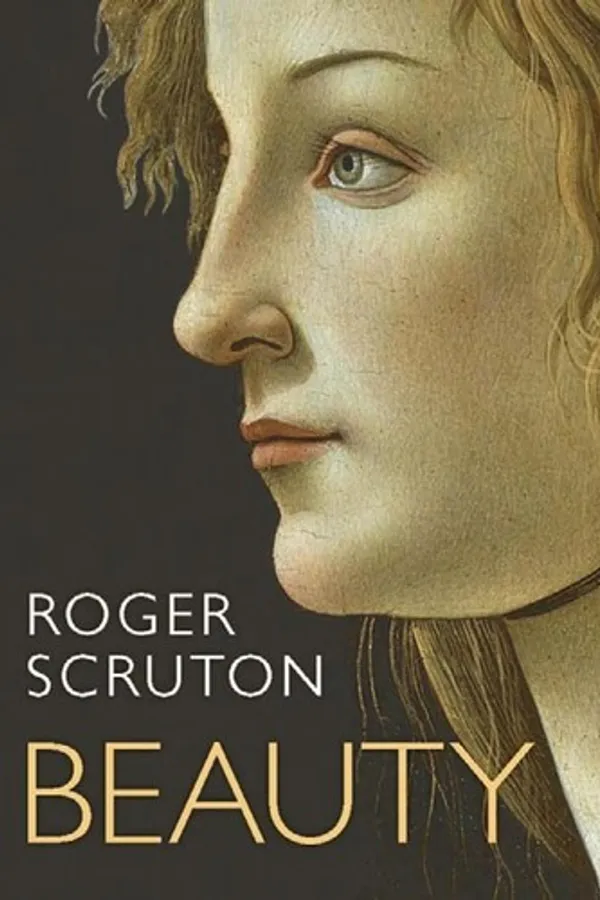
Book
Beauty
Roger Scruton
Beauty is a real value that makes claims on us; the judgment of it can be reasoned and trained, and a culture that forbids the judgment gets kitsch and desecration instead.
- TYPE
- Book
- SHELF
- Art & Aesthetics
- TIME
- 13 min read
- ADDED
- 2026 · 07 · 07
- STATUS
- Completed
- IDEAS
Art · Philosophy
Why it matters
Editing photographs for galleries is a life of saying this and not that; Scruton supplies the spine for making those verdicts out loud and defending them with reasons.
Scruton's subject is the judgment of beauty: what we are doing when we call a face, a building, a landscape, or a song beautiful, and why the act is neither private whim nor provable theorem. From Kant he takes the structure: the judgment is rooted in pleasure yet claims universal assent, which is why we argue about beauty and do not argue about ice cream. From Plato he takes the reach: beauty addresses desire and then educates it, pulling appetite toward contemplation. Between those poles the book covers the whole territory: human beauty, and the difference between desiring a person and consuming one; natural beauty; the minimal, daily beauty of a set table or a planted border, where most aesthetic life actually happens; and art, where taste is formed by comparison, tradition, and criticism. The last movement is a diagnosis. A century that decided judgment was elitist got two substitutes: kitsch, which fakes emotion and asks nothing, and desecration, which soils what it can no longer equal. Scruton's verdict is that beauty is a real value adjacent to the sacred, and that a culture which stops defending it does not become free; it becomes disfigured.
- A judgment of beauty is grounded in pleasure but claims universal assent: calling a thing beautiful invites agreement and accepts the burden of giving reasons, which is why taste can be argued and trained.
- Aesthetic interest is disinterested: pleasure in the thing itself, for its own sake, not in its price, its utility, or its usefulness to your standing.
- Desire for a person individuates; appetite would accept a substitute. Human beauty is the ground where aesthetics and morals meet, and where treating a subject as an object begins.
- Most aesthetic life is minimal beauty: the set table, the proportioned doorway, the tended garden. Everyday arrangement, not the museum, is where taste lives or dies.
- Kitsch fakes emotion: it delivers the feeling without the cost, congratulating the consumer on a sensitivity never exercised. It is a moral fraud before it is an artistic one.
- Desecration is kitsch's twin: transgression as ritual, soiling the sacred it cannot equal. Both are flights from beauty, one into sweetness, one into filth.
The argument
The book is a defense of an activity the twentieth century made embarrassing: judging. Somewhere in that century, saying that one building is better than another became bad manners, then elitism, then a category error, since taste was declared subjective and therefore beyond argument. Scruton’s opening move is to show that this settlement misdescribes what we actually do. When you call a thing beautiful you are not reporting a private tingle; you are making a claim, inviting agreement, and standing ready to give reasons. The structure comes from Kant: the judgment of taste is grounded in pleasure, so it cannot be proven like a theorem, yet it speaks with a universal voice, so it cannot be waved off like a preference in ice cream. Between proof and whim lies the territory of reasoned judgment, the same territory moral life occupies, and the book’s purpose is to reoccupy it.
Two further Kantian instruments do most of the work. Disinterest first: aesthetic pleasure is pleasure in the thing itself, its form, its presence, not in owning it, using it, or being seen beside it. The man who admires the painting because of its auction price has not yet had an aesthetic experience. Purposiveness second: the beautiful object seems organized, meant, coherent, even when no purpose can be named, and this appearance of meaning is what holds attention past the first glance.
From Plato the book takes the harder subject, beauty and desire. Human beauty is where aesthetics stops being polite: it stirs appetite, and the whole moral question is what happens next. Scruton’s distinction is exact. Desire, properly speaking, individuates: it wants this person, irreplaceably, and would be insulted by a substitute. Appetite wants a type and will take any instance. Erotic art holds the embodied person in contemplation; pornography deletes the person and serves the appetite; and the line between them is not prudery but the boundary where a subject becomes an object. Plato’s ladder, desire educated upward toward contemplation, is treated not as mysticism but as an accurate description of what beauty does to longing when longing is disciplined.
The middle of the book widens the field. Natural beauty matters because it is nobody’s artifact and still commands the same judgment, which suggests the judgment tracks something in the world and not merely in the artist’s intentions. And everyday beauty, the chapter I value most, relocates aesthetics from the gallery to the kitchen: setting a table, proportioning a doorway, planting a border, choosing where the lamp goes. These minimal judgments are continuous with the grand ones; they are taste in its daily exercise, and a person who claims aesthetic indifference merely exercises taste badly. Art then appears not as a separate magic but as the concentrated case, where tradition, comparison, and criticism refine the same faculty to its highest pitch. Taste, on this account, is neither rulebook nor whim: it is formed the way moral perception is formed, by long acquaintance and correction, and its verdicts improve with exercise. Which is why great art can take terrible subjects, grief, war, crucifixion, and hold them in a form that neither prettifies nor despairs; that transfiguration, not pleasantness, is what the word beauty is doing in serious criticism.
The final movement is the diagnosis, and it is the part people remember. Modern art’s flight from beauty, Scruton argues, began as an honorable fear of kitsch. Kitsch is fake emotion: the object that delivers the feeling pre-digested, the glow without the grief, sweetness unpaid for; it does not ask you to feel, it congratulates you for feeling, and so it corrupts the heart a degree at a time. But the flight overshot. Terrified of sweetness, the art world embraced its mirror image: desecration, transgression as a standing ritual, the soiling of whatever a previous age held sacred, in stagings, installations, and gestures whose only content is the offense. Duchamp’s urinal could be exhibited once as a joke about exhibitions; repeated for a century, the joke became a curriculum, and originality was replaced by profanation on schedule. Kitsch and desecration are twins: both evade the discipline of form, both are frauds about feeling, and both are what a culture produces when it no longer believes judgment is possible. Beneath the diagnosis sits the book’s quiet metaphysics: the experience of beauty is adjacent to the sacred, a sense that the world is not junk, that it answers our need for meaning, and that is why desecration carries real rage in it. You do not bother defiling what you believe is worthless.
Working notes
Scruton is the philosophy underneath Adams. Beauty in Photography and Why People Photograph both insist that a coherent picture is a wordless argument that meaning is possible, and Adams asserts it from inside the practice; Scruton shows why the assertion is rational, why the felt claim of a beautiful thing is a judgment and not a mood. Reading them together closed a circuit for me: the photographer’s instinct that some frames are true and others merely pleasant is defensible in public, with reasons, and the reasons can be compared and corrected. That is all the objectivity taste needs, and it is enough.
The kitsch chapter gave me the most precise instrument I own for photographic editing. Kitsch is unearned emotion, and photography is the most kitsch-prone medium ever built, because the camera will hand you sweetness for free: the sunset, the mist, the silky water, the golden hour that flatters everything it touches. The test is cost. What did this frame require of the maker, and what does it require of the viewer? A picture can be gorgeous and cost nothing, and those pictures are the enemy, because they train the audience, and the photographer, to stop paying.
The relativism he attacks is mostly manners, and noticing that changed how I hear it. The man who says who is to say always has taste; watch where his eyes rest, what he buys, whom he quotes. He is not without a standard, he is hiding it from criticism, and the hiding is what Scruton refuses. Judgment risked in the open can be educated. Judgment kept private just calcifies.
The kitsch anatomy has acquired a new laboratory since Scruton wrote: generated imagery. A model trained on the aggregate of everyone’s sweetness produces sweetness on demand, feeling at zero cost to maker and viewer alike, and the debate about whether such images are art dissolves under his test before it starts: ask what the image cost, and what it asks. Most of the flood answers nothing and nothing, which is not a verdict on the tools; it is a verdict on the appetite the tools feed, and the appetite predates them by a century. Kitsch was always automation waiting for its machine.
There is a standing argument on this shelf between Scruton and Kandinsky. Concerning the Spiritual in Art reaches the sacred by abandoning the figure; Scruton finds the sacred in form, proportion, and the human face, and distrusts the abandonment. I keep both because the disagreement is about the route, not the destination: both men insist that art answers to something above the market and the ego, and both would recognize the present, where neither route is much walked, as the desert they each predicted.
And the desecration analysis generalizes past art. Profanation became a career strategy wherever attention is scarce: say the unsayable, soil the revered, collect the coverage. Scruton saw the economics early, that transgression is a rent extracted from a sacredness the transgressor did not build and cannot replace. The rent runs out. The sacred, once spent, does not refill on demand.
Where I push back
The recurring fault is a quiet substitution: where the argument establishes that standards of taste exist, Scruton often proceeds as if it had established his standards. The machinery, universal claim, reasons, tradition, comparison, is sound, and it is a machine his own conclusions have to be fed through like anyone else’s; but modernism enters the book on parole, and whole registers, most popular music, most film, are dispatched by category rather than judged case by case. A critic who demands judgment owes it retail. Somewhere there is a record, a building, a film Scruton never weighed that passes every test in this book, and his prose gives you no confidence he went looking.
The sacred is load-bearing and never quite paid for. The diagnosis of kitsch and desecration works because beauty is treated as adjacent to holiness, and for readers who share the intuition the book sings; for those who do not, it is homesickness without an address, eloquence standing where an argument should be. Scruton half concedes this and continues, which is honest, but it leaves the deepest claim in the book resting on a temperament. A foundation that only holds for those born on it is a view, not a foundation.
There is also the matter of the borrowers, and a book must answer for its predictable misuse. This one attracts people who want the verdicts without the labor: the sneer at the new, the reflexive elevation of the old, taste as a uniform announcing a politics. Scruton’s actual demand, look long, compare honestly, give reasons, is harder on that reader than on the avant-garde he despises, but the prose flatters him anyway, and the flattery is a flaw in the writing, not just in the readership. A defense of judgment that licenses judgment without looking has manufactured its own kitsch: the pre-digested verdict, sweetness for the reactionary palate.
How it enters the work
The kitsch test runs on every frame Fineara releases. Long-exposure photography is a genre with a built-in sugar supply: silked water, streaked cloud, the ready-made sublime that the technique produces almost regardless of the operator, and the market rewards exactly that product. Scruton is the reason I treat those payoffs as the hazard rather than the goal. The black-and-white instinct is partly a filter against them: strip the seductive color away and the frame must live on structure, tone, and weight, which is to say on form; what survives the stripping is the picture, and what does not was confection. Before a print goes to a gallery I write the reasons, one or two sentences of actual justification, because a verdict I cannot defend in words is a preference wearing a robe, and the exercise kills more frames than any technical review. It also disciplines the conversations that follow: a gallery partner can argue with a reason, test it, sometimes overturn it, and the work gets better in the exchange. Nobody can argue with a shrug, which is why the shrug is so popular.
The minimal-beauty chapter reaches further into the practice than the art chapters do. Taste is trained in the small daily arrangements, the desk, the room, the spacing of objects, and I now treat those arrangements as practice rather than housekeeping; the eye that hangs an exhibition is the same eye that sets a shelf, and it is exercised or dulled hourly. Order in the small is rehearsal for order in the large. The same conviction, arrived at from the systems side, is why I distrust any architecture whose diagrams are ugly; disorder that visible is never merely cosmetic.
And the book gave the spiritual inquiry a working hypothesis I continue to test: that the experience of beauty is information, not decoration. When a mountain range or a building at dusk arrests me through the viewfinder, Scruton licenses treating that arrest as a datum about the world, a signal that reality holds more order than utility requires, and the discipline is to neither dismiss the signal nor sentimentalize it. That is a narrow path. The photographs are the record of trying to walk it.
- Give reasons for aesthetic verdicts. A judgment you cannot defend is a preference wearing a robe.
- Run the kitsch test: does the work cost you anything, or does it congratulate you for feeling?
- Distrust transgression as automatic depth; profanation is as formulaic as sweetness, and both are evasions of form.
- Practice minimal beauty daily; the table and the room train the eye the print will later need.
- When beauty arrests you, treat it as information about the world, not only about your nervous system.
Scruton's period taste keeps impersonating the standard of taste: modernism gets grudging entry, popular forms are dismissed by category rather than judged case by case, and the sacred that grounds the whole account is asserted with eloquence rather than argument. The book's real danger is its borrowers, who keep the verdicts and drop the obligation of reasons; it can license sneering in people who never did the looking.