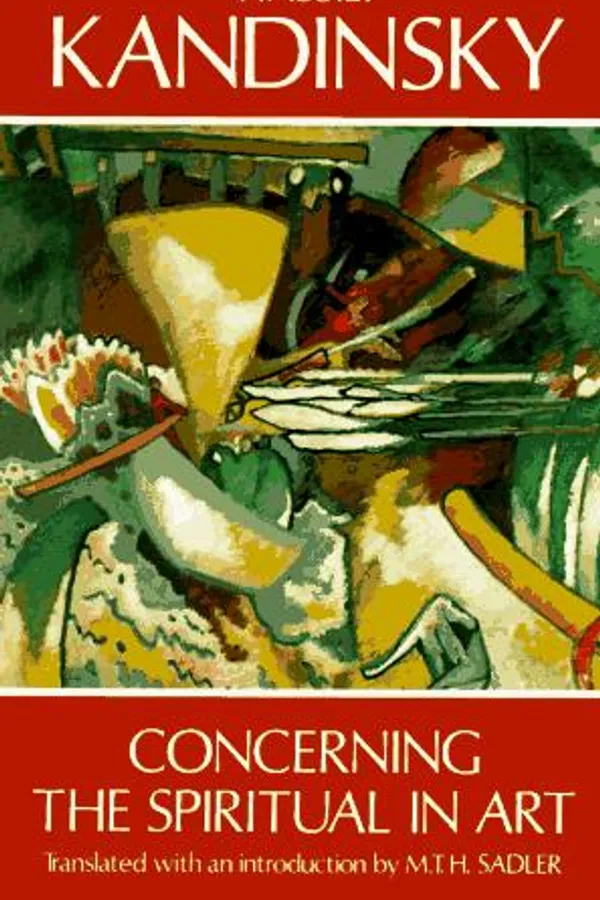
Book
Concerning the Spiritual in Art
Wassily Kandinsky
Form is legitimate only as the garment of an interior state: inner necessity, not likeness or fashion, is the sole law of art, and abstraction is that law obeyed.
- TYPE
- Book
- SHELF
- Art & Aesthetics
- TIME
- 13 min read
- ADDED
- 2026 · 07 · 07
- STATUS
- Completed
- IDEAS
Art · Spirituality
Why it matters
It is the hinge between my art shelf and my esoterica shelf: a working painter arguing, in craft vocabulary, that seeing is a spiritual discipline.
A painter's tract published in Munich at the end of 1911, written on the eve of abstraction by the man about to commit it. Part one is a diagnosis: an age sick with materialism, art demoted to imitation and novelty, the public buying likeness and calling it culture. Kandinsky pictures spiritual life as a great triangle moving slowly upward, the artist at its narrow apex alone and abused, yesterday's madman becoming tomorrow's common ground. Part two builds the instrument: color acts on the eye briefly and on the soul lastingly, and the second effect, the vibration, is the painter's true material. Yellow advances and can turn shrill; blue retreats and deepens toward the infinite; white is the silence before beginnings, black the silence after endings. Governing everything is inner necessity, form justified only by the interior state it answers, drawn from three sources: the personal, the epochal, and the eternally artistic. The freedom this grants is policed from inside; cut loose from necessity, abstraction decays into ornament, neckties and carpets. The book ends sorting his own pictures into impressions, improvisations, and compositions, and announcing an epoch of the spiritual the century declined to deliver.
- Every work of art is the child of its age, and revived past forms are stillborn: the outer gestures of art performed without its inner life.
- Spiritual life moves like a great acute triangle, upward and forward; the apex is occupied by one man at a time, abused now, obvious later.
- Color works twice: a brief physical impression on the eye and a lasting vibration in the one who looks; the second effect is the painter's real material.
- Inner necessity has three sources, the personal, the epochal, and the eternally artistic; the first two are period costume and will date, and only the third crosses time.
- Freedom of form is fenced from inside: abstraction cut loose from necessity decays into ornament, pattern that pleases and means nothing.
- The artist is not free but responsible: the license to abandon appearances is purchased with a duty to content, and the book's conclusion is a job description, not a celebration.
The argument
The book was published in Munich at the end of 1911, and its timing is the first thing to understand about it. Kandinsky was in his mid-forties, a Russian who had left a legal career for painting at thirty, and his own canvases that winter still kept riders, hills, and steeples half legible; the book runs ahead of the paintings and knows it. This is not an aesthete’s retrospective justification. It is a man writing the permission slip he is about to act on, and the urgency of that position is in every page.
Part one is a diagnosis. The age, he says, is coming out of a long materialist night in which the soul was declared a superstition and art was demoted accordingly: to imitation, to novelty, to the market’s competition for likeness and polish. His opening declaration is that every work of art is the child of its age; from it follows the corollary he actually cares about, that reviving the forms of earlier ages produces stillborn work, the outer gestures of art performed without its inner life, an imitation he compares to a monkey copying human motions. The past cannot be re-entered. What can be recovered is the past’s seriousness, the conviction that art answers to something above decoration.
The famous image arrives early: spiritual life as a large acute triangle, moving slowly upward and forward. Each segment holds its population; the apex holds one man at a time, and the crowd nearest him abuses him as a fraud or a madman. Beethoven stands in the book as the example: insulted at the summit in his lifetime, common property of the whole triangle within a generation, because the triangle moves, and where the apex stood, the broad segments eventually arrive. The artist’s position in this geometry is not privilege but employment: each segment is fed by its artists, and the artist who feeds his segment comfortable bread, likeness, sentiment, prettiness, has abandoned the post. Around this he assembles witnesses to the turn he believes underway: Maeterlinck draining words of reference by repetition until only their sound remains; Schoenberg renouncing conventional beauty for the necessities of his ear; Cézanne raising a teacup to the dignity of an inwardly alive thing; Matisse in color and Picasso in form, dismantling the object from two directions. He also notes the theosophists, Blavatsky included, with a sympathy he keeps at arm’s length: symptoms of hunger, not yet food.
Part two builds the instrument, and here the book stops being a tract and becomes a manual. Color, Kandinsky says, acts twice. The first effect is physical, retinal, brief: a charm that fades like a taste. The second is psychic: the color reaches the interior of the one looking and produces a vibration there, and this vibration, not the retinal charm, is the painter’s true material. His model of the instrument is a keyboard: the eye struck, the soul sounding. Then the characterology, delivered with the confidence of a physicist and the content of a confession: yellow is warm, eccentric, advancing on the viewer, capable of the shrillness of a loud trumpet; blue is the concentric color, retreating, deepening toward the infinite, passing as it darkens from cello toward organ; green is stillness satisfied with itself, a complacency he compares, unkindly, to a well-fed cow; red burns with a contained vitality. White he calls the great silence, full of possibility, the pause before birth; black the silence without future, the pause after death. Forms carry their own sounds, and form and color modify each other: the same yellow speaks differently in a triangle and in a circle, so the painter composes in two registers at once.
The law governing the whole is inner necessity. Form is never right or wrong in itself; it is right when it is the exact garment of an interior state and wrong when it is borrowed. Necessity has three sources: what belongs to the artist personally, what belongs to his epoch, and what belongs to art as such, the pure and eternal element; the first two are period costume and will date, and only the third crosses time. The consequence is total freedom of means, anatomy, perspective, and resemblance all optional, and the freedom is immediately fenced from inside: cut every tie to nature without necessity, he warns, and painting decays into geometric ornament, into the pattern of a necktie or a carpet. He predicts a coming theory of pictorial harmony and admits his book cannot supply it. The conclusion sorts his own production into impressions, direct records of outer nature; improvisations, sudden expressions of inner events; and compositions, the slow, deliberate constructions he regards as the summit. The last pages announce an approaching epoch of the great spiritual, with painting as one of its organs. The announcement had three years to run.
Working notes
This is the hinge book of the archive: where one shelf walks across to meet the other. Read next to Tomberg, it passes the filter that book installed: is this an exercise I can practice and test, or a claim I am asked to admire? Inner necessity, the two-stage reading of color, the sorting of one’s own work into modes: exercises, all of them, practicable the same week. The theosophy, the epochal prophecy, the metaphysics of vibration: claims, and the book survives with them amputated. Few books on either shelf survive that surgery. The ones that do are the working canon.
The white and black passages are the ones I have used most, because I work between those two silences. A black-and-white print is, in Kandinsky’s terms, a composition conducted between the pause before birth and the pause after death, and the printer’s real decisions, where the paper stays bare, where the blacks close, are decisions about which silence governs the frame. I had made those decisions for years on instinct. He gave them a theology, and the theology, whatever its standing as metaphysics, is exact as a description of how a deep black behaves beside a held white.
Arnheim and Kandinsky describe the same event from two sides, and keeping both is the point. Arnheim mechanizes expression: the willow reads as mourning because its structure enacts hanging, and the account stops, deliberately, at the eye. Kandinsky asserts what Arnheim brackets: that the vibration lands somewhere, in an interior the diagram cannot reach. I do not need to adjudicate. The photographs get made in the space between the two books, with Arnheim checking the forces and Kandinsky asking what the forces are for.
The triangle repays a colder reading than its author intended. It is a model of how taste moves through a population: the apex is abused, then imitated, then priced. A man who trades recognizes the shape at once, because being early and being wrong are indistinguishable for years, and the only consolation the triangle offers is paid out in decades. Kandinsky lived it: the early abstractions were abused as charlatanry, and within a generation they were a curriculum. The discipline is the same in both markets: position by necessity, not by the segment’s applause.
And his taxonomy of his own work, impressions, improvisations, compositions, is the most quietly useful page in the book. Most bad editing, mine included, is category error: judging an improvisation by a composition’s standards and killing it, or promoting an impression because it took effort. Since reading him I label the mode before I judge the frame, and the labels have ended weeks of argument with myself.
Where I push back
The color doctrine is autobiography wearing a lab coat. Kandinsky reports his own synesthetic constitution, a rare and genuine one, in the grammar of natural law: yellow is, blue does, green wants. Berger’s whole book stands on the other side of this: the eye is schooled, and the school has a district. A reader in Kyoto or Lagos inherits different bells for the same wavelengths, and the well-fed cow in Kandinsky’s green is grazing in Bavaria in 1911, not in the retina. The two-stage mechanism, glance then vibration, survives; the dictionary attached to it is one man’s, and the book never says so.
Inner necessity is the deeper problem, because it is the foundation and it cannot be tested. The criterion is interior, the report of it is verbal, and the sincere and the fraudulent produce identical sentences. Kandinsky sensed the exposure; the ornament warning is his hedge, an admission that freedom without necessity decays. But a warning is not a test, and the century took the license without the fence. Every gallery statement in which a nullity is defended by its maker’s depth of feeling descends from this book, and the book has no instrument for refusing them. A law that cannot be broken detectably is not a law; it is a mood with a constitution.
And the prophecy failed on schedule. The epoch of the great spiritual was announced for the near term; the near term delivered 1914, and after it materialisms with body counts beyond the nineteenth century’s imagination. The triangle may move upward across centuries; the book’s confidence that it was moving upward then, visibly, with painting as its organ, was the period’s own vapor, theosophy’s optimism laundered into aesthetics. What survives is not the forecast but the practice: the book is right about how a serious painter must choose forms, and wrong about what the choosing would summon. Read it as a discipline and it holds. Read it as a prospectus and history has already marked it.
How it enters the work
The long exposure is an abstraction machine, and that is exactly why this book patrols my practice. Minutes of open shutter dissolve water and cloud into fields; the world’s inventory is deleted and form is what remains. Kandinsky’s question lands on every such frame: is this abstraction the garment of an interior state, or is it style, the necktie he warned about, issued by the machine to anyone willing to wait? The market rewards the necktie; smoothed water sells. So the inner-necessity test runs in the Fineara edit as a standing veto: if I cannot name what a frame’s stillness answers, plainly, without borrowed depth, it does not go to the galleries, whatever it cost in cold hours.
The two silences run the printing. A monochrome print is decided at its ends: how much paper stays white, how finally the blacks close. Kandinsky’s descriptions, the silence full of possibility and the silence without future, are operationally exact; a print whose blacks seal too early is a sentence that ends before it means, and a print that never reaches black refuses to end at all. The lighthouse and harbor work lives on this decision. I make it now with his vocabulary in hand, and the prints have gotten quieter and harder to argue with.
The book also settled a private question of standing: whether the spiritual language around the work is permissible. I build systems for enterprises, for capital, and for light, and the third clause used to feel like the one requiring apology in serious company. Kandinsky is the working professional, trained in law, meticulous in craft, who wrote the spiritual claim down in public with theory attached and took the scorn. The permission I take from him is narrow and sufficient: the interior dimension of the work can be spoken of exactly, or not at all; what is forbidden is the vague middle, atmosphere without discipline. That standard came from this book and from Tomberg’s, and between them they police every sentence I write about the photographs.
And the taxonomy became workflow. Scouted architectural work, composed over weeks: compositions. The frame seized when a harbor rearranged itself: improvisation. The record shot of a facade for study: impression. Each mode gets judged by its own law and priced by its own effort, and the portfolio holds all three without pretending they are one thing. The discipline is Kandinsky’s, minus the cosmology; he would call the subtraction a loss. I call it the part of the book that survived a century, which is the only test he set that can actually be scored.
- Before abstracting, name the interior state the form answers; if it has no name and no pressure behind it, the abstraction is fashion.
- Judge color and tone twice: the first glance, then the vibration a minute later; keep only what still sounds.
- Sort your own work into impressions, improvisations, and compositions, and judge each in its own mode; most editing errors are category errors.
- Treat ornament as the failure mode of freedom: when a frame pleases and says nothing, cut it whatever it cost.
- Keep the exercise, drop the cosmology; a practice can outlive its metaphysics, and the useful ones do.
The color metaphysics is one synesthete's autobiography legislated as universal law, and the theosophical scaffolding leans on Blavatsky, whose historical claims were already rubble in 1911. The larger hazard is inner necessity itself: it cannot be tested, and the sincere and the fraudulent invoke it in identical sentences. Take the discipline and the color vocabulary; leave the prophecy, which the century refuted on schedule.