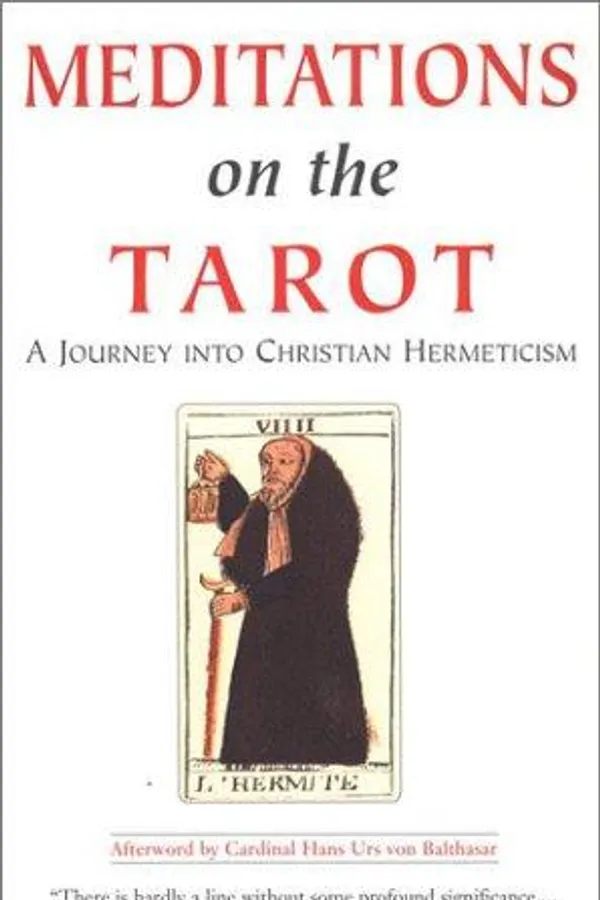
Book
Meditations on the Tarot
Anonymous
The twenty-two major arcana are not a fortune-telling device but a course of spiritual exercises, and the anonymous author walks them as a Christian Hermeticist for whom symbol is a method of knowing.
- TYPE
- Book
- SHELF
- Esoteric & Symbolic
- TIME
- 13 min read
- ADDED
- 2026 · 07 · 07
- STATUS
- Completed
- IDEAS
Esoterica · Spirituality · Philosophy
Why it matters
It is the most serious book in the Western esoteric tradition I have read, and the one that convinced me symbolism can be a discipline of thought rather than an escape from it.
Written in French in the 1960s and published only after the author's death, at his request, without his name, the book consists of twenty-two letters addressed to an unknown friend, one for each major arcanum of the Marseille tarot. The author, long identified as Valentin Tomberg, a Russian émigré who left Rudolf Steiner's movement for the Catholic Church, uses each card as a threshold into one problem of the spiritual life: the Magician opens concentration without effort, the High Priestess the descent of gnosis into memory, the Hanged Man the inversion of worldly gravity, Death the discipline of letting forms die so forces can live. The method throughout is analogy, the Hermetic correspondence of above and below, practiced not as doctrine but as exercise, and the sources are worked with open hands: Scripture, Plato, Kabbalah, alchemy, Bergson, Jung, the mystics. What emerges is not a system but an initiation into a way of reading, in which the images of the tarot become instruments for thinking about prayer, sacrifice, power, and knowledge. It asks for slow reading and repays it like almost nothing else on this shelf.
- The arcana are exercises, not information: each card is a school of one capacity of the soul, and the book's unit of progress is practice, not belief.
- Concentration without effort, the Magician's lesson, is the foundation: the disciplined stillness in which attention works without the tension of the will.
- Analogy is the Hermetic method: correspondences between levels of reality are instruments of inquiry, to be tested in experience rather than asserted as dogma.
- Mysticism, gnosis, and magic are stages of one movement, experience, understanding, and action, and each degenerates when severed from the others.
- The author submits the entire esoteric inheritance to Christian orthodoxy, arguing that the tradition's depth is realized, not cancelled, inside the Church.
- Anonymity is part of the teaching: the author erases himself so the reader confronts the tradition rather than a personality.
The argument
The book announces its method in its form. Twenty-two letters, one per major arcanum of the Marseille deck, each addressed to an unknown friend, each signed by no one. The author, whose identity as Valentin Tomberg is now settled history though the book itself never admits it, asks the reader to treat the cards neither as a game nor as an oracle but as arcana in the old sense: enclosures of meaning that open only to sustained meditation, a ferment or enzyme, as the first letter has it, dropped into the life of the one who works on them. The claim is quietly radical. It says the tarot’s images, vulgar, commercial, endlessly abused, carry a compressed curriculum of the Western spiritual tradition, and that the curriculum activates only in practice, the way a score activates only in playing.
The first letter, on the Magician, lays the foundation stone: concentration without effort. The juggler at his table, relaxed and exact, figures a state in which attention is total and strain is absent, the opposite of the willed, furrowed concentration of the office and the examination hall. Tomberg calls it the transformation of work into play, and he is precise that it is learned, not given: the stillness of a full vessel, not an empty one. Everything later in the book assumes this capacity, and the assumption is itself a teaching, that the spiritual life has prerequisites, and that they are trainable, and that the first of them is a quality of attention. A reader who takes nothing else can take this and be repaid.
From there the letters unfold a psychology disguised as a card commentary. The High Priestess turns concentration into gnosis, the descent of what is seen into what is remembered and written; the Empress into sacred magic, the fertility of forces joined; the Emperor into the renunciation that makes authority legitimate, power that has bound itself. The Hanged Man reverses gravity: the man suspended between heaven and earth is the one whose center of mass has moved above him, so that what looks like helplessness from below is orientation from above. Death is read as the mercy that dismantles exhausted forms so their force can take new bodies, and the Devil, in one of the book’s most sober letters, as the mechanics of enslavement to one’s own generated passions, an anatomy of addiction written before the vocabulary existed. Throughout, the engine is the Hermetic axiom of correspondence, as above, so below, handled with unusual honesty: analogy for Tomberg is not proof but instrument, a way of generating hypotheses about the vertical structure of experience that must then be verified in practice, in prayer, in the laboratory of one’s own attention.
Two letters show the book’s range. The Tower of Destruction is read as the fate of every structure built by pride, spiritual, intellectual, institutional: what is erected against the vertical is corrected by it, and the correction arrives as catastrophe only because the building refused smaller corrections earlier. And the letter on the Star, the naked figure pouring water onto land and stream, becomes a meditation on hope as an objective force rather than a mood, the influx that keeps working when every psychological ground for it is gone. Between those poles, demolition and replenishment, the book conducts what older writers would have called a cure of the soul, and it does so while wearing the costume of a commentary on playing cards. The disproportion between vehicle and cargo is the point: the tradition survived in disguise, and learning to read the disguise is the initiation.
The synthesis under the letters is what the subtitle names Christian Hermeticism. Tomberg’s biography is the argument: trained in Steiner’s Anthroposophy, he concluded that esotericism severed from the Church becomes either fantasy or pride, and the book performs, at length, the submission of the entire occult inheritance, Kabbalah, alchemy, magic, astrology, to Catholic orthodoxy. Mysticism, gnosis, and magic are ordered as stages of one movement: experience of the divine, understanding of the experience, action from the understanding, and each is shown decaying when isolated, mysticism into vagueness, gnosis into intellectual pride, magic into sorcery. Whether the reader accepts the submission or not, its effect on the book’s tone is unmistakable. There is no showmanship, no promise of powers, no flattery of the reader’s specialness, the standing vices of this literature. The anonymity is the final argument: a teacher who has removed himself from the teaching cannot be building a following. It is the strangest credential in the tradition, and the strongest.
Working notes
I came to this book through the shelf around it, and it reorganized the shelf. The Corpus Hermeticum supplies the axioms; Fortune’s Mystical Qabalah supplies the filing system; Jung supplies the clinical vocabulary. Tomberg is the only one of them who reads like a man for whom all of it is ordinary working equipment, handled daily, without either the collector’s distance or the enthusiast’s fever. The tone is the teaching. I know no better demonstration that the esoteric register can be sober, and sobriety is the entire dividing line between this shelf’s wheat and its very abundant chaff.
Concentration without effort is the book’s most portable asset, and I have tested it far from any altar. It is the accurate name for the state in which real architectural work happens, the system seen whole, attention resting on the problem without gripping it, and for the state in which a long exposure is composed: the frame held, the strain gone, the seeing doing itself. Tomberg would say those are minor applications of a capacity meant for higher objects. Perhaps. But the capacity is one thing, and learning its taste in work you already do is how you recognize it in work you have not yet attempted.
The letter on Death gave me a sentence I use in due diligence, though Tomberg would wince at the application: distinguish the form from the force. Companies, protocols, funds, careers all present forms whose animating force may have already departed, and the book’s discipline, mourn nothing whose force has left, ask only where the force went, is a colder instrument for reading a cap table than anything in the finance shelf. Symbolic training turns out to be pattern-recognition training; the patterns are just older than the assets.
The book also gave me a usable definition of the difference between the two esotericisms this shelf must keep separated. The degenerate kind promises leverage: powers, secrets, advantages, the occult as a shortcut through the world’s resistance. Tomberg’s kind promises weight: obligations, exercises, submission to something above the practitioner, the occult as a longer way through the same resistance. The test is what the teaching asks of you versus what it offers you, and it sorts this literature in about a minute per book. Almost everything commercial fails it. The handful of works that pass, this one first among them, form a tradition worth a serious man’s attention, and the rest is inventory for people who want costumes.
And the anonymity keeps working on me. In an economy where every insight arrives stapled to a personal brand, a masterwork published nameless, by a man who wanted the ideas to survive without him, reads as a rebuke addressed to the present. I notice who cannot disappear behind their teaching. The list is long, and this book is the standing exception that makes the list legible.
Where I push back
The historical scholarship is the soft flank. Tomberg harmonizes sources the way a devotional writer must and a historian may not: Hermetic texts, Kabbalistic schemas, and alchemical emblems are bent, sometimes hard, toward the Christian synthesis he needs, and a reader calibrated by Yates or by the modern academic study of esotericism will catch the joins. The Marseille tarot itself is a fifteenth-to-seventeenth-century artifact, a card game’s imagery, and the book’s premise that it encodes a coherent ancient curriculum is, historically speaking, a construction. Tomberg half-knows this and does not care; the cards are for him an occasion, not an authority. But the book never says so plainly, and a credulous reader inherits a false history along with the true exercises.
The Catholic submission, the book’s spine, is also its narrowest gate. Tomberg’s claim is not that Christianity is one valid frame among several but that the whole esoteric inheritance finds its truth only inside the Church, and the letters enforce this with a serenity that a non-Catholic reader will eventually experience as a wall. I respect the wall; it is what keeps the book from dissolving into the syncretic soup that drowns this genre. But it prices out readers whose seriousness is equal and whose orthodoxy is other, and it allows the book to resolve, by authority, tensions it should hold open.
And the method carries its own occupational disease. Analogy generates meaning promiscuously; that is its power and its pathology. Tomberg’s discipline, verify in practice, submit to doctrine, mostly contains it, but the book still contains stretches where correspondence piles on correspondence past any possible test, and the reader’s assent is being purchased by rhythm rather than earned by argument. The genre’s failure mode, everything means everything, is held at bay here, not abolished. A reader who learns the method without the containment will emerge fluent and unfalsifiable, and the world has enough of those.
How it enters the work
This book patrols the border between my spiritual inquiry and my systems instinct, and it is the reason I stopped treating them as separate jurisdictions. Find the structure, then remove everything that isn’t it, is, I eventually noticed, an analogical method: it assumes the visible system corresponds to a simpler generating order that attention can reach. Tomberg names that assumption, trains it, and supplies its ethics: correspondence is a hypothesis, verification is a duty, and attention is a moral act before it is a technical one. The Hermetic axiom turns out to be the working faith of every architect who believes the diagram exists before he finds it.
Concentration without effort has entered the practice literally. The long-exposure work that Fineara shows, minutes of open shutter on water and stone and steel, is technically a meditation protocol: compose, commit, release, and then hold attention without intervention while the light accumulates. I understood my best frames only after Tomberg gave me the vocabulary; they happen when the effort stops before the attention does. The same state, cultivated, is what a trading desk calls discipline in the hours when a thesis is working and the only job is not to touch it.
It also disciplined how I hold the rest of the tradition. The Kybalion’s seven principles, Fortune’s Tree, Jung’s alchemical readings all pass through the filter Tomberg installed: is this an exercise I can practice and test, or a claim I am being asked to admire? The first category earns shelf space and hours; the second earns a note and a return to work. That single filter has saved me from most of what makes this genre a fever swamp, and it came from its most devout book, which is the kind of joke the tradition itself would appreciate.
And the book set the standard this whole esoterica shelf must meet. It proved to me that the symbolic tradition can be studied with full intellectual seriousness, as a technology of interior work with a real history and real hazards, and that the alternative to credulity is not contempt but discipline. Every other book on this shelf gets read against Tomberg’s tone: sober, submitted, anonymous, slow. Most fail the comparison. The shelf exists because a few do not, and this one taught me the difference.
- Practice concentration without effort before any harder interior work; strain is the signature of the amateur in attention as in trading.
- Use analogy as a hypothesis generator and experience as the test; correspondence proposed is not correspondence proven.
- Keep experience, understanding, and action joined; any one of them alone curdles.
- Let forms die when their force has left; mourning a dead structure is the esoteric name for sunk cost.
- Distrust any teacher who cannot disappear behind the teaching.
This is a Catholic book to its marrow, and readers allergic to that submission will feel claustrophobia where devotees feel depth; its harmonizations are also historically loose, and a scholar of Hermeticism will find sources bent toward the synthesis the author needs. The larger danger is the genre's: analogical thinking is intoxicating, and without the author's own discipline it degenerates into seeing correspondences everywhere and testing nothing. Read it as exercises under an orthodoxy you may not share, not as history, and never as divination.