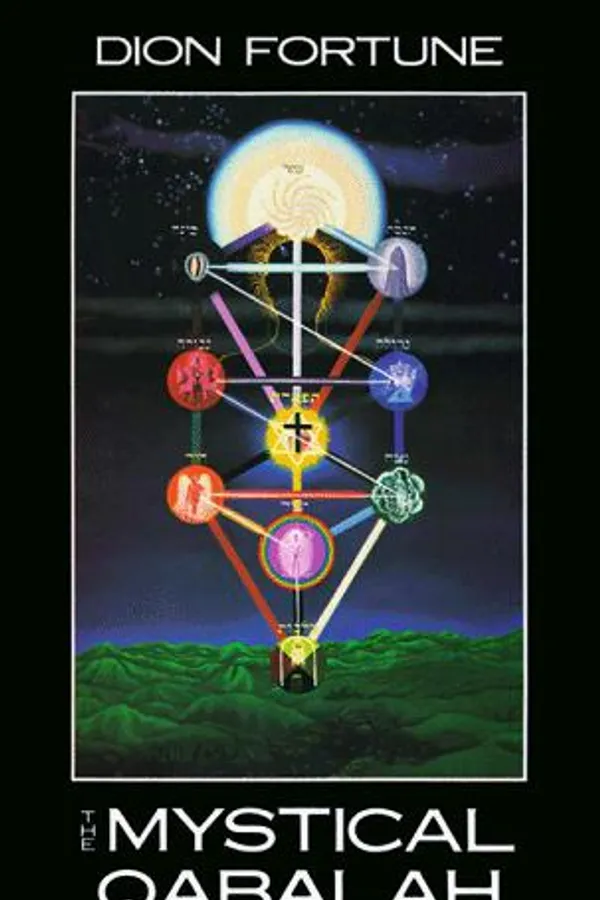
Book
The Mystical Qabalah
Dion Fortune
The Tree of Life is a filing system for consciousness: an artificial glyph that organizes psyche and cosmos on one diagram so both can be worked deliberately.
- TYPE
- Book
- SHELF
- Esoteric & Symbolic
- TIME
- 13 min read
- ADDED
- 2026 · 07 · 07
- STATUS
- Completed
- IDEAS
Esoterica · Psychology · Spirituality
Why it matters
It is the engineering document of Western esoterica, and it taught me that a symbol system is judged the way architecture is judged: by what it lets you retrieve.
Published in 1935 by Violet Firth, who wrote as Dion Fortune and ran her own school after training in the successor lodges of the Golden Dawn, this is the plainest working exposition of the Hermetic Qabalah the tradition produced. Its object is the Tree of Life: ten sephiroth joined by twenty-two paths, arranged on three pillars, the whole read as one diagram of both the universe and the soul. Fortune is candid that the glyph is artificial. Its worth is functional: each sephirah is a station of consciousness with a fixed address, and everything a practitioner encounters, gods, planets, tarot images, colors, states of mind, is filed to an address by correspondence, so that the mind can retrieve and combine what it knows. She argues that Westerners need a discipline fitted to Western temperament and working life rather than one imported from the East, and she offers the Qabalah as that discipline: a method of meditation, sephirah by sephirah, that builds the diagram into the imagination until it operates. The chapters walk the Tree from Kether to Malkuth, assembling for each power its correspondences, its spiritual experience, and its virtue and vice.
- The Tree is a device, not a doctrine: Fortune states plainly that the glyph is a constructed instrument, and its value lies in what it enables the mind to do, not in claims about what the universe is.
- Correspondence is the indexing method: every symbol filed to a sephirah becomes retrievable, and the files cross-reference; the system's power is associative because minds are.
- A discipline must fit the practitioner: her case for the Qabalah as the West's own yoga rests on the claim that imported practices fail by misfit before they fail by falsity.
- Each sephirah carries a virtue and a vice, and they are the same force at different discipline; the diagram teaches that every capacity has its pathology built in.
- Evil is unbalanced force: the three pillars make equilibrium structural, and power taken on before its counterweight exists is the standing accident of the work.
- Macrocosm and microcosm share the diagram: work on the symbol reorganizes the worker, which is the entire mechanism of the practice and the entire risk of it.
The argument
This is the book a working teacher writes after years of watching students break. Violet Firth, who published as Dion Fortune, had trained in the lodges descended from the Hermetic Order of the Golden Dawn, had worked as a lay psychotherapist before that, and by 1935 was running her own school, the Fraternity of the Inner Light. The Mystical Qabalah is her syllabus made public: not a history of Jewish Kabbalah and not a grimoire, but a manual for the central instrument of the Western esoteric tradition, written in flat, confident prose by someone who used the instrument daily and expected the reader to do the same.
The instrument is the Tree of Life. Ten sephiroth, stations of divine force, joined by twenty-two paths and arranged on three pillars: severity on one side, mercy on the other, equilibrium between them. Above the first sephirah the tradition sets the veils of negative existence, its way of refusing to let the diagram claim to contain its own source; across the middle hangs Daath, the sephirah that is not one, where knowledge condenses without receiving a station. Force enters at the crown and descends by the zigzag called the Lightning Flash, taking on density station by station until it earths in Malkuth, the material world; the same ladder read upward is the path of return. One diagram, two directions, and Fortune’s claim is that everything the tradition knows hangs somewhere on it.
What separates her exposition from the shelf around it is candor about what the diagram is. She does not present the Tree as revelation or as a fact of nature. She calls it a constructed symbol, built and refined by generations of practitioners because minds work by association, and a shared structure of association can be trained, transmitted, and used. The Tree is a filing system for consciousness. Each sephirah is an address. The correspondences, god-names, archangels, planets, tarot images, colors, virtues, vices, are the files, and the practitioner’s task is to file experience so thoroughly that any symbol summons its whole neighborhood. The claim is modest in form and immodest in consequence: a mind so organized can move deliberately through its own contents, and deliberate movement through one’s own contents is most of what this tradition means by magic.
Her second claim gives the book its edge. The West, she argues, keeps importing disciplines built for other bodies, climates, and social arrangements, then blames the student when they fail. A method is not portable merely because it is true; renunciate techniques presume a life the Western householder does not lead and should not pretend to lead. The Qabalah is her answer, offered as the West’s own yoga: a mystical method whose symbols already run in the culture her readers inherit, workable by people with offices, families, and rent. The argument essentializes more than it should, and I will return to that; its kernel is operational and survives every correction. Fit the discipline to the practitioner’s actual life, or watch it fail silently and take the student’s confidence with it.
The bulk of the book walks the Tree one sephirah at a time, from Kether to Malkuth, and the chapters share an anatomy: position on the glyph, titles, correspondences, the spiritual experience proper to the station, and, most usefully, the virtue and the vice. Every power is listed with its pathology because they are one force at different discipline: the severity that guards an order and the cruelty that enjoys itself are the same energy, distinguished only by government. From this follows the definition Fortune repeats like a safety notice: evil is unbalanced force. The pillars flank a middle way because equilibrium is structural, not decorative; power drawn down before its counterweight exists is the standing accident of occult work, and she had seen enough casualties to design the syllabus around preventing the next one.
The method she prescribes is deliberately unglamorous. Meditation on one symbol at a time; the slow building of the glyph in the imagination until it stands without effort; correspondences used to test, extend, and cross-check what meditation finds; visionary experience treated as data to be filed rather than attainment to be displayed. Underneath runs the axiom she inherits from the Hermetic tradition: macrocosm and microcosm share a structure, so the diagram of the universe is at the same time a diagram of the practitioner, and reorganizing one’s relation to the symbol reorganizes the self. The axiom is unprovable, and the book’s honesty is to treat it as a working hypothesis whose only test is the practitioner’s own change. On that point, at least, she is more empirical than most of the psychology written in her decade.
Working notes
On this shelf the division of labor is clean. The Kybalion supplies slogans, Tomberg supplies depth, and Fortune supplies the schema. Meditations on the Tarot is read slowly and returned to yearly; The Mystical Qabalah is consulted, the way a reference manual is consulted, whenever a symbol needs an address. The difference in use is not a difference in rank. A tradition needs its cathedral and its card catalogue, and Fortune built the catalogue with an honesty about its artificiality that most of the shelf cannot afford. Belief is optional in a filing system; labeling discipline is not.
The filing insight generalizes past the tradition entirely. What Fortune built is information architecture before the vocabulary existed: a small fixed set of entities, a discipline of classification, and a rule that nothing counts as knowledge until it is filed where it can be found again. Every serious practice I keep converges on that shape. The trader’s journal, the photographer’s contact sheets, the consultant’s canonical data model: all of them are trees of life in the strict Fortune sense, artificial structures that make experience retrievable. Most knowledge dies of bad addressing, not of forgetting.
The virtue and vice pairs are the book’s sharpest psychological instrument, and they cost nothing to use. Every capacity is listed with its pathology, and the two are one force at different discipline. I know no faster audit for a strength beginning to rot: ask what the vice of this virtue is, then ask who nearby would already have noticed it. Severity that has stopped guarding and started enjoying itself; generosity that has become the purchase of comfort; precision that has become a hiding place. The diagram assumes the corruption in advance, which is exactly why it can be trusted.
Her clinic years show everywhere. Fortune is the safety engineer of this tradition: she assumes students will break, designs the guardrails first, and treats equilibrium as a load requirement rather than a spiritual grace. Set her against the tradition’s showmen and the contrast is total. Set her against Tomberg and the contrast is instructive: he asks for submission to an orthodoxy, she asks for balance inside a system; his containment is a church, hers is an engineering margin. I trust both more than I trust any teacher who offers power without either.
Run Tomberg’s filter over the book, exercise or claim, and it passes on the first count and strains on the second. The meditations, the filing discipline, the balancing work: practicable, testable, slow. The emanationist cosmology and the appeals to inner-plane authority: claims, to be held lightly. The book’s own method licenses the sorting. A system honest enough to call itself artificial has waived the right to demand belief, and that waiver is precisely what makes it usable by a man who will not pretend to believe more than he does.
Where I push back
The history is the weak wall. The book stands inside a tradition it implies is ancient and continuous, and much of that continuity is a nineteenth-century construction: Golden Dawn syntheses, tarot attributions from the French occult revival, Renaissance Christian grafts on a Jewish mysticism that has its own integrity and its own scholars. A Kabbalist of the Zohar’s lineage would not recognize large parts of Fortune’s Tree. She concedes adaptation in places, but the book still borrows the authority of antiquity while doing the work of modernity, and the reader should decline the loan even while admiring the building.
The period assumptions have aged worse. Her argument that disciplines must fit practitioners is sound; the scaffolding of Eastern and Western temperaments and evolutionary destiny on which she sometimes rests it is the standard occult furniture of her generation, and it belongs to her generation. The kernel survives without the scaffold: methods are fitted to lives, not to essences.
Authority by assertion is the standing irritation. Where argument should be, the book often says the tradition teaches, or reports what is known to those who work these things, and the reader is expected to extend credit indefinitely. Her candor about the system’s artificiality sits badly beside this habit; a constructed instrument cannot also claim revealed warrant whenever it is questioned. The book is honest about what the Tree is and evasive about how she knows what she knows.
And the system carries its own occupational disease: filing as a substitute for change. Correspondence work is endlessly absorbing, visibly productive, and spiritually inert the moment it becomes its own end; a student can die with perfect files and an unaltered character. Fortune warns against this less than she should, because the warning would indict the pleasure her book supplies best.
How it enters the work
I read Fortune as a data modeler, and the reading is not a joke. At Intelliblitz the recurring failure I am hired to fix is knowledge without addresses: enterprises that know everything and can retrieve nothing, because every department files by its own private associations. Fortune’s Tree is a model of the cure: a small fixed set of entities, stable relations among them, and a correspondence discipline that lets unlimited new material be filed without redesigning the schema. That last property is the one I now test for explicitly. A data model earns its keep by what it can absorb without amendment, and the Tree, whatever else it is, is the most absorbent schema I have studied: ten stations that have been filing gods, planets, and states of mind for generations without a version change.
The balance doctrine crossed into architecture reviews intact. Evil as unbalanced force translates without residue: capability added without its counterweight, write paths without audit, automation without a manual override, a platform scaled without the structure that holds it. I ask the Geburah question in design reviews now: what is the counterweight, and was it built first. The systems that fail worst are never the ones that lack power; they are the ones that took power on credit.
In the spiritual inquiry itself, Fortune supplies the working method that the grander books assume and do not teach. Tomberg gives the exercises their depth; Fortune gives them their filing. One symbol at a time, held until it opens; what it yields written down and filed to its address; progress measured in conduct, not in visions. It is slow, clerical, and unglamorous, which is how I have learned to recognize the real thing in every discipline I practice. The counterfeit always promises speed.
And the book set a boundary I keep. The Tree is a map, and I use it as one; the moment any map begins demanding belief, it has stopped being equipment and started being a creed. Fortune, at her best, built equipment and said so. The archive keeps her book on the shelf where the instruments live, not where the scriptures do, and she would have taken that as the compliment it is.
- Judge a symbol system as you would a schema: by what it lets you retrieve under pressure, not by its claims to antiquity.
- Fit the practice to the practitioner's actual life; a misfitted discipline fails silently and gets blamed on the student.
- Name the vice of every virtue you cultivate; they are one force, and the diagram that shows both is worth more than praise of either.
- Build the counterweight before loading the power; balance is structural work done in advance, not a correction applied after the accident.
- Keep the map and the territory in separate drawers; the Tree earns its keep as a map and forfeits it as a creed.
The unbroken ancient tradition the book implies is mostly a nineteenth-century synthesis, and a practitioner of Jewish Kabbalah would not recognize much of this Tree; Fortune also carries the temperament theories of race and evolution that were her generation's furniture, and they should be left in her decade. The subtler danger is the system's own appeal: correspondence collecting can replace interior work entirely, and a student can spend years filing without once retrieving. Take the method, audit the history, and measure progress by conduct.