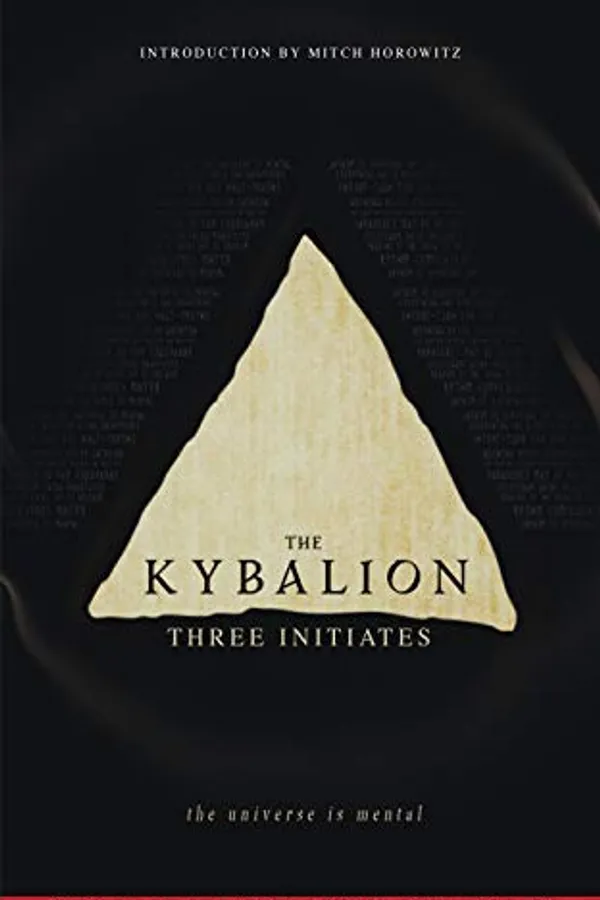
Book
The Kybalion
Three Initiates
A 1908 Chicago book in an ancient mask: its seven principles are shrewd psychology of mood and change, and its claimed antiquity is false, which must be said first.
- TYPE
- Book
- SHELF
- Esoteric & Symbolic
- TIME
- 13 min read
- ADDED
- 2026 · 07 · 07
- STATUS
- Completed
- IDEAS
Esoterica · Psychology
Why it matters
It is the most compact usable statement of Hermetic-style law-thinking on this shelf, and a standing object lesson in how spiritual authority gets manufactured.
Published in Chicago in 1908 by the Yogi Publication Society under the pseudonym Three Initiates, and long attributed on strong evidence to the New Thought writer William Walker Atkinson, the book presents itself as commentary on an ancient Hermetic text that has never been found because it never existed; the maxims it cites are the author's own composition. What the costume covers is a tight, teachable system: seven principles said to govern all planes of existence. Mentalism holds that the universe is mental; correspondence, that the planes mirror one another so the known can be used to reason toward the unknown; vibration, that everything moves and states differ by rate; polarity, that opposites are the two ends of one thing, differing in degree rather than kind; rhythm, that everything swings, and the swing one way measures the swing back; cause and effect, that nothing escapes law; gender, that a generative pairing runs through all creation. On these it builds a practical art called mental transmutation: changing an unwanted state by moving along its pole rather than fighting across a gap, and rising above the rhythm one cannot stop. Read as psychology it earns its shelf space. Read as scripture it lies about its parents.
- The seven principles form a compact model of mental change, and their real subject is never the cosmos; it is the reader's inner weather, described with unusual precision.
- Polarity: opposites are ends of one continuum. Fear is not annihilated but moved along its own axis toward courage; transmutation works the line, never the leap.
- Rhythm: everything swings, and compensation rules the swing; the measure of the move one way is the measure of the return. Crowds, moods, and markets obey it on schedule.
- Neutralization is the art the book actually teaches: you do not stop the pendulum, you decline to ride it, letting the swing happen below the plane you have risen to.
- Mentalism is untestable as physics but usable as psychology: the universe you can act in is your representation of it, and changing the representation changes what actions are visible.
- The book's fake antiquity is itself a teaching: authority can be manufactured from costume, citation, and the word initiate, and a reader who learns that here is vaccinated cheaply.
The argument
The provenance first, because the book will not give it to you. The Kybalion appeared in Chicago in 1908, published by the Yogi Publication Society and signed Three Initiates, and the weight of evidence, stylistic and circumstantial, points to William Walker Atkinson, a lawyer turned prolific New Thought author and editor who wrote under a wardrobe of pseudonyms. The book claims to be a commentary on an ancient Hermetic text of the same name, passed from teacher to student under seal. No such text has ever surfaced, and the aphorisms the book quotes with such ceremony are the author’s own sentences, dressed in quotation marks and centuries. This is not a detail. It is the frame in which everything else must be read: a modern American book wearing an ancient mask, teaching some true things under a false name.
What the mask covers is a system of seven principles, stated early and worked through in order. Mentalism: the All is mind, and the universe is a mental creation held in it. Correspondence: the planes of existence, physical, mental, spiritual, mirror one another, so that what is known on one can be used to reason toward what is unknown on another. Vibration: nothing rests; differences between states of matter and states of mind are differences of rate. Polarity: opposites are identical in nature and different in degree, the two ends of one thing; heat and cold are one scale, and so, the book insists, are hate and love, fear and courage. Rhythm: everything swings like a pendulum, and the law of compensation ties the arcs together; each arc is repaid at the same amplitude in the other direction. Cause and effect: nothing escapes law, and most people are moved as pieces on the board by causes they never inspect. Gender: a generative pairing of masculine and feminine principles runs through all creation, mental life included.
Two refinements keep the system from being as naive as its reputation. The first is the paradox the book installs at the center of mentalism: the universe is mental, and yet on its own plane it is real, lawful, and obligatory. The half-wise, in the book’s own taxonomy, are those who hear that the world is appearance and conclude that its laws may be ignored; they are broken on the laws they denied. Mastery is defined against them: the adept uses higher laws against lower ones, but he obeys the plane he stands on while he does it. The second refinement is the denial of chance. What men call luck, the book insists, is law unrecognized, causation running through levels the observer has not traced. Even the gender principle receives its most defensible reading inside the mind rather than the cosmos: the self splits into a willing aspect and a generated aspect, an I that directs and a Me that produces, and mental creation is the traffic between them. On the page this is Victorian machinery; in a journal it is a workable description of how intentions become states.
The practical art built on these is called mental transmutation, and it is the book’s real cargo. The method is chemistry, not warfare. An unwanted state is not to be denied or fought head-on; it is to be moved along its own pole, fear polarized by degrees toward courage on the axis they share, because states on the same line can be transformed into one another while states on different lines cannot. Rhythm gets the subtler treatment. The pendulum cannot be stopped; the trained will instead rises to a plane above the swing and lets it pass underneath, a maneuver the book calls neutralization. One does not abolish the tide; one declines to be the cork. And through all of it runs the New Thought conviction of the era: that the higher laws can be used against the lower, that the adept escapes being a piece by learning the rules the pieces obey.
The register is the tell. There is mastery talk on nearly every page, planes and vibrations and latent powers, results promised to the studious; there is no worship, no sacrifice, no submission, no cost. The Corpus Hermeticum wants the reader transformed and speaks of becoming god as an obligation of long purification. The Kybalion wants the reader effective. It is religion refitted as technique, Chicago, 1908, and it is entirely honest about everything except what it is.
Working notes
Read next to its claimed ancestor, the book becomes a controlled experiment in what a tradition loses in transmission. The Corpus induces a state and demands a life; the Kybalion extracts the laws and sells the leverage. Promise added, discipline subtracted: that is the signature of every derivative work on this shelf, and the Kybalion is the cleanest specimen because the derivation is total, a modern mind imagining what the ancients must have meant and improving the packaging. I keep it partly as a manual and partly as a specimen jar.
The psychology, though, is better than its costume. Polarity is an accurate description of how emotional change actually proceeds: nobody moves from panic to calm by leaping a gap; he moves by degrees along an axis, and knowing the axis is half the work. The book’s insistence that hate and love, fear and courage, are the same substance at different temperatures matches what any honest journal shows. Rhythm is more accurate still. Everything I have watched, moods, markets, organizations, my own appetite for work, swings and compensates; excess in one direction is the most reliable forecast of excess in the other, and the amplitude of the euphoria tells you the amplitude of the hangover. None of this needed a fictional lineage. It needed a notebook and a decade of attention, which is probably what it actually came from.
The honest use of rhythm is descriptive, not predictive, and the distinction carries money in it. The principle tells you there will be a swing back; it does not date it, size it, or sign it. A trader who reads compensation as a scheduling tool has converted a truth about crowds into a lie about timing. The Kybalion itself never makes this mistake, to its credit; its counsel is posture, not prophecy: position yourself so the swing is survivable and your judgment stays above it.
Neutralization is the book’s one genuinely valuable export, and it is a portable discipline. Rising above the swing does not mean feeling nothing; it means installing the observing mind one plane up, where the oscillation can be watched as weather rather than obeyed as command. Every tradition on this shelf has a version, the Stoics most severely, but the Kybalion’s mechanical framing, planes and pendulums, is oddly usable for a systems mind: it turns equanimity into an engineering position rather than a mood.
And the provenance teaches what the principles cannot. Costume, invented citation, the word initiate: the book is a working demonstration of how spiritual authority is manufactured, and a reader who learns the trick here, where the stakes are the price of a paperback, is inoculated against the versions that cost more. I have never once regretted knowing exactly how this is done.
Where I push back
The forgery matters, and earnestness does not launder it. Atkinson, if it was Atkinson, presumably believed he was distilling something true, but a book that invents its own scripture and quotes it as ancient trains its readers in a corrupt habit: preferring costume to lineage, the feeling of tradition to the fact of it. The mind-power industry that descended from New Thought inherited exactly this method, assert, costume, sell, and the Kybalion is one of its founding patents. Some of what I hold against the modern spiritual marketplace begins on this book’s title page.
Mentalism is the second fault line. As metaphysics it is untestable and therefore idle; as psychology it is useful; but the book blurs the two, and the blur is where readers drown. From the universe is mental it is one careless inference to my thought shapes events, and from there one more to visualization as a substitute for work, risk management, and arithmetic. I have met the graduates. The universe may be mental; the margin call is not, and no principle in this book will polarize an overleveraged position into a solvent one.
The gender principle is the weakest chapter, a Victorian parlor abstraction inflated into cosmic law, and the book’s own examples cannot hold it upright. And the whole performance flatters. The reader is invited, page by page, into the small aristocracy of those who know the laws, and the invitation is the product. Mastery in this book is a feeling delivered in advance of any practice that would justify it; the practices that would justify it, years of them, are exactly what the book does not contain. It is a menu sold as a meal, and the seven principles deserve a more honest waiter.
And the determinism deserves one more sentence. A book that denies chance entirely has abolished luck by decree, and a reader who believes it will read every outcome as caused, his wins as skill and his losses as hidden law, when some of both were noise. The Kybalion has no chapter on variance. Every trader eventually writes that chapter himself, at market prices.
How it enters the work
Trading is where the book pays rent. Rhythm and compensation shaped my standing risk posture before I could have named the source: size every position for the swing back, not for the swing you are enjoying, because the return stroke is the only certainty the principle offers. Polarity runs in the journal. When a mood distorts the desk, fear after a drawdown, appetite after a run, the working question is not how to eliminate it but which axis it lives on and what one degree of movement along that axis looks like today. And neutralization is the desk discipline itself: when a thesis is working, the pendulum of hope and dread keeps swinging, and the job, the entire job some weeks, is to watch it from one plane up and touch nothing. A thesis must survive a cycle; so must the man holding it.
The half-wise clause earns its keep at BlockHedge more than any other line in the book. Crypto is a market of mentalism run hot: narratives openly manufacture price, and half the participants have concluded that because belief moves the asset, belief is the asset. The book’s own correction applies without modification: the plane you trade on remains lawful and obligatory, and leverage does not care what you visualize. Mental causes, physical margin; I keep the paradox where the principles cannot hide it.
In the spiritual inquiry it functions differently: as the gate where I learned to check papers. The Kybalion was an early book for me, as it is for most people who wander into this literature, and discovering its real provenance was the useful shock, the moment the difference between a spring and a bottling plant became permanent knowledge. Every text on this shelf now passes the same checkpoint: who wrote this, when, and what did they want from me. That question, asked coldly and answered honestly, has done more to keep my inquiry serious than any principle the book contains.
So it stays, at influence six, the lowest-ranked book on this shelf and among the most instructive: a half-true book about laws, and a wholly true demonstration of how easily a hungry reader can be sold a lineage. Both lessons were worth the price. Only one of them was intended.
- Locate the continuum before attempting change; you transmute a state along its own pole, not across a gap.
- Expect compensation: size positions, moods, and commitments for the swing back, not the swing you are enjoying.
- Rise rather than wrestle: discipline is choosing which oscillations are permitted to govern you.
- Date your sources; a teaching that lies about its parents may still be useful, but it must earn belief on its own feet.
- Use mentalism as psychology, never as market physics; the universe may be mental, but your margin call is not.
The antiquity is false and the quotations are invented; treat every claim of lineage in it as stagecraft. Its mentalism sits one careless inference from wish-magic, and a reader who concludes that changing his thought changes the market has begun donating his bankroll to more disciplined counterparties. The gender principle is a Victorian abstraction inflated to cosmic law. Take the psychology, refuse the provenance, and never confuse the feeling of mastery it sells with the practice of mastery it skips.