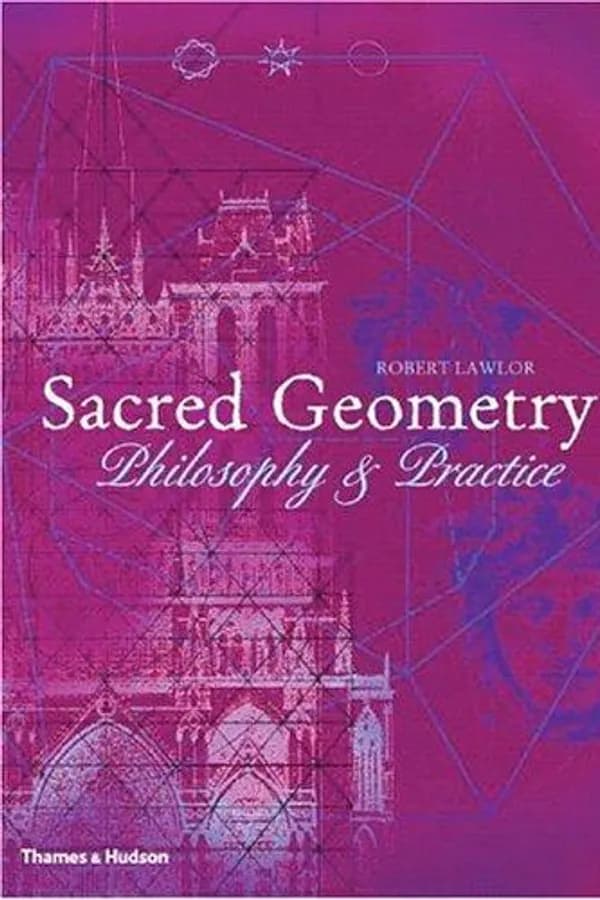
Book
Sacred Geometry: Philosophy and Practice
Robert Lawlor
Geometry done by hand is a contemplative practice: proportion is the joint where number becomes form, and the old builders worked that joint on purpose.
- TYPE
- Book
- SHELF
- Esoteric & Symbolic
- TIME
- 13 min read
- ADDED
- 2026 · 07 · 07
- STATUS
- Completed
- IDEAS
Esoterica · Art · Systems
Why it matters
It trains the one faculty my architecture frames and my systems diagrams share: the eye for proportion, verified with a compass instead of praised.
Published in Thames and Hudson's Art and Imagination series, the book is half treatise and half drawing course, and the format is the argument. The treatise rehearses the Pythagorean and Platonic claim that number is qualitative before it is quantitative: one, two, and three are principles, unity, polarity, relation, and geometry is number given body in space. The drawing course makes the reader perform the tradition: workbook sections alternate with the text, and the constructions are done with compass and straightedge, beginning from the point and circle, opening through the vesica piscis, and proceeding to the root proportions, the golden section, gnomonic spirals, the squaring of the circle, and the Platonic solids. The generative claims are concrete: the diagonal of the square yields root two, the principle of doubling; the vesica yields root three; the double square yields root five, from which the golden proportion unfolds, echoed in whole numbers by the Fibonacci series and in nature by shells and leaf spirals. On this base Lawlor reads sacred architecture, Egyptian temple and Gothic cathedral, as proportion fixed in stone to act on its occupants, and argues that drawing the figures is the only way of actually knowing them.
- The workbook is the thesis: knowledge of form is participatory, and a construction performed with compass and straightedge teaches what no paragraph about it can.
- Number is qualitative before it is quantitative: one, two, and three are read as unity, polarity, and relation, and geometry is the embodiment of those principles in space.
- The vesica piscis is the generative act: two circles sharing a radius open the site from which the root proportions unfold in order.
- The root proportions and the golden section are incommensurable: exact relations that no counting reaches, the tradition's proof that form rests on relation rather than quantity.
- Gnomonic growth is the geometry of living form: expansion that preserves shape, the shell's law, and the test of whether a thing was proportioned or merely assembled.
- Sacred architecture is proportion fixed in stone: temples are read as instruments built to hold relations a body can register whether or not the mind names them.
The argument
The book opens with a distinction that governs everything after it: there are two mathematics. One computes; it handles quantity, and the modern world runs on it. The other contemplates; it studies relation, proportion, the way a whole divides and the way parts answer one another, and on Lawlor’s account this second mathematics was the core discipline of the ancient world’s sacred science. He came to that conviction the slow way, through the work of Schwaller de Lubicz, whose study of the temple at Luxor he helped carry into English, and through the Pythagorean and Platonic texts that treat number as the architecture of reality rather than its bookkeeping. Sacred geometry, in his usage, is not decoration applied to piety. It is the claim that the universe is generated, not assembled, and that the generation has a grammar a hand can learn.
The grammar begins with qualitative number. One is not a count but unity, the undivided; two is not a count but polarity, the primal division that makes tension and therefore relation possible; three is the reconciliation, the child of the first two, the return of relation to wholeness. Geometry is these principles given body in space, and the same doctrine was heard rather than seen in music, where consonance turned out to be ratio: the discovery, attributed to Pythagoras, that harmony is number made audible. Lawlor’s wager is that this is not numerology but psychology of perception with a metaphysical spine: the relations that organize the world are the relations a mind can recognize, because mind and world are proportioned to each other.
Then the book does the unusual thing that earns its place: it stops asserting and starts instructing. Workbook sections alternate with the text, and the reader is told to take compass and straightedge and draw. The sequence is a creation story performed by hand. The point, dimensionless, becomes the circle, the first form, unity displayed. Two circles, each passing through the other’s center, open the vesica piscis, the almond of intersection that the tradition treats as the womb of form: from its geometry falls the square root of three, and from related constructions the whole family of generative proportions. The diagonal of the square yields root two, the principle by which a square doubles its area, the construction Plato stages in the Meno as the very type of latent knowledge. The diagonal of the double square yields root five, and from root five unfolds the golden section: the one cut in a line where the smaller part stands to the larger as the larger stands to the whole. Phi’s whole-number echo is the Fibonacci series, and its natural handwriting is everywhere Lawlor points: the spiral of the shell, the packing of seeds, the arrangement of leaves about a stem.
Two further constructions carry the doctrine’s weight. Gnomonic growth is expansion that preserves shape: the shell adds chamber after chamber and remains itself, because each addition stands in the same proportion to the whole. Growth without deformation is, for Lawlor, the signature of living form, and it is possible only where proportion governs. The squaring of the circle is the opposite kind of lesson: circle and square, the immeasurable and the measured, heaven and earth in the tradition’s shorthand, can be reconciled by construction only approximately, and the approximation is the point. The exercise rehearses incommensurability, the scandal the Greeks discovered in the diagonal: relations that are perfectly exact and yet unreachable by counting. Form rests on relation, not on quantity; the deepest joints in a structure do not appear in any ledger of its parts.
The Platonic solids close the mathematical arc as the complete inventory of regular symmetry in three dimensions, the five figures the Timaeus distributes among the four elements and the heavens, and then the book turns to stone. Egyptian temple and Gothic cathedral are read as the second mathematics practiced at the scale of civilization: proportion fixed in masonry so that a building becomes an instrument, holding relations that act on the bodies inside it whether or not any occupant can name them. The builder’s knowledge, on this reading, was contemplative and practical at once, and the modern separation of those words is the anomaly. The final claim gathers the whole book: you do not learn this geometry by reading about it, mine included; you learn it by drawing, because the knowledge is participatory, a re-performance of generation, and there is no spectator’s seat.
Working notes
The drawing did the teaching, exactly as advertised. Read, the vesica is a curiosity; drawn a few dozen times, it becomes a habit of the hand and then of the eye, and the eye keeps using it after the compass is put away. Whatever one makes of the metaphysics, the pedagogy is verified: constructions performed are retained in a way sentences are not. That alone sorts this book into the small class of esoterica that gives exercises rather than claims, and exercises are the only currency this shelf accepts at face value.
It also completes a triangle on the shelves around it. A Pattern Language holds that form is verified by living in it; Arnheim’s Art and Visual Perception treats composition as a field of forces and weights; Lawlor supplies the skeleton both assume, proportion as the load path of a form. Three books from three disciplines converging on one doctrine: form is known by use, and relation is what is being used. The convergence is worth more than any of the three arguments alone.
Incommensurability is the note I keep sounding to myself. The diagonal of the unit square is exact, necessary, and unreachable by any counting: a relation more real than any measurement of it. A man who builds dashboards for a living needs that sentence framed on the wall. The metrics capture what can be counted; the structure lives in relations between the counted things, and the most consequential ones, in systems as in pictures, do not themselves appear as numbers anywhere. Measure everything measurable, and then remember what the diagonal taught.
Gnomonic growth gave me an aphorism I now apply without mercy: whatever cannot grow without changing shape was never proportioned, only assembled. The shell is the standard, and most of what men build fails it. The failure has a signature I have learned to read early. A schema answers its first ten questions cleanly; the eleventh gets an exception table, because the exception is cheap and the redesign is dear; the exceptions breed, and within a few years the model that fit on one page requires a guide to be read at all. No single addition was wrong. Each was the cheapest move available on the day it was made, and that is the diagnosis, not the excuse: in a proportioned form the cheap move and the right move are the same move, and in an assembled one they are priced apart, so every deadline buys a little deformation. The shell never has to choose between growing and remaining itself. That is what proportion is for, and nothing else does its work.
The qualitative numbers survive best when read as psychology rather than cosmology. Twoness, polarity, tension, is an experience before it is arithmetic; so is the resolving third. Fortune’s pillars, the tarot’s dualities, Lawlor’s dyad: the esoterica shelf keeps converging on the same small integers, and Lawlor gives the cleanest derivation of why they feel structural. Held as a phenomenology of form, the doctrine works. Held as physics, it invites the disease the next section names.
Where I push back
The archaeology of intent is the book’s soft ground. That a ratio is present in a monument does not show the builders intended it; stone tolerances, selective measurement, and the freedom to choose which dimensions to compare will produce the golden section wherever a motivated researcher hunts for it. The pyramid literature is the type case: with enough lengths available, some pair always yields phi, and the discovery is a fact about the search, not the building. Lawlor is more careful than the genre’s worst, but he inherits Schwaller de Lubicz’s Egypt whole, and mainstream Egyptology rejects that Egypt; he takes on the confidence without taking on the burden of proof. The book treats a contested reading as settled ground, and the reader is not told a contest exists.
The deeper overreach is the slide from mathematics to metaphysics. That the golden section is beautiful, generative, and everywhere in living form is established; that it therefore encodes a doctrine of cosmic mind is asserted across a gap where the argument should be. Pythagoreanism is a hypothesis about the world, and a venerable one; the book handles it as a memory of a golden age from which modernity fell, and nostalgia is doing the work that derivation owes. The mathematics is unimpeachable and the archaeology is devotional; the reader must keep two sets of books, and Lawlor never says so.
And for working artists there is a live hazard the book does not disarm: the overlay. Spirals and grids pasted over finished work prove only that spirals fit anywhere at some scale; proportion either governed the making or it governs nothing. A generation of photographers decorating their frames with golden diagrams after the fact is practicing the superstition Lawlor’s own workbook method, honestly followed, would have prevented. The book’s best discipline indicts its laziest readers.
How it enters the work
The transfer to photography is direct, because my subjects are the book’s subjects. An architectural long exposure is a proportion study by construction: minutes of open shutter remove the traffic, smear the sky, and empty the plazas, and what remains of a building is its geometry, which is precisely why I work that way. The Oculus frames that hold up are the ones where the ribs read as a single generative curve; the lighthouse and mountain work obeys the same law at nature’s scale. Black and white belongs in the same sentence: stripping color is stripping everything that is not relation. The compass training runs under the composing eye, and it changed what I frame: intervals and verticals, not objects. I will set a crop as a root rectangle or a double square as a hypothesis, and then the eye votes, and the eye has the veto. Lawlor trained the hypothesis generator; Adams and Arnheim sit on the jury.
At Intelliblitz the gnomonic test has become standing equipment. A well-proportioned system grows like the shell: capacity, tenants, and modules are added and the diagram keeps its shape. When growth deforms the diagram, when every new requirement bends the architecture at a new angle, the proportion was wrong at the start, and the honest fix is the generating construction, not another bolted chamber. I now ask of a proposed platform not only what it does but what its gnomon is: what is the unit of growth, and does the unit preserve the form. Systems that cannot answer are assemblies, and assemblies age badly.
The book also gave a lineage to the operating instinct this site states outright: find the structure, then remove everything that isn’t it. That is a geometer’s sentence. It assumes a generating construction beneath the ornament, simpler than the visible figure and responsible for it, and it assumes the construction can be reached by disciplined attention. Lawlor’s tradition held that assumption for millennia and drew it by hand every working day. I hold it with fewer metaphysical commitments and the same compass loyalty: the diagram exists before I find it, in the building, in the enterprise, in the frame, and the work, always, is subtraction toward it.
- Draw the construction before trusting the doctrine; what survives the compass is yours, and what survives only in the prose is not.
- Use proportion as hypothesis and the eye as verdict; no grid outranks the seeing.
- Grow things gnomonically: a system, a body of work, a practice should expand without changing shape, and deformation under growth means the proportion was wrong at the start.
- Respect incommensurables; the relations that hold a structure together are often exact but not countable, and no dashboard will show them.
- Refuse the overlay: analysis after the fact is not design, in pictures or in buildings or in systems.
The mathematics is sound and the archaeology is devotional: the presence of a ratio in a monument is not evidence that its builders intended it, and at ordinary measurement tolerances the golden section can be found wherever it is hunted. Lawlor also leans on Schwaller de Lubicz's reading of Egypt, which mainstream Egyptology rejects. For working artists the book carries a further live danger: proportion applied as an overlay after the work is made is superstition, not composition.