Book
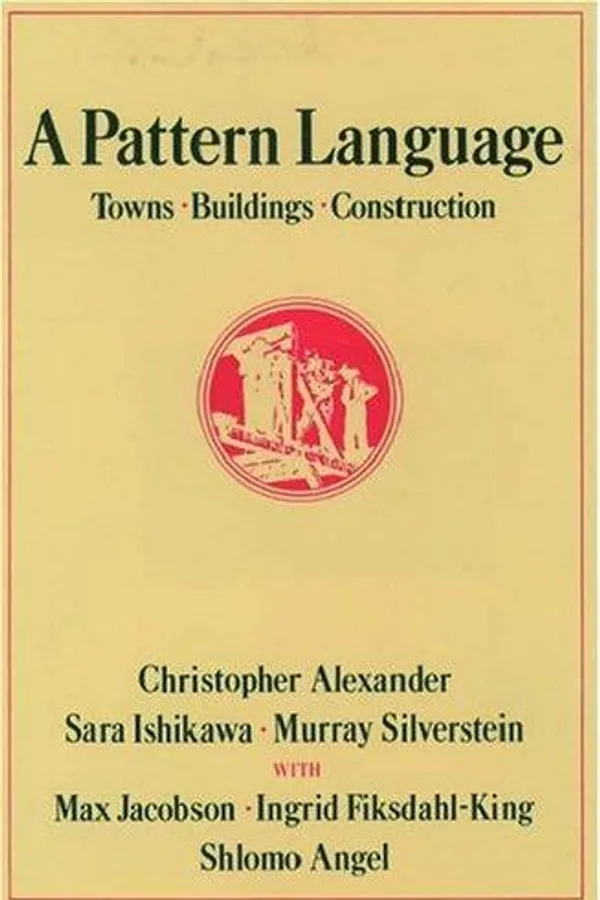
A Pattern Language
Christopher Alexander
Buildings and towns live or die by recurring configurations that resolve real forces, and those configurations can be named, tested, graded, and combined like a grammar.
- TYPE
- Book
- SHELF
- Technology & Systems
- TIME
- 15 min read
- ADDED
- 2026 · 07 · 07
- STATUS
- Completed
- IDEAS
Systems · Art · Technology
Why it matters
It is the most serious attempt I know at making judgment about form explicit without killing it; enterprise architecture borrowed its method, and my photographs keep testing its claims.
Alexander and his collaborators spent years asking why some places feel alive and most modern ones do not, and answered with 253 patterns, ordered from the scale of regions and towns down to rooms, window seats, and ornament. A pattern is not a style; it is an empirical claim: in a recurring context, certain forces come into conflict, and a particular configuration resolves them. People avoid rooms lit from one side; a house whose rooms run from public to private in sequence puts guests and family at ease; a beautiful view survives being glimpsed in passage and dies behind a picture window. Each pattern states its context, the forces, the evidence, and an instruction, then links upward and downward to the patterns it completes and requires, which is what makes the collection a language rather than a catalogue: a project speaks a sequence, large to small, and the design unfolds. The patterns are graded by confidence, invariants marked apart from hypotheses. Beneath the method sits a moral program: ordinary people, given the language, should shape their own streets and houses through piecemeal growth, because life in the built world comes from millions of small acts within a shared grammar, not from master plans.
- A pattern is context plus conflicting forces plus a configuration that resolves them, stated as an instruction with its evidence attached. Style is preference; a pattern is a claim that can be wrong.
- The 253 form a language, not a list: each pattern is completed by smaller ones and completes larger ones, and a project is designed by choosing a sequence and speaking it from the town scale down to the doorknob.
- Confidence is graded pattern by pattern: some are marked as invariants the authors would defend anywhere, others as working hypotheses. A design book that tells you how sure it is remains rare.
- The life of places is treated as objective, not as taste: rooms with light on two sides, gradients from public to private, positive outdoor space. The claim is that bodies register these configurations whether or not opinions do.
- Forces, not features, justify form. A configuration earns its place by resolving tensions that actually recur, which is why the patterns survive translation across cultures better than any style has.
- The language exists to return design to inhabitants: piecemeal growth by many hands inside a shared grammar, against the master plan and the signature building alike.
- Software took the form and built design patterns, wikis, and agile practice on it; mostly it kept the format and lost the forces, which is the difference between a pattern and boilerplate.
The argument
The book is the working volume of a larger argument. Its companion, The Timeless Way of Building, carries the theory: that there is a quality that makes buildings and towns alive, that the quality is objective though it resists naming, and that traditional cultures produced it reliably because builders shared unwritten languages of form. A Pattern Language is the attempt to write one such language down after the cultures that carried them had died. It contains 253 patterns, ordered by scale from regions and towns through neighborhoods, buildings, and rooms, down to construction details and the placement of chairs, and the ordering is not editorial convenience. It is the method: design proceeds by speaking the language from large to small, each decision creating the context in which the smaller decisions are made.
A pattern has a fixed anatomy. A name. A statement of context: where this problem arises. A problem stated as a conflict of forces: not an inconvenience but a tension that recurs wherever the context recurs. A body of evidence and reasoning, drawn from observation, from studies where they existed, from the authors’ fieldwork where they did not. Then an instruction: a configuration, stated in the imperative, that resolves the forces. And finally links, upward to the larger patterns this one completes, downward to the smaller ones needed to complete it. The linking is what makes the collection a language rather than a catalogue. No pattern stands alone; each is a word that means something only in sentences, and a project is a sentence: a selected sequence of patterns, spoken in order, out of which a design unfolds that none of the patterns individually contains.
The texture of the argument is best seen in the patterns themselves. Light on Two Sides of Every Room begins from an observation anyone can verify: given the choice, people gravitate to rooms lit from two directions and avoid rooms lit from one, and the authors argue the mechanism is not preference but perception, since light from a single side flattens faces and deepens glare, so that rooms lit from one side feel subtly hostile whatever their dimensions. The instruction follows: shape buildings so that every important room gets daylight from at least two directions, and accept the consequence, which is that buildings must be shallow, wrinkled, and irregular rather than deep and blocky. One pattern, honestly followed, condemns half of modern floor-plate economics; the authors do not flinch from this, which is either the book’s integrity or its innocence, and is in fact both.
Intimacy Gradient makes the social version of the same move. A building whose rooms run in sequence from public to private, entrance, common rooms, family rooms, bedrooms, lets every encounter find its proper depth, and a building that violates the gradient, where a guest must pass a bedroom to reach the sitting room, produces a discomfort people feel but cannot name. Zen View is the book’s most severe lesson in restraint: a beautiful view is destroyed by the picture window that frames it permanently, because what is always present is no longer seen; the pattern instructs building so the view is glimpsed in passage, from a transition, a stair, a gap, preserved by being rationed. Positive Outdoor Space observes that outdoor areas with shape, courtyards, partly enclosed gardens, are used, while the leftover space around free-standing buildings is not, and derives the instruction that outdoor space must be designed as figure, not remainder.
The smaller patterns carry the empiricism down to the scale of a chair. Window Place begins from a conflict present in nearly every room: people are drawn toward the light and drawn toward comfort, and a room whose comfortable seats stand away from its windows holds its occupants in a low, unnamed tension between the two pulls. The instruction resolves it: in every room where anyone lingers, make at least one window into a place, a seat, a deep sill, a small alcove, where sitting and light coincide. Six-Foot Balcony states its evidence in its own name: balconies shallower than six feet go unused, because they cannot hold a table and a pair of chairs facing one another, and offer no enclosure worth inhabiting; the instruction is six feet or nothing, recessed into the body of the building where possible. A balcony that is not used is ornament pretending to be a room. This is the book’s discipline in miniature: a form is defended because use collapses without it, not because it pleases, and the measurements, where the authors commit to them, are stated so a reader can check them against his own rooms. Dozens more run the same way: an observation about use, a mechanism, an instruction, and the links that stitch it into the whole.
Two features of the apparatus deserve separate weight. First, the confidence grading: patterns are marked, some as invariants the authors believe belong to any living environment anywhere, others as reasonable working hypotheses awaiting correction. A book of design instruction that distinguishes what its authors know from what they suspect had no real precedent and has had few successors. Second, the address: the book is written in the second person, to someone about to build, because its politics are inseparable from its method. Alexander’s claim is that the death of the modern built world is professional: master plans, signature architects, and mass housing severed form from the forces it exists to resolve, and the repair is not better professionals but the return of design to inhabitants, millions of small acts of building and repair, each modest, each inside the shared grammar, aggregating into towns that no plan could draw. Piecemeal growth is not a compromise with ideal planning; it is the only process that produces life, because only it lets each act respond to the real forces present at its moment and place.
The deep claim under all of it is that aliveness in the built world is a matter of fact. Not fashion, not preference, not nostalgia: certain configurations resolve the forces of human use and certain ones suppress them, and bodies register the difference even when opinion has been trained out of noticing. The book’s confidence on this point is total, and everything else, the patterns, the grading, the politics, is scaffolding around it.
Working notes
Simon and Alexander make one argument from two directions, which is why they sit adjacent on this shelf. The Sciences of the Artificial proves that bounded minds can only build and comprehend systems as nearly decomposable hierarchies; Alexander, who began in that same formalist world, spent his life on the remainder, the essay against the tree is his hinge, insisting that living cities are overlapping structures, semilattices, not clean nests. The pattern language is his machine for having both: patterns decompose the problem so that a bounded builder can act, while the links between them preserve the overlap that decomposition destroys. Read Simon for why you can build at all; read Alexander for why what you build is so often dead anyway.
Yanagi is the other neighbor. The Unknown Craftsman locates beauty in anonymous tradition, the unnamed potter whose hands hold a grammar he never articulated and does not need to. Alexander’s project is what becomes necessary after that tradition dies: the grammar must be written down, because the hands no longer carry it. A pattern language is craft tradition posthumously transcribed, and the transcription problem explains both the book’s greatness and its limit. What the potter knew is in the book; what the potter was is not.
The most transferable idea in the book is the smallest: the confidence grading. Every architecture standard, every design system, every set of trading rules I maintain now carries the same discipline, invariants marked apart from hypotheses, because a rulebook that does not state its own certainty teaches its users to hold everything with equal and therefore false conviction. Alexander put epistemic honesty into a format, and almost nobody who copied the format copied that.
Software’s theft of the book is a parable about form and force. The design patterns movement took the anatomy, context, problem, solution, and built a literature on it; the first wiki was created to hold patterns; agile practice descends from the same lineage. And most of what resulted is exactly what Alexander’s definition excludes: configurations documented without the forces that justify them, templates applied because they are named rather than because their tensions are present. Invited to address the software profession at its own conference, Alexander told them, courteously, that they had kept the format and missed the aim, which was life, not reuse. The observation generalizes: every field that adopts a method adopts its packaging first, and the packaging travels precisely because it is the part that does not require judgment.
A second reading, years after the first, turns the book’s certainty inside out. The prose speaks like a prophet; the asterisks confess like a scientist; and the career that followed concedes what the reader slowly suspects: the language alone did not generate the life it promised. Alexander’s late work on living structure exists because ordinary people, given the language, mostly did not produce living buildings, and he was too honest to pretend otherwise. The arc of the man is a demotion of his own solutions in pursuit of the thing the solutions were for, and I find that arc more instructive than the book’s confidence. The severity of the claims made the failure legible. That is what claims are for.
Where I push back
The evidence does not carry the certainty. For every pattern grounded in observation there is another grounded in conviction wearing observation’s clothes, and the grading system, honest in intent, becomes a rhetorical device in practice: the two-asterisk patterns are asserted as invariants of human life while resting on a sample that is mostly the preindustrial building Alexander loved, Mediterranean hill towns, English villages, the vernacular of cultures whose economics and cosmologies are gone. The book universalizes a vernacular. Much of it deserves universalizing, which is what makes the overreach hard to see; but a method that claims empiricism owed us the distinction between what recurs in human nature and what recurs in Alexander’s photographs.
The economic innocence is the sharper failure, because it fails the book’s own test. A pattern, by definition, resolves the forces actually present in a context, and in every modern context the forces include land prices, construction capital, financing, and regulatory drag. The book prices nothing. Its four-story limit and shallow buildings and thousand small acts of piecemeal growth collide with the economics of every city where anyone needs housing, and the collision is never negotiated, only deplored: the developer appears as pathology, not as force. The book is right about places. It is careless about money, and places are built with money.
And the generative promise was oversold. The language metaphor implies that speakers, given vocabulary and grammar, produce living sentences, and the decades since have shown that they mostly do not: taste did not transfer with the vocabulary, and naming forces is not the same as feeling them. Alexander conceded this by his subsequent life’s work, which searched for what the patterns lacked. The concession honors him. The book itself never makes it, and a reader who takes the title’s promise literally, that the language generates, will build with a confidence the method cannot fund. What the book actually delivers is an education of attention: it teaches you to see forces. Whether you can resolve them remains, as it always was, a matter of who you are.
How it enters the work
Enterprise architecture at Intelliblitz uses this book’s method more directly than it uses most books about software. Architecture standards in my practice are written as patterns, not rules: context first, then the forces in tension, consistency against autonomy, latency against cost, ownership against speed of change, then the configuration that resolves them, then the confidence grade, invariant or hypothesis, marked where every future reader can see it. A rule tells a team what to do and expires the moment context shifts; a pattern tells a team why, and lets them recognize when the why no longer applies. Decision records in this format stay useful for years; rulebooks in the imperative rot in one reorganization. And Alexander’s politics translate intact: systems grow piecemeal, by many hands, inside a shared language, and the master-plan rewrite, the signature replatforming that promises a living system by fiat, produces exactly what master plans produce in cities. I have been paid to clean up after several. The grammar scales; the throne does not.
Photography is where I test the book’s deepest claim with my own equipment. The assertion that aliveness is objective, that configurations either resolve forces or suppress them and bodies know the difference, is one a fine-art photographer audits every working day, because the camera is merciless about it. Architectural work, the Oculus, lighthouses against weather, the mountain ranges, is pattern criticism conducted with a tripod: a building whose forms actually resolve light and human movement composes almost by itself, and a dead facade cannot be rescued by technique, only disguised. Light on two sides explains why certain interiors photograph as if lit by intention. Positive outdoor space explains why some plazas fill a frame and others leak out of it. And a long exposure is my instrument for the book’s thesis: it strips the accidental, the traffic, the crowd, the moment’s noise, until only the configuration remains, and the print then shows plainly whether the structure was alive or merely large.
Zen View I have adopted as an ethic of restraint in both crafts: the obvious view, framed constantly, is consumed; rationed, it stays potent. In black and white work that means refusing the postcard angle; in architecture it means refusing the dashboard that shows everything always. Find the structure, then remove everything that is not it: Alexander spent a thousand pages naming what the structure of a living place is. The removal he left to us, and that is the half I practice.
- Name the forces before proposing the form; a solution that cannot state its tensions is decoration.
- Grade your own standards: separate the invariants you would defend anywhere from the hunches you are still testing.
- Grow systems piecemeal inside a shared language; master plans produce dead structure at every scale.
- Judge a place, a system, or a photograph by whether its configurations resolve real tensions or merely exhibit taste.
- Steal the pattern format only with its empiricism attached; context and forces are the pattern, the template is packaging.
- Protect the almost-right view by restraint: what is framed constantly is consumed, and what is glimpsed stays alive.
The book universalizes a preindustrial, largely Mediterranean vernacular and grades its own convictions as evidence; the asterisks confess uncertainty while the prose permits none. It is economically innocent: patterns that ignore land prices and construction capital fail their own definition of resolving real forces. And the generative promise overreached, since ordinary users speaking the language did not reliably produce living buildings; Alexander spent his remaining decades on why, which is the honest measure of the gap.