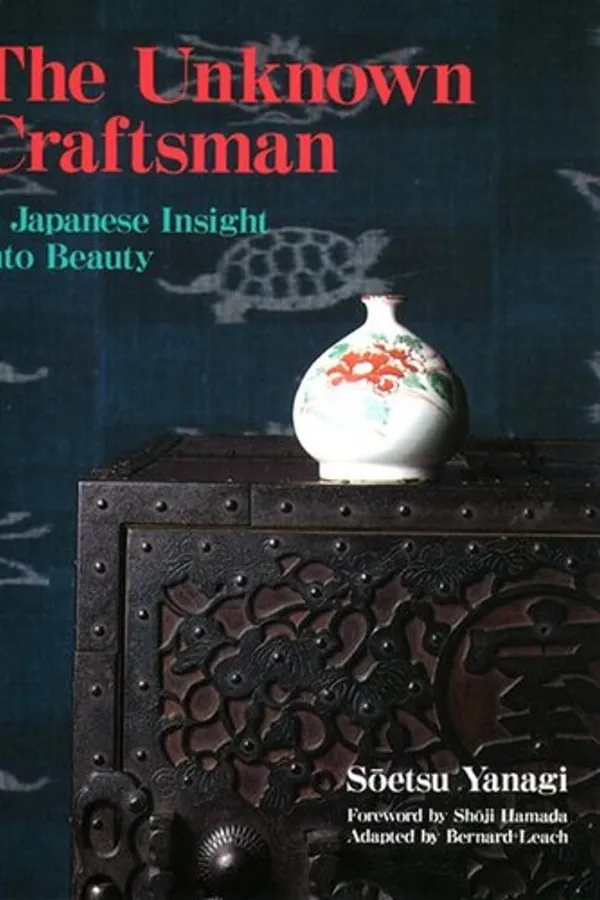
Book
The Unknown Craftsman
Sōetsu Yanagi
The deepest reservoir of beauty in history was made by unknown craftsmen working in tradition for daily use; the signed work of genius is the exception, not the standard.
- TYPE
- Book
- SHELF
- Art & Aesthetics
- TIME
- 13 min read
- ADDED
- 2026 · 07 · 07
- STATUS
- Completed
- IDEAS
Art · Spirituality · Philosophy
Why it matters
It is the strongest case ever made against the cult of the signature, and the book that taught me to judge any object, or any system, by its service rather than its author.
Yanagi Sōetsu spent his life looking at objects nobody signed: Korean rice bowls, kitchen jars, baskets, workaday cloth, the anonymous utensils of ordinary houses. Out of that looking he built the mingei movement, a museum in Tokyo, and this book, assembled into English by the potter Bernard Leach. The claim is direct: the most trustworthy beauty in history was made by unknown craftsmen working in tradition, for use, in quantity, without the ambition to make art. The individual artist walks the hard road of self-power and mostly fails; the craftsman is carried by tradition as a believer is carried by grace, and the pot comes out true because the man did not intrude. The proof is the Kizaemon bowl: a cheap Korean rice bowl, one of thousands, raised by tea masters with eyes into the most revered tea object in Japan. Around that proof Yanagi arranges a discipline: see before you know, trust use over display, prize irregularity over polish, and read the health of a whole society in its ordinary things. It is a theory of beauty that is really a theory of selflessness.
- Beauty of use is the primary beauty: an object made honestly for daily service acquires a rightness that objects made for admiration rarely reach, because service disciplines every decision.
- The craftsman in tradition is carried by other-power, like a believer carried by grace; the individual artist relies on self-power, a harder road that mostly produces strain.
- Seeing comes before knowing: direct perception must precede classification, and a collector who needs the attribution before the judgment does not have an eye, he has a filing system.
- The Kizaemon bowl settles the argument: a cheap rice bowl made in quantity by unnamed Korean potters became the most revered tea bowl in Japan, chosen by eyes, not signatures.
- Irregularity is freedom, not failure: the unselfconscious hand leaves marks the perfectionist cannot fake, and the freest beauty stands before the division into beautiful and ugly.
- A society is legible in its ordinary objects; when the everyday things go dead, the culture is sick, whatever its museums contain.
The argument
Yanagi was a philosopher who spent his eye on the least prestigious objects in Asia: kitchen jars, rice bowls, baskets, work clothes, the unsigned utensils of ordinary houses. In the 1920s, with the potters Hamada Shōji and Kawai Kanjirō, he coined the word mingei, folk craft, to name what he was seeing; in 1936 he opened the Japan Folk Crafts Museum in Tokyo to hold it; and late in his life his friend Bernard Leach, the English potter, adapted these essays into English so the argument could travel. The polemical situation matters. Japan was industrializing at speed, its museums were organized around named masters and imported hierarchies, and the anonymous crafts were dying without anyone thinking them worth a funeral. Yanagi’s claim was that the funeral would bury the largest body of trustworthy beauty the country had produced.
The claim has a mechanism, and the mechanism is the book. Beauty of use comes first: an object made for daily service is disciplined by that service in every dimension, weight, balance, capacity, durability, price, and the discipline removes the arbitrary decisions that make self-expressive work unstable. Tradition comes second: the craftsman inherits forms refined by generations, which is to say he inherits thousands of corrected errors, and his own contribution is the small unconscious variation of a living hand. Repetition comes third: the man who throws hundreds of bowls a day stops deliberating, and what Yanagi prizes arrives precisely when deliberation stops, a sureness that no quantity of artistic intention can counterfeit. Anonymity binds the three together. The unknown craftsman is not suppressing his personality; he has never been offered the idea that a pot is about him.
Then the book makes its most original move and turns aesthetics into a doctrine of salvation. Yanagi borrows the Pure Land Buddhist distinction between self-power and other-power: the sage who saves himself by his own discipline walks a road open to very few, while the ordinary believer is carried by grace. The individual artist is the sage of beauty, and his road is real but rare; most who attempt it produce strain. The craftsman in tradition is the ordinary believer, carried by a power not his own, and this is why unremarkable men in sound traditions made supreme things for centuries. It is a democratic theory of quality: beauty does not require genius; it requires right conditions and self-surrender.
The proof Yanagi offers is the Kizaemon bowl. It is a Korean rice bowl of the Joseon period, made cheaply, in quantity, by potters whose names nobody recorded, for buyers who would never look at it twice. Generations of Japanese tea masters, judging by eye alone, raised bowls of exactly this kind to the summit of the tea ceremony, and the Kizaemon stands at the top of that summit. Yanagi’s reading cuts both ways. The greatness of the early masters was pure seeing: they found supreme beauty in another country’s kitchenware because they looked before they classified. And the decay of the later tradition proves the theory in reverse: once masters began commissioning wares that imitated the accidental irregularity of the originals, self-consciousness entered, and the results were mannered where the originals were free. You cannot make artlessness on purpose. The attempt is a genre of lying.
From this follows the discipline that gives the book its lasting use: see before you know. Direct perception must precede documentation, attribution, and price; the collector who needs the name before the judgment has a filing system where an eye should be. Irregularity belongs here too. The unselfconscious hand leaves asymmetries the perfectionist cannot reproduce, and Yanagi grounds their beauty in the Buddhist intuition of a ground that lies before the split into beautiful and ugly; the freest work comes from before that division, made by hands that never faced the choice. Pattern receives a parallel treatment: generations of seeing compressed into repeatable form, nature distilled by a tradition rather than transcribed by an individual.
The last extension is social, and severe. If the honest measure of a culture is its ordinary objects, then a society whose everyday things are dead is sick, whatever hangs in its museums. Yanagi looked at machine production and saw uniformity without life, goods that discipline no hand and carry no variation; he did not forbid the machine outright, but he refused to pretend its output was alive. The book ends as a demand rather than an elegy: not fake rusticity, not peasant costume, but the deliberate rebuilding of the conditions, use, tradition, repetition, self-surrender, under which good work happens without heroes.
Working notes
Anonymity is the thread that ties this book to the strangest of its neighbors on this shelf. The author of Meditations on the Tarot erased his name so the teaching would outlive the teacher; Yanagi’s craftsman never had a name to erase, and the pot outlives him anyway. Between the two of them I have been persuaded that the signature is mostly a liability: it attaches the work to a self that time will discredit, and it invites the maker to serve the name instead of the work. The operational test is simple and brutal. Strip the attribution and see what remains. Most contemporary work fails it; on bad months, so does mine.
The tradition argument is the argument Adams makes about photographers and Alexander makes about buildings, arrived at from a third direction. A tradition is a compression of solved problems; the craftsman who inherits one starts where centuries finished. A Pattern Language is mingei for architecture, an attempt to write down what unselfconscious builders knew without writing, and Alexander ran straight into Yanagi’s own paradox: a tradition made explicit becomes self-conscious, and a self-conscious tradition begins to imitate itself. The tea masters commissioning spontaneity are the failure case of every revival movement, in craft, in architecture, in religion. You can restore conditions. You cannot restore innocence.
The other-power doctrine reads, from where I sit, like systems design. Yanagi is saying that quality should not depend on exceptional individuals; it should be carried by the structure, the inherited forms, the disciplined repetition, so that ordinary people are lifted to good output. That is the definition of a well-built process. A system that requires genius is a badly designed system, and an organization whose quality lives in one hero is a workshop with no tradition, one death away from nothing. The same test reads a trading operation in one pass: a desk whose discipline holds only while the founder watches has no discipline, it has surveillance. The mingei criterion sorts institutions as accurately as it sorts pots.
Seeing before knowing has become a standing practice. In galleries I read the work before the wall text, always; the label rearranges perception within seconds, and the rearrangement cannot be undone. Taste is built in the interval before information arrives, and that interval now has to be defended on purpose, because every image reaches us pre-captioned, priced, and attributed. The attention economy is a machine for making sure you know before you see. Yanagi’s dictum has aged into a countermeasure.
One uncomfortable note, because the book earns honesty. It took the most refined eye in Japan to see the unsigned bowl. Grace needed a witness with forty years of looking, and the democratic theory of making rests on an aristocratic act of seeing. Yanagi lived that irony daily and never fully absorbed it. Neither has anyone who quotes him.
Where I push back
The museum is the contradiction. A movement founded on beauty in use ends by placing the bowls behind glass, where nobody will ever use them, selected by a connoisseur and displayed with the full apparatus of the art world the theory rejects. The pot on the pedestal has been converted into exactly the kind of object Yanagi says it must never be. He needed the museum to make the argument visible, and the museum quietly refutes the argument. The theory has no stable place to stand, and the book never admits it.
The social reading is romantic in the precise sense: it aestheticizes other men’s necessity. The unknown craftsman did not choose self-surrender; poverty and class chose it for him, and most of those potters would have taken the signed, paid, honored life in an afternoon had history offered it. There is a comfortable seat from which anonymity looks like grace, and it is the seat of a man with a name. Yanagi’s tenderness is real, but tenderness toward a condition is not consent from the people inside it.
His reading of Korean work has been challenged on its own ground. Yanagi wrote about Joseon pottery with love, and about Korea under Japanese occupation with more sympathy than most of his countrymen; but Korean scholars have argued since that his framing of their art as a beauty born of sorrow projected a wounded passivity onto a tradition that was neither wounded nor passive, and the criticism lands. Seeing before knowing has a failure mode: what you see before you know may be your own reflection.
And the movement’s afterlife is the sharpest verdict. Mingei became a retail category, a style purchasable by the crate, which is the one outcome the theory cannot survive: unselfconsciousness as a brand. A doctrine that cannot police its own commodification is incomplete, and this one was commodified within Yanagi’s lifetime.
How it enters the work
The anonymity test is now the last gate in my photographic edit. Before a print goes to the galleries I ask whether the frame would hold a stranger with the name stripped off, no series title, no statement, no account of intentions; if the image needs its paperwork, it stays home. This is Yanagi applied to Fineara directly, and it is the coldest filter I own, because photography is drowning in work that is really documentation of a persona. The long-exposure practice takes the other half of his doctrine. The same lighthouse, the same dusk hours, the same discipline of water and stone, visit after visit: repetition is the school, and the frames that finally hold arrive the way his ten-thousandth bowl arrives, when deliberation has stopped and the hand knows the form. I stopped hunting novel subjects and started trusting return visits, and the work improved as I mattered less.
The seeing discipline governs taste beyond my own frames: judging photographs, buying objects, choosing what hangs in a room, label last, always. And the mingei criterion crossed into the systems work whole. I read an enterprise by its ordinary artifacts, the daily documents, the internal tools, the naming conventions in its codebase, not by the flagship deck, because the everyday things reveal whether a culture is alive by exactly Yanagi’s logic. Intelliblitz builds systems the client owns, structured so that ordinary operators are carried to good output; that is other-power as architecture. I held the conviction before this book. Yanagi gave it a lineage and a standard.
Solitude turns out to be one of his conditions. The craftsman’s freedom was partly the absence of an audience: no market for his personality, no feed to perform to, and that freedom now has to be rebuilt deliberately, because it no longer occurs in nature. Most of the frames that survive my edit were made alone, before a city woke or after a coastline emptied; that is not temperament, it is method, and this book is the clearest statement I know of why the method works. The unwatched hours are where the surrender happens, in the workshop and at the tripod equally. Find the structure, then remove everything that isn’t it: this book taught me that the last thing removed is the maker.
- Cover the signature before you judge; if the work needs its author's name to hold your respect, the work is weak.
- Make for use. The object built to impress announces the ambition, and the announcement is the flaw.
- Repetition is the school of quality, not its enemy; the ten-thousandth bowl is freer than the first.
- Distrust work, including your own, that could not survive anonymity.
- Read any organization by its ordinary artifacts, the daily tools and documents, not by its showpieces.
Yanagi romanticizes an anonymity that poverty imposed; the unknown craftsman did not choose humility, and the connoisseur who celebrates his selflessness remains the one doing the choosing. The doctrine of seeing before knowing can license laziness about history, and Korean scholars have pushed back hard on his reading of their pottery. Treat the book as a discipline of perception, not a costume of rustic taste.