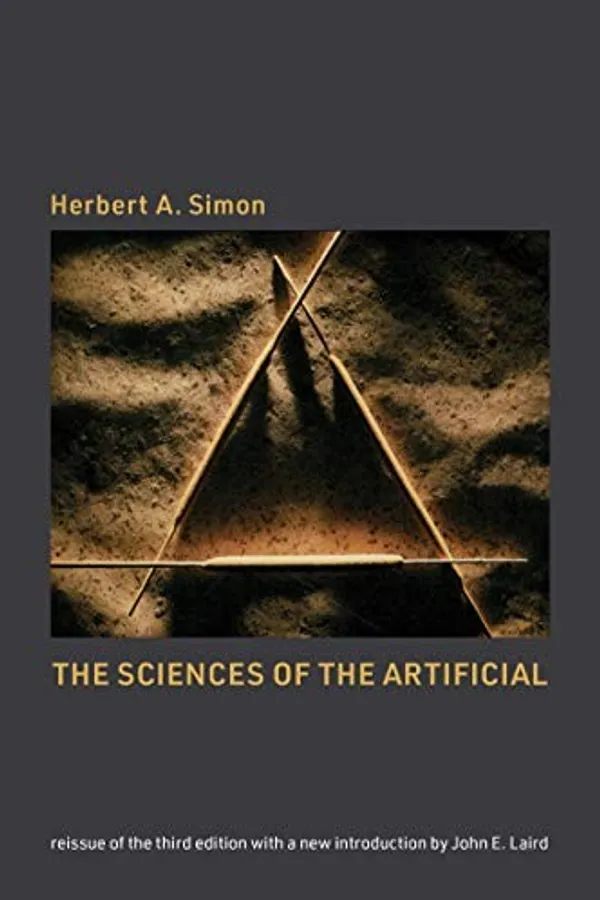
Book
The Sciences of the Artificial
Herbert A. Simon
An artifact is an interface between inner structure and outer demand, and design, the shaping of that interface, is a science with its own laws.
- TYPE
- Book
- SHELF
- Technology & Systems
- TIME
- 12 min read
- ADDED
- 2026 · 07 · 07
- STATUS
- Completed
- IDEAS
Technology · Systems · AI
Why it matters
It is the founding charter for the work I actually do: building adapted systems, under bounded rationality, out of parts that must survive interruption.
Simon asks what kind of science can study things that exist only because someone wanted them: clocks, firms, programs, economies. His answer begins with a definition. An artifact is a meeting point between an inner environment, the substance and organization of the thing itself, and an outer environment, the conditions in which it must operate; when the artifact is well adapted, you can predict its behavior from its purpose and its surroundings without opening it. From this follow the book's three permanent ideas. Bounded rationality: no real decision maker optimizes, because computation and attention are scarce; he searches until an alternative clears an aspiration level, and stops. Design as a discipline: to design is to devise actions that move situations from what they are toward what they ought to be, which makes medicine, management, and engineering one family, and makes design teachable as search, representation, and evaluation rather than as mystique. And hierarchy: complex systems that survive are built from stable subassemblies, nearly decomposable, which is why they can evolve, be repaired, and be understood at all.
- An artifact lives at the boundary of two environments. When adaptation succeeds, function and circumstance explain behavior; the inner mechanism only becomes visible when adaptation fails.
- The ant on the beach: a complex path is not evidence of a complex walker. Most behavioral complexity, in ants and in men, is the environment showing through a simple strategy.
- Bounded rationality replaces the optimizing agent with a satisficing one: search among alternatives, an aspiration level that defines good enough, and a stopping rule. This is not weakness; it is the only rationality that computes.
- Design is a science of its own, with search, means-ends analysis, representation, and evaluation as its subject matter. The professional schools that abandoned it for natural science abandoned their own center.
- The watchmakers Hora and Tempus: the builder who works in stable subassemblies survives interruption; the one who builds in a single pass loses everything each time the phone rings. Evolution and engineering both favor Hora.
- Near decomposability: in viable complex systems, interactions inside a subsystem are stronger and faster than interactions between subsystems, so the parts can be understood, built, and fixed almost in isolation.
- Simulation is a legitimate way of knowing: a system too poorly understood to analyze can still be imitated, and the imitation will teach, because adapted behavior is shaped by the environment more than by the substrate.
The argument
The book opens with a distinction most of science prefers not to examine. Natural science studies what is: the atom, the cell, the star, things that would exist whether or not anyone wanted them. But nearly everything a modern man touches between waking and sleeping is artificial: the clock, the contract, the firm, the program, the city. These things exist because somebody intended them, and they are what they are because they were shaped to serve a purpose inside an environment. Simon’s question is whether there can be a rigorous science of such things, a science of the contingent, and his answer occupies the rest of the book.
The foundation is the artifact as interface. Every designed thing has an inner environment, its substance and organization, and an outer environment, the conditions in which it must perform. The artifact succeeds when the inner is shaped to the outer, and the striking consequence is that a well-adapted artifact hides its own interior. A clock that keeps time can be described entirely by its function and its situation; you learn nothing about its gears until it fails. A sundial and a chronometer are the same artifact in this sense, two inner environments answering two outer ones, one of which rolls and pitches at sea. This is why different substrates can serve one function, and why the science of the artificial can abstract away from physics: what matters is the fit, and fit is a relation, not a material.
Then comes the most famous image in the book. An ant works its way across a beach, and its path is intricate: it doubles back, veers, hesitates. Plot the path and you would guess at a complicated ant. Simon’s verdict is flat: the complexity is in the beach. The ant is running a few simple rules against a difficult surface. He then makes the substitution that carries the book’s weight: a human being, considered as a behaving system, is quite simple too, and the apparent complexity of our behavior is largely the complexity of our environments reflected back. This is not a slur on the species. It is the ground of bounded rationality, the idea for which Simon earned the economics Nobel: because the inner environment of a mind is small, slow, and serial, real decision makers cannot optimize. They search. They hold an aspiration level, take alternatives as they come, and stop at the first one that clears the bar. Satisficing is not a failure of rationality; it is what rationality looks like once you admit that computation costs something. Classical economics assumed the outer environment determines behavior through perfect reason. Simon shows the inner limits binding everywhere: in consumers, in managers, in the organizations that exist precisely because individual minds are bounded and must be composed into larger artifacts that decide.
On this base he builds the book’s professional argument: design is a science and the schools abandoned it. Engineering faculties drifted toward physics, medical schools toward biology, business schools toward economics, each embarrassed by the intellectual softness of their real subject, which is intervention: devising courses of action to move situations from what they are toward what they ought to be. On that definition the doctor, the architect, the manager, and the programmer practice one discipline. Simon sketches its curriculum without apology: the theory of search, means-ends analysis, the allocation of attention, the representation of problems, evaluation under scarce computation. The soft subject turns out to have hard content; it just is not the content of natural science, because it concerns what ought to be, given purposes and constraints, rather than what is.
The final movement is the architecture of complexity, and it explains why any of this is buildable at all. Two watchmakers, Hora and Tempus, assemble watches of a thousand parts. Tempus builds each watch in one continuous pass; when the phone rings, the incomplete assembly falls apart and he starts over. Hora builds stable subassemblies of ten, joins tens into hundreds, hundreds into the watch; an interruption costs him only the piece in his hands. Hora prospers, Tempus is ruined, and the parable scales to everything: evolution reaches complex organisms in reasonable time only through stable intermediate forms, and human institutions and technologies survive their own construction only the same way. The systems that persist are hierarchies, and viable hierarchies are nearly decomposable: interactions within a subsystem are stronger and faster than interactions between subsystems, so in the short run each part can be understood, built, and repaired almost alone. Near decomposability is why complex systems can be comprehended by bounded minds at all. The world is not simple; it is merciful in its structure, and design is the art of keeping it so.
Working notes
The book pairs against Alexander before it pairs with him. Simon says viable systems are nearly decomposable hierarchies; Alexander, in the essay years and in A Pattern Language, insists that living cities are semilattices, overlapping structures, not trees. Both are right, and the tension between them is the actual discipline of architecture in my trade: decompose enough that bounded teams can hold their subsystems, but leave the overlaps that make the thing alive, because a system decomposed to perfect cleanliness is usually dead. Simon explains why we can build at all. Alexander explains why what we build so often feels like nothing.
Meadows completes the other flank. Thinking in Systems gives you stocks, flows, and feedback, the dynamics; Simon gives you the statics, the reason a system can be drawn on a whiteboard in the first place. Kleppmann’s book, read against this one, is applied Simon on every page: partitions, services, and consistency boundaries are Hora’s subassemblies with service-level objectives attached, and every incident postmortem I have read reduces to a place where near decomposability was assumed rather than engineered.
Satisficing improves with use. The vulgar reading is settling; the working reading is that the aspiration level is itself a design variable, the most consequential one in any engagement. Decide what clears the bar before the search begins and the search terminates; decide it during the search and the search terminates never. Most scope creep is an undesigned aspiration level drifting upward on contact with alternatives.
And the ant has aged into prophecy. The current machine-learning systems are not designed in Simon’s sense; they are grown against an environment of data. Yet his frame holds better than most that came after: the model’s behavior is mostly the beach. When an assistant produces something strange, the productive question is almost never about the ant, the architecture; it is about the surface it walked, the data, the context, the incentives of training. Simon predicted machine chess supremacy within ten years and missed by thirty, and the failed forecast teaches the same lesson as the ant: he underestimated the beach.
Where I push back
Design as search is a half-truth stated with the confidence of a whole one. Search presupposes a space: a representation of alternatives, a set of moves, a way of scoring. Simon acknowledges representation as a topic and then spends his energy on traversal, but every difficult design problem I have faced was hard in the framing, not the search. Once the problem is represented well, the alternatives are few and the choice is often obvious; the work was constructing the space, and about that work the book says too little. What Simon calls design is closer to engineering’s second half. The first half is taste, and taste is precisely the faculty his method cannot formalize.
Near decomposability, offered as a property of viable systems, gets quietly promoted to a property of systems in general, and the promotion is dangerous. Tightly coupled systems exist, prosper for a while, and fail all at once: a levered portfolio in a liquidity crisis is one artifact whose subsystems suddenly interact faster outside than inside, which is a formal description of contagion. The engineer who assumes decomposability because Simon said viable systems have it will discover, at the worst moment, that his system was not yet viable.
And the book’s confidence in symbolic search as the substance of thought was wrong in the particulars. Thinking as means-ends analysis over symbol structures produced decades of brittle systems, and the approaches that finally worked kept Simon’s frame, adaptation to an environment, while discarding his mechanism. The frame was right; the mechanism was his own second system, and he shipped it with a scientist’s certainty. A reader who takes the book whole inherits both.
How it enters the work
Enterprise architecture at Intelliblitz is Simon applied twice a week. The interface doctrine comes first: design the membrane between subsystems, publish it, and keep the inner environment free to change behind it; every integration that binds to another system’s interior is a future outage with a signature on it. Then the watchmakers: delivery is structured in stable subassemblies, each one shippable and useful alone, because client organizations are Tempus’s phone, ringing with reorganizations, budget cycles, and departures. A program that is only valuable when complete is a program that will be interrupted into worthlessness. Hora’s discipline, stated in a 1969 book about watches, is the honest core of what consultants now sell as agility.
The aspiration level governs scoping. Before an engagement starts, we fix in writing what clears the bar, because a client searching for the best solution never stops searching, and billing by the month makes that pathology profitable, which is exactly why it must be refused. Satisficing, openly declared, is the most client-respecting practice I know.
In the AI work the ant is the operating rule. When a deployed model behaves badly, we audit the beach first: the data, the retrieval context, the metric it is optimizing, the incentives around its training. Blaming or swapping the model, the ant, is the expensive reflex; curating the environment is usually the fix. Simon named the method before the machines existed to need it.
And the beach followed me into photography. A long exposure of water against a lighthouse is the ant made visible: the sea’s path is intricate, the forces driving it are few, and the long shutter integrates away the accident until the simple strategy underneath shows itself. What survives onto the print is the interface, the meeting of water, stone, and light; the inner workings of the sea matter no more to the image than the gears matter to a clock that keeps time. The structure was always there. The work, in silver tones as in systems, is subtraction.
- Explain behavior by the environment before you credit the agent with complexity.
- Build in stable subassemblies; assume the interruption, because it is coming.
- Set the aspiration level deliberately, search until it is cleared, then stop.
- Design the interface; keep the inner environment free to change behind it.
- Treat decomposability as a property you must engineer, never one you may assume.
Simon treats design as search through a space of alternatives, and the frame quietly assumes the space; in practice the hard work is constructing the problem, not traversing it. Near decomposability describes well-made systems, not all systems, and markets in a crisis or tightly coupled architectures refuse the decomposition exactly when you need it. And satisficing, in careless hands, becomes a license for mediocrity that Simon never issued: the aspiration level is a designed quantity, not an excuse.