Book
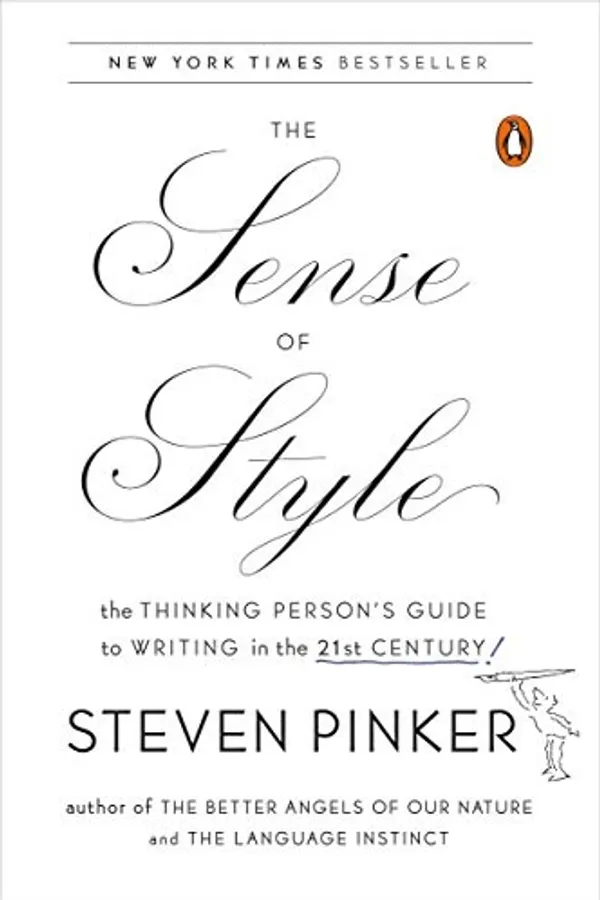
The Sense of Style
Steven Pinker
Bad prose is mostly neither laziness nor deceit; it is the curse of knowledge, a writer who can no longer imagine not knowing what he knows.
- TYPE
- Book
- SHELF
- Writing & Rhetoric
- TIME
- 13 min read
- ADDED
- 2026 · 07 · 07
- STATUS
- Completed
- IDEAS
Writing · Psychology
Why it matters
It replaced my inherited style superstitions with mechanisms, and mechanisms transfer: to documents, to dashboards, to instructions written for machine readers.
Pinker asks why so much writing is bad and refuses the stock answers of decay and laziness. His answer is cognitive. Writing is an unnatural act: knowledge in a head is a web, syntax forces it into a tree, and the page delivers a string; most failures are failures of that conversion. The book opens by dissecting prose he admires, to show the qualities can be named, then makes its two central moves. First, classic style, borrowed from Thomas and Turner: treat prose as a window, the writer as someone who has seen something in the world and positions the reader to see it too. A pose, but a productive one; it settles a thousand small decisions in advance. Second, the curse of knowledge: experts think in chunks whose labels mean nothing to outsiders, and they cannot feel the gaps they leave behind. Then the machinery: how sentence trees overload working memory, why garden paths derail readers, why given information must precede new. A long final chapter takes usage disputes one by one, judging them on evidence rather than folklore. The result is Strunk with reasons attached, and where the reasons contradict the rules, the rules lose.
- The curse of knowledge is the best single explanation of bad writing: the writer cannot simulate a mind that lacks what his own contains, and good intentions do not substitute for the simulation.
- Classic style is a chosen pose, prose as a window on the world and the reader as an equal, and choosing it settles hundreds of sentence-level decisions before they arise.
- A sentence is a tree flattened into a string; it fails when the tree overloads working memory, so keep subjects near their verbs and save the heaviest phrase for last.
- Coherence lives between sentences, not inside them: given information before new, one topical thread, and connectives that declare how each claim relates to the previous one.
- Hedging, signposting, and metadiscourse are the tics of a writer protecting himself rather than informing the reader; classic style deletes the armor.
- Usage rules are tacit conventions, not logic or law; some earn their keep, many are schoolroom folklore, and the test is the practice of careful writers, not the memory of a teacher.
- The passive voice is a tool, not a sin: it exists so given information can come first, and banning it outright breaks the flow the ban was meant to protect.
The argument
Pinker begins by dismissing the customary funeral. Every generation announces that writing is dying, the young are illiterate, the language is in decline; the complaint is centuries old and the corpses keep writing. If prose is bad now, it was bad before, which means the explanation cannot be decay. Nor, he argues, is it the other stock villain, the deliberate obfuscator hiding weakness behind jargon; that writer exists, but he is rare. The ordinary case is worse because it is innocent: a knowledgeable person, trying to be clear, producing prose his readers cannot use, and never finding out.
His method is to treat style as an engineering problem with a known physical substrate. The deep formulation, the one that organizes the whole book, is a data problem: knowledge in a head is a web of associations; syntax can only encode a tree; speech and print can only deliver a string, one word after the next. Writing is the discipline of converting web to tree to string so that a reader can run the process backward and reconstruct the web. Every failure the book catalogues is a failure somewhere in that pipeline.
The first move is a stance. Classic style, a notion he borrows from Thomas and Turner, is a pose the writer adopts: there is something in the world, the writer has seen it, and the prose is a window through which he shows it to a reader treated as an equal. The pose is a fiction, and its value is exactly that it settles decisions. A writer showing something does not hedge every claim, does not narrate his own argument, does not write about the discourse of the field instead of the field’s subject. Against classic style Pinker sets the professional registers everyone recognizes and nobody defends: the academic paper announcing its own sections, the compulsive hedge, the shudder quotes, the nominalizations that turn actions into gray abstractions. His verdict on those habits is clinical: they are not communication but self-protection, prose written to be defensible rather than usable.
The second move is the diagnosis that gives the book its worth. The curse of knowledge: once you know something, you cannot recover what it was like not to know it. The mechanism is chunking. Expertise compresses detail into chunks with private labels, and the expert thinks in the labels; when he writes them down, the reader receives the label without the contents. Add functional fixedness, the expert’s habit of seeing things in terms of their use in his workflow rather than their appearance to a newcomer, and you get prose that is perfectly clear to its author and only to its author. What makes the curse dangerous is that it is invisible from the inside. Sincerity is no defense; the writer cannot feel the gaps, because feeling them would require the very knowledge of the reader’s ignorance that the curse removes.
Then the machinery, which is where the book pays rent. Sentences are trees, readers hold them in working memory, and memory is small; a sentence fails when its structure demands more storage than the reader has. Garden paths, where the reader commits to one parse and must back up. Center-embeddings that nest clause inside clause until the stack overflows. The fixes are mechanical and learnable: keep the subject near its verb, push the heaviest constituent to the end, prefer structures that let the reader close off phrases early. The same logic scales up to the paragraph: coherence is a property of the passage, and it comes from ordering, given information before new, and from connectives that declare each sentence’s relation to the last. Here Pinker rehabilitates the passive voice, which exists precisely so that given material can come first when the agent is the news; the schoolroom ban breaks the flow it claims to guard.
The long final chapter walks through the disputed usages one by one: split infinitives, that and which, singular they, who and whom, the whole inherited docket. His frame is that the prescriptive war is a false one. Usage rules are neither logic nor law; they are conventions, and conventions are real, but they are settled by the evidence of careful writers, not by folklore. Some rules earn their keep. Many are superstitions with traceable, embarrassing histories. He judges each on the record, and the willingness to rule in both directions is what separates the chapter from both camps it annoys.
Working notes
The web, the tree, and the string is the most useful sentence in the book, and it is not really about writing. It describes every serialization problem I have ever worked on. Knowledge in an organization is a web; a schema, a report, an API, a document each force it through a tree into a string, and the failures are always the same failures: cycles flattened into false hierarchies, context dropped in the conversion, labels shipped without their contents. Writing is a data-structure problem with a human parser at the far end. Once I saw that, the two halves of my working life stopped being separate disciplines. The architect who cannot write clearly and the writer who cannot model a system are failing at the same task in different notations.
The curse of knowledge is the consultant’s occupational disease, and Pinker’s account explains a symmetry I had noticed without understanding: competence degrades communication by default. Expertise is chunking; chunking is opacity; the better I get at a domain, the worse I explain it, unless the explanation is deliberately engineered. This is why the most senior person in the room is so often the least able to brief the room, and why organizations promote their way into incomprehensibility. The cure cannot be sincerity, which the curse defeats from the inside. It has to be process: real readers, run against the draft, before the draft matters. The corollary is a hiring instrument I now trust: the expert who can still explain is rarer than the expert who can still perform, and the explaining kind is the one who scales, because his knowledge survives the transfer into other heads. The performing kind takes his chunks with him when he leaves.
Given before new is the rule I use most. It restructures paragraphs silently, and it generalizes past prose: a briefing, a slide, a dashboard panel are all sequences of claims, and each should open from what the audience already holds. Most bad decks are bad because they are ordered by the author’s discovery process rather than the audience’s knowledge state; the fix is Pinker’s, applied at the level of the artifact.
And the usage chapter models something scarcer than its verdicts: adjudication by evidence in a field owned by folklore. Pinker sat on a dictionary usage panel and still ruled against the folklore whenever the record contradicted it. The stacking on this shelf is now clear to me. Strunk is the code, Zinsser the temperament, Pinker the audit; the audit keeps the code honest, and where the elders were right, the mechanisms show why, which is worth more than the rules themselves. A rule you understand can be bent intelligently. A rule you inherited can only be obeyed or broken blind.
Where I push back
The apparatus outweighs the yield. Strip the experiments and the tree diagrams and most of the practical advice is Strunk, Zinsser, and common editorial practice, now with citations; the science frequently justifies the advice rather than deriving it, and I can count on one hand the recommendations that could not have been written in 1959. There is also a private comedy in a book about respecting the reader’s working memory that runs to this length. The audit is real and valuable. The claim that style has been rebuilt from cognition is bigger than what the book actually delivers.
Classic style is oversold, and the overselling matters. It is the style of explanation: truth already found, needing only display. But much serious writing is conducted while thinking, or against resistance, and the window pose has no way to show the writer’s doubt, which is sometimes the most honest content available. Worse, the pose fakes well. Serene, confident display persuades independently of truth; classic style is also the conman’s style, and a book so alert to hedging as self-protection should have been equally alert to fluency as self-promotion. Pinker treats the failure modes of academic prose as vices and the failure modes of classic prose as nonexistent.
The usage half, for all its quality, is a reference work stapled to an argument, and its standard smuggles in a judgment it never defends: the evidence of careful writers decides, but who counts as careful is decided before the evidence is consulted. That circle may be unavoidable. It should have been acknowledged.
And the remedy gap is real. The curse of knowledge is named, mechanized, and made memorable, and then the cure offered is to show your draft to a reader, which every writing teacher has said forever. Diagnosis at this quality deserved a treatment protocol of matching depth. The book names the enemy better than any predecessor and fights it with the standard-issue equipment.
How it enters the work
Every Intelliblitz engagement is a curse-of-knowledge problem running in both directions at once. The client’s domain experts cannot state their own processes; the knowledge is chunked into labels that mean nothing outside the building. My engineers cannot state the system they built; it is chunked into architecture that means nothing outside the team. The deliverables are the bridge between two mutually cursed parties, so I engineer what Pinker says cannot be felt. Documents get read by a designated outsider before they ship. Glossaries are maintained as first-class artifacts, because the chunk labels are where the gaps hide. Every explanation is ordered given before new, and the executive summary is written last and placed first. None of this is style in the decorative sense. It is defect prevention, applied to prose.
The BI work applies the same rules to layout. A dashboard is a paragraph: each panel is a claim, and the sequence either builds from what the viewer already knows or it dumps the author’s web on the screen and calls it insight. Given before new became a design law in my practice: the familiar number first, the new number beside it, the relation declared rather than implied. A dashboard that fails the ordering test is usually failing a deeper one: nobody decided what the viewer already knows, so the design has no starting point, only a destination it hopes the viewer reaches unassisted, and the hope gets billed as insight.
And the AI operating systems work gave the book a second life I did not expect. Writing instructions for machine readers is style under Pinker’s constraints with the tolerances tightened: ambiguity that a human would repair silently becomes cost and error at scale. So specifications get written in something close to classic style, concrete nouns, named agents, one interpretation per sentence, buried verbs revived, and the curse of knowledge applies doubly, because the machine lacks context I cannot even feel myself assuming. The disciplines that help a human parser turn out to be the same ones that keep a machine parser inside its lane, which is the book’s thesis restated: the constraints were never about taste. They were about what minds, of any kind, can reliably decode.
- Assume the curse of knowledge is operating on you right now; you cannot feel it. Show drafts to a reader who owes you nothing.
- Order every explanation given before new; the reader builds on what he already holds.
- Keep subjects close to their verbs and put the heaviest phrase last; most tangled sentences untangle with those two moves.
- Revive buried verbs and name the agents; abstraction hides both the action and the responsibility for it.
- Settle usage disputes with evidence from careful writers, not with rules remembered from school.
The science often decorates advice that Strunk issued for free, and the book proves less than its apparatus implies. Classic style is the style of explanation, and Pinker quietly treats explanation as the whole of writing; argument before a hostile audience, intimacy, and art run on other contracts. And naming the curse of knowledge does not lift it; his remedy, show the draft to a reader, is a folk cure wearing a lab coat.