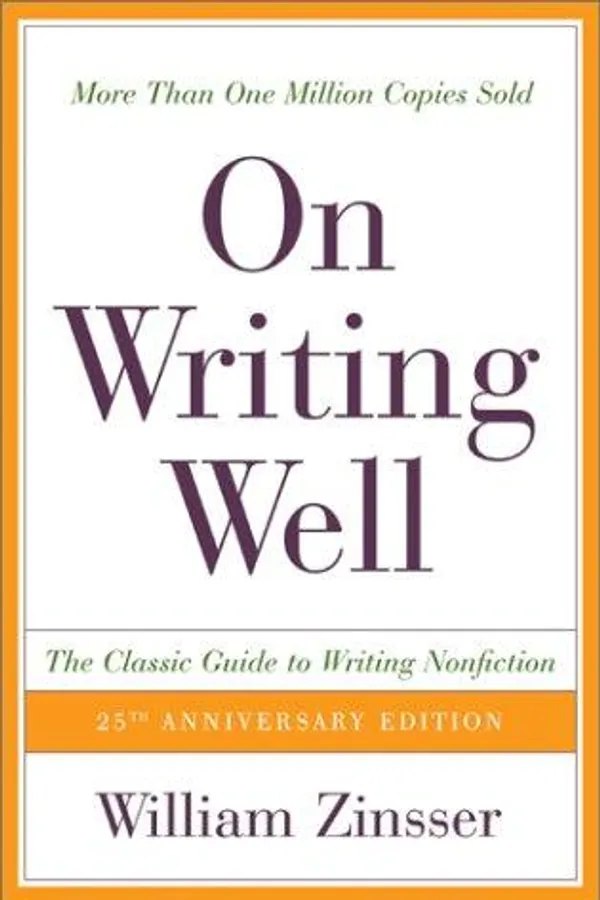
Book
On Writing Well
William Zinsser
Clutter is a moral failure before it is a stylistic one: clear prose is a person thinking honestly in public, and both the clarity and the person are made in rewriting.
- TYPE
- Book
- SHELF
- Writing & Rhetoric
- TIME
- 12 min read
- ADDED
- 2026 · 07 · 07
- STATUS
- Completed
- IDEAS
Writing
Why it matters
Consulting is paid writing more than most consultants admit; Zinsser set the standard I bill against, that a client should never pay to be confused.
Zinsser taught nonfiction at Yale after years at the Herald Tribune, and the book is the course. The disease he diagnoses is clutter: the pompous phrase, the inflated verb, the institutional fog that writes itself while nobody takes responsibility for what it says. The cure is simplification, sentence by sentence, and the standard is a reader who gives every sentence one chance before leaving. But the second half of the doctrine is what separates him from the drill manuals: what the reader stays for is not information but a person. Good nonfiction is a transaction in humanity; warmth and identity are craft requirements, not decoration, and the writer who scrubs himself out of the prose has cleaned away the product. From there, working chapters: the interview, travel, memoir, science, business, sport, criticism, each governed by the same two laws, strip the clutter and keep the person. Under everything runs the mechanic's confession: writing is hard, rewriting is the game, nobody gets it right the first time, and the difference between writers is what they do to the draft after it exists. He revised the book itself for thirty years, which is the argument made flesh.
- Clutter is the disease of American prose, and it is rarely innocent: fog is what institutions write when nobody wants to own the meaning of the sentence.
- Clear writing is clear thinking. A subject that cannot be written plainly has not been understood yet, whatever the writer feels about his grasp of it.
- Write for yourself. Guessing what an audience wants produces exactly the falseness that loses it; the only voice worth reading is the writer's own.
- Good nonfiction is a personal transaction: readers stay for the human being behind the sentences, so humanity is a matter of craft, not a decoration applied afterward.
- Unity is decided before drafting: one pronoun, one tense, one mood. Most disorganized prose failed at these decisions, not at talent.
- Rewriting is the essence of writing. The first draft's only job is to exist; the writing happens to it afterward.
The argument
Zinsser’s authority is a newsroom, not a seminar. He came up at the New York Herald Tribune, wrote for a living across every nonfiction form, and then taught the writing of it at Yale; the book, first published in the seventies, is that course set in type, and he went on revising it for thirty years as the tools and the fashions changed under it. The revision history is not trivia. A book that argues writing is rewriting, itself rewritten for three decades, is practicing its claim in public.
He opens with a scene instead of a rule. On a panel about writing, he sits beside a surgeon who writes for pleasure, and the two of them disagree about everything: whether writing is easy or hard, whether words should be let flow or cut, whether the work is joy or labor. Zinsser’s conclusion is not that the surgeon is wrong. It is that method is personal and the product is not: whatever the process, what the reader buys is a person on the page, thinking. That is the transaction, and the whole book descends from it.
Then the diagnosis. Clutter is the disease of American writing: the inflated phrase doing the work of the plain word, the noun cluster, the euphemism, the qualifier hedging a claim nobody would have challenged. He is precise about where clutter comes from, and it is not ignorance. Institutions generate fog because fog protects them; official language swells in proportion to the desire not to be pinned to a meaning. The corporation that writes about revenue enhancement, the official who writes about pacification, the memo that converts a decision into a process: these are not failed attempts at clarity. They are successful attempts at something else. Which is why he can treat simplification as a moral act, not a cosmetic one. To strip a sentence to its cleanest components is to accept responsibility for what it says. He calls Thoreau as witness and works the doctrine hard: every sentence pared, every third word cut, the brackets he drew around needless words in his students’ drafts standing for a discipline anyone can run on any page.
The reader he writes for is impatient and entitled to be. A person gives a sentence one chance; lose him through carelessness, an ambiguous pronoun, a switched tense, a sentence that cannot decide its subject, and he does not come back. So the craft chapters are built on decisions made before drafting: unity of pronoun, unity of tense, unity of mood, one question answered per piece. The lead has one job, to make the reader continue; the ending has one job, to let him go a moment before he expects it. None of this is inspiration. It is carpentry, and he teaches it as carpentry.
The second half applies the two laws, strip the clutter and keep the person, across the working forms. The interview chapter is about the ethics of other people’s words. The travel chapter is a war on the brochure adjective. Science and technology writing he treats as the purest test of the craft: assume nothing, begin with the one fact the reader needs, add one fact at a time, in order, until the machine or the process stands assembled in the reader’s mind. Business writing gets the sharpest sermon: institutional prose dehumanizes the institution, and the manager who writes plainly reads as stronger, not weaker, because plainness signals that a person is willing to be identified with the decision. Memoir he defends as the honest small subject against both grandiosity and shame. Sport and criticism are warned off their in-house jargon, the ready-made phrases that let a writer type without thinking.
And beneath all of it, repeated until it cannot be missed: writing is hard, and the hardness is the point. There is no easy first draft, no waiting for the mood, no trick. The first draft exists to be rewritten; the rewriting is where thought actually happens; the writer’s real skill is not fluency but the willingness to go back in. The book’s warmth misleads people about its severity. Its actual demand, a person on every page and not one needless word around him, is among the hardest standards in the craft.
Working notes
Strunk gives the code; Zinsser gives the temperament. The little book tells you what to cut, and this one tells you what must survive the cutting: a human being, audibly thinking. That second law is the harder one. I have read a great deal of prose, my own included, that passed every test of concision and failed the transaction, clean sentences with nobody home in them. Severity is also a style, and it is a false one when it is used to hide the writer. An archive like this one runs that risk on every page; Zinsser is the corrective I keep against my own preferred failure.
His theory of clutter has a diagnostic edge he never states outright, so I will: where the prose goes passive, a decision is hiding. Fog is almost never a writing problem. It is an accountability problem wearing a writing problem’s clothes. When a paragraph refuses to say who did what, someone benefits from the refusal, and the exception, if there is one, has stayed hidden from me. This turns Zinsser from a style manual into an audit instrument. Read any organization’s internal prose and you can map where responsibility pools and where it evaporates, before you have seen a single org chart.
The claim that clear writing is clear thinking runs the other way too, and the reverse direction is the useful one. Writing is the cheapest test of understanding that exists. If I cannot write the system plainly, I do not understand the system yet; the sentence that will not come clean is pointing at the thought that was never finished. I trust that instrument more than I trust my own feeling of comprehension, because the feeling lies and the sentence cannot.
His doctrine of rewriting maps exactly onto the photographic edit. The first draft is the contact sheet: necessary, unpresentable, and nobody’s business. The work happens afterward, in selection and refinement, and the practitioners who embarrass themselves in both fields are the ones who publish their contact sheets. What Zinsser adds to the commonplace is scheduling: rewriting is not a mood that follows drafting but a separate task with its own hour. The draft’s author is too close to the crime scene; give the case to the colder detective who arrives the next morning.
Beside Pinker, Zinsser reads like a practitioner anticipating the theory. The impatient reader who gives each sentence one chance is the curse of knowledge seen from the receiving end; Zinsser asserts what the cognitive account later explains, and the two books agree so completely on the mechanics that the agreement itself is evidence. When a newspaperman’s scars and a linguist’s experiments converge on the same sentence surgery, the surgery is probably real.
Where I push back
His general reader is a vanished species. Zinsser writes for the intelligent nonspecialist of the midcentury magazine, a reader with an attention span, a general vocabulary, and no particular expertise, and his confidence that any subject can be made plain to that reader shades into a denial of irreducible technicality. Some precision does not simplify; it only translates, with loss, and an honest translator says so. The working edge of any serious field, law, mathematics, distributed systems, runs on prose that must be dense to be correct, and Zinsser’s method, applied there, does not clarify the material. It replaces it with a lighter substance that reads better and means less. He never quite admits this, because admitting it would put a boundary around the craft he spent a life teaching.
His canon has the same borders as his taste. Warm American nonfiction is the whole of his evidence, so density, formality, and ceremony appear in the book only as diseases, when each is sometimes the correct register: a contract should be formal, a liturgy should be ceremonial, and neither is improved by sounding like a magazine feature. The method is sound inside its territory and quietly imperial beyond it. A method is entitled to its borders; a method that denies having any becomes a tic, and the writer trained only on Zinsser acquires the tic early: the reflexive lightening of whatever he touches, whether or not the subject can bear to lose the weight.
And the presence doctrine has aged into something he did not intend. Everyone is now present on every page; the first-person flood, confession without craft, personality without subject, is the ambient condition of the internet. Zinsser’s permission was always paired with a discipline, the person earns the page by thinking well on it, but permissions travel farther than their conditions. He would have despised the outcome. He still helped write its charter, and a fair reading of the book today has to carry that weight.
How it enters the work
Consulting is a writing trade that believes itself a technical one. What an Intelliblitz engagement actually delivers, beneath the systems, is a set of documents: proposals, architecture memos, runbooks, the handover that decides whether the client owns the system or merely hosts it. Zinsser set the standard those documents are held to, and it is billing discipline as much as prose discipline: a client should never pay to be confused. Fog in a deliverable charges the client for thinking that did not occur, and I treat it exactly as I would treat a billing irregularity, something to be found and removed before the invoice goes out.
The practice is specific. Every system document opens with a summary a nonengineer can read without help, written last and placed first; if the architecture cannot survive that translation, the architecture is not finished, and the document has just told me so. Technical sections run on Zinsser’s science-writing rule: one new fact per sentence, assembled in a straight line, nothing assumed that was not established. And his diagnostic runs on the inbound side too. When I read a client’s existing documentation, I read for the passives; where the prose goes anonymous, a decision is hiding, and the buried decisions are usually where the engagement’s real problems live. The audit begins in their sentences before it reaches their systems. And the handover documents get the strictest pass of all, because they decide whether the client owns the system or rents an ongoing dependence on us; a runbook the client cannot read plainly is a leash, whatever the contract says, and we are not in the leash business.
The discipline shelf claims the rest of him. Rewriting as a scheduled task, not a mood, is how the essays on this site get made: draft one day, cut on another, the colder eye given its own appointment in the calendar. And the standard underneath, a person thinking honestly in public, is the standard this archive answers to. These entries are working notes, not performances; when I catch a sentence performing, Zinsser is the voice that says cut it, and he is right at a rate that keeps him on the desk.
- Bracket every word doing no work in a finished draft; what survives the brackets is the piece.
- Decide pronoun, tense, and mood before the first sentence; unity is chosen, not found.
- In technical prose, give the reader one new fact per sentence and build in a straight line.
- Cut the fog and keep the pulse; a document with no person in it will not be believed, only filed.
- Schedule the rewrite as its own task, on its own day; that is where the writing happens.
Zinsser's taste is the midcentury American magazine, and applied without judgment it flattens registers that need density: law, mathematics, the outer edge of any technical field. His permission to be present on the page, granted to writers with nothing to be present about, helped build the first-person flood he would have hated. And write for yourself is counsel for the disciplined; in an undisciplined hand it blesses indulgence.