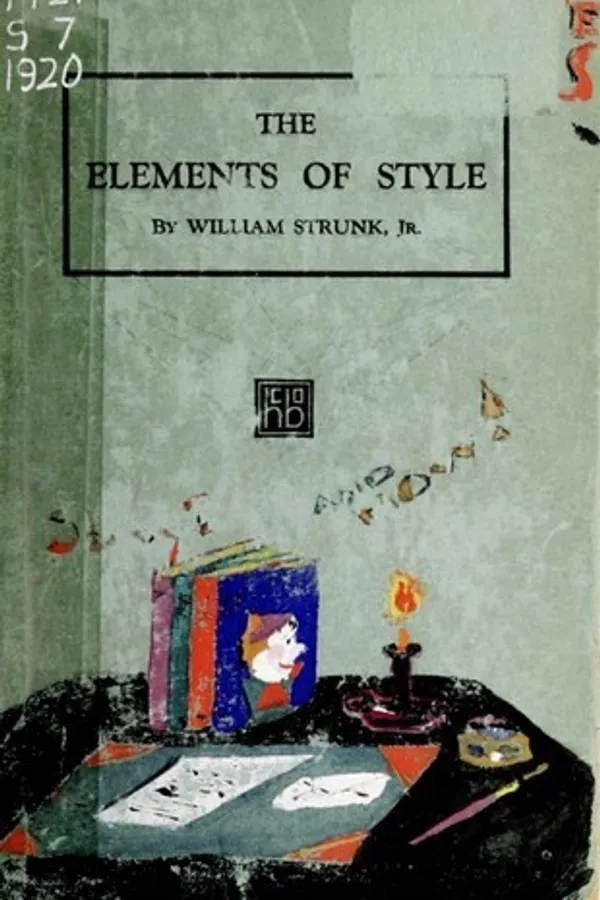
Book
The Elements of Style
William Strunk Jr. and E. B. White
Vigorous writing is subtraction practiced as a rule: every word must do work or go, and the discipline of cutting is the discipline of seeing.
- TYPE
- Book
- SHELF
- Writing & Rhetoric
- TIME
- 12 min read
- ADDED
- 2026 · 07 · 07
- STATUS
- Completed
- IDEAS
Writing
Why it matters
It is my operating instinct, find the structure and remove everything that is not it, applied to the sentence; I keep it as a whetstone, not a law.
A Cornell professor's classroom code from 1918, revised four decades later by the student who became its most famous graduate. Strunk's portion is a short table of commandments: rules of usage for the comma and the possessive, then principles of composition. Use the active voice. Put statements in positive form. Prefer the definite and the concrete. Omit needless words. The reasoning behind the famous rule is structural, not decorative: a sentence should carry no word that does no work, for the same reason a drawing should have no unnecessary lines and a machine no unnecessary parts. Prose leaks force through its idle words. White's additions change the key without changing the doctrine. His closing chapter concedes that style cannot be commanded, only approached: place yourself in the background, write plainly, revise, and what survives the cutting will be identity, because no writer can remove himself from his own choices. The book practices what it orders. It is short because its authors obeyed it, and it has outlived every rebellion against it because the rebellions were written in prose that had, first, been cleaned by it.
- Omit needless words is a theory of energy, not a tip on brevity: a sentence loses force in proportion to the words in it that do no work.
- The active voice and the concrete noun carry prose; abstraction and qualification are where meaning goes to hide.
- Put statements in positive form: say what is, not what is not, so the reader never performs the inversion the writer avoided.
- Design precedes writing: work from a shape you have chosen, because revision needs a standard to cut against.
- White's amendment: style is not applied to prose but revealed by it; strip the ornament and what remains, unavoidably, is the writer.
- The rules govern the ninety ordinary cases; the writer who breaks one in the tenth pays for the break with credibility earned in the other ninety.
The argument
The book began as a classroom economy. William Strunk Jr. taught English at Cornell, and in 1918 he had a code printed privately for his students: the little book, he called it, a few rules of usage, a few principles of composition, a short list of words commonly misused. E. B. White sat in that classroom the following year. Four decades on, asked to revise the book for a general audience, he kept his teacher’s commandments, added an introduction remembering the man, and closed with a chapter of his own on style. The result is a collaboration across forty years between a drill instructor and an essayist, and the tension between the two halves is half the book’s value.
Strunk’s part is a code, not a treatise. The usage rules are small and exact: form the possessive with an apostrophe and an s, set off parenthetic expressions with commas, keep the comma before the last term in a series. The principles of composition are where the doctrine lives. Use the active voice. Put statements in positive form. Prefer the definite, the specific, the concrete. Keep related words together. Put the emphatic words at the end of the sentence. And at the center, the rule the book is remembered for: omit needless words.
The reasoning matters more than the rule. Strunk does not argue for brevity as a manner. He argues from structure: a sentence should contain no unnecessary words for the same reason a drawing should contain no unnecessary lines and a machine no unnecessary parts. The comparison is an engineer’s. Every word in a sentence draws a share of the reader’s attention, and a word that does no work does not sit there neutrally; it taxes the words that do. Prose fails the way machines fail, through friction. This is why the rule is not an instruction to write short sentences or to strip detail. Detail that works is the whole point; the definite and the concrete are commanded two rules earlier. What must go is the word that only occupies space: the qualifier that hedges, the phrase that restates, the abstraction standing in front of its fact.
The other principles follow from the same mechanics. The active voice is preferred because it names an agent and commits to a claim. Positive form is preferred because assertion carries information and negation carries evasion; the reader of a negative statement must construct the positive one himself, and a writer who requires that has shifted his labor onto the customer. Emphasis belongs at the end of the sentence because the end is the position the ear retains. None of this is offered as taste. It is a theory of where force in prose comes from, stated as drill because Strunk was teaching undergraduates and had one term to do it in.
White’s introduction gives the book its human warrant. He remembers Strunk at the lectern, a man who had followed his own rule so ruthlessly that his lectures ran short, getting through the hour by delivering each commandment several times over. The portrait is affectionate and slightly comic, and it makes the book’s central claim in miniature: the doctrine was lived before it was printed.
Then White’s closing chapter quietly reverses the book’s direction. Strunk legislates; White concedes. Style cannot be commanded. No rule produces the sound of a particular writer, and the attempt to acquire style directly, through ornament, fancy words, an adopted manner, produces its opposite. His reminders are therefore mostly prohibitions: do not overwrite, do not overstate, avoid qualifiers, do not affect a breezy tone, do not inject opinion, revise and rewrite. Place yourself in the background, he says, and with that the book completes its single thought. The writer who removes every needless word and every borrowed ornament does not disappear. What remains is the writer, because the choices that survive the cutting, of subject, of noun, of rhythm, could not have been made by anyone else. Style is the residue of subtraction. You do not add it. You uncover it.
That is the whole book. It can be read in an evening and applied for a lifetime, and its longevity comes from the alignment of its form with its claim: a short book about omission that omits, a plain book about plainness. Generations of writers have rebelled against it, usually in essays whose best sentences would pass its editing untouched. The rebellions are right about the book’s misuse and wrong about its use. It was never a constitution. It is a whetstone, and a whetstone does not tell the blade what to cut.
Working notes
The rule about needless words is really a rule about seeing. You cannot cut a sentence until you can see its load path: which words carry the meaning, which words carry other words, which words carry nothing. Most writers cannot see this in their own prose, which is why the rule reads as trivial and applies as surgery. The first serious pass I make on anything I write is structural in exactly this sense: find what the paragraph is holding up, then remove every member that bears no load. Half the time the subject of the piece changes under the knife. Subtraction is not polish. It is discovery. The draft does not know what it is about until the clutter stops blocking the view.
The book’s authority is formal before it is intellectual: it obeys itself. A writing manual written badly refutes itself on every page, and most of them do. This one is its own evidence, and that is a standard worth generalizing. Distrust any advice, in any field, that the adviser’s own work does not exhibit.
Its neighbors on this shelf form a sequence I only saw after years of use. Strunk and White give the code. Zinsser expands the code into a temperament and supplies the reasons a working writer needs. Klinkenborg radicalizes it: if the word is the unit of cutting, the sentence is the unit of thought, and he pushes the doctrine to its limit one sentence at a time. Pinker arrives last and audits the lot, keeping the instincts and discarding the false grammar. Read in that order, the little book is not a rulebook but a first position: the stance you learn before you are allowed to move.
The imperative mood of the book is its pedagogy, and the pedagogy is the same as any physical discipline. Rules stated as commands are meant to be drilled until they become reflex, then forgotten; a writer consciously obeying rule seventeen is like a swimmer consciously counting strokes, correct and slow. The code exists so that judgment has something to stand on. This is how every practice I trust works: scales before improvisation, drills before sparring, the rule held daily until the day it becomes unnecessary is the rule that changed you.
One more note, on the order of the halves. White’s chapter is the more dangerous one, because it is the half people quote to excuse themselves from Strunk’s half. Style as personality gets invoked by writers who have not yet earned a personality on the page; the background rule gets skipped by writers eager to be foreground. The book’s sequence is the training sequence. Code first. Freedom later, and only for those who paid for it.
Where I push back
The grammar is wrong in places, and not trivially. Linguists, Geoffrey Pullum the loudest among them, have catalogued the failures: illustrations of the passive voice that are not passive, prohibitions with no basis in the history of the language, superstition issued in the same imperative voice as sound counsel. The deeper fault is a confusion of categories. The book mixes grammar, usage, and taste, three kinds of law with three kinds of authority, and commands all three identically, so generations of editors have enforced one classroom’s 1918 preferences as if they were syntax. A rule of taste presented as a rule of grammar is a small dishonesty, and the book commits it often.
The omission doctrine also has a blind side: it has nothing to say about abundance. Some of the strongest prose in the language is long, recursive, ornamented, and would fail every test in this book; the sermon, the epic catalogue, the sentence that builds for half a page and lands. Strunk’s mechanics explain why lean prose works. They cannot explain why rich prose works, so the book quietly implies it does not, and a writer formed entirely inside these covers will mistake one virtue for the whole of virtue. Economy is itself a manner, with a temperament attached, and the book never concedes it; plainness is one register of good prose promoted here to the definition of prose, and the promotion is argued nowhere. It is simply assumed, in the confident schoolroom voice that assumes everything.
And the book cannot teach the first act. It assumes you have something to say and polishes the saying. Applied to an empty draft, the discipline produces clean emptiness, and the cleanliness disguises the emptiness; Strunk-compliant prose has a way of sounding authoritative precisely when it has nothing to assert. The book is a knife. A knife is no help at the market, and the market, deciding what is worth writing at all, is where most writing actually fails.
How it enters the work
My stated operating instinct, find the structure, then remove everything that is not it, is this book generalized past prose; or rather, the book is the instinct applied at the scale of the sentence. I did not learn the instinct here. I recognized it here, stated in the imperative, decades before I needed it, and the recognition is why the book stays within reach.
The clearest transfer is photographic. A long exposure is rule seventeen executed by the shutter: traffic, crowds, the chop on the water, everything transient is averaged out of the frame until only the structure remains, the bridge, the lighthouse, the tower holding its geometry against a smoothed sky. Black and white is the same commandment applied to color: remove the hues and the frame is forced to argue with weight, line, and light alone, which is why my instinct runs monochrome whenever the subject’s structure is the subject. And the gallery edit is the rule applied to the body of work itself. Of the frames that survive a night’s shooting, most are needless words. The edit that reaches an exhibition wall has been cut by the same fraction as a hard-revised draft, for the same reason: every frame that does no work taxes the frames that do.
The essays get the discipline literally. Each one takes a Strunk pass before it ships: read aloud, cut to a target, positive form enforced, every qualifier made to defend itself. The target matters. A fixed fraction to remove keeps the knife honest on the days when the prose feels precious, and the days it feels precious are exactly the days it is fat.
And the book earns its place in the discipline shelf of this archive, not just the writing shelf, because it is the cheapest daily proof that rules held as practice outperform philosophies held as opinions. Five minutes with a draft and the code either was applied or was not; there is no way to feel compliant. Very few disciplines give feedback that honest, that fast. I keep the little book for the same reason I keep a light meter. Neither one flatters.
- Cut a finished draft by a fixed fraction before showing it to anyone; a target keeps the knife honest.
- Prefer the concrete noun and the active verb; repair the sentence before reaching for an adverb.
- State it positively. If the sentence pivots on a negation, rebuild it.
- Choose the design before drafting; subtraction needs a structure to cut toward.
- Place yourself in the background. The work carries the signature whether or not you sign it.
Its grammar is sometimes wrong and much of its law is 1918 classroom taste in uniform; linguists have catalogued the errors, and editors who enforce the book as logic are enforcing a dialect. Read it as a discipline of attention, not as an authority on English. And the omission rule, held by a timid writer, produces thin prose: cutting is the second act of writing, and the book is silent about the first.