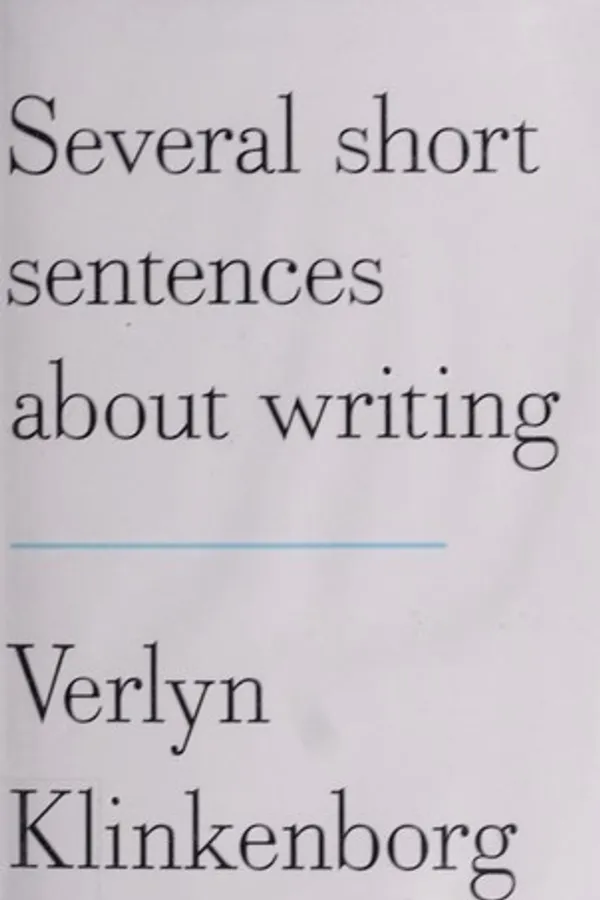
Book
Several Short Sentences About Writing
Verlyn Klinkenborg
Prose is made of sentences, one at a time, by a writer who knows what each says, leaves unsaid, and implies; every doctrine that hides this teaches writing badly.
- TYPE
- Book
- SHELF
- Writing & Rhetoric
- TIME
- 13 min read
- ADDED
- 2026 · 07 · 07
- STATUS
- Completed
- IDEAS
Writing · Art
Why it matters
It is the one writing manual built on the instinct I run everything on: find the structure, remove everything that is not it, one sentence at a time.
The book is set out like a poem: spaced single assertions, nothing you could call a chapter. The form is the thesis. Klinkenborg, after years on the New York Times editorial board and years of teaching writers, wrote a demolition of nearly everything school teaches about prose. Writing is not flow, inspiration, or self-expression; it is the making of sentences. The sentence is the unit: improve the sentences and the piece improves, and there is no other route. Short sentences come first, since most long ones are short ones badly joined. A writer must know what each sentence says, what it leaves unsaid, and what it implies, because unmeant implication is where prose goes bad. Between sentences lies the gap, and the gap carries meaning; transitions mostly comfort the writer. Against the standard workflow of fast drafts repaired later, he argues for deliberate composition: make the sentence well before you keep it. And beneath the craft sits a diagnosis: people write badly because school trained them out of their own noticing and into a borrowed institutional voice. The cure is authority. Trust what you notice, and say it plainly.
- The sentence is the unit of writing. Not the idea, not the paragraph, not the draft. All improvement in prose is improvement in sentences.
- Short sentences are the instrument, not the training wheels. Length is earned by clarity, and most long sentences are short ones joined before they were understood.
- Every sentence says something, leaves something unsaid, and implies something. The writer is responsible for all three, and the unmeant implication is the commonest defect in prose.
- The gap between sentences carries meaning. Readers leap it easily; transitions exist mostly to reassure the writer, and cutting them tightens the prose.
- Noticing precedes writing. Schooling trains people to distrust their own perceptions and imitate an approved voice; recovering authority means recovering attention.
- Revision is not a stage after writing but the condition of it: compose deliberately, sentence by sentence, instead of manufacturing a bad draft on the promise of fixing it later.
- Grammar is not etiquette; it is anatomy. Knowing the names of what a sentence does lets you see its skeleton before you trust weight to it.
The argument
The book refuses to look like a book. Short lines, broken like verse. One proposition at a time, each surrounded by white space, no chapters worth the name. The form is not decoration. It is the thesis, performed: writing is made of sentences, so the teaching arrives in sentences, each left alone long enough to be examined. You cannot skim it. Skimming is the habit it exists to break.
Most of what people believe about writing arrived by rumor, and school delivered it: flow, inspiration, outlines, topic sentences, transitions, the hook, the fast draft repaired later. Klinkenborg treats the inheritance itself as the problem, and not because rules constrain. These rules describe no actual act of writing. Flow names a feeling in the writer, not a property of the prose; the sentences that came easily are precisely the ones that need the hardest audit, because ease is how cliché feels from the inside. Inspiration is a word for not remembering what you did. And the workshop’s great mercy, write it fast and fix it later, he refuses as a bad bargain: it manufactures debt, trains a tolerance for bad sentences, and postpones the only decision that matters, which is this sentence, made well, now.
The positive doctrine is small and total. The sentence is the unit of writing. Not the idea: ideas do not exist for the reader until they are sentenced. Not the paragraph: a paragraph is an arrangement of sentences and inherits every virtue it has from them. Improve the sentences and the piece improves; there is no other route, and every route that claims otherwise is a detour through vagueness. Short sentences come first, and not as training wheels: as the instrument itself. A short declarative can carry more than most writers trust it to carry, and most long sentences, inspected, turn out to be several short ones joined before they were understood, lashed together with which and while and although until the seams take the weight the thought should have taken. Length is not forbidden. It is earned, later, by a writer who knows exactly why the thought needs it. Usually the thought does not.
The book’s sharpest instrument is a triple question. Every sentence says something: its content, the proposition on the table. It leaves something unsaid: the ground it declines to cover, the qualifications it does not offer, the claims it stops short of making. And it implies something: about the subject, about the writer, about what the reader is assumed to know and to be. The writer is responsible for all three, and the last two are where prose goes quietly wrong; the unsaid and the implied are the sentence’s shadow, and most bad sentences are innocent of their own shadows. Then there is the space between sentences. The reader leaps the gap without effort, and the leap is a pleasure; readers are more athletic than the schooled writer believes. Prose that carries them over every gap on a stretcher of connectives insults them. However, moreover, as we have seen: scaffolding for the writer’s anxiety, not the reader’s need. Cut them and watch. If the sentences stand in the right order, the gap speaks. If the gap fails, no connective was going to save it; the order was wrong, and the transition was hiding that.
Against the manufacture of drafts he sets deliberate composition. Make the sentence in your head. Turn it. Test its weight. Write it down when it deserves writing down, and then treat revision not as a later stage but as the permanent condition of the work: every sentence remains provisional until the whole piece stops moving. Grammar, in this shop, is not etiquette. It is anatomy: the names of what you already do, learned so you can see the skeleton of a sentence before trusting weight to it.
Under all the craft sits a diagnosis. People write badly, he argues, because their authority was schooled out of them: years of being graded for imitating an institutional voice, of learning that their own perceptions were not the assignment. So the deepest instruction in the book has nothing to do with syntax. Notice. Trust what you notice, and treat your attention as evidence. Authority in prose is not confidence and not credentials; it is responsibility accepted for every word on the page, and it is available to anyone willing to accept it. The book is severe in a plain coat. It assumes the reader is serious. It never assumes the reader is advanced. The two are different, and nearly all writing instruction confuses them.
Working notes
The Elements of Style hands down laws; this book grows the faculty the laws were compressed from. Omit needless words is a commandment, and like all commandments it gets obeyed mechanically by people who cannot hear the needlessness. Klinkenborg builds the ear. The two books also quietly disagree: Strunk trusts convention, and Klinkenborg audits convention along with everything else school certified. Read Strunk early, before the habits form. Read Klinkenborg after you have written enough to own habits worth breaking; earlier, and the severity has nothing to cut.
Pressfield and Klinkenborg divide the writing life between them. One wins the war of getting to the desk. The other governs what the sitting is for: one sentence, made deliberately, owned entirely. The pairing matters because each is dangerous alone. A man with Pressfield only will produce heroic volumes of unexamined prose; a man with Klinkenborg only will polish the first paragraph of a book that never gets written.
In Praise of Shadows is the aesthetic twin. Tanizaki’s beauty lives in the unlit corner; Klinkenborg’s meaning lives in the gap between sentences. Both trust the perceiver to complete the work. Both know that full illumination is a form of contempt: the room lit like an operating theater, the paragraph that explains each step, the frame that leaves nothing outside the edge. Implication is shadow. What is withheld, in prose as in a room, is what gives the visible its weight.
The triple question turned out to be a general instrument, not a literary one. It audits a proposal, an architecture memo, an artist statement, a difficult email. In practice the last two terms do nearly all the work: most sentences I cut are cut for what they left unsaid or for what they implied, because they said an accurate thing and implied a wrong one, about certainty, about the reader, about who was serving whom. Said, unsaid, implied. Nothing I have found catches the quiet terms as reliably.
The authority diagnosis also generalizes past prose. Most bad dashboards, most bad decks, most bad client memos are written in the surrendered voice: the author impersonating an institution instead of stating what he saw. The cure is identical. Report your own noticing, plainly, and accept responsibility for every claim. Institutions cannot write; only people can, and a person hiding is the one thing a reader always detects.
On first pass the book feels slight, almost an afternoon’s read. The second pass shows the trick: no sentence leans on its neighbor. Each line bears its own weight, which is the hardest standard in prose and invisible until you attempt a single page under it. A short sentence cannot smuggle. Everything it carries is on the table, which is why weak writers avoid it and strong ones begin with it.
Where I push back
The method is a jeweler’s method, and it scales down better than up. A page can be made true one sentence at a time; a long argument cannot be made sound that way, because soundness at length is architecture, and the sentence is masonry. Klinkenborg’s scorn for outlines was earned at editorial length, where the whole structure fits in the head. At forty pages the gaps stop speaking and start dropping readers, and the writer discovers, somewhere in chapter three, that perfect stones do not assemble themselves into a nave. Structure at scale is designed. The book does not say so, and its silence on the point reads like a denial.
The composing-in-the-head doctrine is quietly aristocratic. It assumes a trained memory, unhurried hours, and a mind that clarifies before committing. Many good minds work the other way: they discover what they think by writing badly and reading what they wrote. For them the fast draft is not debt; it is noticing by other means, and the book shames a working method it merely does not share. A doctrine of attention should be able to recognize attention in forms unlike its own.
And the style transmits as tic. Imitators inherit the cadence and skip the perception, producing prose that sounds like conviction and contains none; the borrowed staccato is audible all over the internet now, and it certifies nothing about the writer except the reading list. The book teaches attention; its imitators learn rhythm. Related, and deeper: Klinkenborg issues verdicts and shows no work. That is the aphorist’s privilege, and its cost is that every claim must be tested against your own page before it is believed. He would accept the condition. His most devoted readers tend to skip it.
How it enters the work
A photograph is a sentence with edges instead of syntax, and the triple question survives the translation intact. A frame says something: its subject. It leaves something unsaid: everything outside the edge, the moment before the shutter opened and the moment after it closed. And it implies something: the hour, the patience, the mind that chose this and not that. The black-and-white long-exposure work runs on the third term almost entirely. Water smoothed to silence implies duration; a facade’s unlit flank implies mass; the empty foreground of a lighthouse frame implies the scale of what surrounds one small persistent light. I compose now asking Klinkenborg’s question in optical form: what does this frame imply that I did not intend? Accidental implication is harder to remove than dust on a sensor, and it costs more.
Sequencing a series for a gallery is transition-cutting. The frames must stand in an order where the gaps speak: from the ribs of the Oculus to a mountain ridgeline is a leap a viewer makes with pleasure if the order is right, and no wall text saves the sequence if it is wrong. The explanatory frame, the one included to carry the viewer between stronger pictures, is a transitional phrase. I cut it now. The series gets shorter and harder, and the gaps do the arguing.
The essays on systems, building, and seeing are written under this book’s supervision, and so are these notes. Draft, then the audit: sentence by sentence, said, unsaid, implied, and the strike-list is always longest in the third column. The site states my operating instinct: find the structure, then remove everything that is not it. Klinkenborg is that instinct issued a prose method. In systems the unit is the interface; in photographs, the frame; in prose, the sentence. One discipline, three materials, and this book is where the prose leg finally matched the other two.
And noticing is the root shared with the camera. Photography taught it first: you record what you actually see or you produce postcards, and the difference is a discipline, not a gift. Klinkenborg demands the same act at the desk, which is why the book reads to me less like writing instruction than like a second application of a practice already kept: attention, held daily, until what you notice becomes what you can say.
- Write the sentence you are writing. The paragraph will take care of itself if the sentences are true and in the right order.
- Before keeping a sentence, ask what it says, what it leaves unsaid, and what it implies; strike the implications you did not intend.
- Cut transitions first. If the order is right, the gap carries the meaning; if the gap fails, the order was wrong.
- Record what you actually noticed, not what the form expects you to have noticed.
- Distrust flow: ease of writing is no evidence of ease of reading, and the sentences that came smoothly deserve the hardest audit.
The method scales down better than up. It will make a page true; it will not, by itself, structure a long argument, and a reader who takes the scorn for outlines literally discovers the difference around chapter three. The composing-in-the-head doctrine assumes a trained memory and unhurried time; minds that find their thoughts by writing badly first are not wrong, only different. And the style is contagious in the worst way: imitators inherit the staccato without the noticing, which produces mannerism, not prose.