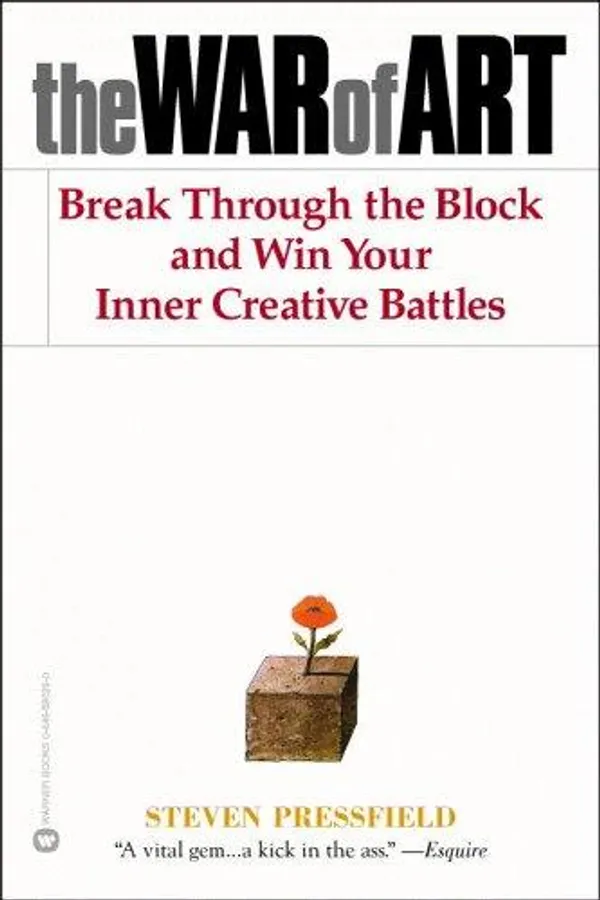
Book
The War of Art
Steven Pressfield
The force that stops serious work is internal, predictable, and hostile; Pressfield names it Resistance, and the only cure anyone has found is turning pro.
- TYPE
- Book
- SHELF
- Writing & Rhetoric
- TIME
- 13 min read
- ADDED
- 2026 · 07 · 07
- STATUS
- Completed
- IDEAS
Writing · Psychology · Philosophy
Why it matters
It gave the enemy a name and a set of habits; a named enemy can be planned against, and I plan against this one every morning.
Pressfield failed at the writing life for decades before anything was published, and this is the field report he brought back. Between the life a man lives and the work he knows he owes stands a single force. Pressfield calls it Resistance: internal, impersonal, universal, and aimed at any act that ranks the long term above the immediate, which is why it attacks diets and prayers as reliably as novels. It works through procrastination, drama, self-medication, and the criticism of others, and it retains rationalization as counsel. Its one gift is that fear is a compass: the project that frightens you most is usually the one that matters most. The cure is not inspiration but identity. The amateur becomes a professional, shows up daily, plays hurt, masters technique, and takes neither rejection nor applause personally. The last movement claims the labor is answered: begin, and forces Pressfield calls muses and angels lend a hand. Read that as psychology or as theology; the machinery runs either way. A drill manual, not a theory, and built for rereading before work rather than study after it.
- Resistance is internal and self-generated. Blaming circumstance, family, or era is one of its disguises; the enemy travels with you and knows your arguments in advance.
- Fear is a compass. The strength of Resistance around a project measures that project's importance to the person postponing it.
- Procrastination is Resistance's favorite instrument because it never says no: it schedules the work for tomorrow, indefinitely, and rationalization supplies the paperwork.
- Turning pro is a decision, not a talent. The professional shows up every day, works hurt, respects technique, and commits across years rather than weekends.
- The amateur over-identifies with the work and so cannot risk it. The professional serves the work like a trade and survives its failures.
- Orient by territory, not hierarchy: measure yourself by what the work returns for labor put in, never by your rank in an audience's eyes.
- Inspiration exists and is punctual: it arrives during work, never before it. Begin, and the help comes; wait, and it does not.
The argument
The premise is stated in the opening pages and never revised: nearly every person carries an unlived life, the book unwritten, the venture unfounded, the practice never begun, and nearly every person can explain the delay. Pressfield’s claim is that the explanations are cover stories for one force, and that the force can be studied the way a soldier studies an enemy: its aims, its habits, its preferred hours. He names it Resistance and capitalizes it, and the capital letter is the first argument. This is not a mood, not a circumstance, not a character flaw with your name on it. It is standard human equipment, as impersonal as gravity, and it activates whenever a man attempts to move from a lower state to a higher one. Art triggers it. So do enterprise, education, diet, prayer, and sobriety; the common element is any act that ranks the long term above the immediate. The evidence offered is the reader’s own history, which is why the book carries no footnotes and needs none. Pressfield’s authority is biographical: he failed at the writing life for decades, and the book reads like a report smuggled back from the years the failing took.
The first of the three movements is a field guide. Resistance is internal: blaming the spouse, the market, or the childhood is not an error the enemy corrects but a maneuver it performs. It is universal, which is a comfort of a cold kind: the blocked novelist and the relapsed dieter are fighting the same war. Its favorite instrument is procrastination, the perfect weapon because it refuses nothing; it only defers, one day at a time, until the days have quietly become the life. Its house counsel is rationalization, which supplies reasons that are true and beside the point. It recruits allies: drama, illness, self-medication, the endlessly absorbing troubles of other people; a man fleeing his own work can make himself heroically busy with rescue operations. It speaks through criticism too, since the venom a man directs at another’s work is often his own Resistance talking. And it has a public form: Pressfield’s aside on the fundamentalist, who retreats to a fixed past because the open future is unbearable, reads the whole posture as Resistance organized into a creed. Two properties matter tactically. First, Resistance is a compass: it concentrates around the acts that matter most, so the project you avoid hardest is, with uncomfortable reliability, the one you were built for. Second, it peaks at the finish: projects that survived years die in the final week, because the enemy fights hardest at the door it is about to lose.
The second movement is the cure, and its refusal to be clever is the content. There is no technique for defeating Resistance; there is a change of identity. The amateur, in Pressfield’s anatomy, is not a man without talent but a man who plays part-time and over-identifies. Because he is his gift, every risk to the work is a risk to his person, so he protects himself: he does not start, does not finish, does not show the work, and calls the protection by prettier names. The professional inverts each term. He shows up every day, whatever the weather inside him. He stays on the job all day and commits across years, not weekends. He masters technique, because inspiration cannot be scheduled and competence can. He plays hurt. He takes money seriously, not from greed but because payment is a discipline that burns off preciousness. Above all he declines to take results personally: rejection and applause are both weather. Pressfield retells the old Maugham anecdote about writing only when inspiration strikes, and arranging for it to strike on schedule each morning; the joke is the doctrine entire. Beneath the doctrine he places the Bhagavad Gita, cited as a source rather than an ornament: give yourself to the act, renounce the fruits. The renunciation is not piety. It is the only psychology that survives work whose rewards arrive years late or never.
The third movement pays the wage, and it is where the book stops being safe. Pressfield claims, with a straight face, that the effort is answered: sit down at the appointed hour and unseen forces move to assist. He calls them muses and angels and does not apologize. A modern reader can translate without losing anything that works: begin, and the unconscious takes up the problem; ideas arrive during labor because labor is the summons. The final distinction may be the book’s most durable. A man can orient by hierarchy, defining himself by rank, audience, and applause; or by territory, the work itself, which returns exactly what is put into it and cannot be flattered, bribed, or rushed. The gym is territory; so are the desk, the darkroom, the practice field. Hierarchy places the artist’s center of gravity in other people’s heads, which is rented ground. Territory returns it to him. The book closes the way drill manuals close: nothing in it is to be admired or debated. It is to be executed tomorrow morning, and again the morning after, and that is the entire teaching.
Working notes
The book’s whole value is a christening. Before it, the fog between intention and execution was weather: private, shapeless, and apparently mine alone. After it, an enemy with habits, and habits can be anticipated. Half of tactics is knowing what the other side will do; the other half is admitting there is another side. Most productivity literature fails because it treats the problem as logistical. Pressfield treats it as adversarial, and the adversarial frame is the one that matches the experience of any man who has watched himself, in full possession of the facts, choose the lesser task again.
One observation the book made possible but does not contain: Resistance tailors its costume to the man. For the lazy it dresses as comfort and is easily seen. For the disciplined it dresses as discipline: more research, better tools, a cleaner system, one more rehearsal before the real attempt. The diligent man’s Resistance is indistinguishable from diligence except by a single test: does it postpone contact with the work itself? Sharpening the scythe is work until the field is ready. After that it is theater.
A second observation from use: the enemy garrisons thresholds. Starting costs; finishing costs; the middle is strangely cheap. I have learned to distrust my own ease in the middle of anything, because ease usually means the next threshold is near and the enemy is saving its strength for the door.
Seneca’s essay on the shortness of life and this book are one argument at two altitudes. Seneca counts the stolen years and indicts the thieves: other men’s demands, preoccupation, postponement. Pressfield names the inside agent who unlocks the door for them. The preoccupied man of the essay and the resisted man of this book are the same man: busy, scheduled, well regarded, and absent from his own life.
Musashi reaches the professional from the opposite direction: not up from failure but down from a lifetime of duels. His register contains no enemy within, only practice; where Pressfield requires a war, Musashi requires a Way, and the difference is temperament, not truth. Beneath both sits the Gita, which Pressfield has the sense to acknowledge openly: act with full force, renounce the fruits. The professional is Arjuna with a trade. The fight is his; the outcome never was.
And from the photography shelf, Adams agrees without raising his voice: the vocation runs on habits, not inspiration, and the nights the light gives nothing are the practice, not its failure. Two writers with no shared vocabulary, one doctrine. When independent witnesses agree, the testimony is probably true.
Where I push back
The compass claim is the book’s best gift and its deepest flaw, because it is unfalsifiable. Fear does gather around the work that matters; fear also gathers around genuine mistakes: the wrong partnership, the doomed venture, the book that should be written by someone else. Pressfield’s instrument reads both as true north. Once every hesitation is Resistance, no project can ever be judged misconceived, and every retreat becomes cowardice by definition. But some retreats are intelligence, and some abandoned projects are the best decision in a working life. The book is right about the enemy. It has no theory of the days the enemy is right.
It also has no doctrine of rest. Fallow seasons, sleep, the deliberate closed period: every durable practice depends on them, and the book’s logic quietly criminalizes each one. A reader who cannot stop will use these pages to strip-mine himself and call the extraction virtue. Hustle culture did precisely that at industrial scale, turning a war book written for the paralyzed into a whip for the exhausted. That is a misreading, but the book invites it by arming one side of the soul and disarming the other.
And Resistance explains the first decade better than the third. Early on, the obstacles really are mostly internal, and the doctrine is exact. Past a certain point the obstacles are real: markets, money, bodies, the arithmetic of a finite day. Calling all of it Resistance flatters the will and insults the arithmetic. The muses have the same problem read literally: what works as a psychology of beginning becomes, in credulous hands, a mysticism about output. Pressfield would likely accept the translation into psychology. Some of his readers refuse it, and they are the ones who quote him most.
How it enters the work
The practical residue is one question, asked at the start of the working day: what am I avoiding hardest? The answer arrives fast, is rarely welcome, and names the day’s real work more reliably than any planning system I have used. Everything else the book changed follows from asking it daily.
Photography is where I meet Resistance in its purest concentration, because the practice looks optional. No client waits for a lighthouse frame; nothing visibly breaks if the tripod stays home. Resistance specializes in optional work, which is exactly the work that decides what a life amounts to. So the dusk hours are defended in advance, on the calendar, like a shift: hours that negotiate with mood are hours the enemy already owns. What use taught me is where the fighting happens. It happens in the doorway: the gear check, the drive out, the first cold minutes of scouting. Once the tripod is set and the long exposure is running, the enemy goes quiet; the stillness a four-minute frame enforces is territory it cannot enter. The battle is never at the work. It is always at the threshold of the work.
Solitude is the arena, and the book explains why solitude is difficult in a way that praise of solitude never does. Alone, Resistance must fight without reinforcements, so it argues hardest against your being alone at all. Company, errands, the phone’s small garrison of allies: all of it arrives precisely when the serious work is scheduled. Part of my standing interest in solitude and self-command is this tactical understanding: the work happens where the enemy is cut off from its supply lines.
And the professional’s refusal to over-identify turned out to be load-bearing armor. A fine-art practice that submits to galleries is a rejection business; the juries owe nothing and explain less. Territory, not hierarchy: the print returns exactly what the labor put into it, whatever the jury said, and the next frame is unaffected by the verdict on the last. That single reorientation has kept more work alive than any technique in the bag. Pressfield did not teach me to photograph. He taught me to keep showing up to it, which turned out to be the scarcer skill.
- Ask each morning what you are avoiding hardest; the answer is usually the day's real work.
- Schedule the work like a shift. Hours that negotiate with mood are hours Resistance already owns.
- Audit your prudence: the most dangerous rationalizations are the reasonable ones.
- Hold the work as territory, not identity; then rejection is information instead of injury.
- Expect the enemy to be strongest at the start and at the finish; guard the last mile deliberately.
- Start before you feel ready. Readiness is a feeling, and Resistance controls the feelings.
The central concept is unfalsifiable: once every hesitation is Resistance, no project can ever be judged misconceived, and the compass cannot tell a calling from a folly. The book has no doctrine of rest, so the reader who cannot stop turns it into a whip and calls the self-harm professionalism. And the muses, taken literally, mystify what is finally a labor problem. Use the enemy's name; keep your own judgment.