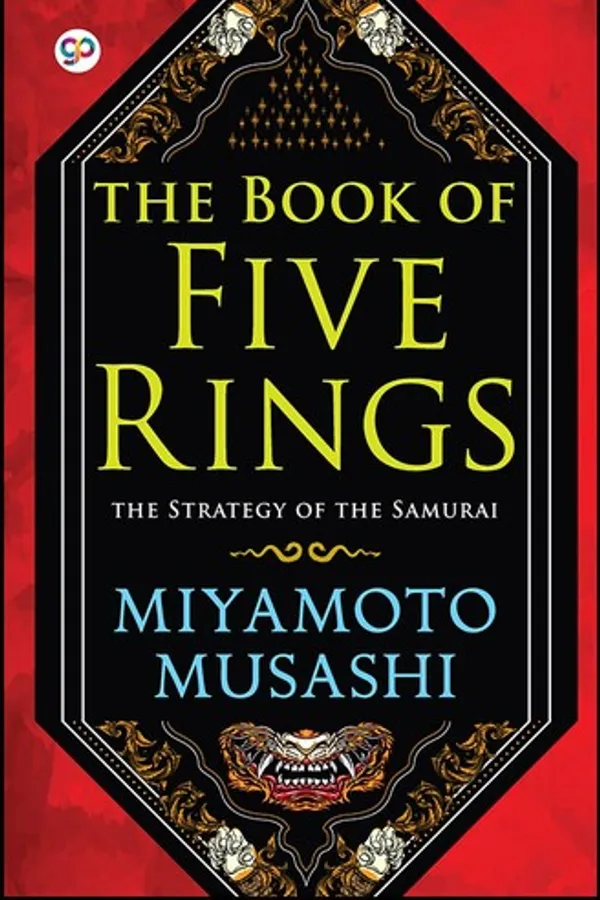
Book
The Book of Five Rings
Miyamoto Musashi
Victory is a trainable state, not a stock of techniques: rhythm, perception, and initiative decide the fight before the cut, and what one discipline teaches, all disciplines confirm.
- TYPE
- Book
- SHELF
- Philosophy & Self-Command
- TIME
- 13 min read
- ADDED
- 2026 · 07 · 07
- STATUS
- Completed
- IDEAS
Philosophy · Strategy
Why it matters
The shortest serious book on winning that I own, written by a man whose method was audited by death and never returned a loss.
In his last years, withdrawn to a cave near Kumamoto and within reach of death, Miyamoto Musashi wrote down what sixty undefeated duels and the decades of training that followed them had taught him, addressing it to a student and refusing, by his own account, to lean on Buddhist doctrine, Confucian texts, or old war chronicles. The result is five scrolls. Earth lays the foundation: strategy as a craft like carpentry, the warrior obliged to know his tools and use everything he carries. Water shapes the practitioner: posture, grip, footwork, the gaze that perceives the whole field rather than staring at the sword, and stances learned precisely so they can be dissolved. Fire is combat itself: the three ways of taking initiative, becoming the enemy to count his constraints, breaking his rhythm and finishing without pause. Wind audits the rival schools and finds them selling ornament: extra-long swords, secret techniques, flowers instead of fruit. The Void closes in a few pages: emptiness not as mystery but as unobstructed action, perception and act made simultaneous by training that has removed all confusion. The claim throughout is transfer: the Way seen truly in one thing is seen in ten thousand.
- Rhythm is the master variable: everything has rhythms of rising and decaying, and the fight is won by reading the enemy's rhythm, acting in its intervals, or breaking it outright.
- Perception beats sight: the wide gaze that takes in the whole field defeats the stare fixed on the flashing object, holding distant things close and close things at a distance.
- Become the enemy: think from inside his position and count his constraints, because most of what reads as his strength is his fear arranged to face you.
- Initiative has three modes, striking first, drawing the strike and countering, and meeting force in the instant, and all three are one doctrine: the lead is taken, never granted.
- The Void is not mysticism but unobstructed action: when training has removed delusion, knowledge of what exists reveals what does not, and the response arrives without deliberation.
The argument
The circumstances of composition are the first argument. Old and sick in his final years, Musashi had withdrawn to the Reigandō cave near Kumamoto, and by 1645, close to death, he completed a short treatise there for his student. He states his credentials in the opening pages without ornament: first duel at thirteen, more than sixty contests thereafter, never once defeated. Then he states the harder thing: reflecting on that record around the age of thirty, he concluded that his wins proved less than they appeared to, owing perhaps to aptitude, or to the weakness of the other schools, rather than to understanding. So he trained on, morning and evening, for roughly twenty more years before he judged that he had reached the Way. A man who doubts his own perfect record is conducting epistemology, not autobiography; knowledge, for Musashi, is what survives contact, and then survives suspicion of the contact’s meaning. He borrows no scripture and cites no chronicles, which leaves the book resting on nothing but tested practice, and reading it you feel the absence of cushioning the way you feel a bare floor.
The Earth scroll lays the foundation with a craftsman’s analogy. Strategy is a trade like carpentry: the foreman must know the qualities of his timbers and his men, assign each according to grain, and keep his tools sharp; soldier and carpenter alike are judged by the work. The warrior should be able to use every weapon he carries, in either hand and at any distance, and should regret dying with a blade left idle at his side; the two-sword method that named his school exists not as flourish but to make both hands educated. And the scroll closes with rules for study that compress the whole book: think honestly, train without pause, touch many arts, distinguish gain from loss, develop the eye that perceives what is not visible, attend to trifles, and do nothing that is of no use.
The Water scroll shapes the instrument, which is the man. Posture, grip, and footwork are specified with the exactness of a machinist, but the scroll’s center is the gaze: perception must be broad and calm, taking in the whole field, holding distant things as if close and close things as if at a distance, and never fastening on the enemy’s sword, because the stare is a leash. The five stances are taught and then demoted: they exist to teach the lines along which a cut can travel, and the mature practitioner holds stance no-stance, position without commitment, from which anything can follow. The scroll’s most quietly radical instruction is continuity between combat and life: make the everyday body the combat body and the combat body the everyday body, so that nothing about the encounter is special and nothing needs to be summoned.
The Fire scroll is the fight. Initiative comes in three modes, attacking first, drawing the enemy’s attack and taking him in it, and meeting his attack in the same instant, and the three are one teaching, that the lead belongs to whoever takes it and is never granted. Commitment is total but not reckless: he compares the decisive entry to a captain crossing a strait, undertaken only with the winds and tides known, and then undertaken wholly. The psychological instruments are the scroll’s real cargo: become the enemy, thinking from inside his situation until his apparent menace resolves into a man with constraints and fears facing yours; break his rhythm, acting in the intervals of his timing; and when his rhythm falters, collapse him, pursuing the advantage instantly and completely so that no recovery is possible, because an enemy allowed to recover has been taught, not beaten. When a method fails twice, he says, do not try it a third time; change like mountain and sea, since nothing informs an opponent faster than repetition.
The Wind scroll is an audit of the competition, and a theory of why schools go bad. Other traditions favor extra-long swords, purchasing advantage at one distance and bankruptcy at another; or they worship strength, or speed, or the accumulation of techniques, or they sell secret inner teachings to students hungry for mystery. His verdict is a merchant’s: they are cultivating flowers instead of fruit, and in strategy there is no inner gate and no outer, no hidden curriculum, only shallow training and deep. The scroll teaches the study of rivals as self-diagnosis; you learn the shape of your own school by walking the perimeter of theirs.
The Void scroll runs a few pages and refuses to be the mystical payoff the structure seems to promise. Emptiness, for Musashi, is not a metaphysical claim; it is the condition of the trained man, in whom delusion and hesitation have been removed and perception issues in action without an intermediate step. By knowing thoroughly what exists, technique, rhythm, distance, the enemy, one comes to know what does not. Where the mind holds no cloud, he says in effect, the sky is simply sky, and the book ends not with a secret but with an instruction it has given twenty times already: train.
Working notes
Read against Hagakure, this book gains its edge. Tsunetomo was a courtier who never drew a blade in earnest, and his way of death is a devotional mood, magnificent and unfalsifiable; Musashi’s every sentence was refereed by men trying to kill him. One book is a temperament, the other a method, and the difference shows in their treatment of dying: Hagakure embraces death as identity, Musashi studies it as an opponent’s constraint and his own. I keep both on the shelf, but I only take orders from one of them.
Sun Tzu is the complementary intelligence. The Art of War is the general’s economy, war decided before contact by position, information, and logistics; Musashi is the duelist’s phenomenology, what remains when contact arrives anyway. A working life needs both books: Sun Tzu for the quarter, Musashi for the ten seconds. The difference in scale conceals an identity of doctrine: both insist the fight is won by the one who sets its terms, and both regard the requested fair fight as a contradiction no serious practitioner should honor.
Mark Douglas, three and a half centuries later, rewrote the Water scroll for traders without knowing it. Trading in the Zone is stance no-stance as market posture: no bias carried into the open, no attachment to the last trade, probability accepted in the body rather than argued in the head. What Douglas calls the zone, Musashi calls the Void, and both writers, to their credit, refuse to mystify it: it is the residue of training, available to anyone willing to do a boring thing daily for years. The convergence is the best evidence for Musashi’s largest claim, that the Way seen in one discipline is the Way seen in all.
I qualify the claim with one condition his arena enforced invisibly: transfer holds where feedback is honest. Dueling, trading, and photography qualify; the cut lands or it does not, the position pays or it does not, the print holds or it does not. In domains where feedback is social, committees, politics, most of corporate life, the ten thousand things do not confirm the one thing, they confirm whoever controls the scorekeeping. Musashi’s epistemology assumes a referee that cannot be lobbied. Choose arenas with that referee, and his book works; choose without it, and the book’s confidence becomes a costume.
His rule about repetition deserves its own note: fail twice, change entirely. Most practitioners escalate instead, running the failed method harder, because abandoning it feels like abandoning the self that chose it. Musashi’s indifference to his own previous choices is the deepest discipline in the book.
Where I push back
A perfect record is evidence, but the dead filed no rebuttals. Sixty victories tell us Musashi was formidable; they cannot tell us how much was method and how much was selection, since a duelist of his era chose his fights, and the losers of the period wrote no scrolls. To his honor, the book’s opening makes the same objection against himself, and his answer was twenty more years of training rather than a better story. The reader should extend the suspicion further than Musashi does: the most famous duels, the island meeting he is said to have won with a carved oar among them, come to us encrusted in legend, and a book of method should not borrow authority from stories its author never verified in ink.
The amorality is not a gap; it is a wound. The book optimizes victory and is silent about what deserves it, and the silence is total: no account of when not to fight, no just cause, no obligation to anything but the Way. Hagakure, for all its morbidity, at least binds the sword to service. Musashi’s blade serves the blade. The book contains no friendship, no family, no rest, and no laughter, and the omission is the invoice: this is what a life optimized for a single referee costs, presented without regret by a man who paid it in full. Read as physics, the book is nearly flawless; read as a life, it is a warning it never intends.
And the transfer to modern arenas misleads exactly where it is most quoted. Dueling is single-shot with total downside; markets and business are iterated games with memory. The doctrine of collapsing an opponent utterly is correct where no one returns, and corrosive where everyone does: counterparties remember, reputations compound, and the man who wins every negotiation like a duel finds, in a few years, that no one will stand across from him. The executives who cite Musashi most warmly tend to borrow the ruthlessness and skip the training, which inverts the book: the ruthlessness was downstream of thirty thousand hours, and without them it is only temperament with a reading list.
How it enters the work
Trading is where the book earns its keep daily. Rhythm is the working discovery: markets breathe in rhythms of rising and decaying conviction, and timing is a separate skill from analysis, drilled separately, exactly as he says; a correct thesis entered against the rhythm is a losing trade with good grammar. The three initiatives map onto entries: act first on your own signal, draw the move out and counter it, or meet the break in the instant, and in all three the lead is taken, never granted by the market. Become the enemy is the underwriting instrument: most price action that reads as menace resolves into other men’s constraints, forced sellers, trapped longs, mandates expiring, fear arranged to face you. And the weapons doctrine governs the firm: a desk that bridges traditional finance and digital assets can afford no instrument religion, no venue loyalty, no attachment priced at zero; everything is judged by whether it cuts, and a favorite is a leak.
Photography takes the Water scroll nearly whole. The gaze is the craft: perceiving the field rather than staring at the subject is the difference between a frame with structure and a postcard, and holding distant things close and close things at a distance is a serviceable description of how a long exposure is composed, the far structure gripped, the near incident released. Stance no-stance is how I arrive at a location now: no preset composition carried up the trail, the structure allowed to announce itself, and then execution running on technique trained past the need for thought, the camera operated without deliberation, because attention spent on the instrument is subtracted from the seeing.
Self-command is the scroll under the scrolls. Make the everyday stance the combat stance: the discipline is not summoned for occasions, it is the resting state, trained in trifles precisely so that nothing about the decisive moment is special. That instruction, kept daily, is worth the rest of the book. Do nothing that is of no use is carved over the door of every practice I run; I fail it weekly, and I have stopped expecting to retire the standard. A thousand days to forge, ten thousand to polish: the arithmetic is the mercy in this merciless book, because it means the Way is not a talent. It is a schedule.
- Train the principle until the checklist disappears; still needing the checklist under stress is the signal to keep training.
- Read the rhythm before acting: timing is a separate skill from analysis and must be drilled separately.
- Keep no favorite instruments; an attachment is a position you did not choose and cannot price.
- Widen the gaze: attend to the whole field, not the flashing object in front of you.
- Strike everything useless from the practice, then strike again.
This is a manual written by a professional killer, and it optimizes winning while staying silent on what deserves to win; the reader must supply the ethics, because Musashi will not. The corporate adoption of the book is mostly costume, and its terseness makes it a mirror: readers project their own ideas onto it and then cite Musashi as authority. And dueling is a single-shot game while most modern arenas are iterated; the doctrine of finishing an opponent utterly misleads wherever reputations persist and counterparties return.