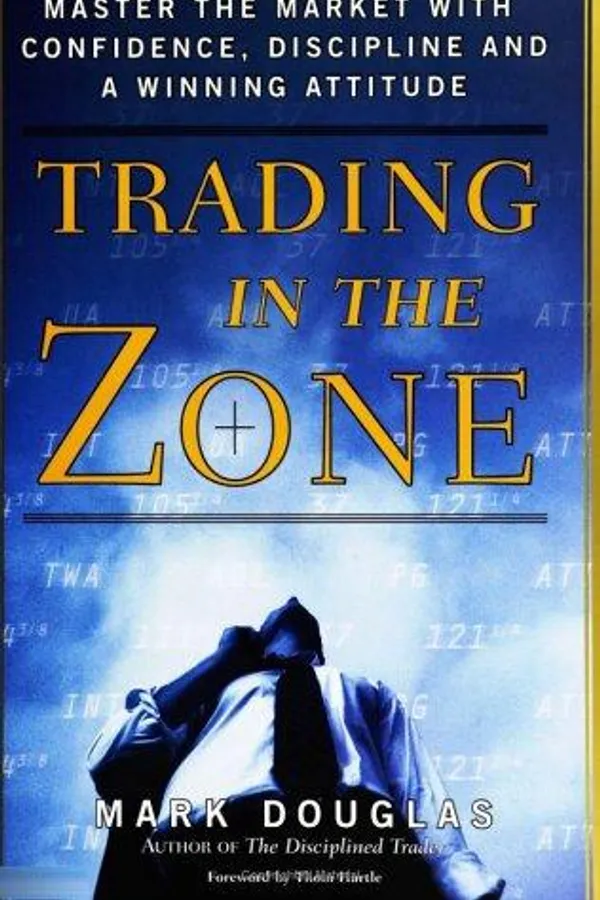
Book
Trading in the Zone
Mark Douglas
Your method produces signals and your state of mind produces results; Douglas moves the trader's whole attention from predicting the market to executing an edge without fear.
- TYPE
- Book
- SHELF
- Trading & Markets
- TIME
- 13 min read
- ADDED
- 2026 · 07 · 07
- STATUS
- Completed
- IDEAS
Markets · Psychology
Why it matters
It is the treatment manual for the disease every other market book only describes: knowing the right thing and being unable to do it.
Douglas begins from an uncomfortable industry fact: analysis has improved for decades and the failure rate of traders has not moved, so the limiting factor cannot be information. His diagnosis is that markets place an untrained mind in the one environment it is least built for: unlimited freedom, no external structure, permanent uncertainty, and random reinforcement, where the same behavior is sometimes paid and sometimes punished. The mind responds by defending itself, filtering what it sees to avoid the pain of being wrong, and the defenses produce the standard errors: hesitation, chasing, winners cut early, losers held to ruin. The cure is not better prediction but a rebuilt relationship with probability. An edge is only a higher likelihood of one outcome over another; wins and losses inside an edge arrive in random order; any single trade can lose; every moment in the market is unique. A trader who holds those truths in his body rather than his head has nothing to fear from any individual outcome, and can execute without hesitation or residue. Consistency, Douglas insists, is not a streak of results. It is a state of mind, built deliberately, through mechanical repetition, until probabilistic thinking stops being an idea and becomes a reflex.
- Anything can happen: every price requires only one counterparty with different beliefs and sufficient size, so no analysis, however good, removes the risk from a single trade.
- You do not need to know what will happen next to make money; an edge is nothing more than a higher probability of one outcome over another, and it pays only across a series.
- Wins and losses within any edge are randomly distributed; demanding the pattern of the aggregate from each individual trade is the root error from which the others grow.
- The market does not generate painful information; the trader's unaccepted risk does. What you cannot afford to feel, you will refuse to see, and the refusal is expensive.
- Risk is accepted only when a loss can pass through you without residue: no hesitation on the next signal, no revenge, no need to win it back.
- Consistency is built mechanically before it is felt: a fixed edge, executed identically across a sample of twenty trades, judged only at the level of the sample.
The argument
Douglas opens with the observation that indicts the whole industry: the analytical tools available to traders improved beyond recognition across his career, and the proportion of traders who fail did not move. Better information should have collapsed the failure rate. It did not, so the limiting factor is not information, and every dollar spent sharpening analysis past that point is spent on the wrong variable. His earlier book, The Disciplined Trader, staked out this territory; Trading in the Zone builds the working protocol on it. The gap that matters is not between the trader and the market. It is between what the trader knows and what he can actually execute, and that gap is made of feeling, not fact.
The diagnosis is environmental. Markets are the one arena that combines unlimited freedom with permanent uncertainty and then adds random reinforcement: the same behavior is sometimes paid and sometimes punished, on no schedule the nervous system can learn. Ordinary life trains us badly for this. Everywhere else, being wrong is made expensive and rare, so the mind builds its architecture around avoiding it; error is a verdict on the self. Carry that architecture into a market and it turns perception itself into a defense system. The trader in a losing position does not see the market; he sees the threat to his self-image, and the mind, protecting him, edits the evidence. This is where the four standard errors come from, and Douglas is precise about the mechanism: hesitation is fear of repeating the last loss; chasing is fear of being left out; cutting winners early is fear of giving back; holding losers is fear of making the loss real by taking it. None of these are analytical failures. They are a sane mind doing its normal job in the one environment where its normal job is ruinous.
The cure is a rebuilt relationship with probability, and Douglas compresses it into a set of plain truths he wants installed as reflexes. Anything can happen, because prices move on other participants’ beliefs and size, and no analysis holds jurisdiction over another man’s decision to sell. You do not need to know what will happen next to make money, because an edge is nothing more than a higher probability of one outcome over another, and it delivers only across a series of trades. Within that series, wins and losses arrive in random order, so no individual outcome carries information about the trader’s worth or the method’s validity. And every moment in the market is unique: the pattern may repeat, the participants holding it do not, so the certainty the mind demands from resemblance is counterfeit. A trader who genuinely holds these truths has nothing left to fear from any single trade, and a trader who fears nothing from a single trade has no reason to hesitate, chase, or hold.
The casino is the book’s governing figure, and it is exact rather than decorative. A casino owns a small, fixed edge and is completely indifferent to any individual hand; it does not read the gambler’s hot streak as meaning, because it operates at the level of the sample, where its arithmetic is law. Douglas asks the trader to become the house: same edge logic, same indifference, same refusal to let any single outcome reach identity. Every losing trader can recite that losses are part of the game; the recitation is the head’s acceptance, and trading runs on the body’s. Risk is accepted, in Douglas’s strict sense, only when a loss can pass through without residue: no flinch before the next signal, no compulsion to win it back, no story afterward. Until then, the trader has not accepted risk; he has memorized a sentence about it.
The protocol for getting there is deliberately mechanical. Take a defined edge, any honest one. Trade it in samples of twenty, executing every signal identically, with risk pre-accepted and exits predefined, and forbid all judgment except at the sample’s end. The exercise is not for profit; it is for evidence. Twenty trades executed without deviation give the mind proof that randomness within the series is survivable, that the edge pays at the aggregate, and that no single loss meant anything; and beliefs, Douglas holds, are rebuilt only by this kind of experienced evidence, never by argument. Discipline is scaffolding, borrowed structure holding the trader to the method while the new beliefs cure underneath it. He names three stages, mechanical, subjective, intuitive, and insists on their order: intuition is the reward of the mechanical stage, not a substitute for it. The zone of the title is simply the far end of the process: a state without fear and without euphoria, where the trader perceives what the market offers because nothing in him needs it to be otherwise.
The argument travels well beyond its packaging, and the packaging is a seminar: promises on the cover, repetition in the chapters, a workbook’s cadence throughout. The notes below have to hold both the doctrine and its salesmanship.
Working notes
Lefèvre supplies the case histories; Douglas writes the protocol. Reminiscences shows hope and fear transposed in their natural habitat, narrated with charm and left untreated; Douglas takes the same transposition and builds the clinical procedure for reversing it. Reading them close together is the useful shock: seventy years of technological revolution between the two books, and the patient presents with identical symptoms. Whatever the market’s instruments become, the organism trading them arrives unchanged.
The deepest thing in the book is the point about random reinforcement, and it deserves more fame than the five truths. A machine that pays bad behavior occasionally is the most efficient trainer of superstition ever built; markets are that machine at planetary scale. Every trader carries habits that were reinforced by a payout that had nothing to do with the habit, and undoing them requires exactly what Douglas prescribes: sample-level accounting, because only the sample separates the behavior from the noise that occasionally rewarded it. I have come to read most trading folklore, mine included, as archaeology of old reinforcements.
Douglas stands closer to Epictetus than to any market writer, which is why Discourses sits beside him on this shelf. The dichotomy of control, drilled daily by the Stoics, is his entire architecture translated into position language: entries, exits, size, and state are within the trader’s command; the outcome of any single trade is not, and suffering begins at the exact point where you demand command over the second category. Douglas never cites the Stoics and does not need to; he reinvented the drill because the problem is permanent. What he adds that antiquity lacks is the reinforcement schedule: a specific, countable exercise for moving a belief from the head to the body.
The body is where the book proved itself to me. Acceptance in the head is cheap and always available; the tell is physical. Breath held at entry, the cursor hovering over a position that does not need managing, the check of a price that answered itself an hour ago: each one is unaccepted risk reporting for duty. I learned to read these signals as instrumentation; my notes on Reminiscences treat excessive checking the same way, as a sizing tell. The state Douglas describes is real and reachable, and its arrival is unmistakable: the trade becomes uninteresting, and the execution becomes exact.
On rereading, the repetition that irritated me the first time reads differently. Douglas is not informing; he is conditioning, saying the same small set of things in slow variation because that is how beliefs are actually replaced. The book practices its own theory on the reader. That is either a defense of the prose or the most charitable possible description of it; I hold both.
Where I push back
The book’s silence on expectancy is not a gap; it is a structural hazard. Every exercise in it presupposes an edge that pays, and Douglas spends almost no ink on how a trader would come to know, statistically, that his edge is real rather than remembered. The machinery is indifferent to what it is fed: give it a genuine edge and it produces a professional; give it a curve-fit illusion and it produces a man executing his ruin with beautiful consistency, sample after sample, fear conquered, account bleeding. The psychological cure and the analytical illness are separable problems, and the book’s confidence blurs the separation. It should have said, once, plainly: none of this matters until the arithmetic is proven, and proving it is a different book.
Second, sizing is missing, and sizing is half of survival. A trader can hold every Douglas truth in his body and still be destroyed by risk of ruin, because indifference to individual outcomes is only rational at sizes where the losing streak, which the random distribution guarantees, is survivable. Douglas gestures at pre-accepted risk and stops; the mathematics that would make the acceptance honest never arrives. The minimum is plain arithmetic: win rate and payoff imply a worst plausible streak, the streak implies a maximum fraction of equity per trade, and the book asks for neither number.
Third, the hard separation of psychology from analysis flatters exactly the reader who should not be flattered. Some traders fail because fear corrupts a sound method; the book is written for them and serves them well. Others fail because the method is empty, and this book hands them a more comfortable explanation: the system is fine, the mindset needs work. For that reader, every reread is another season of consistent losses reframed as spiritual progress. A book about self-deception should have guarded its own exits better; it built a doctrine against denial with one door left open to it.
How it enters the work
The desk rule that came directly from this book is written where I can see it: no order until the invalidation and the size are in the journal, and the loss is pre-accepted as a cash number, not a percentage. Percentages are how the head accepts risk; cash is how the body does. If the number produces a flinch, the size is wrong, and the size gets changed before the entry does. This single mechanical gate has removed more error from my trading than any analytical improvement in the same years, which is Douglas’s opening statistic reproduced on a sample of one.
The sample of twenty became the unit of self-judgment. The journal grades execution, not outcome: each trade is marked for whether the plan was followed, and the P&L is reviewed only at sample boundaries. The effect Douglas promises arrived on schedule: individual losses lost their voltage, because the frame in which they meant something was removed, and the frame turned out to be the whole problem. Trades taken outside the plan are logged in their own column, whatever their result; a profitable violation is still a violation, and paying yourself for one is training the wrong animal, which is the random-reinforcement lesson applied with the fur still on.
The state itself is trained, not summoned, and this is where the book joined a longer discipline. Self-command in the moment of execution is downstream of a hundred rehearsals nobody sees: the routine before the session, the same checklist in the same order, the deliberate reduction of everything discretionary in the minutes around an entry. Douglas taught me to treat composure as infrastructure, built in advance and maintained on a schedule, rather than as a virtue to be exhibited under fire. The Stoics on this shelf run the same doctrine at the scale of a life; Douglas runs it at the scale of a fill, and a man who cannot hold it for a fill is unlikely to hold it for a life.
The protocol has since leaked, usefully, into everything the desk touches: judged at the sample, executed by the plan, feelings logged as instrumentation rather than obeyed as commands. Probability accepted in the body turns out to be a general-purpose skill. Markets are simply the room that tests it daily.
- Define the edge, the risk, and the exit before entry; execution is the only place discipline actually exists.
- Trade in samples of twenty; judge the sample and refuse to judge the trade.
- Pre-accept the loss in cash terms before the order goes in; if the number is unacceptable, the size is wrong, not the market.
- Treat hesitation and revenge as data: each one marks a belief that has not yet caught up with the method.
- Stop asking to be right; ask to be consistent, and let the edge do the arithmetic.
The book presupposes the one thing it cannot supply: an edge with positive expectancy. Its machinery installs consistent execution into whatever it is given, and consistent execution of a losing method is a metronome for ruin. Douglas is also nearly silent on position sizing and the mathematics of risk of ruin, and his seminar-bred prose repeats itself past the point of patience. Read it after the method exists, never instead of one.