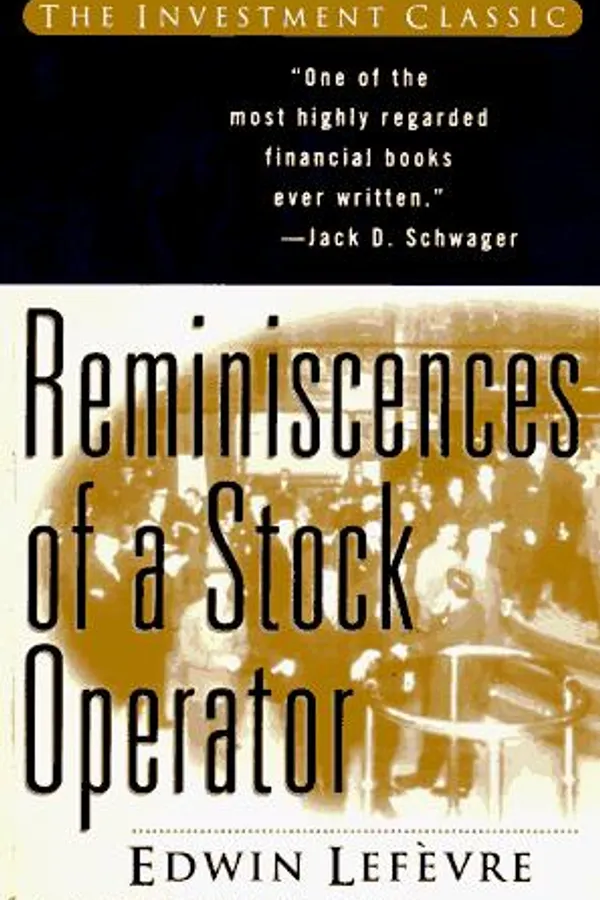
Book
Reminiscences of a Stock Operator
Edwin Lefèvre
The market has not changed in a century because the crowd has not; a man's account is the ledger of his character, and both were legible in 1923.
- TYPE
- Book
- SHELF
- Trading & Markets
- TIME
- 13 min read
- ADDED
- 2026 · 07 · 07
- STATUS
- Completed
- IDEAS
Markets · Psychology · History
Why it matters
Every expensive lesson I have taken from a market is somewhere in this book, priced in 1920s dollars; rereading it is cheaper than relearning it.
Lefèvre's thinly fictionalized life of Jesse Livermore follows a boy who starts reading the tape in New England bucket shops and rises, through several fortunes and several ruins, to the largest speculative operations of his era. The machinery is antique: tickers, pools, margin in a manila envelope. The content is not. The narrator's education proceeds loss by loss toward a small set of permanent findings. The big money is not in the reading of the tape but in the sitting; a man can call the move correctly and still lose, because being right and staying right are different skills. Markets run on hope and fear misapplied: the amateur hopes when he should fear the loss growing and fears when he should hope the profit runs. Tips are how wealth transfers from the impatient to the patient. And the speculator's real enemy books no commissions: it is his own need for action. The book endures because it is not a system but a mirror, and the reflection has not aged a day.
- It was never my thinking that made the big money; it was the sitting. Correct analysis is common, and holding through the discomfort of being right is rare.
- There is only one side of the market: not the bull side or the bear side, but the right side. Loyalty to a direction is vanity wearing a thesis.
- The amateur inverts hope and fear: he hopes a loss will recover and fears a profit will vanish, so he cuts his winners and keeps his losers.
- Prices move along the line of least resistance. The speculator's work is locating that line and waiting for the market itself to confirm it before size follows.
- Tips are morally corrosive both ways: taking them outsources judgment, and needing them reveals a position sized past understanding.
- The trader's costliest impulse is the need to act daily; the market pays for discrimination, not attendance.
- A man must know himself thoroughly before markets become tradable at all, because every weakness of character will be located by the market and invoiced.
The argument
The book wears the costume of a rags-to-riches memoir, and the costume misleads. A boy with a gift for arithmetic starts posting quotes in a Boston bucket shop, notices that prices move in patterns before news explains them, and begins betting the patterns. The bucket shops ban him for winning. He goes to New York, loses everything, and makes the first of the book’s real discoveries: the game is not one game. Scalping fluctuations in a bucket shop, where fills are instant and the tape is the whole world, is a different profession from speculating in a real market, where size moves prices and time is a position. Every ruin in the book, and there are several, is the tuition for one of these distinctions.
The education advances through named characters who are really named temptations. Old Partridge, mocked as Turkey by the office boys, answers every plea for advice with the same sentence, that it is a bull market, and the narrator eventually understands the sentence is not laziness but the whole doctrine: in a confirmed trend, the position is the analysis, and the man who trades in and out to be clever will miss the move he correctly predicted. This is where the book plants its most quoted flag, that the big money was never in the thinking but in the sitting, and it is worth noticing what the claim actually says. It does not say analysis is worthless. It says analysis is the cheap half. Conviction held through drawdown, held through the newspapers, held through the friend with the tip, is the expensive half, and almost no one pays for it willingly.
The bucket-shop apprenticeship deserves more attention than readers give it, because it explains the narrator’s entire epistemology. In a bucket shop, the bet settles against the printed quote: no slippage, no market impact, no time between decision and fill. It is a laboratory of pure pattern, and the boy trained in it emerges with a laboratory instinct, hypotheses tested against price alone, small stakes until the pattern confirms, no loyalty to any opinion the tape declines to ratify. His first New York failure is the discovery that real markets add friction the laboratory lacked, and his response is the book’s model of professional behavior: he does not blame the game. He goes back, studies the difference between the game he mastered and the game that beat him, and rebuilds his method around execution, timing, and the cost of size. Most traders never perform that autopsy even once. The narrator performs it after every ruin, and the ruins are the syllabus.
The middle of the book is a taxonomy of self-sabotage that reads like a clinical text with better prose. The amateur hopes when he should fear: the position is losing, the loss is information, and he converts it to hope and holds. He fears when he should hope: the position is winning, the trend is information, and he converts it to fear of giving back and sells. So he systematically keeps his errors and liquidates his insights, a portfolio constructed by his nervous system against his own interest. Tips get a full anatomy: the tipped man loses either way, because if the tip fails he has a loss without a lesson, and if it works he has a profit without a process, which is a loan the market will collect with interest. The narrator, by then rich, still takes one late in the book, from a cotton king with beautiful conviction, and loses millions on it: the point being that immunity is never conferred, only practiced.
The last movement is about manipulation and scale, running pools, marking up stocks for distribution, the mechanics of moving size through thin markets, and modern readers skip it as period crime. Skip less. The machinery is illegal now; the underlying physics, that size must be accumulated and distributed against the crowd’s emotion, that the operator’s job is to make liquidity appear where he needs it, is the daily business of every large fund’s execution desk, sanitized into algorithms. Lefèvre is describing market impact before the term existed. And running beneath all of it is the book’s actual thesis, stated plainly near the end: the speculator’s enemies are ignorance, greed, fear, and hope, and of these only ignorance is curable by study. The other three are curable, if at all, only by a man’s full knowledge of himself. The market is a machine for locating the part of you that you have not yet audited, and it never misses.
Working notes
The book pairs with Trading in the Zone as diagnosis pairs with treatment. Lefèvre shows the disease in its natural habitat, hope and fear transposed, the itch for action, the tip as moral hazard; Douglas, seventy years later, builds the clinical protocol for it, probabilistic thinking installed as reflex. Read in that order, the century between them demonstrates the thesis: the instruments changed completely and the patient not at all.
What the book taught me that no risk textbook did is that position size is an epistemological claim. A position you cannot hold through normal noise is a statement that you know more than you do; the market will price that statement accurately. The narrator’s ruins are all, at root, size errors wearing thesis costumes. When I find myself checking a position with a frequency out of proportion to its thesis horizon, that is the tape telling me the size is wrong, and I have learned to treat the checking itself as the signal.
The cotton episode is the book’s finest hour precisely because the narrator loses. Rich, famous, and at the height of his powers, he meets a promoter whose sincerity is total and whose analysis is wrong, and against his own tested judgment, against the tape in front of his eyes, he averages into a collapsing position because the man’s conviction is better company than his own doubt. Millions go. The lesson is not about cotton. It is that persuasion is a market force with no ticker, that expertise creates a new vulnerability, the flattery of being consulted, and that the strongest argument for rules is the documented failure of the man who wrote them. Every compliance manual is trying to say what this chapter shows.
Old Partridge deserves his own line in any working notes. It is a bull market is the most compressed statement of regime-thinking I know: identify the regime, hold the exposure, and refuse the daily invitation to be intelligent. Most of what my generation calls conviction is actually commentary, position-adjacent opinion generating turnover. Partridge would have made a magnificent long-only crypto allocator and a terrible podcast guest.
The tape-reading chapters read differently after you have watched order flow on a modern book. The vocabulary is quaint; the epistemology is current. Lefèvre’s narrator refuses to act until price behavior itself confirms the hypothesis, which is exactly the discipline of waiting for the market to validate a level rather than defending a prediction. The tools improved by ten thousand fold. The discipline they serve did not change by one word.
And a note on the ending the book does not contain: Livermore’s actual life closed in bankruptcy and suicide. I keep that fact next to the book deliberately, not as gossip but as the control group. The same temperament that produces the sitting produces the stubbornness, the same self-belief that funds the comeback funds the blowup, and the book, written at the peak, cannot see the asymmetry. The reader must supply it.
Where I push back
The book’s greatest defect is survivorship narrated as wisdom. Every principle it teaches was also held, at some point, by the men on the other side of Livermore’s trades, and they are not in the book because they are not interesting. The sitting that becomes legendary when the trend continues becomes averaging-down-to-ruin when it does not, and no rule inside the text distinguishes them in advance. The honest reading is that Lefèvre documents necessary conditions for speculative survival, self-knowledge, size discipline, respect for the tape, and the book’s romance smuggles them across as sufficient ones.
Second, the glamour is a real cost. Generations of traders have taken from this book not the discipline but the aesthetic: the heroic solitary operator, the fortune staked on nerve, the comeback as identity. That aesthetic is leverage on the ego, and it produces exactly the oversized, narrative-driven trading the text itself warns against. A book can be wiser than its influence, and this one is, but if I handed it to a young trader I would staple the caution to the cover: the author of these lessons died broke.
Third, the manipulation chapters, whatever their historical interest, quietly teach that edge is something done to markets rather than found in them, and the narrator’s pride in a well-run pool sits unexamined next to his contempt for tips, though the pool exists to manufacture the very tips he despises. The book has no ethics, only craft. It never notices the contradiction, and a reader who inherits the craft without noticing the vacancy inherits both.
How it enters the work
BlockHedge operates in the one market that most resembles Lefèvre’s: young, thin, reflexive, narrative-driven, and populated by bucket shops with better interfaces. Nothing in the book required translation. The hope-fear inversion is visible in every funding-rate cycle; the tip economy did not have to be reinvented for crypto, it simply acquired group chats. The firm’s discipline, theses that must survive a full cycle, size that can be held through a regime’s normal violence, is Partridge, institutionalized. When a thesis is confirmed, the work is sitting, and the desk’s job is to make the sitting structurally easy: sizing, hedges, and mandate written so that conviction does not depend on anyone’s daily courage.
The narrator’s habit of periodic self-audit became firm process. After every material drawdown, BlockHedge runs the Lefèvre autopsy before any strategy discussion is permitted: was the thesis wrong, the size wrong, or the trader wrong, and the three verdicts are kept separate because their remedies are different. A wrong thesis costs money; a wrong size costs more; a wrong trader, unaudited, eventually costs everything. The book’s ruins are all cases where two of the three were confused, and the confusion, not the loss, was the fatal event.
The book also polices my relationship with action itself. Trading gives the builder’s temperament a dangerous toy, because building rewards initiative hourly and markets invoice it. I keep a Lefèvre audit in the journal: for each trade, one column answers was this discrimination or attendance. The attendance trades, taken from boredom or the need to feel present, are tallied monthly and priced. The number has gone down over the years. It has never gone to zero, and the book told me it would not: the enemy books no commissions and takes no holidays.
And one lesson crossed from the trading desk into the studio. The discipline of waiting for the line of least resistance before committing size is, almost word for word, the discipline of waiting for the light. A long exposure at dusk is a position: you locate the structure, you commit to the frame, and then you sit while the sky does the work, resisting every itch to intervene. The photographers and the speculators I respect share one trait Lefèvre named a century ago. They do not need the action. They need the moment when action becomes obvious, and they can wait for it.
- Judge every trade twice: once for the entry thesis, once for whether you can hold it at the size you chose. The second judgment is the real one.
- Let the market confirm the line of least resistance before committing size; being early is a cost center dressed as insight.
- Never average a loser; the market is telling you the one thing you paid to learn.
- Audit your appetite for action weekly. Trades taken from boredom are tuition with no course attached.
- Keep a written account of your own recurring weaknesses; the market already has one.
The narrator's charm launders his record: Livermore leveraged ruinously, broke his own rules repeatedly, and eventually died broke by his own hand, and none of that is in the book's frame. Read it as psychology and it is permanent; read it as method and it will teach you to romanticize oversized bets and to call revenge trading intuition. The sitting that made him rich and the stubbornness that ruined him are the same trait; the book never tells you how to know which one you are practicing.