Book
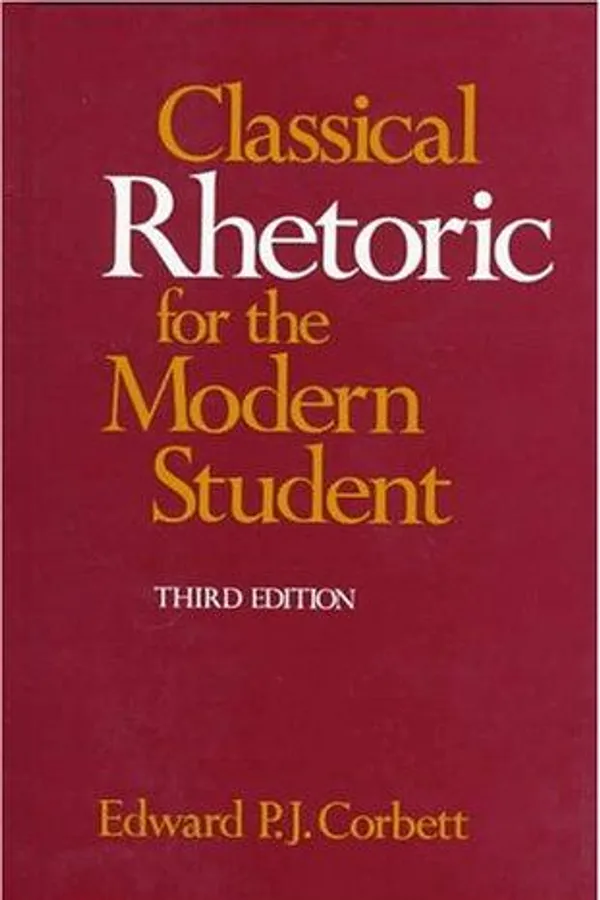
Classical Rhetoric for the Modern Student
Edward P. J. Corbett
Persuasion is a discipline with a complete toolset, built twenty-five centuries ago; the modern writer, trained only in style, is working with a third of the machine.
- TYPE
- Book
- SHELF
- Writing & Rhetoric
- TIME
- 12 min read
- ADDED
- 2026 · 07 · 07
- STATUS
- Completed
- IDEAS
Writing · History
Why it matters
Capital moves on structured persuasion; this is the manual for the machinery every pitch in every room is running, mostly without knowing it.
Corbett's textbook restores a curriculum that governed Western education for two thousand years and vanished within living memory. Rhetoric, in the classical sense: the discipline of finding, in any given case, the available means of persuasion. The system has three working canons. Invention is the discovery of arguments: the three appeals, reason, emotion, and the audience's estimate of the speaker's character, plus the topics, a systematic checklist for generating material through definition, comparison, relationship, circumstance, and testimony. Arrangement assigns the discourse its parts, each with a function: the opening that secures attention and goodwill, the statement of facts, the proof, the refutation of the opposing case, the close. Style, the third canon, covers diction, sentence architecture, and the figures, schemes and tropes catalogued by name and learned through deliberate imitation of masters. Around the machinery Corbett wraps a history: the Sophists, Plato's attack, Aristotle's system, Cicero, Quintilian, the long decay into ornament. The claim throughout is that persuasion is not a talent but a technology, teachable, drillable, and morally neutral, which is both the offer and the warning.
- Rhetoric begins before writing: an audit of the case, the audience, and the available means of persuasion; the discourse is designed from the audit, not from inspiration.
- Three appeals carry every argument: logos, pathos, and ethos; and ethos, the audience's estimate of the speaker's character, is the strongest and the least deliberately practiced.
- The topics are an invention machine: definition, comparison, relationship, circumstance, testimony; run as a checklist, they find arguments that waiting for insight never surfaces.
- Arrangement is itself argument: each part of a discourse has one job, and the refutation, stating the strongest opposing case fairly before answering it, separates persuasion from assertion.
- The figures are named instruments with known effects, acquired by imitation before they can be deployed; style is the third canon, not the first.
- The machinery is symmetrical: it arms truth and falsehood equally, which is why the tradition's history is one long argument over whether the good speaker must be a good man.
The argument
The book is a restoration project, and it opens by explaining what was lost. For most of Western history, rhetoric was not a subject but the subject: the center of education from the Greek law courts through Rome, the medieval schools, and the Renaissance, the discipline through which a citizen learned to think in public. Then, within a century or so, it collapsed into a slur, a word for empty or manipulative speech, and composition students inherited only the last and least of its parts, the rules of style. Corbett, writing as a professor of English in the 1960s, set out to hand the whole machine back, and the book is exactly that: a working manual first, a history last, with drills throughout.
The definition doing the load-bearing work comes from Aristotle, and Corbett keeps its precision: rhetoric is the faculty of discovering, in any given case, the available means of persuasion. Note what the definition does not say. It does not promise victory, and it does not begin with words. It begins with an inventory: this audience, this question, these constraints, these appeals available and those closed off. Persuasion is designed from the audit. The amateur starts drafting; the rhetorician starts surveying.
Classical rhetoric divides the work into five canons: invention, arrangement, style, memory, and delivery. The last two belong to the orator’s stage, so Corbett concentrates on the three that survive on paper, and the structure of the book is simply the structure of the craft.
Invention is the discovery of arguments, and it has two instruments. The first is the three appeals. Logos, the rational appeal, works through argument proper: the example, and the enthymeme, a syllogism with a premise left unstated so the audience completes it themselves, persuading themselves with their own materials. Pathos, the emotional appeal, Corbett refuses to treat as cheating: audiences are not reasoning machines, emotions are judgments about how things stand, and a speaker who moves an audience is supplying grounds of a kind. Ethos, the ethical appeal, is the audience’s estimate of the speaker: intelligence, character, goodwill, projected by the discourse itself. The classical judgment, which Corbett preserves, is that ethos is the most potent of the three; an argument is heard through the audience’s estimate of the man making it. The second instrument is the topics, the famous checklist: definition, comparison, relationship, circumstance, testimony. They are places to look for arguments, a search procedure run over the case, and their point is that invention should not wait on inspiration. Arguments are found the way anything else is found: by looking systematically where arguments tend to be.
Arrangement gives the discourse its anatomy, inherited from the courtroom: an opening that secures attention and goodwill, a statement of the facts, the proof of one’s own case, the refutation of the opposing case, and the close that gathers everything into memory and feeling. Corbett is flexible about the parts but firm about their logic: each exists for a function, and the refutation carries the most ethical weight, because it requires the speaker to state the opposing case, fairly, in public, and answer it. A discourse without refutation is assertion. The willingness to give the enemy’s best argument the floor is what distinguishes persuasion from propaganda, and the tradition understood this as both tactics and honesty: the audience trusts the man who shows he has heard the other side.
Style arrives third, demoted from the whole of rhetoric back to a canon of it. Corbett works through diction and sentence architecture, then the figures: schemes, which pattern syntax, parallelism, antithesis, anaphora; and tropes, which transfer meaning, metaphor, metonymy, irony. Every figure is a named instrument with a known effect, and the pedagogy is imitation: copy strong passages out longhand, then write your own sentences to the master’s pattern, until the forms are in the hand and not just the eye.
The closing history explains the ruin the book was built to repair. Rhetoric born in Sicilian courtrooms, citizens pleading for their own property; the Sophists selling victory; Plato’s attack on the whole art as flattery, cookery for the soul; Aristotle’s answer, that the art is real and truth needs advocates too; Cicero the practitioner, Quintilian insisting the orator must be a good man; then Ramus amputating invention and arrangement into logic, leaving rhetoric only style, and the nineteenth century finishing the job. The modern sense of the word rhetoric, decoration or deceit, is the fossil of that amputation. The machine never stopped running, Corbett observes; advertising and politics run it daily. Only the education stopped, which means the machine now runs mostly on the unknowing.
Working notes
Read Corbett beside Cialdini and the two books collapse into one. Influence is pathos and ethos rediscovered by experiment: reciprocity, authority, social proof, scarcity are topics with laboratory receipts, compliance where the Greeks said persuasion. Twenty-four centuries separate the books and the animal has not changed. What the comparison taught me is which direction the traffic runs: the classical system is the map, the experiments are surveying confirmation, and a practitioner needs the map more, because the map includes arrangement and invention, the parts the psychology literature never rebuilt.
The topics look pedantic and are not; they are a generative procedure, and generative procedures beat inspiration everywhere I have watched the two compete. Waiting for the argument to arrive is like waiting for the diagnosis to arrive: the professional runs the differential instead. Define the thing. Compare it to its neighbors. Trace its causes and its consequences. Weigh what circumstances permit. Call testimony. I run this list when a thesis feels thin, and it reliably surfaces the argument I would not have found by staring, which is all a method ever owes you.
Ethos is the appeal the modern world practices least deliberately and rewards most. Amateurs polish logos: the model, the numbers, the deck. But rooms decide early, on their estimate of the speaker, and the estimate walks in the door before the first slide: track record, alignment, who made the introduction. The classical insight is that ethos can be constructed, deliberately, and mostly outside the discourse itself; by the time the meeting starts, the strongest argument has usually already been made or lost. Corbett would call this the ethical appeal operating at the scale of a career. I call it reputation compounding, and the compounding is why the appeal cannot be improvised on the day it is needed.
The enthymeme deserves its own note, because it names the most powerful move in persuasion and the most dangerous thing about it: the premise the audience supplies is the premise the audience will not audit. Every strong pitch, sermon, and slogan runs on unstated premises the crowd contributes and therefore owns. Learning to hear the missing premise, in my own arguments first, is the most valuable single skill the book trains.
And the figures catalogue reads both directions: composition manual and threat taxonomy. Once you can name anaphora, the keynote’s hammering repetitions stop working on you; the named scheme loses its grip. This is the same use I make of the power literature on this shelf: study the anatomy so the technique cannot be run on you unannounced. Plato’s quarrel with the whole art stays live on the shelf beside it; truth-seeking and assent-winning are different games, and a builder plays both. The discipline is knowing, at any given hour, which one you are playing.
Where I push back
Corbett soft-pedals the moral problem, and the decorum of the textbook makes it worse. The art is symmetrical: every instrument in the book arms truth and falsehood equally, and the tradition’s history has blood in it that the classroom apparatus politely drains away. The Sophists were a scandal for reasons; the demagogues of every century were superbly trained; and Quintilian’s answer, that the true orator must be a good man, is a wish wearing a definition’s clothes. Nothing in the system enforces it. A curriculum this powerful handed over with this little alarm is a curriculum that trusts its students more than history says it should.
The pedagogy has a failure mode the book does not guard against: mechanization. Drilled topics and memorized arrangements produce the sound of argument without its life, and anyone who has graded student themes, or read a consulting deck, knows the product: competent emptiness, every part present, nothing at stake. The checklist can replace thought while appearing to organize it, and the better the student’s discipline, the more convincing the emptiness.
The audience is also gone. The full classical arrangement assumes listeners who will sit for structured discourse from exordium to peroration, and that audience died with the occasions that trained it. The memo, the deck, and the feed each mutilate the canon differently; arrangement survives, but only in translation, and Corbett offers transcription. His exemplary texts have dated the worst: models of a formal eloquence that now reads embalmed, teaching cadences no living room will sit through.
And the machine is verbal only. Modern persuasion is multimodal: the chart argues, the demo argues, the room itself argues. A rhetoric of the spreadsheet and the prototype remains unwritten, and the students who most need Corbett’s system are working in registers his book never imagines. The restoration is real; the update it demands is someone else’s book.
How it enters the work
Raising and deploying capital is structured persuasion under uncertainty, and an investor memo is a classical oration whether or not its author has heard the terms. Mine are built on the anatomy deliberately: an opening that earns standing and states why now; the facts of the market laid out plainly, separated from the claims I intend to make on them; the thesis proven; the bear case stated in its strongest form and answered; the close with the terms. The refutation section is mandatory and it is the section that does the compounding. A memo that pre-states the best argument against itself earns a kind of trust no accumulation of favorable points can buy, because it demonstrates the author has priced his own downside. In capital as in court, the refusal to mention the other side reads as fear or concealment, and the room always notices.
Ethos runs the longer game. In markets, the ethical appeal is not a manner; it is track record, alignment of interest, capital of my own beside the client’s, and the source of the introduction, all of it built before the meeting, none of it improvised in the room. Pathos I ration on principle: fear and greed are the market’s own appeals, permanently in session, and a serious allocator names them out loud rather than riding them, because the client who was moved by greed into the position will be moved by fear out of it at the worst possible price.
The status and power reading is defensive. Rooms run on this machinery whether or not anyone in them can name it, and the catalogue is armor: I hear the anaphora in the keynote now, the enthymeme buried in the deal terms, the manufactured scarcity in the closing pressure, and hearing them buys distance. Study as anatomy, not endorsement; the moral cost of the tools is real, and the tradition’s whole history says the operator is corroded exactly as fast as he stops noticing which game he is playing. My standing rule holds the line: never argue a case I would not hold with my own capital. The machinery is neutral. The operator cannot afford to be.
- Audit before drafting anything meant to persuade: audience, stakes, available appeals; write nothing until the inventory is done.
- Build ethos before the meeting; the argument is heard through the audience's estimate of the speaker, and that estimate is set early.
- When arguments run dry, run the topics: define, compare, trace causes, weigh circumstances, summon testimony.
- Always include the refutation. State the strongest objection fairly and answer it; its absence reads as fear or concealment.
- Learn the figures by imitation and deploy them sparingly; a scheme the audience notices is a scheme discounted.
- Never argue a case you would not hold with your own capital; the machinery corrodes the operator who forgets it is neutral.
A method for finding what persuades is indifferent to what is true, and Corbett's decorous classroom tone can make you forget you are being handed weaponry; the same topics build the demagogue's speech. Drilled mechanically, the system produces the sound of argument without its life. And the tradition assumes an audience that will sit still for structured discourse; modern attention will not, so the canons need translation, never transcription.