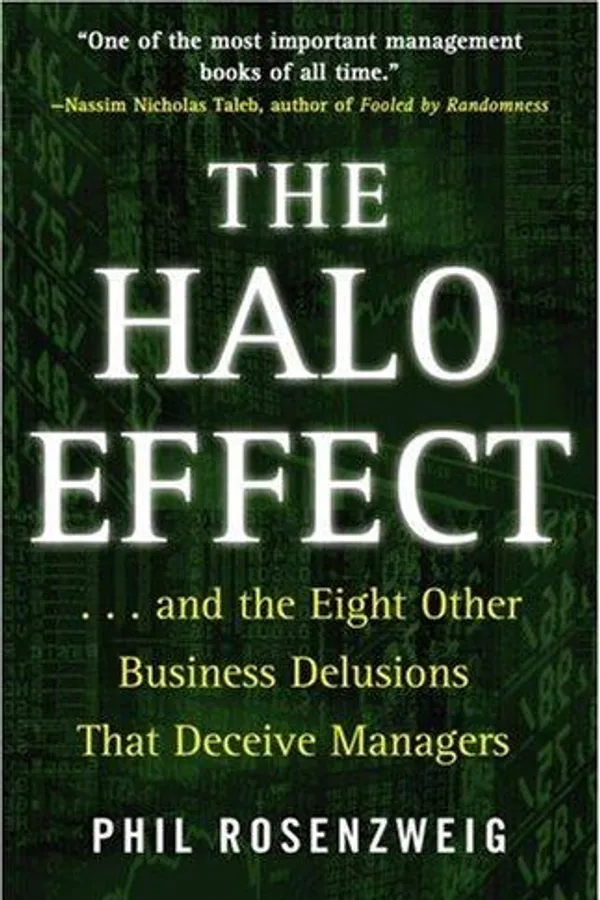
Book
The Halo Effect
Phil Rosenzweig
Outcomes write the attributes: the same company is visionary while the stock rises and arrogant after it falls, and most management research is that echo with footnotes.
- TYPE
- Book
- SHELF
- Business & Enterprise
- TIME
- 13 min read
- ADDED
- 2026 · 07 · 07
- STATUS
- Completed
- IDEAS
Business · Psychology
Why it matters
It is the audit function for this shelf: every success formula offered to me, in consulting or in markets, has to pass through this book first.
Rosenzweig begins in psychology: Edward Thorndike found that raters scoring a man on separate traits cannot keep the columns apart; one global impression wears several costumes. Carry the finding into business and most management knowledge falls over. When results are good, observers judge the culture cohesive, the leader visionary, the strategy bold; when results fall, the same company is rewritten as insular, arrogant, reckless. The raw material of business research, press coverage, interviews, retrospective surveys, is contaminated by the outcome it claims to explain, so the celebrated studies of corporate greatness are, whatever their sample sizes, stories told backward. From this flagship error he unwinds a family of delusions: correlation dressed as cause, winners sampled without losers, permanence promised where regression to the mean rules, absolute progress measured in a relative game. What remains is modest and adult. Strategy and execution are choices under uncertainty; good decisions can produce bad outcomes; the manager's real work is probabilistic judgment without the comfort of formulas, and anyone selling a guarantee is selling the halo.
- The halo effect: observers infer a company's attributes from its results, then offer the attributes back as causes of the results. Culture, leadership, and focus are usually the stock price, restated.
- Data drawn from the press, from interviews, and from retrospective surveys already contains the outcome; no sample size or statistical polish can extract cause from inputs that already carry the answer.
- Studying winners alone cannot reveal what separates winners from losers. Without the failed companies that ran the same play, the common traits of the successful are trivia.
- Performance is relative, not absolute. A company can improve every internal measure and still decline because competitors improved faster; Kmart got better while it died.
- Lasting greatness is mostly mirage: regression to the mean is the rule; the exemplar companies of the success literature drift back toward the pack once the book is in print.
- Strategy and execution are both bets placed under uncertainty, so good decisions can produce bad outcomes and bad decisions good ones. The two verdicts must never be merged.
- Explanations overlap. Culture, leadership, customer focus, and execution are frequently one halo counted four times; the claimed contributions of success factors sum past the whole.
The argument
Thorndike found the defect a century ago. Officers asked to rate their men on separate qualities, physique, intelligence, leadership, character, could not keep the judgments apart; a soldier impressive in one column was scored impressive in all. The rater believes he is making four measurements and is making one. Psychology named it the halo effect and has replicated it ever since. Rosenzweig’s contribution is to carry the finding into the business world and demonstrate something worse than a bias in the data about companies: the halo is the data.
Watch the mechanism at market scale. Through the late nineties Cisco was written up as the model modern company: obsessed with its customers, disciplined in its culture, an acquisition machine that folded startups in without a seam. The stock collapsed after 2000, and the same publications described the same company: now the customer focus was hubris, the culture insular, the acquisitions reckless. The practices had barely changed. The outcome had changed, and the attributes obediently followed it. ABB ran the same arc in Europe: celebrated for years as the model of the decentralized global corporation, its chief executive lionized; when performance sagged, the identical structure was rewritten as chaos and the boldness as arrogance. These descriptions were never observations of the companies. They were derivatives of the share price.
This would be an amusing defect of journalism if business knowledge were built on something else. It is not. The celebrated studies of corporate performance share one method: select companies by their results, then gather material about their attributes from press, interviews, and surveys of people who already know how the story ended. Every input carries the halo. It does not matter how many documents were coded or how sophisticated the analysis was; rigor applied to contaminated inputs is contamination with confidence intervals. Rosenzweig walks the famous success literature, excellence studies to greatness studies, and shows the same machine running in each: outcome first, attributes second, causation asserted third. A thousand halo-soaked interviews are not evidence; they are the same interview a thousand times.
The sampling compounds the sin. Studying winners to learn the traits of winning is connecting dots after removing every dot that would falsify the line. Without the failed companies that had the same focused strategy, the same strong culture, the same charismatic leadership, the shared traits of the successful are trivia; they may be traits of the industry, or of survivorship itself. From this flagship error the other delusions unwind, and they interlock. Correlation is dressed as cause: satisfied employees and strong results travel together, but when anyone sequences the data, success appears to produce satisfaction at least as much as the reverse. Single explanations double-count: culture, leadership, customer orientation, and execution are each credited with most of the outcome, which is arithmetic proof that they are largely one factor wearing four names. Permanence is promised where regression rules: enduring greatness sells books precisely because it does not exist, and the exemplar companies of each study drift back toward the pack after publication. And performance is treated as absolute when the game is relative. Kmart improved through the nineties, honestly and measurably; it was destroyed anyway, because Walmart improved faster. A company that measures itself against its own past can record progress every quarter of its decline.
The delusion Rosenzweig saves for last is the one the others exist to protect: the belief that business performance obeys discoverable laws, so the formula guarantees the result. The genre is one of secular promises, and the promises are the product; the research is packaging. His answer is that outcomes are decided by choices made under uncertainty, in competition with rivals choosing at the same moment, and no such game can carry a guarantee. Strategy is a bet about customers and competitors; execution is a bet that the organization can do what it intends; both can be well chosen and still fail. What follows is the book’s quiet positive program, easy to miss behind the demolition. Separate the quality of the decision from the quality of the outcome. Think in probabilities. Expect a sound process to show its worth across many trials while any single result proves nothing. The managers he respects are not the prophets on the magazine covers but the ones who speak in odds and prepare to be wrong. It is a thin doctrine, and he knows it. His defense is that a thin truth outranks a thick comfort, and that the alternative on offer is not knowledge but stories about winners, sold to people who would rather be reassured than informed.
Working notes
This book is the third leg of a stool. Taleb names the narrative fallacy and shows it operating in markets; Kahneman supplies the mechanism, a fast mind that manufactures coherence and experiences the coherence as truth; Rosenzweig does the fieldwork, cataloguing the fallacy in the corporate press with names and dates. Read in that order, the three converge on one uncomfortable finding: the halo is not an error the mind occasionally commits. It is the mind’s default rendering engine, and outcome data is its favorite pigment.
On second reading the delusions stopped being a list and became a single machine with stations. Sample on results, gather halo-soaked testimony, extract overlapping causes, promise permanence: that is the production line of the business bestseller, and once the line is visible you cannot stop seeing it run. The vendor case study runs it. The conference keynote runs it. The awed profile of the founder runs it, and the postmortem of the failed founder runs it in reverse, because the halo works both directions: failure rewrites virtues as vices with the same efficiency, the decisive man becomes rash, the focused company becomes blinkered, the patient investor becomes asleep. It is worth learning this before your own drawdown, because it will be applied to you, and the only defense is a record of what you actually decided and knew at the time.
The book also indicts the shelf it stands on, which is the correct test of whether you have understood it. I went back through the business entries in this archive and ran the audit. Grove survives it, and the reason is instructive: Grove deals in mechanisms, not attributes. Leverage, limiting steps, paired indicators are claims you can test on a Tuesday without knowing anyone’s stock price. “Visionary culture” is not a testable claim; “pair every metric with its counter-metric” is. The success literature fails Rosenzweig’s audit because it traffics in adjectives, and adjectives are where halos live. Engineering survives because mechanisms do not care how the story ended. That is now my test for any business book before it earns a place here: strip the adjectives and see whether anything testable remains.
The chapter on relative performance is the one operators forget fastest. Nearly every internal dashboard measures the company against its own history: revenue versus last year, cost versus budget, satisfaction versus last quarter. Almost none plots the competitor’s rate of improvement, which is the only line that decides survival. Rosenzweig’s Kmart is not a story about failure to improve; it is a story about improving while losing, which is the more frightening and the more common death. A story that explains everything after the fact has explained nothing before it; a dashboard that compares you only to yourself has measured nothing that matters.
Where I push back
The demolition outruns the construction, and not by a little. After the delusions are cleared away, the reader is handed two words, strategy and execution, and a counsel of probabilistic humility. All true, and thin. The manager persuaded by every page still has to choose a market, a price, and an organization on Monday morning, and the book is nearly silent on how. Rumelt wrote the constructive half of this argument, diagnosis and coherent action in place of aspiration; Rosenzweig cleared the ground and left it cleared. That is honest work, but a reader should know he is buying a vaccine, not a meal.
Second, the book underestimates its own misuse. Skepticism is also a costume, and a cheaper one than optimism. The reader who leaves dismissing every study, every metric, and every comparison has not become rigorous; he has retreated to instinct, which is halos without the paperwork. The cure for bad inference is better inference, not the abolition of evidence, and the rhetoric of demolition occasionally licenses the abolition.
Third, Rosenzweig treats story only as contamination and never as fuel. Organizations run on narrative; capital runs on it too. The leader who refuses all story because it is epistemically impure will be outrun by the one who can tell a true-enough story that moves people, and the book has no chapter on the difference between wielding a narrative and being deceived by one. The halo cannot be abolished. It can only be spent carefully, and someone in every company has to spend it.
Last, the split between decision quality and outcome quality is the most abusable sentence in the book. Every underperformer discovers it eventually: good process, bad luck. The distinction is correct and it demands an audit protocol the book never specifies, because without one it is not epistemology, it is an excuse with a bibliography.
How it enters the work
At Intelliblitz the book functions as procurement hygiene. Enterprise software is sold almost entirely by halo: the vendor’s case study is a winner sampled without its losers, and the implied syllogism, this reference customer succeeded, therefore the platform causes success, is the delusion of connecting the winning dots with an invoice attached. When I evaluate platforms for a client I now ask the Rosenzweig questions out loud: how many companies ran this same stack and stalled, what was measured before the outcome was known, and what part of the reference story is the customer’s market rather than the vendor’s product. The questions are unwelcome. They are also most of the value of having an outside architect in the room.
The book also constrains what I allow a BI system to say. Analytics built carelessly is halo manufacture at industrial scale: outcomes on one axis, adjectives on the other, and an executive invited to draw the causal arrow his mood prefers. The discipline I impose in the build is Rosenzweig applied: benchmarks relative to competitors where the data permits, decision logs captured before outcomes arrive so that attribution has something honest to work against, and no dashboard that lets a company grade itself solely against its own past. Find the structure, then remove everything that isn’t it: the halo is precisely the part that isn’t.
At BlockHedge the book has hardened into a journal rule. Markets manufacture halos faster than any boardroom: every daily recap performs the trick, the price moves, and causes are assigned within the hour, confident in both directions on consecutive days. Crypto is the pure case, a market where founder halos and narrative inflation move billions before any mechanism is examined. Against that noise the rule follows the book exactly: the thesis is written and dated before entry, and every trade is graded twice, once for the decision given what was knowable, once for the result. A profitable trade with a broken process is recorded as an error; a losing trade with a sound process is recorded as tuition. Confusing those two columns is how a good quarter teaches bad habits.
And the discipline runs inward. After a strong stretch, the halo turns on the self: the habits, the schedule, the instincts all look causal because the results were good. I treat my own process audit as a fixed cadence, independent of results, for the same reason the thesis is written before the trade. The record has to exist before the outcome starts telling me what to think of myself.
- When a company is praised for its culture or its leadership, ask what was measured before the results were known. Usually: nothing.
- Grade every decision on the information and odds available at the time; grade the outcome separately; never let either verdict stand in for the other.
- Refuse any formula extracted from winners only. Ask where the failures are that ran the same play, and treat their absence as the finding.
- Benchmark against the competitor's rate of improvement, not against your own history. Absolute progress in a relative game is how a company improves its way into irrelevance.
- Write the thesis down before the outcome arrives. The dated record is the only instrument that survives your own halo.
The book demolishes and barely builds: a shelf of delusions dismantled, then a thin closing counsel of probabilism, and a careless reader leaves having traded credulity for a blanket suspicion of evidence, which returns him to instinct, and instinct is halos all the way down. Worse, the split between decision quality and outcome quality, correct in logic, shelters every manager who would rather relitigate his luck than his reasoning, and Rosenzweig hands over the sentence without the audit that must accompany it. Read it as a discipline for your own attributions, not as a license to dismiss everyone else's.