Book
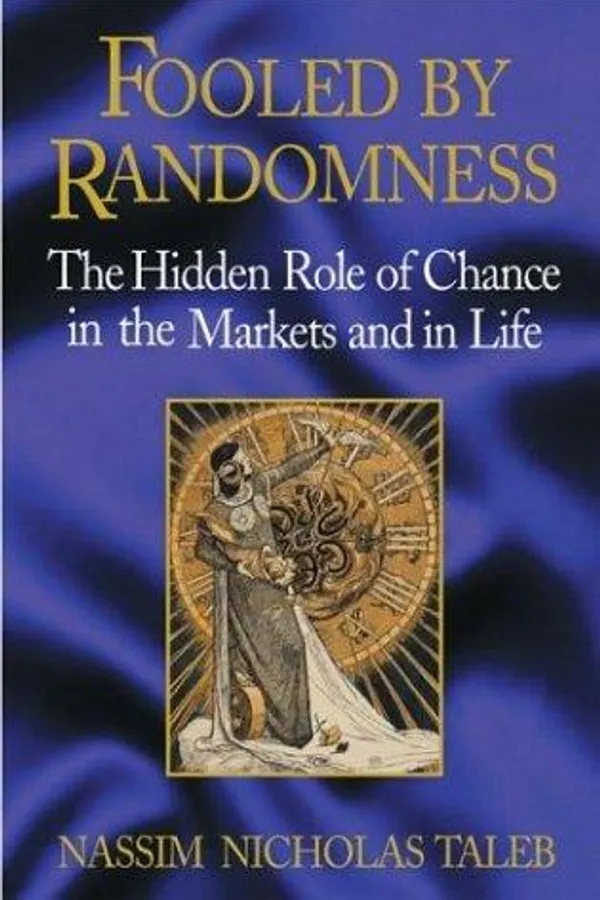
Fooled by Randomness
Nassim Nicholas Taleb
Wherever outcomes are noisy, most visible success is luck wearing the costume of skill, and the only honest discipline is judging decisions against the histories that did not happen.
- TYPE
- Book
- SHELF
- Trading & Markets
- TIME
- 13 min read
- ADDED
- 2026 · 07 · 07
- STATUS
- Completed
- IDEAS
Markets · Philosophy · Psychology
Why it matters
It polices the border between my process and my results; in an asset class where one regime can mint geniuses, that border is the whole business.
Taleb opens with Solon's warning to Croesus: call no man happy until his end, because what fortune granted, fortune can repossess. The book translates the warning into probability. An outcome is one draw from a distribution of paths that could have occurred, so a result proves almost nothing about the decision that produced it; ten million made playing Russian roulette and ten million made practicing dentistry are identical on a bank statement and opposite as achievements, because they carry different invisible histories. From this single move the rest unfolds. Survivorship bias corrupts every inference from observed success, since enough coin-flippers guarantee a streak and the graveyard of the identical-but-unlucky holds no press conferences. Skewness breaks the amateur's arithmetic: how often you are right matters less than the size of the payoffs when you are, so a man can be usually wrong and rich, or usually right and ruined. At short horizons, price movement is nearly all noise, and the more often you look, the more randomness you consume. And because knowing about these biases does not cure them, Taleb's defenses are structural: rules, rationed information, and, at the end, Stoicism, dignity as the one variable randomness cannot touch.
- Judge every decision against the ensemble of alternative histories, not the realized path; the quality of a choice lives in the distribution it was drawn from, not in the draw.
- A fortune won at Russian roulette and a fortune earned in dentistry are the same number and opposite objects; the difference is carried entirely by the histories that did not happen.
- Survivorship bias is the master distortion: enough participants guarantee streaks, we interview the streak, and the graveyard that would correct the lesson stays silent.
- Skewness beats frequency: expectation is probability times consequence, so the rare heavy payoff can dominate a strategy that is wrong most days, and ruin one that is right most days.
- Over short intervals variance swamps any real drift, so high-frequency attention to a portfolio is a machine for consuming noise and paying emotional interest on it.
- Knowing about biases does not remove them; the working defenses are structural, rules and rationed information standing where willpower has already been proven to fail.
- When the regime is in the returns, the trader mistakes the regime for himself; the mistake is invisible from inside and fatal at the regime change.
The argument
The book begins in antiquity because the problem is not modern. Solon, visiting the court of Croesus, declines to call the richest man he has ever seen happy, on the grounds that fortune reclaims what fortune grants and the account is not settled until the end. Croesus later loses his kingdom and remembers the warning on the pyre. Taleb takes the story as the founding statement of his subject: in any domain governed by chance, the present state of an account is not a verdict, because the process that produced it is still running, and the process, not the state, is the thing being judged.
The analytical move underneath the whole book is the ensemble of alternative histories. Any observed outcome is one draw from a distribution of paths that could have occurred; the quality of a decision lives in that distribution, not in the draw. His cleanest instrument for the point is Russian roulette. A man paid ten million dollars to survive one pull of the trigger has the same bank balance as a dentist who compounded a careful practice over decades, and the two fortunes are opposite objects, because five of the six worlds adjacent to the first one contain a corpse. Reality does not show us the five worlds; accounting shows us the balance. So the observer who judges by results alone is systematically transferring admiration from dentists to roulette players, and every incentive structure that pays on realized outcomes is doing the same at scale. Taleb’s Monte Carlo simulators are the prosthetic for this blindness: run the generator, watch the alternative paths fan out, and learn to see every realized track record as one line in a bundle.
Survivorship bias is the master distortion, and the book’s account of it is the one that should be taught first everywhere. Put enough coin-flippers in a stadium and a run of consecutive winners is guaranteed by arithmetic; walk the last one out and ask for his method, and he will have one, sincerely held. Markets run this stadium continuously. The investors we observe are the ones selection left visible; the cohort that started beside them, ran identical processes, and drew the other histories is gone from the sample, and its absence flatters everything that remains. The error compounds because the survivors write the books and give the interviews, so the available evidence about how to succeed is composed almost entirely of noise that happened to be promoted. Taleb’s fictional traders carry the demonstration: Carlos the emerging-markets buyer and John the high-yield trader, men whose strategies embedded a short position against the rare event, compound gorgeously for years, are ratified by bonuses and deference, and are then deleted by 1998 in a few weeks; while Nero Tulip, deliberately modest, structurally allergic to blowup, survives on the returns that embarrassed him at every dinner party. The regime was in their results the whole time, and they had mistaken the regime for themselves.
Skewness is the second correction, and it separates the professionals from the commentators. Expectation is probability times consequence, and the two factors are independent, so the question that matters is never how often a strategy wins but what the payoffs do at the extremes. Taleb recounts telling a meeting that the market was more likely than not to rise over the coming week while he was positioned short, and enjoying the incomprehension: the modest probability of a fall carried consequences large enough to dominate the expectation. In thin-tailed domains frequency is a fine proxy; in fat-tailed ones it is a trap, because the decisive observation is precisely the one the historical sample has not yet produced. A strategy can be right daily and hold its ruin in the tail; the daily rightness is what finances the audience for the ruin.
Then the noise arithmetic, the most immediately usable pages in the book. Over long horizons, a genuine edge dominates variance; over minutes and days, variance dominates everything, so the difference between a good year and a random one is invisible at high frequency. The investor who checks his portfolio constantly is therefore consuming almost pure noise, and paying for it twice, because losses are felt roughly twice as heavily as equivalent gains. Watching more produces knowing less and hurting more. And since Taleb does not believe knowledge cures bias, including his own, his response is structural: he removes the noise feed rather than resolving to ignore it, rations his own access to prices and news, and lets rules stand guard where he knows his biology will desert. The book closes where it opened, with the Stoics: randomness will deal what it deals, and the only variable entirely under a man’s control is the dignity of his conduct under the dealing. It is not resignation; it is the correct allocation of effort, aimed at the one thing in the game that is not a draw.
Working notes
This book, The Halo Effect, and Thinking, Fast and Slow are one scandal reported from three jurisdictions. Kahneman documents the machinery of misjudgment in the laboratory; Rosenzweig catches the business press manufacturing causes for outcomes after the fact; Taleb walks the same fraud through trading floors, where the invoice arrives fastest. Read together they close the loop: the mind that cannot see randomness builds institutions that reward it, then writes literature explaining the rewards as merit. Of the three, Taleb’s is the version written from inside the casino, and it is the one that changed my behavior rather than my opinions.
Against The Black Swan, which grew out of it, I hold this book higher for use. The later book is grander, more architectural, and more impressed with itself; this one is closer to the desk, the observations still smelling of the P&L that taught them. The black swan problem is already here, stated plainly: the decisive event is the one not in the sample, so induction from any track record has a hole in the floor. The sequel built a cathedral over that sentence. The working trader needs the sentence.
The line that cost me the most to accept is the one about the regime in the returns. Everyone trading through a persistent trend is long that regime, whatever they believe they are long, and the returns will flatter their process exactly as long as the regime holds. From inside, skill and regime are indistinguishable; the alternative histories where the regime broke early are unavailable for inspection. The only honest responses are structural: grade decisions rather than outcomes, keep the journal that preserves what you actually knew at the time, and size as if the regime could end on any given morning, because in every history that matters, it did.
Time has also settled which of Taleb’s two lessons was the durable one. The famous lesson is suspicion of others’ track records. The durable one is suspicion of your own: the same generator that manufactures false geniuses elsewhere is manufacturing your good years, and it does not send a notification when your turn comes. Solon’s warning is not about Croesus. It is addressed to the reader, at the exact moment the reader is most certain it describes someone else; the book’s severity is a mirror, and most of its fans are holding it facing outward.
Where I push back
The book demonstrates that luck mimics skill and then hands the reader no instrument for telling them apart. That is not a small omission; it is the working half of the problem. Skill exists: there are operators whose edge survives cohort correction, regime accounting, and long samples, and distinguishing them from the lucky is difficult, evidence-hungry, and possible. Taleb shrugs at exactly the point where the real work begins, and the shrug licenses his laziest readers to dismiss every success as a coin flip, a cynicism precisely as cheap as the credulity the book set out to cure. Suspicion is a starting posture, not an epistemology, and the book confuses the two often enough to damage people who trusted it.
Second, the voice taxes the message. The book teaches humility before randomness in a tone of sustained contempt for journalists, executives, economists, and most of the trading profession, and the tone is what transfers: its readers acquire the sneer in a weekend and the discipline never. A book about invisible graveyards should have been written by a man visibly frightened of ending in one, and the fear is in the arguments but not in the voice. Lefèvre, with a tenth of the erudition, carries more genuine dread.
Third, Taleb’s own preferred exposure, structured to bleed small and collect on catastrophe, is presented as the honest side of the asymmetry, and the presentation quietly exempts itself from the book’s method. Bleeding premium while waiting for rare events has its own distribution of alternative histories, and in a long stretch of them the crisis hunter is carried out before the crisis arrives: capital exhausted, investors gone, conviction spent. Survivors of that strategy also write books. The argument does not fail, but it is symmetrical, and the book presents it as if it were not; the sample of visible crisis hunters was selected by the same stadium as everyone else.
How it enters the work
BlockHedge lives in the market this book warned about most directly. Crypto compresses the stadium experiment into every cycle: thousands of funds and traders enter, one regime pays a subset of them spectacularly, and the survivors arrive at the next cycle as authorities, with track records exactly one regime long. The firm’s diligence process is Taleb applied without apology. Before any record earns attention, two questions get answered: how large was the cohort this emerged from, and what regime was in these returns. Then the question that actually decides: what did this operator do in the stretch where the regime was against him? A record with no such stretch is not evidence of skill; it is an unpriced bet that the weather never changes, and we have watched that bet settle twice.
The journal practice is the alternative-histories discipline made daily. Decisions are graded on what was knowable at the time, in writing, before outcomes exist to contaminate the grading; a profitable trade taken outside process is recorded as an error that happened to be paid. The hardest habit the book installed is applying this to good years: after a strong run, the review asks which returns belonged to the process and which to the regime, and the answer sets sizing for the next cycle. Croesus never audits the good years. That is the entire mechanism of his surprise.
Sizing carries the tail doctrine. Positions are built so that the path not yet seen, the one outside the sample, is survivable as a matter of arithmetic rather than hope; expectation on this desk includes the histories that have not happened, or it is not called expectation. And the noise diet is enforced by structure, in Taleb’s own spirit: theses measured in quarters are denied intraday data, dashboards are built to the decision horizon and not to the appetite, and the terminal is dark on days when no decision is scheduled. The discipline is not serenity. It is plumbing, rules standing watch where willpower has already lost its case history, and it holds precisely because nothing about it depends on my being wiser than the man the book describes.
- Grade decisions, not outcomes, and keep the journal that makes the grading survive your memory.
- Before admiring any track record, count the cohort it emerged from and name the regime that paid it.
- Size every position so the rare event is survivable; the expectation includes paths you have not seen.
- Ration market data by decision horizon: nothing intraday for a thesis measured in quarters.
- Build rules where your biology is known to fail; never schedule willpower for a moment it has already lost.
The book supplies suspicion without a method: it demonstrates that luck mimics skill and then offers no instrument for telling them apart, so a careless reader graduates into universal cynicism, which is as lazy as the credulity it replaced. Taleb's contempt for nearly everyone in the story teaches an epistemology of humility in a voice that has none, and readers learn the voice faster than the epistemology. And his own preferred strategy, positioned for rare events, has a graveyard of its own that the book declines to visit.