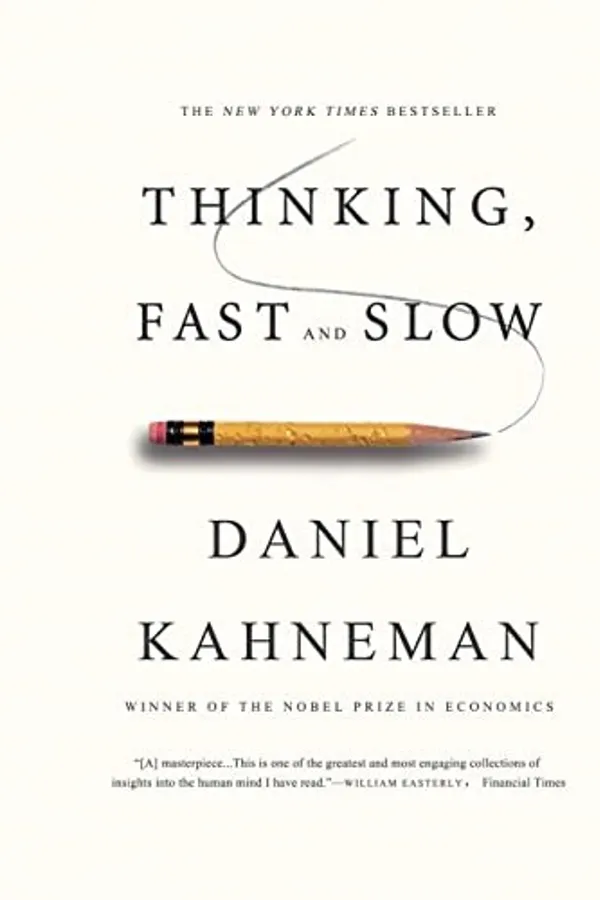
Book
Thinking, Fast and Slow
Daniel Kahneman
Judgment runs on a fast machine that answers an easier question than the one asked, while the slow machine signs off; the errors are systematic, therefore predictable.
- TYPE
- Book
- SHELF
- Psychology & Behavior
- TIME
- 16 min read
- ADDED
- 2026 · 07 · 07
- STATUS
- Completed
- IDEAS
Psychology · Markets
Why it matters
The ledger of the mistakes my account has already paid for; I keep it as a trading manual and an engineering specification, not as science writing.
The book compresses five decades of research, much of it with Amos Tversky, into one account of judgment under uncertainty. Two characters carry the exposition: System 1, fast, associative, effortless, always running; System 2, slow, effortful, and lazy, a supervisor who mostly endorses. The central mechanism is substitution: faced with a hard question, the mind answers an easier one and does not notice the swap. From this flow the heuristics and their signatures: availability, representativeness, anchoring; base rates ignored, small samples over-read, regression to the mean credited to skill and to punishment. Confidence, on the evidence, measures the coherence of the story at hand rather than its truth, which is why it survives knowledge of its own invalidity. Intuition is recognition, and it earns trust only in regular environments with fast feedback; elsewhere simple formulas beat experts. Prospect theory replaces the rational actor: value is change from a reference point, losses weigh roughly double, probabilities are warped at both ends, and framing decides between identical outcomes. The closing chapters split the self into one that lives and one that remembers, with the rememberer holding the pen. The counsel throughout is procedural: individuals barely improve; organizations can.
- Substitution is the master move: the hard question is swapped for an easy one, the answer arrives with confidence, and neither system files a report about the swap.
- Confidence is a feeling produced by the coherence of available evidence; it is indifferent to the quantity and quality of that evidence, which is why sincerity is no defense.
- The law of small numbers: variance in small samples reads as causation, so the best and the worst results in any table both come from the smallest cells.
- Regression to the mean runs the world's performance reviews: extremes moderate on their own, and praise or punishment takes the credit.
- Intuition is recognition; it deserves trust only where the environment is regular and the feedback fast, which describes chess and anesthesia and does not describe markets.
- Prospect theory: value is change from a reference point, losses weigh about twice gains, and the fourfold pattern explains lotteries, insurance, and the refusal to close a losing position.
- Debiasing individuals mostly fails; the workable remedy is procedure: outside views, independent judgments, premortems, and a vocabulary precise enough to criticize decisions intelligently.
The argument
The two systems are admitted inventions, and Kahneman says so early: there is no seat in the brain for either. System 1 is shorthand for everything fast, associative, and automatic, the machinery that reads a face in a tenth of a second and completes the phrase bread and; System 2 is the effortful sequence-follower that can do long division and check a proof, and whose defining trait in this book is not power but laziness. The bat-and-ball problem is the handshake: a bat and ball cost a dollar ten, the bat costs a dollar more than the ball, and the wrong answer arrives instantly, wearing the feeling of rightness. The check would take seconds; most people, including most students at elite universities, decline to spend them. That is the book’s model of the mind in one transaction: the cheap answer is delivered, and the supervisor signs without reading.
Substitution is the load-bearing mechanism beneath the famous biases. Confronted with a hard question, System 1 answers a related easier one and passes the answer up as if it were the original. Is this stock a good investment becomes do I like this company. How dangerous is this technology becomes how much do I dread it. How good is my life becomes what is my mood at this minute. The swap is silent; no error message is generated. On top of substitution sits what Kahneman calls the defining bias of the machinery: judgment is built exclusively from the evidence at hand, and the absence of evidence does not register. Confidence is therefore a report on the coherence of the available story, not on its completeness or its truth. A good story built on three data points feels better than a mediocre story built on three hundred, and the feeling is the only gauge most decisions ever consult.
The individual heuristics follow as case law. Availability: risks are priced by the ease with which examples come to mind, so the vivid and the recent are overweighted and the statistical is ignored. Representativeness: Linda, described as a socially conscious philosophy graduate, is judged more likely to be a feminist bank teller than a bank teller, a conjunction that cannot be, because resemblance has replaced probability; the same move buries base rates whenever a stereotype is available. Anchoring: a rigged wheel of fortune shifts estimates of how many African nations belong to the UN, and professional real estate agents move with a manipulated listing price while denying that it touched them. The statistics chapters then attack the intuitions themselves. The law of small numbers: American counties with the highest kidney cancer rates are small and rural, and so are the counties with the lowest, because sparse samples produce extremes in both directions; the mind reads geography where there is only sample size. Regression to the mean: Israeli flight instructors observed that praised cadets flew worse the next sortie and reprimanded cadets flew better, and concluded that punishment works, when both movements were regression doing what regression does. Whatever fluctuates will produce this lesson forever, and it will always feel like evidence.
The most personal chapter is the strongest. As a young officer Kahneman helped run leadership assessments for the Israeli army, watching candidates on a group obstacle exercise and writing confident forecasts of their futures. The unit later learned its predictions were barely better than chance, and, knowing this, went on producing them with undimmed conviction. He named it the illusion of validity: statistical knowledge of one’s own invalidity does not switch off the feeling of insight. From there the book adjudicates expertise. Meehl’s dry finding, that simple formulas match or beat trained clinicians across dozens of domains, still holds. The adversarial collaboration with Gary Klein, who had spent a career documenting brilliant intuition in firefighters, produced an agreed boundary instead of a winner: intuition is pattern recognition, and it can be trusted where the environment is regular and the feedback fast and unambiguous. Chess masters and anesthesiologists qualify. Stock pickers, pundits, and interviewers largely do not; the trading records Kahneman cites show the shares individual investors sold going on to beat the ones they bought. The planning fallacy closes the case: his own textbook committee estimated two more years for a project, while the one member with reference-class data knew such projects ran seven to ten years or died, and the team, having heard him, kept the two-year forecast. The inside view eats the outside view even at the table where the outside view was invented.
Prospect theory is the book’s second wing, and it begins with an error that stood for two centuries: Bernoulli attached utility to states of wealth, when choices respond to changes from a reference point. Losses loom about twice as large as gains; sensitivity diminishes as amounts grow; and probabilities are distorted at both ends, so certainty is overpaid for and mere possibility is overweighted. The fourfold pattern falls out: risk aversion over likely gains, risk seeking over likely losses, lottery tickets and insurance at the tails. The refusal to accept a sure loss is the pattern’s most expensive cell; it is where doubling down lives. Around the theory cluster its dependents: the endowment effect, where a coffee mug doubles in value the moment it is owned; framing, where identical outcomes are chosen or refused depending on whether they are described as lives saved or lives lost; mental accounting, sunk costs, and the narrow framing that makes a man reject each small favorable gamble one at a time while an aggregate he would love goes unoffered. The final movement divides the self: an experiencing self that lives in three-second windows, and a remembering self that keeps the album, scores episodes by their peaks and endings, neglects duration entirely, and makes all the decisions. Subjects choose to repeat a longer cold-water immersion because its ending was gentler; patients rate procedures by their worst moment and final moment. The rememberer is a storyteller with the checkbook. Kahneman ends without a conversion story: individuals improve a little, mostly at recognizing situations where error is likely; organizations can do better, because organizations can enforce procedure, and because deciders behave differently when they expect the decision to be criticized by people with a precise vocabulary for how it might be wrong.
Working notes
The archive pairing runs in both directions. Taleb is the market’s prophet of these findings, Kahneman their mechanic: Fooled by Randomness shouts what this book measures, and each corrects the other’s temperament. Cialdini is the applied wing, six ways professionals bill System 1. Haidt extends substitution into morals: the elephant answers, the rider drafts the memo. Read in a cluster, the four converge on a verdict none would dare alone: the machinery answers first, and the man finds out what he has decided later, if he finds out at all.
The disposition effect had my name on it before I knew its name. Early years: harvest the small winners, warehouse the losers, refuse the sure loss exactly as the fourfold pattern predicts. What fixed it was not insight but machinery, exits decided at entry, and that order of events is the book’s deepest counsel confirmed: the remedy was procedural, and it worked precisely because it did not require me to be better.
Confidence as coherence is the most valuable sentence in the book for anyone who trades. The most coherent story in a market is the most crowded one; by the time a narrative has no loose ends it has no expected return either. I now treat the feeling of a complete story as a caution flag: in markets, the quality of the story measures how much of it is already in the price.
The flight instructors run every performance review on earth. Extreme quarters moderate, and management takes the credit or assigns the blame; strategies get sized up on their best run and cut on regression, which is backwards twice. The desk rule that came out of this chapter: nothing and nobody is re-rated on an extreme result, in either direction.
The planning fallacy chapter reads like the minutes of every large program I have scoped. The inside view is not a preference but a gravity: reference-class data does not win by being present, as Kahneman’s committee proved when it heard the seven-to-ten-year base rate and kept the two-year forecast. The correction that works is procedural and slightly insulting. The estimate is built from the record of programs shaped like this one, and the team’s own story is admitted afterward, as an adjustment argued in writing, never as the starting point; the story is charming, and the record is not obliged to be.
The remembering self is the account’s unreliable historian. It keeps the album by peaks and endings: one great exit outshines the quiet quarter that paid for it, and the final tick of a losing position colors everything the position did before. The journal exists to outvote it. Entries written at the time, in the vocabulary of the time, are the experiencing self’s testimony, and rereading them against memory is a repeatable small shock: the trade I remember and the trade I recorded are rarely the same trade.
Rereading, what holds the book together is Kahneman’s candor about himself. The assessment unit, the textbook committee: he indicts his own judgment with the same instruments he turns on everyone else, and that self-indictment is the license for the whole enterprise. The imitators skip it. Bias literature without the author’s own failures in evidence is a sneer with citations, and there is a shelf of it now.
The AI reading has become the live one for me. Machine fluency deserves the book’s own suspicion: a fluent answer is coherence, and coherence is what confidence feels like from the inside. The model’s prose arrives wearing the feeling of rightness, and rightness is exactly what the feeling cannot certify. A System 1 in a lab coat is still a System 1.
Where I push back
The priming chapter failed, and the failure is structural rather than incidental. The Florida effect and its relatives did not replicate; Kahneman first wrote an open letter urging the priming field to clean house, then conceded that he had placed too much trust in underpowered studies because their results cohered. Notice what that is: the law of small numbers, claiming its own author, in the very book that codified it. He deserves credit for the concession, and the chapter should still be read only as a specimen. A text about the seduction of coherent stories was itself seduced by coherent stories, and no later edition rebuilt the chapter.
Gigerenzer’s quarrel gets less space than it has earned. Many of the canonical errors soften or vanish when problems are posed as natural frequencies instead of probabilities. The screening problem is the clean demonstration: hand physicians a disease’s base rate, a test’s hit rate, and its false alarm rate as percentages, and most overstate the meaning of a positive result by an order of magnitude; recast the same facts as counts, ten sick women in a thousand, eight of them testing positive, nearly a hundred healthy women testing positive too, and the answer becomes almost visible, fewer than one positive in ten marking a real case. Heuristics, on his account, are not defects but adaptations matched to environments, and rationality is ecological before it is logical. The book treats this as a settled skirmish. It is a running dispute about what error even means, and a reader deserves to know the case files are still open.
The two-system frame invites a reification the text cannot police. Kahneman flags the fiction repeatedly; the flag does not survive contact with the market for simple stories about the brain, and the shorthand hardens into anatomy, then into alibi: my System 1 made me do it. A book about the mind’s appetite for coherent characters handed the culture two of the most coherent characters ever written.
And the catalogue arms the cynic. Since debiasing barely works, and the book says so, the net effect of casual reading is a vocabulary for dismissing other people’s judgment while one’s own runs unaudited. The work asks to be used as procedure and is mostly used as ammunition. That is the reader’s failure before it is the author’s, but a wiser edition would have said so on the first page instead of the last.
How it enters the work
At the desk the book long ago stopped being theory and became the template. Every thesis of size starts with the outside view written first: the reference class, the base rate of trades or ventures shaped like this one, before a word of the story is allowed on the page. Then the premortem, taken from these chapters: assume the position is dead in a year and write the obituary, because the exercise surfaces the risks the coherent story had smoothed over. Sizing prices loss aversion in advance: the position is set small enough that the sure-loss reflex never gets a vote, and exits are decided at entry while the deciding self is still sane. Performance is read in broad frames only, portfolio and month, never position and hour; narrow framing is how a sound book gets liquidated one bad day at a time.
The discipline lesson is the humbling one. Knowing this catalogue changed almost nothing; installing procedure changed a great deal. That ordering is the book’s own conclusion and the part every self-improving reader refuses: the knowledge does not run on willpower, it runs on checklists, and the checklist is the knowledge in its only usable form.
At Intelliblitz the book functions as an engineering specification for decision systems. Estimates are collected independently before any meeting sees them, because discussion anchors; dashboards put the reference class beside every forecast, so the outside view is present without being requested; algorithms are assigned the seats where Klein’s conditions hold, regular environment and fast feedback, and human judgment keeps the seats where they fail, with the boundary written down rather than felt. That boundary has become our deployment checklist for AI itself. Meehl’s formulas are the oldest argument for model-driven decisions, and the checklist states where the argument holds: regular environment with fast, unambiguous feedback, and the model earns the seat; irregular environment with slow or noisy feedback, and it manufactures the same illusion of validity the assessment unit did, confident forecasts, chance accuracy, conviction undimmed. So every proposed deployment is scored on those two axes before anything is built, and the score goes into the design document where it can be argued with before it is obeyed. Model output is treated as what it is, coherence at speed: audited by procedure, held to base rates, never trusted for its fluency, because fluency is the one product these systems deliver even when they are wrong.
And the closing insight, the one about gossip, turned out to be the durable one: deciders improve when they expect intelligent criticism in a precise vocabulary. Anchor, narrow frame, sunk cost, inside view: the words themselves are infrastructure. Building that vocabulary into a firm is cheap. This archive is part of the same construction, one man’s decision hygiene, written where the anticipation of criticism can reach it.
- Write the base rate before the story: every forecast starts from the outside view and adjusts inward, never the reverse.
- Run a premortem on every commitment of size: assume failure a year out and write its history before signing.
- Broad-frame the risk: judge decisions in aggregates, portfolio and month, never one loss at a time.
- Distrust confidence as evidence, your own first; ask what is missing, not how coherent the present story feels.
- Reserve intuition for domains where you have years of fast, unambiguous feedback; everywhere else, use the checklist.
- Expect regression: never reward, punish, or re-rate anyone or anything on an extreme result.
The priming chapter did not survive the replication crisis, and Kahneman conceded in public that he had trusted underpowered studies because their stories cohered; read that chapter as the book's own thesis, executed on its author. The two systems are expository fictions that readers harden into anatomy and then into alibi. And the catalogue is a mirror that most buyers use as a telescope: it is other people's biases they go looking for.