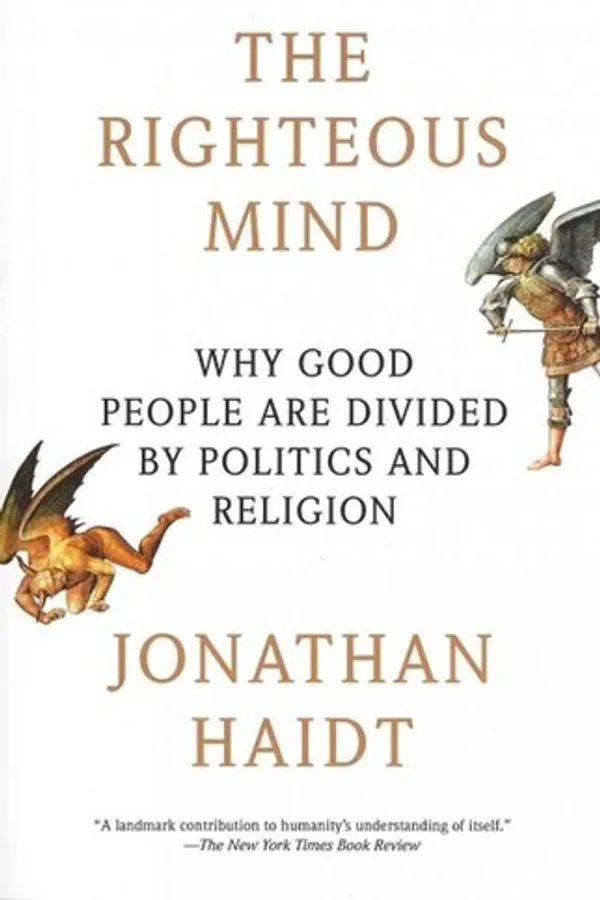
Book
The Righteous Mind
Jonathan Haidt
Moral reasoning is the press office of moral intuition; men are bound into teams by the sacred and blinded by the binding.
- TYPE
- Book
- SHELF
- Psychology & Behavior
- TIME
- 12 min read
- ADDED
- 2026 · 07 · 07
- STATUS
- Completed
- IDEAS
Psychology · Philosophy
Why it matters
It replaced my surprise at other men's convictions with a map of what those convictions are doing for them; disagreement became legible.
Haidt builds the book from three claims, each carried by a metaphor. First, intuitions come first and strategic reasoning second: the mind is a rider on an elephant, and the rider's job is not steering but public relations. In the moral dumbfounding experiments, subjects condemn harmless taboo violations instantly, watch every offered reason get dismantled, and keep the verdict anyway. Second, morality is broader than harm and fairness: drawing on Shweder's fieldwork and on the finding that Western educated subjects are global outliers, Haidt proposes six moral foundations, care, fairness as proportionality, loyalty, authority, sanctity, liberty, and shows political camps cooking different cuisines from the same receptors; the data say conservatives model liberal morality more accurately than the reverse. Third, morality binds and blinds: we are mostly primate and partly bee, equipped with a hive switch that dissolves the self into the team under the right triggers. Religion is examined as binding technology rather than parasite, and institutions are credited with moral capital that reformers spend without seeing. The purpose is diplomatic: moral and political disagreement mapped as colliding matrices rather than a war between reason and evil.
- Moral judgment is instant and intuitive; reasoning arrives afterward as counsel for the defense, which is why refuting a man's reasons so rarely moves his verdict.
- Reason evolved for reputation, not truth: we are press secretaries who believe our own briefings, and accountability improves reasoning only when the audience's views are unknown.
- The moral palate has more receptors than harm and fairness: loyalty, authority, and sanctity are moral tastes, not moral failures.
- WEIRD subjects, Western, educated, industrialized, rich, democratic, are the psychological outliers of the species, and most published morality research is a study of them.
- We are conditional hive creatures: drill, dance, awe, and shared threat can switch the self off into the group, which is the source of both transcendence and atrocity.
- Institutions carry moral capital: accumulated trust and constraint that appears on no ledger until a reform burns it.
The argument
The book opens by taking Hume’s side in a very old fight: the passions command, reason serves, and the modern contribution is the data. Against the rationalist tradition that runs through Kohlberg, in which moral judgment matures as reasoning matures, Haidt sets the social intuitionist model: judgment arrives first, fast and affect-laden, and reasoning follows to justify it. The evidence that made his name is moral dumbfounding. Subjects hear stories engineered to be harmless and repellent at once: adult siblings who try consensual incest with full contraception and tell no one; a family that eats its dog after a car kills it; a woman who cleans with a cut-up flag. Subjects condemn instantly, then hunt for a harm; when each proposed harm is closed off by the story’s design, they do not update. They laugh, admit they cannot say why, and keep the verdict. The judgment was never the conclusion of the reasons; the reasons were employees of the judgment.
Why keep a reasoning faculty at all, if it steers so little? Haidt’s answer is Glaucon’s. The challenge in the Republic, that a man with the ring of Gyges would do as he pleased, is treated not as cynicism to be refuted but as psychology to be measured: we are built to seem good, because reputation, not righteousness, was the survival variable. Reasoning is therefore a press secretary, fluent, loyal, and unembarrassed. Tetlock’s accountability research gives the model its boundary condition: people reason more honestly when they must justify themselves to an audience whose views they cannot predict. Confirmation bias is not a bug in the lawyer; it is the lawyer’s job description. The individual is a poor truth-seeking device, and the book draws the institutional conclusion early: good thinking is a property of well-structured groups, where biases are arranged to collide.
The second movement widens the moral domain. As a young researcher Haidt went to Bhubaneswar expecting to find harm-based morality under exotic custom, and instead found Shweder’s three ethics running at full strength: autonomy, community, divinity, each coherent, only the first of which his training recognized as morality at all. Add the WEIRD finding, that Western educated industrialized rich democratic subjects are outliers on measure after measure, and the discipline’s picture of the moral mind stands revealed as a self-portrait. Moral foundations theory is his repair: the moral sense as a tongue with several receptors, each with an evolutionary story. Care, grown from the long vulnerability of children. Fairness, grown from reciprocity and sharpened, the data forced him to concede, into proportionality rather than equality. Loyalty from coalition; authority from hierarchies that had to be negotiated rather than merely feared; sanctity from the disgust system, guarding the group against contamination physical and social; liberty, added when libertarians and egalitarians alike failed to fit, tuned against bullies and dominators. The political application made the book famous: self-described liberals build their matrix chiefly on care, liberty, and fairness; conservatives use all six more evenly. Asked to answer questionnaires as the other side would, conservatives and moderates model liberals with fair accuracy; liberals, especially the most liberal, miss conservatives badly, unable to believe the other matrix is sincere.
The third movement is the gamble. Humans, Haidt argues, are mostly primate and partly bee: shaped overwhelmingly by individual selection toward selfishness managed by reputation, but carrying a conditional hive switch, an inheritance he defends with multilevel selection. Drill, dance, awe, and shared threat flip it; the self dims, the group brightens, and men will die for the unit they would not die for as individuals. Oxytocin, on the evidence he cites, binds within the group rather than across it. Religion enters here, against the New Atheist account of a parasitic meme: a binding technology, gods as commitment devices, and in the commune data he cites, the religious communes decisively outlasting the secular ones because sacredness makes cooperation cheap to enforce. From this he derives moral capital: the stock of shared norms, institutions, and sacred objects that lets a community extract cooperation from strangers. It is the conservative insight the book asks liberals to price: reforms that ignore moral capital burn an asset no ledger records. The ending is diplomatic by design: morality binds and blinds, everyone is on a team, and the other team is running a different matrix, not a missing one.
Working notes
The pairing with Kahneman is exact: dumbfounding is substitution with a constituency, the elephant is System 1 with a flag planted on it. The pairing with Becker cuts deeper. The Denial of Death reads sacredness as the community’s immortality project, and that is why the sacred question lands as an insult rather than a query: you have priced a man’s death-defense at zero and told him it was analysis. An argument about the sacred is never about the object; it is about the group’s survival wearing the object’s costume.
The Lessons of History stands behind part three like a proof by scale. The Durants, counting civilizations rather than questionnaire subjects, arrive at the same accounting: moral codes are cohesion technology, and a society spends its inherited discipline faster than it replaces it. Haidt found in the survey data what they found in the archive, and convergence between instruments that different is the kind of evidence I trust more than either source alone.
The book changed my conduct in rooms more than my theory of anything. I stopped debating and started mapping: before a charged meeting, list which foundations each side has activated, loyalty here, authority there, sanctity somewhere unexpected. The list predicts the meeting better than the agenda does. Nobody in the room is defending a proposition; every man is defending a membership, and the propositions are the uniforms.
Glaucon, institutionalized, is simply good governance. Assume seeming rather than being, then design so that the honest act and the visible act are the same act: written records, decisions with names attached, audits assumed from the start. Sincerity is not a control. Visibility is a control. Every organization I trust runs on the second and merely hopes for the first.
The press-office model also explains the document that every operator learns to dread: the postmortem that exonerates. Reports drafted after a failure are verdicts hiring reasons, Tetlock’s condition inverted, the audience known and the conclusion pre-sold. The fix is structural: criteria fixed before the outcome, reviewers whose sympathies cannot be forecast. Arranging the second condition is concrete work, not a phrase: the reviewer comes from outside the reporting line, carries no history with the project and no stake in its verdict, and is named only after the failure, so that no draft can be written for a known reader. Tetlock’s condition, restored by administration.
What the book quietly bought me was a reduction in contempt. Reading opponents as running different receptor weights rather than missing data does not make them right, but it makes them legible, and contempt is expensive: it forecloses information and advertises weakness in the same gesture. A second reading showed me the sentence I had skipped the first time through: the book is about the reader’s team. Applied only outward, it becomes one more instrument of the blindness it describes.
Where I push back
Moral foundations theory is a strong taxonomy and a weak theory. The receptor count moves when the data complain, five, then six, fairness split toward proportionality under pressure, and a framework that adds a module whenever it is surprised is a filing system, not a mechanism. Nothing in it predicts which foundation will fire, at what threshold, or how matrices form and dissolve. As anatomy it is useful; as physics it is not there yet, and the book’s confidence does not mark the difference.
The descriptive keeps leaking into the normative. If every matrix binds and blinds, that includes the courteous centrism from which the book is narrated, and Haidt turns the instrument on his own position too gently. Worse, the map disables the very judgment it informs: explain every conviction as a receptor profile and you have quietly made all convictions tastes. Haidt gestures at a Durkheimian utilitarianism to get his footing back, and never pays the philosophical bill. A reader who fully believes the book loses the ground on which he could condemn anything, and the book does not tell him where to stand.
There is a methodological irony the book declines to linger on. The WEIRD critique indicts the field’s samples, and the moral foundations evidence is itself built largely on web questionnaires answered by volunteers self-selected onto a morality website: educated, Western, online. The theory’s reach exceeds its instrument’s, and it is the book’s own best chapter that taught me to notice.
The bee is doing rented work. Multilevel selection remains a minority position in evolutionary biology, and the hive phenomena, drill, awe, self-loss, are explicable through kin selection, reciprocity, and culture without it. The observations survive; the origin story is the weakest joint in the build, and the book leans its most consequential chapter against it.
And there is the standing contradiction: a book of arguments about the futility of argument. Haidt would answer that he is addressing elephants with warmth and story, and he is. But the press secretary who writes a book proving press secretaries cannot be trusted has not exempted his own briefings, and the book never quite faces that.
How it enters the work
On status and power the book is a working manual, and a dangerous one, so I state the practice with its cost. Before proposing any significant change, I map the elephants: whose standing the proposal threatens, whose past decisions it implicitly indicts, which sacred objects it handles. Then the change is presented as loyalty to the institution’s story rather than as an indictment of its authors, because an argument that arrives as an attack on standing will be answered by the standing, not the argument. This is one step from manipulation, and the step is the whole ethics of it. The rule that keeps it honest: use the map to be understood, never to obtain an agreement the argument has not earned on its merits. The day the mapping substitutes for the merits, I have become the press secretary with better tools.
Glaucon governs the architecture. Systems that assume seeming outperform systems that trust being, so the processes I build put decisions in writing, with names and dates, visible by default: reputation made load-bearing instead of decorative. It is not cynicism; it is respect for the actual material. The test of such a system is dull and reliable: when the honest act and the visible act are the same act, the press secretary has nothing left to spin, and the elephant, watched, behaves.
Solitude is the counterweight, and the book is why I schedule it rather than merely enjoy it. The hive switch works on me: conferences, launches, a team in full agreement running on shared adrenaline. The euphoria is real and it is also an editor, rewriting judgment without notification. So the discipline is mechanical: no significant decision inside the hum; a deliberate withdrawal after every immersion, long enough for the borrowed convictions to announce themselves by fading. Solitude is where I check which of my positions are mine and which belong to the team, and this archive is that audit conducted in writing.
What the book finally buys is a listening instrument, and what it must never become is a verdict machine. After the mapping, judgment still has to be passed, alone, on the merits. The map explains the other side. It excuses nothing, on either side.
- Speak to the elephant first: standing, identity, and interest move before arguments do, in others and in you.
- When a position looks insane, find the foundation it protects; the madness is usually a loyalty, an authority, or a sanctity you priced at zero.
- Treat your own reasons as press releases and audit the verdict they were hired to defend.
- Before reforming any working arrangement, estimate the moral capital it holds; the invisible asset is the one you will be billed for.
- After any immersion in a team, take deliberate solitude before deciding anything; the hive edits judgment without notification.
The map is descriptive and the book keeps leaning normative: cataloguing moral matrices licenses no verdict among them, and Haidt's practiced even-handedness is itself a matrix with its own blind spots. The foundations shift in number when the data complain, which is the behavior of a taxonomy, not a mechanism. And the hive argument rests on multilevel selection, a minority position in evolutionary biology; the phenomena are real, the origin story is rented.