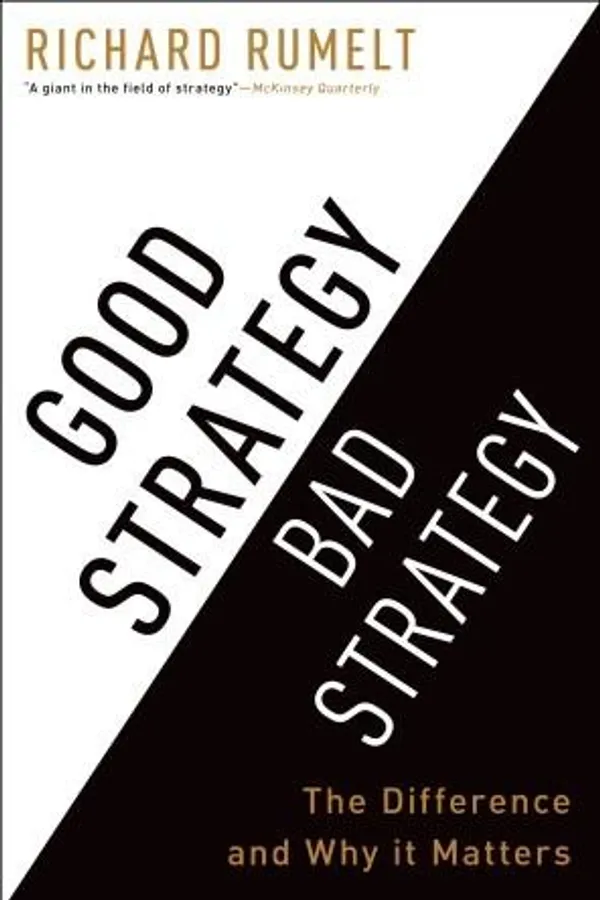
Book
Good Strategy Bad Strategy
Richard P. Rumelt
Strategy is a kernel of diagnosis, guiding policy, and coherent action; whatever lacks any of the three is decoration, however sincere and however expensive.
- TYPE
- Book
- SHELF
- Business & Enterprise
- TIME
- 13 min read
- ADDED
- 2026 · 07 · 07
- STATUS
- Completed
- IDEAS
Business · Strategy
Why it matters
It is the instrument I use to tell strategy from slideware, applied to my own firms before anyone else's.
Rumelt's claim is that good strategy is rare not because insight is rare but because bad strategy is easier and feels like leadership. Bad strategy has field marks: fluff, the jargon that restates the obvious; failure to face the challenge, so nothing in the plan can be evaluated; goals mistaken for strategy, ambition presented as if intent were method; and bad objectives, the list of forty initiatives or the blue-sky target with no bridge to it. Against this he sets the kernel. A diagnosis names what is actually going on. A guiding policy commits to an approach for dealing with the obstacle. Coherent action coordinates resources and moves so they reinforce one another. Around the kernel he arranges the sources of power a policy can draw on: leverage at pivot points, proximate objectives, chain-link systems, design, focus, waves of change, and the inertia and entropy of rivals. The examples run from Trafalgar to the desert war to discount retail, and the thread is constant: strategy is a designed response to a diagnosed challenge, it concentrates strength where it counts, and it therefore requires saying no.
- The kernel has three parts: diagnosis, guiding policy, coherent action. A document missing any one of them is not a strategy, whatever its title page says.
- Bad strategy is not the absence of good strategy; it is a positive species with identifiable marks: fluff, ducked challenges, goals dressed as methods, and incoherent objectives.
- Good strategy is concentration: the focused application of strength against a diagnosed weakness. It therefore creates losers inside the building, which is why committees rarely produce it.
- Diagnosis is the strategic act. Get it wrong and everything downstream is efficient nonsense; change it, as Gerstner did at IBM, and the same assets point in a new direction.
- Proximate objectives: leaders earn their keep by choosing targets close enough to be hit, and feasibility is a design input, not a compromise.
- In a chain-link system the whole is limited by the weakest link, so excellence in one link is wasted unless matched across all of them; coherence is what makes such systems nearly impossible to copy piecemeal.
- A strategy is a hypothesis about what will work. It deserves stated conditions of refutation and the scientist's readiness to be wrong.
The argument
Rumelt opens off Cape Trafalgar. Nelson, outnumbered, facing a combined fleet whose commanders knew the conventions of line battle as well as he did, split his own fleet into two columns and drove them perpendicular into the enemy line, accepting terrible risk to his lead ships in exchange for cutting the enemy into fragments that could not support one another. The point is not audacity. The point is that good strategy is a designed response to a specific, diagnosed situation; that it concentrates strength against weakness; and that it is rare because design and concentration both require choices most leaders will not make. His modern twin is the desert war of 1991: the enveloping left hook that crushed the Iraqi army was standard doctrine, available in every staff manual, and the world reacted as if it were sorcery. The surprise was not the maneuver. The surprise was that a large modern institution had actually chosen a focused strategy instead of distributing effort fairly among its parts, and Rumelt wants the reader to sit with what that astonishment implies about the default.
Against this he sets the anatomy of bad strategy, the book’s most valuable instrument, because bad strategy is not an absence but a species with field marks. Fluff: jargon that restates the obvious with borrowed gravity. Failure to face the challenge: if the document never defines the obstacle, nothing in it can be evaluated, and most documents never do. Mistaking goals for strategy: ambition, growth targets, and willpower presented as if the intent were the method. And bad strategic objectives: the dog’s dinner of forty initiatives that no resource base could honor, or the blue-sky target connected to the present by nothing. His specimen is a chief executive whose entire plan was twenty percent revenue growth and twenty percent margins, to be achieved by believing in them with sufficient intensity; Rumelt declined the engagement, and the pages explaining the refusal are worth most strategy retainers. Bad strategy, he argues, is not stupidity. It is avoidance. Choice is painful, choice forecloses, choice makes enemies of the options not chosen, and the template ritual of vision, mission, values, and goals lets an organization feel strategic while deciding nothing. He traces the style’s ancestry to the mind-cure movements of the nineteenth century, the doctrine that thinking makes it so, migrated from revival tents into corporate off-sites with its theology largely intact.
The alternative is the kernel, three parts and no more. A diagnosis that names what is actually going on, simplifying the situation to its critical aspects; a guiding policy, an overall approach chosen from many possible approaches, that channels action without dictating it; and coherent action, resources and moves coordinated so they reinforce rather than merely coexist. Each part disciplines the others. His cleanest case is Gerstner’s IBM: the fashionable diagnosis said the company was too integrated and should be broken into pieces, and Gerstner’s diagnosis said integration was the one asset no rival possessed; the guiding policy, stay whole and sell what the pieces could do together, reversed the company’s direction because the diagnosis had.
The back half assembles the sources of power a guiding policy can draw on, and the chapters deserve unequal attention; two of them carry the book. Proximate objectives first. Kennedy’s moon commitment sounded like pure audacity and was, in Rumelt’s telling, carefully proximate: each enabling step had already been judged feasible by the people who had done the engineering, so the goal was extravagant in sum and buildable in sequence. An objective nobody can engineer against is an ambition, not an instruction, and choosing the target that can actually be struck is not timidity; it is the strategic act. Chain-link systems second. Where the whole is limited by the weakest link, excellence in one link is wasted unless matched across all of them, which is why a coherent system like IKEA’s resists piecemeal imitation, and why turning around a chain-linked failure is so thankless: every link must be raised before any reward appears, so the early work reads as waste to anyone watching the quarterly numbers. The remaining sources, leverage at pivot points, design under scarcity, focus on a defensible segment, the harvest of rivals’ inertia and entropy, run the same logic of concentration through different terrain. The Walmart chapter distills the method. Every student recites that discount retail required towns of a certain size and Walton defied the rule; the working insight is that Walton changed the unit of analysis, because the store was never the thing. The network of stores, trucks, and data was the thing, and Kmart’s decentralized doctrine could not copy the network without repealing itself.
The close turns inward. A strategy is a hypothesis, the strategist a scientist obliged to say what would refute him; and because the first answer is almost never the best and almost always defended, Rumelt trains himself to convene an imagined panel of the toughest minds he knows and let them attack it. The book ends where it began: strategy is design plus nerve, and both are choices.
Working notes
The kernel is the highest-yield diagnostic instrument I have taken from any business book. Hold a strategy document against it and the verdict arrives in minutes: most enterprise strategies are goals wearing a diagnosis costume, and most transformation programs are coherent action orphaned from any diagnosis at all. A list of ambitions is a letter to Santa Claus. A strategy is an argument, and arguments can be wrong, which is precisely what the authors of lists are avoiding.
Rumelt also supplies the frame that makes the older strategy shelf legible. Liddell Hart’s indirect approach is a family of guiding policies; Sun Tzu’s economy of force is concentration doctrine with the arithmetic removed; Trafalgar and the left hook are the same design separated by two centuries. Read this book first and the classics stop being aphorisms and become engineering worked in different materials.
Proximate objectives took a second reading to land. The first time through, the chapter reads as a plea for modest goals; it is actually a doctrine about the division of labor between leader and led. The leader absorbs the ambiguity and hands down a target concrete enough to be engineered against; hand down the ambiguity itself and you have not led, you have delegated your job with a vision statement stapled to it. Most of what enterprises call empowerment is exactly that handoff, and the teams on the receiving end know it.
The observation that has aged best in my hands is that bad strategy is a peace treaty. The forty-initiative list does not exist because nobody could prioritize; it exists so that no executive loses. Good strategy creates losers inside the building before it creates winners outside it, and that ordering, not any analytic difficulty, is why it is rare. Strategy work is therefore political expenditure wearing analytic dress, and the analyst who does not know this will produce beautiful kernels that die in committee.
The Halo Effect belongs beside this book as its corrective lens. Rumelt’s specimens are chosen after the outcomes are known, and the same concentrated designs would read as recklessness in the counterfactual histories where the wind shifted. He is strongest exactly where hindsight matters least: the anatomy of bad strategy needs no halo, because fluff is fluff before the returns come in. I trust the pathology chapters completely and the trophy cases at a discount.
And a craftsman’s note: the diagnosis chapter quietly describes my trade. What a client calls the problem is a symptom voted acceptable to name. The moment of value in consulting is the renaming, and it is bought rarely, because a true diagnosis usually has an author list of the people who signed the last one.
Where I push back
The book is stronger at pathology than at generation. The anatomy of bad strategy is close to definitive; the sources of power are a museum tour, well lit and well labeled, from which you exit able to recognize a strategy without being much closer to conjuring one. Rumelt would answer that recognition is the scarce skill, and he is half right. The other half is that the generative act, producing a live guiding policy under uncertainty and political constraint, remains as untaught after the book as before it, and the confidence of the prose conceals that.
Second, the hindsight problem is real and underpriced. Nelson’s design succeeded and is genius; a shift of wind and the same design is a cautionary tale about dividing a fleet under fire. Rumelt writes as if design quality and outcome quality were tightly coupled, and every trader knows they are not; luck sits between them, and the book gives luck no chapter. The pathology diagnoses survive this objection. The trophy cases do not, entirely; their honest use is grammatical, teaching what a designed strategy looks like from inside, not how often design wins.
Third, the kernel is already being Goodharted. I have sat through kernel-shaped decks, diagnosis on slide three, guiding policy on slide four, coherent action in an appendix of forty initiatives, and the fluff simply moved into better-labeled containers. Form does not guarantee thought. Rumelt knows this; his readers’ employers mostly do not.
Last, the book explains bad strategy as intellectual failure when much of it is moral failure with better manners. A chief executive who accepts a true diagnosis often indicts his own tenure; fluff persists not because people cannot think but because thinking, out loud and in writing, is unsafe. The book gestures at this and moves on. It deserved the full chapter that courage never gets in the strategy literature.
How it enters the work
At Intelliblitz the kernel is the engagement gate. No roadmap, no platform selection, no architecture until there is a one-sentence diagnosis the client’s own leadership will sign, because coherent action against a wrong diagnosis is the most expensive product my industry sells. The firm also runs on its own kernel. The diagnosis: enterprises are structurally dependent on systems they do not understand and do not own. The guiding policy: build systems the client owns and can operate without us. The coherent action is everything that follows, including the engagements we refuse; a guiding policy that has never declined revenue is fluff with a bank account.
At BlockHedge the book translates without modification, because a trading thesis is a kernel. Diagnosis: the specific mispricing and the mechanism producing it. Guiding policy: the family of exposures that gets paid if the diagnosis is right. Coherent action: sizing, hedges, and invalidation levels that all serve the same claim. Most market commentary fails Rumelt at the first clause; a price target without a mispricing mechanism is a goal mistaken for a strategy, and the market grades that confusion harshly and promptly. The refutation-conditions habit is now mandate language: a thesis states in advance what evidence kills it, and the review runs on a calendar, not on a mood. Chain-link logic polices the desk as well: execution, custody, and risk reporting are links in one chain, and an upgrade to any one of them buys nothing until the weakest is raised to match it.
Capital formation is where the field marks earn most, because BlockHedge works the border where traditional finance meets crypto, and on that border capital forms in public. A project’s whitepaper is its strategy document, and most fail Rumelt in the first paragraph: vision offered as diagnosis, market size as guiding policy, a token schedule as coherent action. The sorting test is the one a trading thesis already answers: name the proximate objective, the next provable step, and ask whether the capital sought is sized to that step or to the ten-year dream. Money raised against the dream is a bad strategic objective with a treasury attached, and treasuries spend faster than dreams mature. A thesis on any such project begins with that diagnosis, made before the appendix of initiatives can bury it.
- Refuse to call anything a strategy until its diagnosis fits in one sentence a non-expert can evaluate.
- If the plan does not say no to something large, it is a budget, not a strategy.
- Set proximate objectives; ambition without a feasible next target is prayer.
- Translate every strategic sentence into plain words; whatever dies in translation was never alive.
- State in advance what evidence would prove the strategy wrong, and review against it on a calendar, not a mood.
The kernel is clean enough to become another template, and consultancies now sell kernel-shaped decks with the same fluff inside. The case studies are read backward from known outcomes, so the same designs would read as recklessness had the coin landed otherwise. And the book treats diagnosis as an intellectual act when inside an organization it is a political one: naming the problem allocates blame, which is why so few real diagnoses get signed.