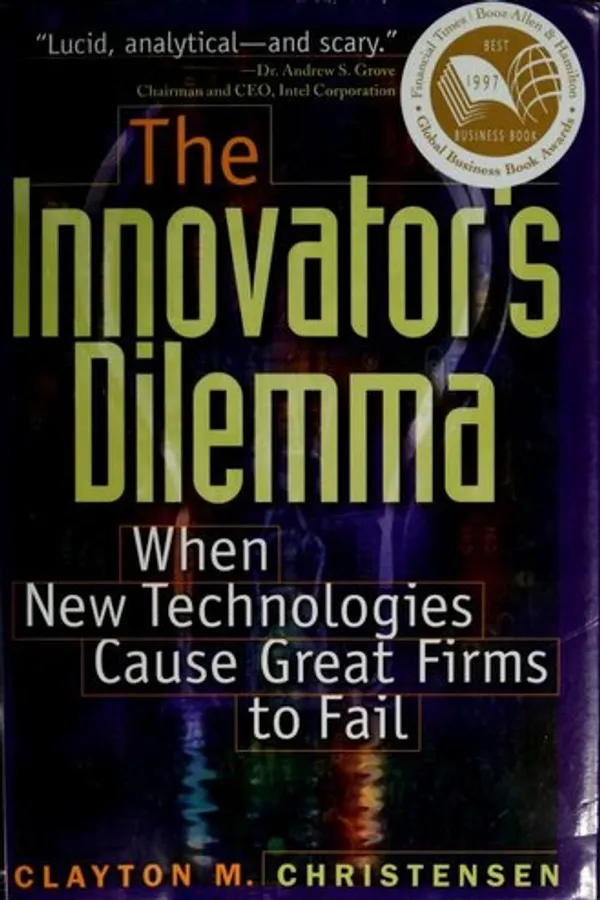
Book
The Innovator's Dilemma
Clayton M. Christensen
Great companies fail not despite good management but through it: the disciplines that serve existing customers are the same mechanism that surrenders the future.
- TYPE
- Book
- SHELF
- Business & Enterprise
- TIME
- 13 min read
- ADDED
- 2026 · 07 · 07
- STATUS
- Completed
- IDEAS
Business · Technology
Why it matters
I sell technology change to incumbents for a living; this is the book that explains why the most capable clients are the ones most at risk.
Christensen asks why well-run companies, the ones with the best customers and the most disciplined processes, fail when a particular kind of technology arrives. His laboratory is the disk-drive industry, chosen because its generations turned over fast enough to watch the pattern repeat. When innovation improved the performance existing customers valued, incumbents won, however hard the engineering. When innovation was architecturally modest but redefined the market, smaller, cheaper, worse on the metric that mattered and better on one that did not yet matter, incumbents lost almost every time. The mechanism is the value network: a firm perceives opportunity through its customers, margins, and cost structure, so its rational resource allocation steers it away from footholds that later become the market. Technology improves faster than demand grows; the inferior product marches upmarket; the fortress falls without a single stupid decision inside it. The prescriptions follow from the causes: house the disruptive effort in a separate organization small enough to be excited by the foothold, plan to learn rather than to execute, and never ask a value network to act against its own economics.
- Sustaining innovation improves the dominant performance metric for existing customers, and incumbents almost always win those contests regardless of technical difficulty.
- Disruption redefines the metric: worse on what the mainstream values, better on what a fringe values, and the fringe grows into the mainstream because technology improves faster than demand does.
- Value networks, not org charts, allocate resources: a firm's sense of what performance means, what margins are acceptable, and what markets are worth entering is set by the network it lives in.
- Resource dependence runs deep; disruptive proposals are killed rationally in the middle of the organization, by good managers doing their jobs, before any executive votes.
- Small markets cannot solve the growth problems of large companies, so the footholds that matter most are structurally invisible to the firms with the most to lose.
- Markets that do not exist cannot be analyzed. The first plan for a disruptive product is wrong by default, and resources must be reserved for the second and third try.
- When performance overshoots what the market can absorb, the basis of competition shifts: from functionality to reliability to convenience to price, and yesterday's excellence stops being paid for.
The argument
Christensen’s question is narrow and the narrowness is the achievement: why do well-managed companies, the ones with the best customers, the deepest engineering, and the most rigorous allocation processes, fail when a certain kind of technology arrives? Not why bad companies fail. Why the good ones do. His laboratory is the disk-drive industry, chosen the way geneticists choose fruit flies: generations were short enough that leadership and death could be observed across repeated cycles, from fourteen-inch drives for mainframes to eight-inch for minicomputers to five-and-a-quarter for desktops to three-and-a-half for portables. The record splits cleanly. When the innovation was sustaining, improving the capacity and cost per megabyte that existing customers already valued, the incumbents won almost regardless of technical difficulty; the established leaders mastered even the most demanding component transitions. When the innovation was architecturally simple but redefined the market, a smaller drive inferior on the dominant metric, the leaders lost nearly every time, and the entrants who beat them were not run by better managers. They were embedded in different economics.
The mechanism is the value network. A firm does not perceive markets directly; it perceives them through its customers, its cost structure, and its margins, which together define what performance means, what an acceptable profit looks like, and what size of opportunity is worth a meeting. The maker of fourteen-inch drives asked its mainframe customers about the eight-inch drive, and those customers, accurately reporting their needs, said no: less capacity, no thanks. So the incumbent’s disciplined resource allocation steered investment back into what its best customers wanted, which is what disciplined resource allocation is for. Meanwhile the entrant camped in a network the incumbent’s economics could not see, and both products improved at the pace technology allowed, which was faster than the pace any market’s demands grew. The trajectories cross. The disruptive product becomes good enough for the mainstream while keeping its advantages of cost and simplicity, and the fortress is taken from below without a single stupid decision inside it. That is the dilemma of the title: the practices that constitute good management, listening to customers and investing where the margins are, are the failure mechanism itself.
Christensen hardens the story into principles. Resource dependence: companies are captives of their customers and investors, and disruptive proposals die rationally in the middle layers, filtered out by good managers protecting the numbers, long before executives vote on anything. Small markets cannot solve the growth problems of large companies: a foothold that would transform a startup is a rounding error to a giant, so the giant’s processes are correct to ignore it, and correctness is the trap. Markets that do not exist cannot be analyzed: the data the planning process demands is unavailable precisely when the opportunity is real, so planning must be discovery, with the first plan assumed wrong and resources reserved for the revisions. And capability lives in processes and values, not only in people: hiring different engineers does not change what an organization can do, because the organization is itself a machine tuned to its network, and asking it to disrupt itself is asking a tuned machine to detune on command.
The corroboration reaches outside disk drives. Mechanical excavators: hydraulic backhoes arrived as toys for narrow residential trenches, dismissed by contractors who moved earth by the cubic yard, and improved until the cable-shovel makers were nearly all gone. Steel minimills: the integrated mills ceded rebar gladly, because rebar carried their worst margins, and every later retreat, to angles, then structural shapes, then sheet, raised their average margins again, so each step of the surrender was rewarded by their own accounting. Overshoot completes the model: once performance exceeds what a tier of the market can absorb, the basis of competition shifts, from functionality to reliability to convenience to price, and the incumbent’s costly excellence stops commanding a premium at exactly the moment its cost structure depends on one.
The prescriptions follow from the causes rather than from exhortation. You do not defeat resource dependence with speeches about innovation; you create a separate organization embedded in the new value network, small enough that the foothold feels like victory, free to carry its own cost structure and its own definition of good. You match the organization to the task, because processes and values that make a firm excellent at sustaining work actively disable it for disruption. And you plan to learn: agnostic about who the customer will be, cheap enough to be wrong twice. The book closes by running the framework forward on the electric vehicle, a demonstration that the theory is meant to be used prospectively, not recited at funerals.
Working notes
The quietest big idea in the book is that margins are a gravitational field. Every firm drifts toward its most demanding, highest-margin customers, and the drift is invisible because every individual step is a promotion, a bonus, a good quarter. The integrated steel executives who abandoned rebar were not blind; their instruments rewarded the surrender in installments. When I want to know where a company will be in ten years, I no longer read its vision statement. I look at which customers it is proudest of, and assume the drift.
Read beside Rumelt, the two books form one argument. Rumelt names inertia and entropy as the strategist’s richest source of opportunity; Christensen supplies the mechanism, the value network that makes the incumbent’s paralysis rational rather than lazy. One is the anatomy of the rot, the other the doctrine for exploiting it. And Zero to One sits on the far side: Thiel counsels escape from competition, and Christensen shows why the escape route through the low end is so reliably unguarded. The incumbent is not asleep. It is diligently maximizing, which is better than asleep, because maximizing is predictable.
What separates the book from its shelf is instrument design, a virtue rarer in business writing than good prose. Most management books photograph winners at a single moment and call the survivors a sample; Christensen built an apparatus that could catch the same experiment rerunning, which is why his mechanism still holds while his contemporaries read like horoscopes.
The framework also reads inward, and nobody warns you about that. A career is a value network: the clients who pay best, the skills they pay for, the margins a man grows used to. The same rational filter that kills the incumbent’s foothold projects kills his own. The work that will matter in ten years arrives disguised as a poor use of this week, undersized and underpaying, and he declines it with the disciplined good sense of a fourteen-inch executive. I have caught the mechanism running in my own scheduling, and the catching is the whole defense, because this drift never announces itself either; it arrives as good news, one flattering engagement at a time.
The theory is about demand, not technology, and this is the most common misreading. The disruptive technology is usually pedestrian; the smaller drive was not a research triumph, it was a bet that somebody would pay for smallness before they paid for capacity. The innovation is the customer. Firms that scan for threats by reading engineering journals are watching the wrong door, because the door the theory names is a spreadsheet: some entrant’s cost structure that makes your worst customer their best one.
What the book taught me to distrust is the comfort of the improving graph. Every metric an incumbent tracks improves right up to the failure: share of the high end rises, margins rise, customer satisfaction among remaining customers rises. The numbers are not lying; they are measuring a shrinking kingdom with growing precision. It is the same lesson the trading desk already knew in another dialect: the account statement of a man selling tail risk looks magnificent until the day it does not.
Where I push back
The theory’s unit of analysis is a free parameter, and free parameters are how frameworks stop being falsifiable. Disruptive relative to which value network, measured from which incumbent? Choose after the fact and every outcome confirms the theory; choose before the fact and the choice is where all the difficulty lives. Christensen’s own famous miss makes the point: he read the iPhone as a sustaining improvement relative to the incumbent handset makers and expected them to hold it off, and it gutted the personal computer instead. The instructive part is not that a scholar guessed wrong. It is that the theory offered no principled way to pick the network that mattered, and a theory whose hardest step is unformalized is a taxonomy with confidence.
Second, the empirical record is tidier in the book than in the industry. Later critics who went back through the disk-drive history found survivors the pattern says should be dead and transitions the leaders crossed successfully. Histories sampled on failure flatter their patterns; The Halo Effect applies to this shelf too, including its best occupant.
Third, the prescription has aged worse than the diagnosis. The autonomous spin-out has a long record now, and it is mixed at best: the parent either strangles the unit with its own values, exactly as the theory predicts, or starves it at the first recession, which the theory does not dwell on. Structural separation solves the resource-dependence problem on the org chart and reproduces it in the capital allocation cycle.
Last, the book treats corporate survival as the goal by definition, and a capital allocator should refuse the premise. Firms exist for their owners, not for immortality; there are industries where the rational strategy is to harvest the decline and return the cash, and The Outsiders documents executives who created fortunes doing exactly that. Christensen writes as if death were failure. Sometimes death is the dividend.
How it enters the work
My clients are incumbents, and the book explains the exact shape of their hesitation about AI. An enterprise IT department is a value network that prices reliability, auditability, and compliance, because those are the metrics its internal customers invoice it on; measured on that scale, early AI systems look like toys, and the pilots die in committee precisely as the theory predicts, killed rationally by good managers. The Intelliblitz playbook is Christensen’s prescription made concrete: scope the system to a foothold where the current standard is nothing at all, the analysis nobody could afford, the reconciliation nobody had headcount for, so the toy competes against nonconsumption instead of against the incumbent metric. Let it earn its reliability in production, then march upmarket inside the client’s own walls. And the ownership rule matters here too: a client who rents intelligence from a vendor’s roadmap has outsourced its resource dependence, not escaped it.
The sorting question is now standing practice in every AI architecture engagement: is this capability sustaining or disruptive relative to this organization’s value network? Sustaining work, making an existing process faster on its existing metric, should run through the normal machinery, because incumbent processes win sustaining fights. Disruptive work gets the separate context: a small team, its own definition of good, success criteria a foothold can actually meet, and a plan whose first version is formally expected to be wrong.
The overshoot lens rounds out the architecture reviews. Enterprise portfolios are full of systems still being polished past any conceivable demand: reports rendered at a fidelity nobody reads, internal tools engineered to availability targets nobody would miss for an hour. Where performance has overshot, the basis of competition has already shifted to convenience and price, and the honest architectural response is commoditization and decommissioning, not another release. Christensen taught me to say that out loud: the point where a system stops deserving excellence is a finding, not an insult, and clients who accept it fund the foothold work with what the polishing used to cost. That trade, excellence withdrawn from the overshot and reinvested at the frontier, is the whole book compressed into a budget line.
- Classify every innovation first: sustaining or disruptive relative to your value network. The answer decides who will win and what kind of organization can do the work.
- Watch the low end and the nonconsumers, not just the feature race among the top competitors.
- Size the team and the cost structure to the foothold, not to the ambition; the market must feel like a victory to somebody.
- In new markets, spend to discover the market, not to execute the plan; budget for being wrong about the first customer.
- Audit where performance has overshot demand; that is where the basis of competition is about to change, in your products and in your systems.
The word disruption has been eroded into a synonym for new, and most of what carries the label would fail the book's own definitions. The theory's unit of analysis, which value network you measure from, is a free parameter, and free parameters let careless readers explain everything and predict nothing; Christensen's own misreading of the iPhone shows the edge condition. Read it as a precise mechanism, not a universal account of incumbent failure.