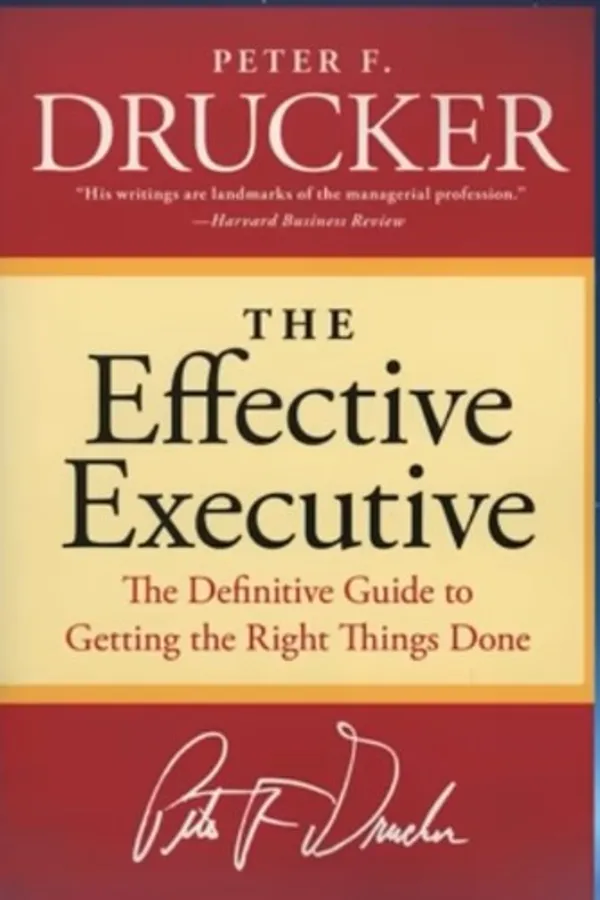
Book
The Effective Executive
Peter F. Drucker
Effectiveness is not a talent but a practice: five habits, learnable by anyone willing to be bored by repetition, and without them intelligence is only overhead.
- TYPE
- Book
- SHELF
- Business & Enterprise
- TIME
- 13 min read
- ADDED
- 2026 · 07 · 07
- STATUS
- Completed
- IDEAS
Business · Systems
Why it matters
It is the base layer under every operating role I hold; before leverage, before strategy, a man has to make his own hours produce.
Drucker begins with an observation that has not aged: organizations are full of intelligent, imaginative, knowledgeable executives, and effective ones are rare. The difference is not temperament. Effectiveness is a set of practices, and practices can be learned the way multiplication tables are learned: by repetition until they become character. He names five. Record where your time actually goes, prune what wastes it, and consolidate what remains into blocks large enough to matter. Ask what you can contribute to the institution's results, not what the institution owes your role. Staff and build on strength, your own and other people's, so that weakness becomes irrelevant to output. Concentrate on the few tasks where superior performance produces visible results, which requires the sterner discipline of abandoning yesterday's commitments. And make the important decisions as judgments at the level of principle: few, slow, and fed by organized disagreement rather than consensus. The knowledge worker cannot be supervised into productivity; he must direct himself, and this book is the manual for that self-direction. It is short, plain, and severe, and it has outlived every management fashion that promised to replace it.
- Effectiveness can be learned, and must be: no gift substitutes for the practices, and the practices ask nothing but repetition until they harden into habit.
- The executive is defined by responsibility, not rank: anyone whose decisions materially affect the organization's capacity to perform holds the job, with or without the title.
- Time is the limiting resource and memory lies about it. Record time as it is spent, cut the recurring waste, and consolidate the discretionary remainder into continuous blocks; fragmented time is spent, not used.
- The question that converts a specialist into an executive points outward: what can I contribute that changes the results of the whole. Effort that cannot answer it is cost.
- Staff on strength. Ask what a man can do, not what he cannot; design jobs big enough for strength to show; make weakness irrelevant through structure rather than reformed through sermons.
- First things first means one thing at a time, and it is enforced by posteriorities: the deliberate abandonment of whatever we would not start today if we were not already doing it.
- Important decisions are judgments between alternatives, made at the level of principle and fed by dissent. A decision reached in comfortable unanimity has not yet been made.
The argument
Drucker starts from a fact he spent decades verifying inside client organizations: brilliance does not predict results. He had watched brilliant executives produce nothing durable and men of modest gifts build institutions; the difference lay in a small set of acquired habits. Effectiveness, he insists, is not a personality. There is no effective type. The effective executives he knew were extroverts and recluses, generalists and monomaniacs, warm men and cold ones. What they shared was practice, in the musician’s sense of the word: the same drills, performed until they stopped being effortful and became character.
The book’s definition of the executive is quietly radical. Rank does not make the job; responsibility does. Anyone whose decisions materially affect the organization’s capacity to perform is an executive, including the specialist who never manages a soul, and the definition matters because knowledge work cannot be supervised. A foreman can watch a lathe operator and count pieces; nobody can watch a man think and tell whether he is producing. The knowledge worker must direct himself, and self-direction, ungoverned, defaults to busyness. The rest of the book is the governance.
Before the practices, the diagnosis. Four realities press every executive toward ineffectiveness. His time belongs to everyone else; the day is consumed by claims he did not originate. He is forced to keep operating, responding to the flow of events, unless he acts deliberately to change what reaches him. He is effective only through other people who use what he contributes, which means his output is hostage to their comprehension. And he lives inside the organization while every result lives outside it; nothing that happens within the walls is a result, only cost. Left alone, these four currents carry a capable man into a busy, respected, useless career.
Then the five practices. First, time. Drucker refuses to begin with planning, because plans made before the facts are fiction. Record where time actually goes, as it goes, because memory is a flatterer. The record will show that the discretionary remainder is smaller than feared and shredded into fragments, and fragments are useless for the work that matters, because thought has a setup cost. So cut the recurring waste, most of which is malorganization wearing the mask of duty: the crisis that returns annually is a system defect, not an event; the meeting that decides nothing is a structure failing in public. Then consolidate what remains into continuous blocks.
Second, contribution. The effective executive asks what he can contribute that will significantly affect the performance of the institution, and the question is a compass needle pointing outward, to results in the market, in patients, in readers, wherever the institution touches the world. The question rescues the specialist from his specialty. The man who asks it is forced to make himself understood by people who do not share his discipline, and forced to care about their output, and in that turn a chemist or an accountant becomes an executive.
Third, strength. Drucker’s staffing rule is to ask what a man can do superbly, fill positions on that answer, and arrange the structure so his weaknesses are irrelevant. He offers Lincoln appointing Grant, fully warned about the drinking, because Grant won battles; the appointment was staffing on strength, and it decided a war. Jobs must be made big enough that strength has room to show, and the rule runs upward too: managing a superior means building on what he does well. The alternative, staffing to avoid weakness, produces the organization of the mediocre, safe at every position and capable of nothing.
Fourth, concentration. First things first, one at a time; effectiveness in the executive job means doing the few right things with full force. The gate is not the priority list, which anyone can write, but the posteriority list, which takes courage: the deliberate sloughing off of yesterday. His test is permanent equipment in my kit. If we were not already doing this, would we begin it today? If not, the only question is how fast to get out.
Fifth, decision. Effective executives make few decisions, slowly, at the level of principle. Most events that present as crises are generic, and generic events deserve a rule, not a fresh heroic judgment; solving the same problem weekly is not diligence but a design failure. A real decision starts from opinions rather than facts, because facts are selected by the hypothesis that goes looking for them. It defines its boundary conditions, the minimum it must accomplish to be worth making. It builds execution into itself, naming who does what by when, or it remains a good intention. And it feeds on dissent: Drucker tells of Sloan adjourning a General Motors committee that had reached easy unanimity, sending the matter back until someone could produce real disagreement. He gives Theodore Vail, who defined Bell’s business as service, embraced public regulation while his peers fought it, and built a laboratory assigned to make the company’s current technology obsolete on its own schedule: decisions at the level of principle, each one wrong by the conventions of its day, each one still standing when the conventions were gone.
Working notes
Drucker and Grove divide one territory without overlapping. Drucker settles what an executive is for; Grove settles what Tuesday looks like. One writes the constitution, the other the traffic code, and a manager needs both jurisdictions: contribution without a calendar is philosophy, a calendar without contribution a well-run errand. Questions that survive both books are real.
The time chapter has appreciated the way waterfront property appreciates: no more of the resource is being made, and the neighborhood got louder. Drucker fought the telephone and the ceremonial lunch; we fight machinery engineered by the best-funded companies in history to shred attention and sell the pieces. His remedy did not change, because it cannot: the record, not the resolution. Every time I log a working week honestly, the log embarrasses me, and the embarrassment is the product. Memory reports a week of building; the record shows a week of reacting, punctuated by building. No plan survives contact with the calendar, and only the calendar tells the truth.
The contribution question is an altitude instrument. Asked honestly, it deletes most of a professional’s activity, because most activity is defensible at the level of the role and indefensible at the level of the institution. It is also the closest thing the management canon has to my own operating rule, find the structure and remove everything that is not it: contribution is the structure of a job, and everything that cannot answer the question is the everything else.
Planned abandonment is the least practiced idea in the entire literature. Organizations are accretion machines; every initiative arrives with a sponsor and departs with none, so the portfolio only grows. Drucker’s question supplies the missing funeral. I have seen more capacity released by one honest abandonment review than by any hiring plan, and I have watched companies decline while every project inside them was, by its own lights, succeeding.
The decision chapter is secretly a probability document. Start from opinions and test them against results; require dissent before commitment; define in advance what the decision must accomplish. That is a speculator’s checklist wearing a suit: hypothesis, falsification, boundary conditions set before the position is taken. Drucker was not writing for traders, but he understood that unanimity is not evidence, it is a sampling failure, and that the cheapest place to meet the counterargument is before the commitment rather than after.
The examples have grayed; the argument has not, and the difference is evidence for the thesis. Techniques date, practices ripen, and an hour recorded or a contribution named asks nothing of the machinery around it. What the decades took is the loyalty Drucker assumed between institution and man, and that loss indicts the reader’s complacency, not the book.
Where I push back
The executive of this book works in an institution scrubbed of politics. Nobody in Drucker sabotages a rival, hoards information, or profits from a colleague’s failure; contribution is always legible and always rewarded. Years in and around large organizations have not shown me that institution. Power is a load-bearing fact of organizational life, and a man armed only with Drucker will be repeatedly outmaneuvered by men armed with Machiavelli. The disciplines are necessary; the book’s silence about the arena in which they are exercised is a real hole, not an omitted detail.
Second, build on strength has a failure mode Drucker does not police. There are weaknesses that structure cannot make irrelevant: the brilliant architect who cannot tell a client the truth, the rainmaker who burns every junior assigned to him. Strength-based staffing degenerates, in weak hands, into a doctrine of tolerated damage, and the book’s confidence that weakness can always be designed around hands the weak manager his alibi.
Third, the book places the entire burden of effectiveness on the individual, and Deming would object with statistics on his side: the system defeats individual virtue routinely. An effective executive inside a badly designed organization produces beautifully consolidated hours of work that the structure then wastes. Drucker knows organizations shape men; he still writes as if self-development were sovereign. It is necessary and it is not sufficient, and the difference between those two words is a career.
Last, the time discipline can curdle into time worship. I have met executives who audit their calendars with monastic rigor and have not had a new thought in years; the log is immaculate and the output is efficient emptiness. Drucker would say they skipped the contribution question. True. But the book makes the mechanical practice easier to adopt than the moral one, and most adopters take the easier half.
How it enters the work
Intelliblitz is built on the contribution question. A consultancy’s occupational disease is activity: decks, workshops, status calls, all billable, all defensible, none of it a result. The firm’s rule that a client should own the system rather than rent the dependency is Drucker’s outward question hardened into a business model: the contribution is what runs after we leave. Every engagement gets the question at the gate: what changes for the client’s business, stated in their numbers, not ours? Work that cannot answer is declined, and the declining has cost real revenue and been right every time.
The decision chapter runs the architecture practice. Enterprise environments generate the same failures on a schedule, and each recurrence is treated locally as a fresh crisis: the integration that breaks every quarter, the access request that escalates every week. Drucker’s distinction between generic and unique events is the sorting instrument. A recurring exception is not an incident; it is an unwritten rule, and the deliverable is the rule. A fair fraction of what clients buy from me as architecture is this chapter applied: find the class behind the cases, decide it once at the level of principle, and build the execution in so the decision does not evaporate into agreement.
The time discipline is personal infrastructure. Twice a year I run the honest log, and it has never once failed to find a leak; the recurring offenders are meetings that exist because they existed and availability offered as a courtesy that hardened into an obligation. The work that matters, an architecture, an essay, a decision worth the name, happens only in consolidated blocks, mornings guarded like collateral, and Drucker is the reason they are guarded. The abandonment question gets the same cadence and reaches further: services still offered, tools still running, commitments still honored out of inertia. If we were not already doing it, would we start today? Discipline, in this book’s version, is not intensity. It is the refusal to let yesterday allocate tomorrow, enforced twice a year with a log and a list, and it is the least glamorous and highest-yield practice I own.
- Log a real week twice a year, in real time. The calendar does not flatter; memory does.
- Before accepting any task, name the contribution it makes to results outside your own function; if you cannot, decline it or kill it.
- Staff, delegate, and partner on strength; engineer around weakness instead of moralizing at it.
- Run the abandonment question quarterly: what would we not start today if we were not already in it.
- Treat recurring problems as rules to be written once, not fires to be fought weekly.
- Never finalize an important decision without hearing a real dissent; if none exists, manufacture one before you commit.
Drucker's executive lives in a clean institution: no politics, no knives, no superior who profits from a subordinate's ineffectiveness. The book is silent on power, and a reader who takes it as a complete map will be outmaneuvered by people who read other books. Its counsel to build on strength is also easily bent into an excuse for never repairing a disqualifying weakness. Take it as the discipline layer, not the whole game.