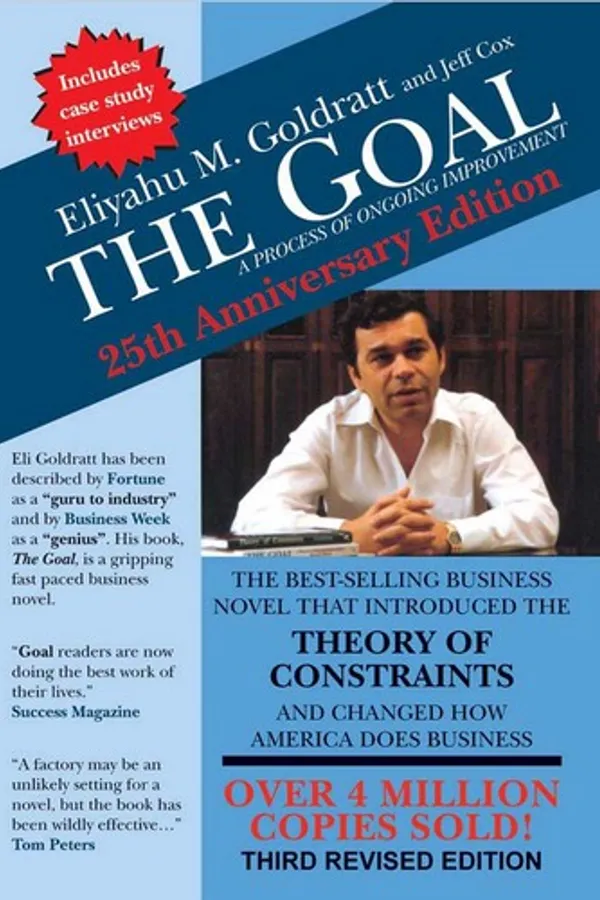
Book
The Goal
Eliyahu M. Goldratt
Every system is governed by one constraint, and improvement anywhere else is an illusion that the accounting will happily certify as progress.
- TYPE
- Book
- SHELF
- Business & Enterprise
- TIME
- 13 min read
- ADDED
- 2026 · 07 · 07
- STATUS
- Completed
- IDEAS
Business · Systems
Why it matters
It is the book I use to stop clients from improving everything at once; the bottleneck rules the plant, the program, and the week.
Goldratt wrote a management theory as a novel because he believed a conclusion handed to you is dead and one you deduce is yours. Alex Rogo runs a failing plant with three months to live and a marriage in roughly the same condition; Jonah, a physicist who answers questions with questions, refuses to hand him solutions. What Rogo deduces: the goal of the business is to make money, and three measures describe it operationally. Throughput is the rate at which the system turns sales into money; inventory is the money trapped inside; operating expense is the money burned converting one into the other. Two physical facts, dependent events and statistical fluctuations, mean variance accumulates along a chain instead of averaging out, so a plant balanced exactly to demand starves itself. One resource governs total output. An hour lost there is lost to the entire system; an hour saved anywhere else is a mirage. From this follow the five focusing steps, the case against local efficiency, and the strange, correct conclusion that most resources must sometimes idle for the whole to produce.
- The goal is singular and must be named before anything can be improved. Efficiency, quality, and technology are means or necessary conditions; treating a means as the goal is the root error of management.
- Throughput, inventory, and operating expense are sufficient to run the operation, and they price every local decision by its effect on the whole system.
- Dependent events plus statistical fluctuations: in any chain, variance compounds downstream instead of canceling, which is why the hike moves at the pace of the slowest boy no matter how the others hurry.
- An hour lost at the bottleneck costs the throughput of the entire system for that hour; an hour saved at a non-bottleneck has no value at all.
- A plant in which every resource is fully utilized is not efficient; it is drowning. Activation is not utilization, and keeping people busy manufactures inventory, not money.
- Balance flow with demand, not capacity with demand; protective excess at the non-constraints is what lets the constraint run without starving.
- The five focusing steps: identify the constraint, exploit it, subordinate everything else to it, elevate it, and when it moves, begin again. The final constraint of every system is inertia.
The argument
The form is the first argument. Goldratt, a physicist who had wandered into factory scheduling, believed that conclusions given to a manager bounce off and conclusions a manager deduces himself become conviction, so the theory arrives as fiction. Alex Rogo manages a plant drowning in late orders and inventory; the division gives him three months before closure; his marriage is running on a similar deadline. Into this walks Jonah, a physicist Rogo once knew, who will not give answers. He asks questions, each aimed at an assumption Rogo does not know he holds, and then leaves. The Socratic machinery is not decoration. It is the book’s claim about how adults actually change their minds, and anyone who has tried to change a manager’s mind will concede its accuracy.
The first question is the deepest: what is the goal? Rogo’s plant has new robots and rising efficiency numbers, and Jonah asks whether the robots let the plant ship anything sooner, sell anything more, or carry anything less. They did not. Efficiencies rose while the business declined, which means the efficiencies were measuring something other than the business. The goal of a manufacturing company is to make money, now and in the future; everything else, quality, service, technology, market share, is a means or a necessary condition, and confusing the two is where the trouble begins. Goldratt then replaces the cost-accounting apparatus with three operational measures. Throughput: the rate at which the system generates money through sales, with the stress on sales, because a product made and shelved is not throughput but its opposite. Inventory: the money the system has invested in things it intends to sell and has not. Operating expense: the money spent turning the second into the first. Every decision in the book is priced against these three, and most of what the plant had been proud of turns out to be inventory manufactured to keep the efficiency reports green.
The physics enters on a hike. Rogo, marching a Scout troop single file, watches the line stretch: each boy’s small variations in pace do not cancel, because no boy can go faster than the boy ahead of him. Dependent events plus statistical fluctuations, the two facts every plant and every project share, and the reason variance compounds downstream instead of averaging away. The slowest boy, Herbie, sets the pace of the whole line, and the lesson follows: put Herbie at the front, take the weight out of his pack, and the line moves as one. A dice game with matchsticks makes the same point in miniature: a chain of average performers, each fluctuating around the mean, delivers well below the mean, and the shortfall is structural, not moral.
Back at the plant, the same logic finds two Herbies: a numerically controlled machining center and the heat-treat furnaces. Everything follows from their identification. Quality inspection moves in front of the bottlenecks, because an hour the constraint spends on a part that was already scrap is an hour of the whole plant burned. The bottlenecks run through lunches and shift changes. Obsolete machines come out of mothballs, because their miserable unit economics are irrelevant if they relieve the constraint. Tags mark bottleneck parts for priority. Batch sizes are cut in half over the controller’s protest, and inventory falls and orders ship while unit costs, as the accounting computes them, rise: the book’s most useful scandal, a plant visibly recovering while the official instruments report deterioration.
Behind the story stand the doctrines the book exists to teach. A balanced plant, capacity trimmed to demand at every station, is the textbook ideal and a guarantee of failure: dependency plus fluctuation means every station needs protective capacity except the one deliberately chosen as the drum. Activation is not utilization: a resource producing what the constraint cannot use is not working, it is converting money into clutter. And the five focusing steps generalize the whole: identify the constraint; exploit it fully; subordinate every other decision to it; elevate it if it still binds; and when it breaks, return to the beginning, because the constraint has moved and the rules built around its old position are now the obstacle. That last step carries the sting. Inertia, the residue of your last correct answer, is the final constraint of every system. Rogo saves the plant, is handed the division, and asks Jonah what he must learn next; the answer, in effect, is the method of deduction itself, which is where the novel closes its loop.
Working notes
Grove states the same first principle in one flat sentence: every production flow has a limiting step. Goldratt refuses the flat sentence and stages it instead, hanging a dying plant, a strained marriage, and a stubborn teacher on the idea until the reader deduces the principle for himself and therefore keeps it. The packaging embarrassed academics and worked. The book reached plant managers who will never open a management text, precisely because it does not read like one, and there is a lesson about writing in that fact sharper than most books about writing contain.
The deeper attack is not on bottlenecks but on local optima. Cost accounting fails in the novel because it prices actions locally, this machine’s utilization, this department’s efficiency, this part’s unit cost, while the system’s economics are global. Once the structure is visible you see it everywhere. Nearly every broken measurement regime I have been hired to repair is a local optimum with a sponsor: the sales metric that stuffs the channel, the utilization target that fills the pipeline with unshippable work, the cost-per-ticket figure that rewards closing tickets that should never have opened. Goldratt’s three measures are crude, and the crudeness is the feature. They are global or they are nothing. The same test sorts modern metrics in seconds: ask of any number whether it can improve while the company gets worse. If it can, it is local, and somebody is probably being paid on it.
Protective capacity is the book’s most countercultural gift to the present. Modern knowledge-work culture worships utilization: every calendar full, every engineer allocated, every sprint packed to its ceiling. The Goal demonstrates, with dice and matchsticks, that a chain of dependent, variable steps run at full utilization does not flow; it accumulates. Slack at the non-constraints is not waste. It is the price of throughput, and organizations that refuse to pay it pay instead in queues, expediting, and burned people. I have retold the hike to more executives than any other passage in the management canon, because it converts an argument about variance into a picture nobody forgets.
Deming pairs with Goldratt like the two lenses of one instrument. Deming: stop blaming workers for variation the system produces. Goldratt: stop pricing local acts as if the system were a simple sum of them. Both locate failure in structure rather than character, and both are therefore resisted by managements for whom blame is the operating system.
A last, private note: the marriage subplot that reviewers dismiss as filler is the theory applied at home. Rogo’s household is a system with a constraint, and the constraint is his hours; no effort elsewhere compensates until that is named and protected. The passage is clumsy fiction and correct systems analysis at the same time, which is the book in miniature.
Where I push back
The novel wins every argument because the author owns all the characters. The controller’s objections are scripted to collapse, the skeptics convert on schedule, and nobody on the shop floor games the new tags, hides protective capacity, or lies to the drum. Real organizations produce all three within a quarter. The book mistakes the ease of its fictional victories for the ease of the method, and the consulting industry that inherited it repeated the mistake at scale.
The goal itself is narrowed by fiat. Make money now and in the future is a defensible operational compression, and Goldratt files quality, safety, and people carefully under necessary conditions; but the filing teaches a habit of mind, and the habit has costs. A generation of readers learned to treat everything that is not throughput as friction. Some of what they filed as friction was the reason customers stayed, and some of it was the reason employees did. The compression is useful in a failing plant with ninety days to live. Installed as a permanent worldview, it is corrosive, and the book never marks the boundary.
The theory also travels worse than its evangelists claim. In a factory the constraint is physical, visible, and slow to move; you can walk to the furnace and put your hand on it. In knowledge work the constraint is a decision rhythm, an overloaded approver, a committee’s calendar, and it moves the week after you name it, sometimes because you named it. The five focusing steps still hold. But the identification step, which the novel renders as a walk through the plant, is nine tenths of the work and political the whole way down. Herbie is easy to find when he is a boy on a trail, harder when he is a sign-off, and nearly impossible when he is the chief executive’s attention.
What survives is the physics, dependency plus variance, and the discipline of pricing local acts globally. That is enough to keep the book permanently on the shelf. It is not enough to justify the certified apparatus that grew over it.
How it enters the work
Intelliblitz meets The Goal on the first day of nearly every engagement. Enterprises do not call a consultancy because nothing is being improved; they call because everything is being improved and nothing is getting better. Twelve initiatives, each locally successful, each reporting green, and the system’s throughput flat: that is not a paradox, it is the signature of improvement applied everywhere except the constraint. The first real deliverable is a sentence naming the constraint, and it is the hardest deliverable to get signed, because the constraint is usually not a technology. It is an approval step, a data owner, a legacy interface guarded by someone’s retirement plan. Clients will pay handsomely for software. Naming the furnace costs somebody their story, and the invoice for that is political.
The architecture practice inherited the subordination step whole. Once a constraint is named, everything upstream is paced to it: release cadences matched to the slowest genuinely fixed gate, queues made visible in front of it, quality checks moved before it so it never spends an hour on work that arrives broken. Data platforms obey the same law. The bottleneck is rarely compute; it is one nightly batch window, one steward’s review, one brittle interface, and the design answer is Goldratt’s answer: buffer in front of it, inspect before it, subordinate the schedule to it, and withhold engineering from stations the flow never waits for.
The book is also the standing rebuttal to a request I receive constantly: the utilization dashboard, the chart that proves everyone is busy. It gets Goldratt read back to it. Activation is not utilization; a portfolio of full calendars is inventory in human form, work in process piling up in front of a constraint no chart has named. The firm takes its own medicine here. Intelliblitz’s real constraint is senior architectural attention, not headcount, so engagements are scheduled the way the plant learned to schedule: that attention is protected, work is inspected before it consumes those hours, and the non-constraints are allowed to idle without guilt. The plant is fictional. The physics has billed real money every year since I read it.
- Name the system's constraint before funding any improvement; if you cannot name it, you have not yet looked.
- Price every local decision by its effect on system throughput, not on local efficiency.
- Protect the constraint: inspect work before it arrives, buffer it, staff it through breaks, and never let it process what is already scrap.
- Keep protective capacity at non-constraints; running everything at full utilization guarantees that nothing flows.
- Rerun the whole analysis after every fix; the constraint moves, and yesterday's rule becomes tomorrow's inertia.
The novel stacks its deck: the accountants are cartoons, the skeptics exist to be converted, and the constraint is always visible on the shop floor. In knowledge work the constraint hides in a calendar or a committee and moves the week after you name it. Read the book for its physics, not for the theology and certified apparatus that later grew over it, and remember that naming the goal as money is a compression with costs the story never invoices.