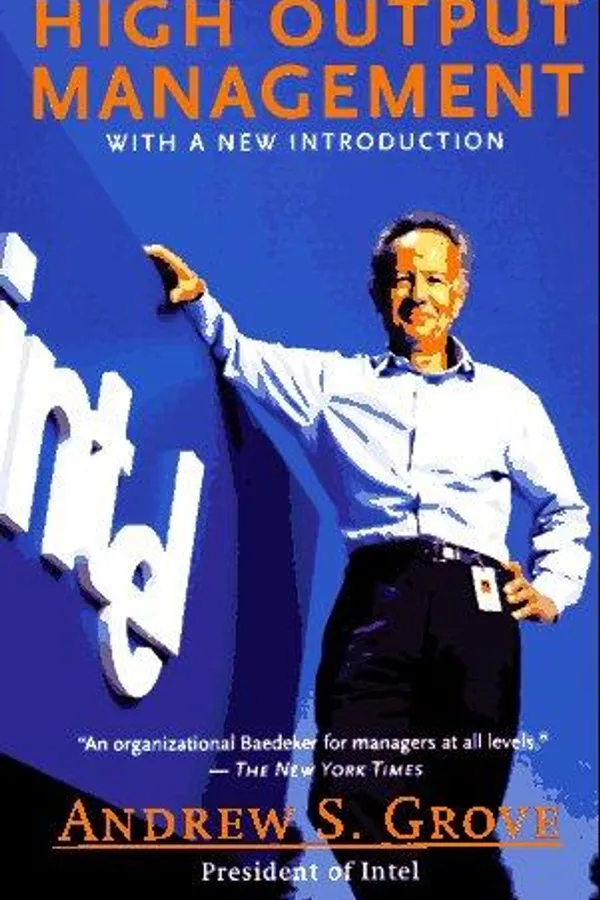
Book
High Output Management
Andrew S. Grove
A manager's output is the output of his organization, and everything he does all day is either leverage on that output or noise.
- TYPE
- Book
- SHELF
- Business & Enterprise
- TIME
- 12 min read
- ADDED
- 2026 · 07 · 07
- STATUS
- Completed
- IDEAS
Business · Systems
Why it matters
It converts management from temperament into engineering, which is the only version of the job I am willing to do.
Grove ran Intel's factories before he ran Intel, and he refuses to see any difference between the two jobs. A breakfast factory has a limiting step, quality gates, and indicators; so does a sales team, a compiler group, a hiring pipeline. The manager's output is not his own work but the total output of the organization under his influence, so the job reduces to one question: where does an hour of my attention multiply most? From that single premise he derives the whole apparatus, production principles applied to knowledge work, leverage as the measure of every managerial act, meetings as the medium of the work rather than an interruption of it, task-relevant maturity as the dial for how closely to manage anyone, and performance review as the highest-leverage document a manager writes. The book is plain, numerate, and entirely without romance about leadership. It treats the organization as a machine that can be instrumented, tuned, and made to yield more; and it holds the manager responsible for the reading on the gauge.
- The output of a manager is the output of his organization plus the organizations under his influence. He is not paid for what he does; he is paid for what they produce.
- Every production flow has a limiting step. Find it, build around it, and stop polishing stations that are not the constraint.
- Managerial leverage is the ratio of organizational output to managerial activity. High-leverage acts: teaching, deciding early, building process. Negative leverage: waffling, meddling, delay at the top.
- Monitor at the point of lowest value. Catch the rotten egg at delivery, not in the omelet.
- Task-relevant maturity decides management style: close instruction for the new, objectives for the competent, trust for the proven. There is no one right style, only a right style for this person on this task.
- Meetings are the medium of managerial work. A one-on-one is the subordinate's meeting; the manager's job there is to listen and to teach.
- Indicators must be paired so they cannot be gamed alone: measure output with quality, speed with rework, or the number you reward will be manufactured at the expense of the one you forgot.
The argument
Grove begins with breakfast. An egg, toast, and coffee must arrive together, hot, at an acceptable cost. From that trivial menu he extracts the whole discipline: identify the limiting step (the egg, which takes longest), schedule everything else around it, inspect early where correction is cheap, and instrument the flow with indicators so you know today what will go wrong tomorrow. The move is deliberate. If you can see that a breakfast factory has a structure, you can be made to admit that a sales region, a design team, and a legal department have one too. Most managers never admit this. They experience their organization as weather: moods, surprises, personalities. Grove insists it is a machine with a throughput, and that refusing to see the machine does not make you humane, it makes you blind.
The center of the book is a definition. The output of a manager is the output of his organization plus that of the neighboring organizations he influences. This sounds banal and is not. It means the manager’s calendar is a portfolio of investments, and each activity should be judged by one measure: leverage. Leverage is high when a small act changes the output of many people for a long time: writing down the decision rule so forty people stop asking, teaching a skill once that is used a thousand times, making the call early while the options are still open. Leverage is negative when the senior man is depressed, undecided, or meddling, because his state propagates down through the whole structure with the same efficiency as his teaching. An indecisive executive is not a neutral absence. He is a factory-wide defect.
From leverage the rest follows with the logic of a datasheet. Meetings, which the management literature of every era loves to despise, are for Grove the medium in which managerial work is performed; a manager who says he is too busy for meetings is a machinist who says he is too busy for the lathe. But the medium must be engineered. The one-on-one belongs to the subordinate: his agenda, his problems, the manager listening for the tremor under the status report. The staff meeting handles what touches more than two. The operation review performs a slower, ceremonial function: it teaches people two levels down what the standard looks like. Each form has a purpose, a cost measured in attention, and a failure mode when misused for theater.
Then the human chapters, which are better than they are remembered to be. Task-relevant maturity is the idea I have seen most often missing in practice: how closely you manage a person is a function of his demonstrated competence at this task, not of his seniority, his title, or your temperament. The same engineer needs instruction on a new domain and needs silence on his old one. Managing everyone one way is not a style, it is a refusal to look. Performance review Grove treats as the highest-leverage document a manager produces all year, and he is severe about its corruption: the review exists to improve the subordinate’s output, not to justify the rating, and every sentence that serves the second purpose at the expense of the first is embezzlement of leverage.
Grove also defends the org chart nobody loves. Hybrid organization, functional groups crossed with mission teams, produces dual reporting, and dual reporting produces the standing complaint that no one has a single boss. His answer is unsentimental: the ambiguity is not a design flaw, it is the price of getting both leverage from shared functions and speed from dedicated missions, and the only real solution is a culture in which people can take direction from two masters without requiring a tiebreaker for every dispute. Complaining about matrix structures, in Grove’s view, is complaining that the organization has more than one purpose. It does. Grow up and manage the seam.
The chapters on motivation are the least quoted and among the most exact. Once training and systems have removed incapacity, the residual variable is desire, and Grove reads it through a plain adaptation of Maslow: fear and money motivate only until they are satisfied; after that the engine is self-actualization, the need to get better at the craft for its own sake. His figure for it is the athlete, and the manager’s task is track design: set the measured field so that people compete against the standard rather than against each other, and failure reads as a time to beat rather than a verdict. A manager who cannot make the work feel like sport in this sense is left with only fear, and fear produces compliance at exactly the moments when you need initiative.
Under all of it runs the paired-indicator rule, which may be the most quietly important idea in the book. Any single measure will be achieved by sacrificing the thing you failed to measure. Reward shipments and quality will pay for it; reward quality and the warehouse fills. So indicators must come in opposing pairs, tension built into the instrumentation itself. Grove learned this from wafers. It is just as true of dashboards, of sales quotas, and of every key-performance regime I have ever been asked to repair.
Working notes
The book’s real subject is attention, treated as a scarce industrial input. Drucker says the executive’s resource is time; Grove operationalizes it. Where Drucker gives you the moral frame (contribution, effectiveness, the disciplined calendar), Grove gives you the plumbing: here is the meeting, here is its yield, here is the point of lowest-value interception for this class of problem. The two books are one course taught by two temperaments, the Viennese essayist and the Hungarian engineer, and the engineer grades harder.
What struck me on rereading is how much of the book is about teaching. The highest-leverage activities Grove names keep reducing to it: training, the one-on-one, the written decision rule, the operation review as instruction disguised as ceremony. The popular memory of Grove is the paranoid hard man of Intel. The text is a man who believes the manager’s first product is competence in other people. Severity and pedagogy are not opposites here; the severity is what makes the pedagogy honest.
The limiting-step idea travels further than Grove takes it. Goldratt built an entire novel and theology around it, but Grove’s version is quieter and more usable: every process has one step that governs the rest, and effort spent elsewhere is cosmetic. Most organizations I have walked into are polishing non-constraints, usually because the constraint is political and the polish is visible.
The paired-indicator rule is the one I quote most and follow least comfortably, because it indicts the industry I work in. Business intelligence, sold as clarity, is usually the mass production of unpaired indicators: one number per slide, each gameable in isolation, each rewarded in isolation. Grove would call the resulting dashboards what they are, instruments for manufacturing the number.
A note on datedness. The book smells of the eighties: the examples are Intel and breakfast, the technology is memos. None of this matters. The units of the argument are attention, output, and leverage, and those have no firmware version. What has changed is only the noise floor: Grove fought for signal against paper; we fight for it against the feed. If anything the book has appreciated, because the cost of an unexamined hour has gone up and the instruments for wasting one have improved.
Where I push back
The factory frame earns its keep and then quietly overcharges. People are not wafers, and the difference is not sentimental: a wafer does not change its behavior because it is being measured, and a person does almost nothing else. Grove knows this, his paired-indicator rule is precisely a defense against reflexive humans, but he underestimates how deep the reflexivity goes. An organization managed hard on output learns to perform output. The defect rate does not fall; it relocates to where the instrumentation is thinnest. Every gamed OKR system on earth is running Grove’s playbook with Grove’s warning label removed.
Second, the book assumes a good-faith operator. In the hands of an insecure manager, “monitoring at the point of lowest value” becomes surveillance, and task-relevant maturity becomes a rationale for never extending trust. The tools are neutral; the tone that must accompany them is not, and tone is the one thing a book cannot ship.
Third, Grove is nearly silent on direction. High Output Management perfects the machine’s throughput and says almost nothing about whether the machine is pointed anywhere worth going. He knew this; Only the Paranoid Survive is the missing chapter, written a decade later, about the moments when the whole production system must be betrayed rather than tuned. Read alone, this book can produce the most efficient factory in a dying market, run by a man too busy with indicators to notice the strategic ground moving under it. Optimization is not judgment, and the book’s confidence can make you forget which one is scarce.
How it enters the work
Intelliblitz is, on Grove’s terms, a leverage business. A consultancy that bills for activity is a factory with no notion of output; the only honest product is a system the client owns and operates without us, which means the highest-leverage hours are the ones spent teaching the client’s people and writing the decision rules down. I schedule engagements around Grove’s question, what does this hour multiply, and it is remarkable how much consulting theater fails the test: the status deck, the standing call with no agenda, the review that reviews nothing. Via Grove, I cut them without guilt.
The paired-indicator rule is now a design constraint in every BI system I architect. When a client asks for a metric, the build includes its counter-metric or the request goes back. Pipeline velocity ships with rework rate; cost reduction ships with quality escapes; adoption ships with depth of use. One number alone is not information, it is an incentive, and incentives without tension are instructions to lie. This single idea has paid for the book several thousand times over.
The limiting step governs how I sequence enterprise work. Most transformation programs fail by improving everything except the constraint, because the constraint is usually a person or a policy and the improvements are usually software. Finding the real limiting step, and saying it out loud, is half of what a client actually buys.
And the trading desk gets the same medicine, because a solo trader is a one-man organization whose manager is himself. The one-on-one becomes the journal review; the indicators come paired there too, return with drawdown, win rate with average loss, or the ledger learns to flatter. Grove would not have traded, I think. But he would have audited a trader’s week ruthlessly, found the three hours of leverage and the thirty of noise, and the discipline of running that audit on myself is his book, applied.
- Ask of every hour: what output does this multiply? If the answer is none, the hour was consumed, not invested.
- Find the limiting step in any system before improving anything else.
- Pair every metric with its counter-metric before anyone is rewarded on it.
- Match supervision to task-relevant maturity, not to your preferred style.
- Treat the one-on-one as sacred infrastructure: it is where problems surface while they are still cheap.
The factory metaphor is the book's engine and its blind spot. People are not wafers; a culture optimized purely for measured output will manufacture its numbers and hide its defects, exactly as Grove's own paired-indicator rule predicts. And his confidence in instrumentation can license surveillance in the hands of a small manager. Read it as a book about leverage and teaching, not about control, or it will make you worse.