Book
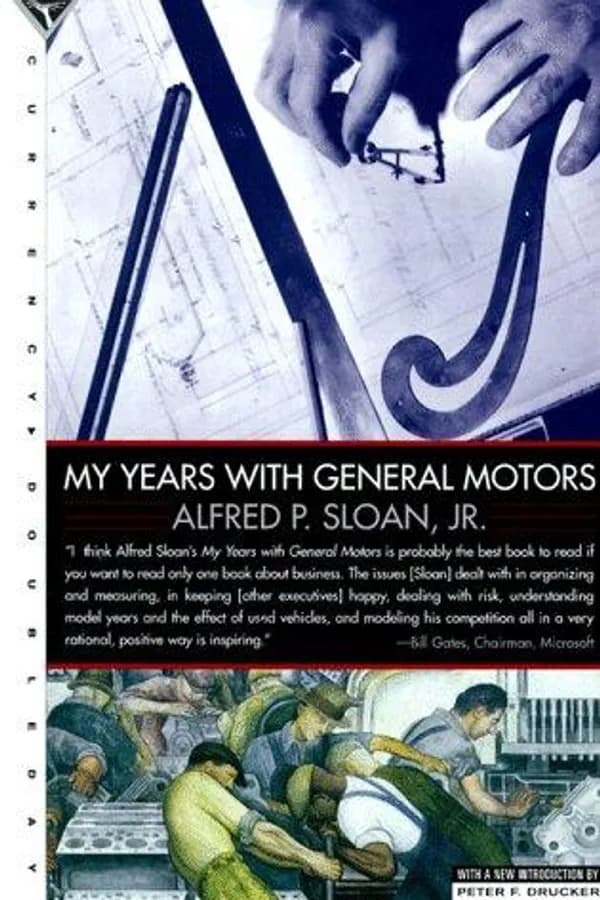
My Years with General Motors
Alfred P. Sloan Jr.
The corporation is a designed object: decentralize operations, centralize policy and appraisal, instrument everything, and the structure will outlive every personality including its architect's.
- TYPE
- Book
- SHELF
- Business & Enterprise
- TIME
- 13 min read
- ADDED
- 2026 · 07 · 07
- STATUS
- Completed
- IDEAS
Business · Systems · History
Why it matters
Every enterprise architecture I am hired to repair is a corrupted copy of the machine this book describes being built; it is the original schematic.
Sloan inherited the wreckage of a genius. William Durant assembled General Motors by acquisition, brilliantly and without controls, and in the slump of 1920 the structure nearly died of its own inventories: divisions ordering materials against their own optimism, cash unaccounted for, no one at the center able to state what the corporation owned or owed. Sloan's answer, drafted before the crisis and adopted because of it, became the modern corporation. Decentralized operations under coordinated control: divisions run as businesses by men accountable for results, the center holding policy, finance, and appraisal, with forecasting, return-on-investment analysis, and rapid dealer reporting making the whole legible from one room. Onto that structure he set a product policy of equal consequence: a graded ladder of cars from Chevrolet up to Cadillac, no gaps for a rival to enter, no overlaps to waste a division, financed by installment credit, fed by trade-ins, renewed by the annual model. Ford perfected a car; Sloan designed a system for making, financing, selling, and replacing cars, and it won so completely that it became invisible. The book reports the invention in the flattest prose in business literature, which is the point.
- Decentralization with coordinated control is not a compromise between freedom and order but a design: divisions own operations, the center owns policy, capital, and appraisal, and everything depends on that boundary staying drawn.
- Structure precedes scale. Durant proved the assets could be assembled; 1920 proved that an assembly without financial controls is exposure wearing letterhead.
- The instruments are the management: forecasting, standard-volume costing, return-on-investment appraisal, and ten-day dealer reports made a continental enterprise legible decades before computing existed.
- A product line is an architecture. A graded price ladder with no gaps and no internal overlaps turns a market into an upgrade path and a competitor's opening into a covered square.
- Sell the customer's next circumstance, not his current one: installment credit, the trade-in, the closed body, and the annual model beat a perfect unchanging product by moving with rising incomes.
- The copper-cooled engine taught the limit of central brilliance: research may propose, but the divisions accountable for results must dispose, or the organization learns to lie to its center.
The argument
The book is the rarest kind of memoir: the architect reporting on the building, with the architect mostly removed. Sloan entered General Motors when Durant bought the roller-bearing company he ran, and he watched from inside as the founder assembled the corporation the way a collector assembles a room, by appetite. Durant’s GM was a miracle of acquisition and a void of administration: divisions bought materials against their own forecasts, spent capital on their own authority, and reported results the center could neither verify nor compare. In the postwar slump of 1920 the bill arrived. Inventories swallowed the cash, the banks moved in, Durant lost the company, and the du Ponts took the chair while the enterprise learned, nearly fatally, that no one could state its actual position. Sloan had already written his Organization Study before the crisis; the crisis made it constitutional law. He became president in 1923 and spent the next three decades proving the design.
The design holds one tension, and holds it on purpose. Operations were decentralized: each division a business, with its own engineering, manufacturing, and sales, run by an executive answerable for its results. Policy was centralized: capital, finance, product boundaries, and appraisal belonged to the corporation, exercised through governing committees where divisional and general officers sat together. What the divisions surrendered was not initiative but the right to improvise on policy; what the center surrendered was the right to meddle in operations it did not run. Sloan’s committees were not the disease bureaucracy later made of them. They were the deliberate instrument for making policy collectively so that execution could be individual, and each side’s authority depended on the boundary holding. He never claims the tension resolves. He claims it is the productive tension, the one a large enterprise must maintain rather than escape.
Structure alone would have been philosophy; the instruments made it management. Forecasting committed each division to a stated volume before the money moved. Standard-volume costing priced the car against a normal rate of plant utilization rather than against the cycle’s mood, so prices and margins stopped chasing the weather. Donaldson Brown’s return-on-investment appraisal, brought over from du Pont, decomposed every division’s result into margin and turnover so that unlike businesses became comparable on one page. And the ten-day reports pulled actual retail sales from dealers fast enough for production to follow the market instead of the divisions’ hopes. It was telemetry before electronics, a data pipeline made of paper, and it converted a continent of factories into something one room could read. The 1920 catastrophe had been an information failure wearing a financial costume; Sloan answered it with instrumentation.
The product policy was the same mind applied to the market. In 1921 the corporation rationalized its scattered brands into a graded ladder of price classes, Chevrolet at the bottom, Cadillac at the top, each division assigned a rung, no gaps left open for a competitor, no overlaps to set the divisions against one another. Against this stood Ford, who had solved the previous problem perfectly: one unchanging car at a relentlessly falling price. Sloan saw that the problem itself had changed. Installment credit through GMAC, the trade-in, the closed body, and the annual model had converted basic transportation into an ascending market, where the used car occupied the bottom and the new car was bought with rising income and rising appetite. The ladder made the corporation the beneficiary of its customers’ whole lives: enter used, trade up through Chevrolet, leave in a Cadillac, financed at every rung.
Chevrolet against the Model T is the tactical set piece. Sloan declines the frontal assault on a perfected product and positions Chevrolet just above it, more car for somewhat more money, and waits for the market to climb toward him. It does. Ford, unwilling to believe the age of the static car had ended, finally shuts down for months to retool, and the field is ceded without a battle. Styling then becomes policy rather than decoration, and the corporation institutionalizes change itself as its product.
The copper-cooled engine is the book’s confession. Kettering’s air-cooled design, championed at the center as the future, was pressed on divisions that had to build and sell it; the engine failed in the field, the divisions had known their objections were being overridden, and relations between research and operations nearly poisoned. The lesson Sloan draws is structural, not technical: central brilliance cannot be decreed onto accountable operators, because decree corrupts the information the center needs most. Innovation, like capital, must pass through the structure, or the structure begins reporting fiction upward. That a chief executive chose to preserve this episode, in a book otherwise stripped of failure’s texture, tells you which lesson he thought was load-bearing.
Working notes
The style is the argument. The prose has the rhythm of minutes, policy stated, considerations weighed, decision recorded, and the man who ran the largest enterprise on earth appears in his own memoir mostly as a signature. Set it against the founder-memoir genre, where the company is the author’s autobiography with revenue, and the flatness reveals itself as doctrine: the organization is the achievement, and any sentence that glorified its administrator would falsify the thesis. It is the least quotable great book on this shelf, and deliberately so.
Drucker studied this corporation from inside for Concept of the Corporation, and Sloan was famously cool toward the result; this book reads in part as the machine answering back in its own idiom, policy against sociology. I keep The Effective Executive beside it as the human complement: Drucker distills the executive, Sloan documents the executive’s habitat. One tells you how to decide; the other shows what deciding is embedded in, the committees, the appraisal instruments, the boundaries that make a decision executable by people who were not in the room.
Deming’s doctrine, blame the system and not the worker, presumes there is a system to blame; Sloan built the first one big enough to qualify. Standard volume is the detail that shows the kinship. By pricing against normal utilization rather than this quarter’s, Sloan refused to let the cycle’s noise masquerade as divisional performance, which is Deming’s war on misread variation fought thirty years early with accounting instead of statistics. The two books share an enemy: management by reaction to the last data point.
Beside Titan the century turns. Rockefeller built by combination, secrecy, and will, the founder’s empire in its purest form; Sloan built by administration and measurement, and needed no secrecy because the advantage was the structure itself, which competitors could read about and still not replicate. Something was gained: permanence, legibility, the corporation that survives its men. Something was lost, and the book is too honest to fully hide it: nothing in Sloan’s machine could have generated Durant.
The note I keep returning to is about latency. The ten-day reports were a competitive weapon before anyone had a word for such things: whoever hears the market first, moves first, and Sloan treated reporting speed as a design variable of the corporation rather than a clerical detail. What the cycle bought him was not foresight but a shorter interval between the world changing and the corporation knowing it, and that interval is still the honest measure of a reporting system: not how much it shows, but how stale it is when it arrives. Most of the reporting I am hired to repair fails there, not in coverage. The instinct transfers intact to every data platform I have ever built. The frequency changed; the physics did not.
Where I push back
The blood has been drained, and the draining was policy. Workers appear in this book chiefly as a bargaining variable; the era in which they occupied the plants and forced the corporation to recognize their union arrives with the temperature of a pricing decision. A machine this size runs on lives, and the book’s ledger has no column for them. The reticence extends to the boardroom: the maneuvers, the firings, the du Pont politics are all present as orderly minutes, and the reader must supply the knives. Even publication obeyed the tone; the finished manuscript waited years while the corporation’s lawyers weighed what its candor might cost, the machine very nearly burying its own founding text.
Second, the design contains no procedure for doubting the design. Sloan’s great insight was that the concept of the market had changed under Ford while Ford perfected his answer to the old one; he never turns that insight on his own construction. The committees that coordinated became committees that insulated; finance, installed as appraiser, ended as sovereign; and the corporation that read the 1920s market perfectly spent the 1970s unable to see Toyota, defeated by exactly the trap it had sprung on Ford. The book teaches the building of structure and is silent on its demolition, and a structure that cannot be questioned is Durant’s error inverted: not too little order but order that has forgotten it was once a decision.
Third, the founder is undervalued because the founder was the problem the book exists to solve. Sloan’s machine could administer assembled genius; it could not have assembled it. Set Durant down inside the mature corporation and watch: the acquisitions strangled in committee, the hunches failed by the appraisal instruments, the boldest purchases recorded as breaches of process. The machine would have been correct by its own lights and smaller for it. Order of this quality organizes fire, and produces none. Read alone, the book will teach a man to govern what he has not taught him to create.
How it enters the work
Decentralization with coordinated control is, nearly verbatim, the pattern beneath every sound enterprise data platform, and I reach for Sloan whenever a client wars over centralizing or federating analytics, because they are relitigating 1921 without knowing it. Domains own their operations and their data at the edge, where the knowledge lives; the center owns policy, standards, and appraisal, where the comparisons live. Governance committees are Sloan’s finance committee wearing new clothes. The failures are his failures too: centralize everything and the edge stops telling the truth; federate everything and there is no truth to tell. My work at Intelliblitz is mostly drawing that boundary and building the instruments that let it hold.
The instruments travel with the structure or the structure is theater. Every KPI decomposition I ship descends from Brown’s return-on-investment tree, one result opened into its causes so unlike units can be compared on a page. Legibility from one room is still the deliverable. The tools went from paper to streams; the design question, what must the center see, how fast, at what grain, has not moved since 1923.
The copper-cooled engine is the memo I would hand every enterprise AI program if only one page were allowed. The standing failure mode of the industry is Kettering’s: a central lab, certain of the future, decreeing pilots onto divisions that own the results, then reading the divisions’ polite sabotage as backwardness. Adoption must pass through accountability. I pilot where the profit and loss lives, with the operator’s hand on the instrument, and treat any enthusiasm that has no owner as a cost, however advanced its architecture.
And under all of it, the sentence I already lived by before I could source it industrially: find the structure, then remove everything that isn’t it. Sloan is that instinct’s corporate ancestor. He found the structure inside Durant’s pile and removed everything that was not the structure, including, in the end, himself; the book’s strange impersonality is what that removal looks like in prose. Structure precedes scale. I decline to scale a client’s system, or my own firm, past the point where the decision rights are drawn, because 1920 arrives for every organization that confuses growth with design, and it does not send a warning first.
- Draw the decision rights before scaling anything; autonomy without a boundary is Durant, and control without autonomy is paralysis.
- Build the measurement instruments in the same motion as the org chart; a structure you cannot appraise is a rumor.
- Design product ranges as ladders: no gaps a rival can enter, no overlaps that set your own units against each other.
- Never let central enthusiasm decree what accountable operators must execute; pilot where the profit and loss actually lives.
- Write policy plainly enough to survive your own departure; a system that needs its author is not yet a system.
This is corporate history with the blood drained out: the politics, the firings, and the human cost of the assembly line arrive processed into policy language, and labor appears mainly as a variable to be bargained. The machine it celebrates is also the machine that later seized, committees multiplying, finance outranking product, the structure that beat Ford unable to see Toyota coming. Read it as the invention of a form, not a defense of the form's decay; Sloan offers no procedure for questioning the design itself.