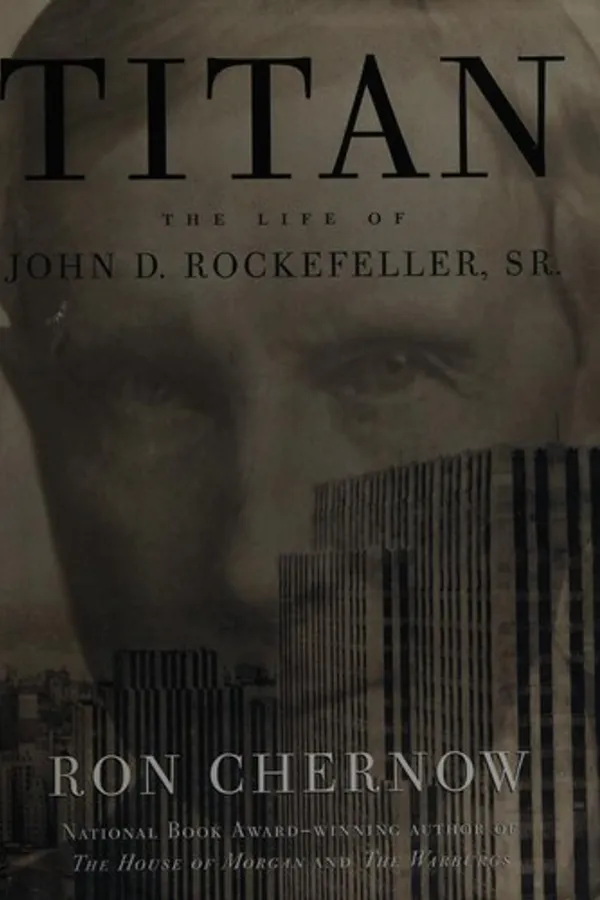
Book
Titan: The Life of John D. Rockefeller, Sr.
Ron Chernow
A bookkeeper's piety and a predator's patience built the most complete industrial system of its century, and Chernow refuses to let either half excuse the other.
- TYPE
- Book
- SHELF
- Biography & Lives
- TIME
- 14 min read
- ADDED
- 2026 · 07 · 07
- STATUS
- Completed
- IDEAS
Business · History · Psychology
Why it matters
The best case study I own of order as a competitive weapon, and the best warning about what a man permits himself once his ledger feels holy.
Chernow's Rockefeller is two inheritances in one body. The father was a bigamist and a traveling con man who sold quack medicine under an assumed name; the mother was a devout Baptist who ran a household on thrift and scripture. The son fused them: the confidence man's nerve harnessed to the churchwoman's discipline. He began as an assistant bookkeeper in Cleveland, tithed from his first pay, and kept a personal ledger with religious care. He chose refining over drilling because chaos cannot be systematized and process can, used volume to extract rebates from the railroads, absorbed most of Cleveland's refining capacity in a matter of weeks after the South Improvement scheme collapsed, and drove unit costs down until competition became arithmetic. The trust his lawyer devised in 1882 gave the empire a legal body; decades of corporate silence gave Ida Tarbell her opening; the Supreme Court's dissolution of 1911 made him richer than ever. The second act was philanthropy run on the same operating system: wholesale, conditional, aimed at root causes. Chernow declines to resolve the man into saint or monster, which is exactly why the book is dangerous and worth owning.
- Rockefeller positioned himself at the one stage of the oil business where discipline compounds. Drilling was a lottery; refining was a process; he chose the process and let the gamblers be his suppliers.
- The rebate was a structural edge, not a trick: the largest and steadiest shipper earns pricing no rival can see or match, and every discount funded the volume that justified the next one.
- Order was the strategy itself: unit costs known to the decimal, plants and barrels standardized, insurance and cooperage brought inside; competitors were often beaten by bookkeeping before they were beaten by price.
- He preferred to buy rivals with stock rather than cash, converting defeated men into shareholders whose futures merged with his.
- The trust of 1882 was an invention as consequential as anything in the refineries: structure to hold what strategy had captured, and an ancestor of the modern corporation.
- Silence was policy: Standard explained nothing for decades, so a journalist with a grievance and better prose defined it forever. Refuse to tell your story and someone else will sell it.
- The piety was not a mask. The tithe and the drawback were entries in one ledger, held together by a doctrine of stewardship strong enough to carry anything; that coherence is the frightening part.
The argument
Chernow opens with the parents because the parents are the thesis. William Avery Rockefeller was a traveling mountebank who sold sham cancer cures, vanished for months at a stretch, and eventually kept a second wife under the invented name of Doctor Levingston. Eliza Davison Rockefeller was a Baptist of severe thrift who raised the children on scripture, chores, and the fear of waste. The son took the father’s nerve and the mother’s discipline and fused them into a single instrument. Chernow’s psychological engine, sustained across seven hundred pages, is that John D. built order the way other men build monuments: as a permanent answer to the chaos he came from. The boy kept accounts, lent small sums at interest, and treated arithmetic as a form of safety. In 1855 he found work as an assistant bookkeeper at a Cleveland produce firm, and for the rest of his long life he privately celebrated the anniversary of that hiring as a holiday. His first ledger recorded every cent earned and every cent tithed, and he tithed from the beginning, when there was almost nothing to tithe. The habits were all present before the oil was.
The strategic masterstroke, visible only in hindsight, was the choice of refining. The Pennsylvania oil regions were a lottery: gluts, fires, dry holes, instant fortunes and faster ruins. Drilling could not be systematized because geology does not negotiate. Refining could. It was chemistry, logistics, and cost control, and Cleveland sat on the rail and water routes that made it a natural refining hub. Rockefeller planted himself at the one point in the chain where a disciplined man’s advantages compound, and let the speculators upstream absorb the variance. With Henry Flagler he then turned scale on the railroads, which were desperate for steady volume and would pay for it in secret rebates. The South Improvement Company scheme of 1872 went further: not just rebates on Standard’s own shipments but drawbacks paid to Standard on the shipments of its competitors. The scheme leaked and died in scandal, but in the panic it created Rockefeller bought out the bulk of Cleveland’s refining capacity in a matter of weeks. Chernow’s account of those negotiations is the book in miniature: quiet, courteous, and total. He opened his books to certain rivals to demonstrate that resistance was arithmetic, offered cash or Standard stock, and remarked for decades afterward that the wise ones took the stock.
What follows is less a business narrative than the construction of a system. Standard made its own barrels, laid its own pipelines, carried its own insurance, and hunted waste at a scale no one had imagined waste could matter. The famous solder episode is emblematic: told that forty drops sealed a kerosene can, Rockefeller asked whether thirty-eight might do; thirty-eight leaked, thirty-nine held, and thirty-nine became the standard across millions of cans. By the late 1870s Standard controlled roughly nine tenths of American refining. Chernow keeps the consumer in the frame, which most retellings drop: across the years of consolidation the price of kerosene fell steeply and its quality standardized, and the cheap, safe light in millions of ordinary rooms was the same system seen from its other end. The monopoly’s case for itself was half the ledger, and it was kept as scrupulously as the rest. In 1882 the lawyer Samuel Dodd designed the trust: shareholders of the constituent companies exchanged their shares for trust certificates, and a small board coordinated what the law still pretended were separate firms. It was a legal invention as consequential as anything done in the refineries, the first structure capable of governing an industrial organism across state lines, and the direct ancestor of the holding company and the modern corporate form that Sloan would later perfect.
Then the silence, and the price of silence. Standard’s press policy for decades was to say nothing: no interviews, no explanations, no defense. Into that vacuum walked Ida Tarbell, daughter of an oil regions producer who had been squeezed by Standard’s methods, and her serialized history in McClure’s, running from 1902 to 1904, fixed the company’s public character permanently. Chernow is careful here: Tarbell got facts wrong and carried a family grievance, and it did not matter, because Standard had spent thirty years forfeiting the narrative. He adds the fact that makes the fury stranger: by the time Tarbell wrote, Rockefeller had been out of active management for years while keeping the title of president, so the most hated man in America was answering for decisions he no longer made. In 1911 the Supreme Court dissolved the trust into thirty-four companies. The market then delivered the century’s driest joke: Rockefeller held his proportional shares across all the successors, the parts were repriced above the whole, and the dissolution made him wealthier than the monopoly ever had.
The second act occupies the last third of the book and deserves its space. Overwhelmed by begging letters, Rockefeller hired Frederick T. Gates and industrialized his giving on the same principles that built Standard: wholesale rather than retail, root causes rather than symptoms, conditional grants that required matching funds so that recipients kept skin in the enterprise. The University of Chicago, the medical research institute that became Rockefeller University, the campaign that substantially rid the American South of hookworm, the General Education Board, and in 1913 the Rockefeller Foundation. Gates warned him that the fortune was compounding faster than it could responsibly be given away, and the philanthropy became a race against the arithmetic of his own returns. Chernow’s refusal to simplify holds to the end: the man who took secret drawbacks on other men’s freight built the modern infrastructure of medical research, and he experienced no contradiction, because in his own theology the fortune was a stewardship assigned to him by God. The book’s deepest finding is that this coherence was sincere. Not a mask over predation but a single integrated character in which the tithe and the drawback were entries in one ledger. A sufficiently coherent inner narrative can hold anything. Chernow proves it with the largest specimen on record.
Working notes
Read against The Outsiders, Rockefeller is the prototype the eight CEOs unknowingly copied: indifference to opinion, equity as acquisition currency, buying in panics, cash discipline as religion. Thorndike’s men allocated capital inside legal boundaries Rockefeller predates; the temperament is identical, the constraint set is not. That difference is the whole history of securities law, and it is worth keeping in view whenever someone calls a modern operator ruthless.
Read against My Years with General Motors, the sequence becomes visible: Dodd’s trust and Sloan’s committees are chapters of one story, the discovery that the decisive inventions of industrial capitalism were legal and organizational, not mechanical. Nobody photographs a holding structure, so nobody remembers that it was invented, and that a Cleveland bookkeeper paid for its drafting.
Read against The Power Broker, the pairing this entry belongs to: two empires of order, one compounding capital and the other compounding jurisdiction. Rockefeller’s power depended on the public not seeing freight rates; Moses’s depended on the public not reading bond covenants. Every monopoly begins as an efficiency and ends as a jurisdiction. Both books document the transition; neither man noticed himself crossing it.
The ledger is the detail I keep returning to. Ledger A was not an accounting document; it was a devotional one. A man who records every cent given and earned from the age of sixteen is not tracking money, he is building a self, and the self he builds will be capable of exactly what the ledger legitimizes. What you count daily you eventually become. This cuts both directions, which is why it belongs in working notes and not in a sermon: the practice that made him charitable before he was rich is the same practice that let him book a drawback without a tremor. Counting is a technology; it takes the morality of its owner.
The thirty-ninth drop of solder is the other permanent note. Everyone hunting edge looks in visionary places: strategy, narrative, genius. His decisive edges lived in cans, barrel staves, and freight schedules, in places too boring for his competitors’ attention. Boredom is a moat. I have found nothing in my own operating that contradicts this, and much that confirms it.
And the cost, since the register of this shelf is the life as evidence: his digestive system gave out in his fifties, his hair fell out entirely, and he withdrew from daily management not in triumph but in a state approaching collapse. The serenity of the old man handing out dimes was a reconstruction. The son, meanwhile, inherited the reputation as a debt and spent a lifetime servicing it. Order on that scale is not free; the invoice simply arrives at a different address.
Where I push back
Chernow’s even-handedness, the book’s chief virtue, occasionally curdles into a false symmetry. The prose grants Rockefeller’s inner calm more pages than it grants the men on the other side of his acquisitions, and calm narrates better than ruin. A refiner who sold at Standard’s appraisal, with secret freight rates arrayed against him and no way to verify the arithmetic he was shown, was not a participant in fair dealing; he was executed politely. The book records this and yet its temperature does not; the reader leaves remembering the courtesy and forgetting the gun on the table.
Second, the architecture of the book invites a teleological misreading. Because the philanthropy arrives last and is genuinely magnificent, the story wants to be read as redemption, the monopoly as the regrettable fundraising phase of the hookworm campaign. Chernow never says this, but the shape says it for him. Giving does not run backward in time. The Foundation and the drawbacks coexist; they do not net.
Third, the great man frame underweights the vacuum that made him possible. There was no antitrust statute until 1890, no disclosure regime, no policing of interstate commerce worth the name. Standard Oil was an artifact of that vacancy as much as of one man’s will; the same temperament operating inside modern securities law produces an excellent CEO, not a private sovereign. Chernow gestures at the era’s structure but keeps the camera on the face, because faces sell. The honest conclusion is less flattering to everyone: institutions, not character, decide how much damage a disciplined man is permitted to do. Titan is a mirror the ambitious should read with supervision, and I include myself in the sentence.
How it enters the work
BlockHedge operates in the closest thing this century has produced to the Pennsylvania oil regions: an extraction frontier full of lotteries, gluts, and instant ruin, with fortunes advertised at the drill head. The Rockefeller lesson is positional. The durable economics sit in the refining layer: custody, execution, market structure, data, the unglamorous processing of what the speculators pump. The firm’s theses must survive a full cycle, and the positions that survive cycles are the ones built where discipline compounds rather than where variance pays. I reread the Cleveland chapters whenever a frontier narrative starts sounding like a business.
At Intelliblitz the book operates as a standing question about waste. The thirty-ninth drop of solder is asked, in some form, in every engagement: which drop in this process is decorative, and who is paying for it. Enterprises rarely lack vision; they lack anyone willing to count. The consultant’s temptation is to sell the vision, because counting is billed lower than prophecy. Chernow keeps me honest about which one actually built Standard.
The trust chapters read, from inside my trade, as the founding document of enterprise architecture. Dodd’s insight was that the container is as decisive as the engine: what strategy captures, structure must hold, or it evaporates in the holding. In modern dress this is data models, governance, and ownership design, the legal and structural layer that outlives every application built on top of it. When I insist that a client own their system rather than rent it, I am arguing Dodd’s brief in reverse: structure written for the client’s permanence instead of the vendor’s.
And one practice crossed from the book into the desk drawer. I keep the equivalent of Ledger A, not for money but for time and attention, on the theory the book demonstrates from both ends: the ledger builds the man, and the man will do whatever the ledger has learned to legitimize. Rockefeller’s ledger sanctified everything it recorded, which is precisely why the recording must be audited by something outside itself. Mine gets that audit. His did not, until a journalist with a grievance performed it for the whole world.
- Position where discipline compounds: choose the stage of a system where process, not luck, sets the return.
- Know your unit costs to the decimal; the operator who does negotiates against men who are guessing.
- Build the structure before the scale arrives; strategy captures, structure holds.
- Pay in equity when you want allies instead of enemies; a bought rival is a liability, a converted one is a distribution channel.
- Refusing to tell your story is itself a story, and a hostile narrator will finish it for you.
- Write down what you believe your money is for, and audit that belief like an account; his held both the tithe and the drawback, and nobody audited it until Tarbell.
The book's balance can be misread as absolution, and its subject's serenity sets an emotional temperature the facts do not deserve; courteous coercion is still coercion, and many of the men who sold to Rockefeller signed under a duress dressed as fair dealing. Read Titan as a playbook and you inherit methods whose costs were paid by people with no ledger of their own. And beware the backward reading in which the philanthropy retires the debts of the monopoly; both are real, and neither settles the other.