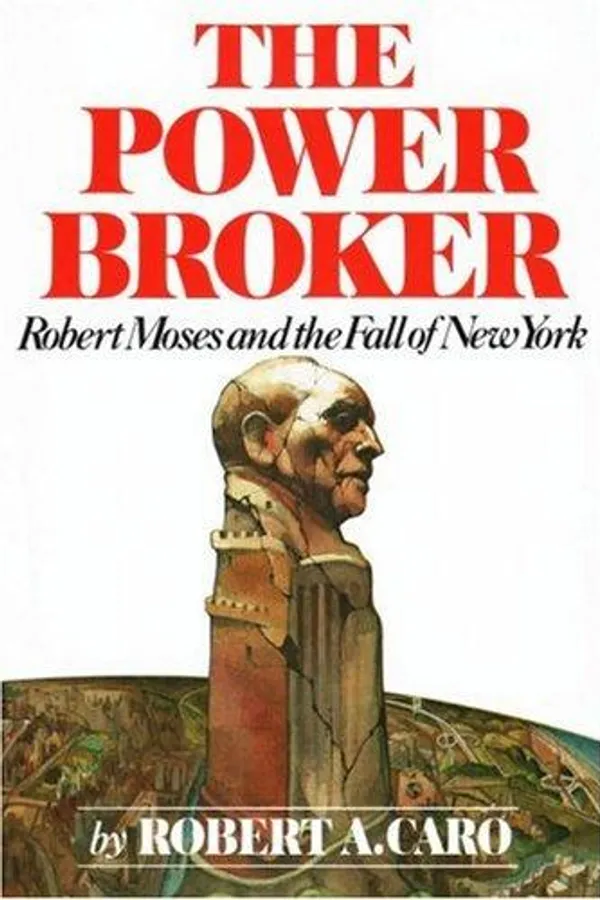
Book
The Power Broker
Robert A. Caro
Power in a democracy does not have to come from votes; Moses assembled an unelected empire out of parks, tolls, and statutory fine print, and New York is the receipt.
- TYPE
- Book
- SHELF
- Biography & Lives
- TIME
- 14 min read
- ADDED
- 2026 · 07 · 07
- STATUS
- Completed
- IDEAS
History · Strategy · Systems
Why it matters
I build systems inside institutions and photograph the city this man poured; the book is the working anatomy of how power actually moves through structures.
Robert Moses never won an election. He entered public life as an idealistic civil service reformer, was crushed by Tammany Hall, and drew the conclusion that governs the next thousand pages: nothing can be done without power, so power must come first. Under Al Smith's patronage he took the parks portfolio nobody wanted and made it an empire, drafting the very statutes that created his offices and burying in their dull language authorities no legislator noticed until they were law. His masterstroke was the public authority: fed by tolls, financed by bonds whose covenants are contracts the Constitution will not let legislatures impair, it gave him revenue, patronage, and autonomy that elections could not touch. For over four decades he built parks, parkways, bridges, and housing at a scale no American has matched, and evicted hundreds of thousands of people, mostly poor, to do it. Caro documents both without letting either cancel the other: the reformer who became the thing he had set out to replace, and a city permanently shaped by a man the public could not remove. It is the most complete study of institutional power ever written.
- The public authority was the central discovery: bond covenants are contracts protected by the Constitution, so powers written into them sit beyond the reach of any future legislature. A tollbooth is a tax that nobody votes on and nobody can repeal.
- Whoever drafts the statute owns the office it creates. Moses wrote his own enabling acts and hid extraordinary powers in language calibrated to bore the men voting on it.
- Physical accomplishment is armor: a finished bridge answers every editorial. Moses drove stakes and poured concrete early, because a project underway is politically unkillable.
- Power did not merely corrupt him; it converted him. The reformer's certainty and the autocrat's certainty are the same faculty, and Caro shows the years in which one became the other.
- Information is terrain. Moses had read the statute, the covenant, and the file when his opponents had read the press release, and he won most fights before they were understood to be fights.
- An institution optimizes whatever feeds it. Triborough's revenue came from cars, so the region got cars; the neighborhoods and transit lines that fed no tollbooth were expendable by design, not by malice.
- Democratic accountability and executive capacity trade against each other. The covenants that entrenched Moses are also why the bridges exist; Caro is honest enough to leave the dilemma standing.
The argument
The book’s shape is a conversion narrative run in reverse, and Caro makes you feel the reversal in your own sympathies. The young Robert Moses of the 1910s is the best man in every room: Yale, Oxford, a doctorate, and a plan to rebuild New York’s civil service on merit, drawn up with genuine idealism and no political sense whatever. Tammany Hall destroyed the plan without effort, and Moses, brilliant and unemployed, absorbed the lesson that organized power beats righteous argument every time it plays. When Belle Moskowitz brought him into Al Smith’s orbit, he attached his talents to a man who had power, and he never made the reformer’s mistake again. Caro’s first movement establishes the book’s engine: this is not a story about a bad man, it is a story about what an intelligent man concluded from watching goodness lose.
The parks were the beachhead precisely because nobody wanted them. As head of the new state park commission, Moses drafted his own enabling legislation, and here the book teaches its first mechanism: he wrote powers into the bills that no one voting on them noticed, including appropriation procedures that let him seize land first and litigate afterward. Legislators approve summaries; power hides in the drafting. Jones Beach, opened in 1929, was the proof that the method could produce splendor: a public pleasure ground built to standards private wealth would envy, and the press coverage made Moses untouchable for a generation. The public loved what he built, and the love was earned. Caro never pretends otherwise, which is what separates the book from a pamphlet.
The central chapters contain the discovery that gives the book its title. Public authorities were conceived as modest instruments: issue bonds, build the bridge, collect tolls until the bonds retire, then dissolve. Moses saw what everyone else missed. An authority that refinances its debt never reaches retirement, and the covenants securing its bonds are contracts, which the Constitution forbids states to impair. Write the authority’s powers, and its chairman’s, into the covenant, and no governor, mayor, or electorate can amend them without triggering a constitutional violation. Triborough became a fourth branch of government: toll revenue in perpetuity, its books effectively closed to outside audit, its surpluses funding banks, contractors, unions, insurance men, and the retinue of politicians’ law firms that Caro calls out one by one. The machine fed everyone who could threaten it. That, and not any single bridge, is the book’s monument: the demonstration that in a democracy, durable power is constructed out of revenue and legal drafting, not out of votes.
Around the mechanism, Caro builds the anatomy of method. Moses held as many as twelve city and state positions at once, arranged so that each office’s powers covered another’s gaps. He kept files on allies and opponents alike and used them. He mastered engineering detail so thoroughly that no subordinate or rival could contest him on substance. He drove stakes early: once construction began, no project could be stopped, so he began construction before opposition could organize, sometimes before financing was complete. He handled the press with ribbon cuttings and rage, and reporters chose the ribbon cuttings for forty years. The armor cracked, when it finally cracked, over the smallest project of his career: a parking lot for a Central Park restaurant in 1956, opposed by mothers with baby carriages and taken anyway behind a fence raised overnight. The papers that had absorbed the eviction of hundreds of thousands without a headline turned on him over a grove of trees, and Caro lets the disproportion stand as a finding about the press, not about Moses: power is rarely checked where the harm is greatest, only where the picture is best. And he was personally vindictive at a level the reader keeps refusing to believe: the treatment of his brother Paul, ruined and denied while Robert prospered, is the book’s coldest thread, included because Caro understands that how a man treats a powerless brother is evidence about the system he will build for powerless strangers.
Then the costs, counted at street level. The Cross-Bronx Expressway chapters are the moral center of the book: East Tremont, a functioning working-class neighborhood, severed and destroyed when Caro’s reconstruction shows an alternate route was available at trivial cost, rejected, in the residents’ conviction and Caro’s framing, because yielding was not in the man’s grammar. Hundreds of thousands of New Yorkers, disproportionately poor and Black, were evicted for his roads and his renewal projects; the transit lines that might have served them were starved while the highways multiplied, and Caro charges that some parkway infrastructure was deliberately built to exclude the buses the poor rode. One man’s preferences, compounded over four decades and protected from every election, hardened into the permanent geometry of the largest city in America.
The fall is the mechanism run against its inventor. Moses had survived six governors and five mayors; he did not survive Nelson Rockefeller, the one adversary who was richer, better connected, and equally indifferent to public opinion. The merger that folded Triborough into the new Metropolitan Transportation Authority in 1968 took his revenue, and Caro notes the detail that closes the loop: the bondholders’ interests, the sacred covenant Moses had hidden behind for thirty years, were represented by a bank run by the governor’s brother, and no one litigated. He was promised continued relevance and received none. Power built on revenue ends when a bigger operator takes the revenue, and the man who taught New York that votes were irrelevant was removed without a single vote being cast.
Working notes
Read beside Titan, the pairing the archive intends: Rockefeller compounded capital and Moses compounded jurisdiction, and both depended on public illiteracy about instruments, freight rebates in one case and bond covenants in the other. The durable form of power is always a document the public finds too boring to read. Greene’s 48 Laws abstracts this material into aphorism; Caro is the primary source with the invoices attached, and the invoices change the reading. A law of power stated in the abstract is entertainment. The same law documented across an evicted neighborhood is a charge sheet.
The Grove note, because the archive keeps one set of books: East Tremont is the unpaired indicator at city scale. Triborough measured vehicles and revenue; it did not measure severed neighborhoods, foregone transit, or the decades of borough decay that followed, so those numbers accumulated silently where the instrumentation was thinnest. An institution does not need malice to do harm; it needs one metric and no counter-metric, and it will manufacture the metric at the expense of everything unmeasured. Moses is what a factory looks like when the dashboard is designed by the man it measures.
The conversion arc is the severest personal note in the book. Moses did not sell out; selling out is trivial and common. He converted, over about fifteen years, from a man who wanted good things done to a man for whom his own agency was the good thing, and no single year contains the change. The reformer’s certainty and the tyrant’s certainty are one faculty pointed at different objects. Anyone who runs institutions carries that faculty, and the book’s practical use is as a mirror held to it: the moment you catch yourself defending a decision because it is yours, East Tremont is on the table.
A note on method, because Caro’s method is itself instruction. The book exists because one man read the files, the covenants, and the statutes, and interviewed everyone still alive, including the powerless whom no previous account had thought to ask. It is a demonstration of its own thesis: information is terrain, and the researcher who holds the documents beats the institution that assumed nobody would read them. Caro defeated Moses with Moses’s own weapon, twenty years late.
One detail carries more weight than its size suggests: Moses never learned to drive. The most prolific road builder in American history experienced his expressways from the rear seat of a chauffeured limousine fitted out as a rolling office, working while other men sat in the traffic he had poured. It is the purest specimen I know of a designer insulated from his own system’s feedback, and I now ask its question in every architecture review: who on this team rides the system we are shipping, and in which seat.
And the unphotographable detail that stays with me: the book’s real subject is never visible in any single place. You cannot stand anywhere in New York and see the power; you can only see concrete. The power was in the drafting, and drafting does not weather.
Where I push back
The book is a prosecution, and a prosecution this well written creates its own distortions. Caro’s narrative gravity makes the verdict feel like a fact of nature, but parts of it are contested on the record: the low bridges charge rests on thin and disputed sourcing, and the transit counterfactual is not clean, because the whole American century chose the automobile, with federal money and public appetite pushing the same direction Moses drove. New York without Moses does not obviously get the subways Caro mourns; it plausibly gets the same expressways, built slower, by men who took a percentage. Executing a national consensus with unusual efficiency is a different crime from inventing it, and the book’s structure blurs the two.
Second, the great man frame cuts both ways and Caro, having spent a thousand pages dismantling the myth of the selfless builder, erects its negative: the city’s every deformity traced to one will. That attribution flatters the subject, the author, and the reader’s appetite for a villain. Cities are shaped by capital flows, federal statute, and a million private choices; Moses surfed those forces brilliantly and claimed credit for the wave, and the biography occasionally honors the claim in the act of condemning it.
Third, the dilemma the book leaves standing deserves harder pressing than Caro gives it. The covenants that entrenched Moses are also why anything was finished. The institutions that replaced him, fully accountable and fully paralyzed, have needed decades for projects he would have finished in three years, and the people paying for that paralysis are the same poor the book defends. Caro documents the cost of unaccountable capacity. Someone still owes us the honest ledger of accountable incapacity. Reading the first without demanding the second is how the book becomes comfortable, and it should not be comfortable.
How it enters the work
In every enterprise engagement, my first private question is Caro’s: find the Moses. Not the org chart’s ranking officer, but the person whose power is structural, who wrote the integration everyone depends on, owns the budget line that renews itself, controls the data no one else can produce. That person can bury a system or carry it, and they are identified by reading the plumbing, not the titles. The book trained the habit: the real chart of any institution is drawn in revenue, drafting, and information, and I do not begin architecture until I have drawn it.
The covenant lesson transfers whole into technology contracts. Vendor lock-in is a bond covenant: an arrangement whose termination costs are engineered to make every future decision automatic, sitting beyond the reach of the people who will live under it. When Intelliblitz insists that the client own the system, the models, and the data outright, that is anti-Moses architecture, structure drafted for the owner’s permanence rather than the operator’s entrenchment. I have sat in rooms where a platform’s pricing schedule was, functionally, Triborough’s toll, and the client had never read the document that set it. Someone always reads the document. Better that it be you.
The metric lesson is a design constraint. Any system I build that measures throughput must also carry the counter-metric for what the throughput consumes, because East Tremont is what accumulates in the unmeasured column, at whatever scale you operate. Dashboards are small constitutions; they decide what the institution is allowed to notice.
And the city itself. My photographs of New York, Lower Manhattan, the bridges, the waterfront geometry, are pictures of congealed decisions, and this book is the archive of whose decisions. Long exposures flatter infrastructure; they render it serene, inevitable, almost geological. Caro removes the inevitability. Since reading him I photograph the city knowing that every serene structure in the frame was an argument somebody lost, and the frame is more honest for it. Form is power made mineral. The photographer who does not know that is making postcards.
- Read the covenant, not the org chart; real power lives wherever amendment is impossible.
- Never delegate the drafting of anything that defines your powers or your obligations.
- Trace the self-renewing revenue: whatever feeds an institution is what the institution will optimize, whatever its charter says.
- Beware accomplishment as moral anesthesia; the more you build, the less you examine what you flatten.
- When you fight an entrenched operator, do not attack the man; attack the revenue.
This book is a loaded weapon for ambitious readers: the mechanism chapters teach exactly how to build unaccountable power, and admiration is the natural response to competence rendered at this scale, which is the seduction Caro spends a thousand pages warning against. Remember also that it is a prosecution; some of its claims and emphases are contested by later scholarship, and the counterfactual city without Moses is unknowable. Trust the mechanics completely and the verdict mostly.