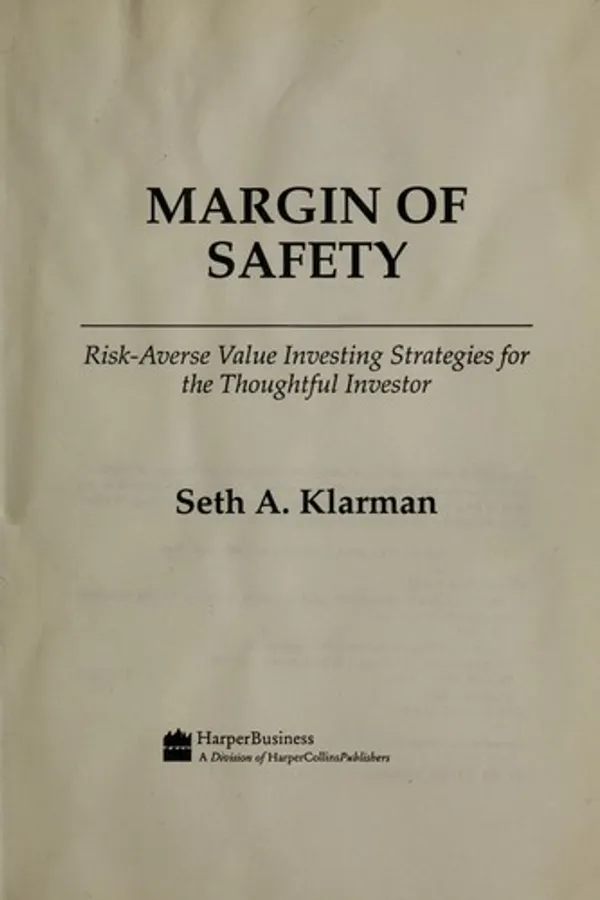
Book
Margin of Safety
Seth A. Klarman
Avoiding loss is not one objective among several; it is the objective, because the arithmetic of compounding forgives almost everything except the large drawdown.
- TYPE
- Book
- SHELF
- Trading & Markets
- TIME
- 13 min read
- ADDED
- 2026 · 07 · 07
- STATUS
- Completed
- IDEAS
Markets · Psychology
Why it matters
It anatomizes the institutional incentives that make prudence professionally dangerous, which is the exact terrain a firm oriented to absolute returns has to stand outside.
Klarman's question is why sensible investing stays rare when its principles are public, and his answer is structural rather than moral. Most market participants are speculators by function whatever their title: they buy what they expect others to buy, and their horizon is the next mark, not the underlying claim. Institutions are conscripted into a relative-performance derby, measured quarterly against benchmarks, required to stay fully invested, and punished more for unconventional failure than for conventional loss. Wall Street itself is paid on activity and issuance, so its optimism is a business model rather than an opinion; the junk-bond machine of the 1980s stands as his exhibit of instruments engineered for issuers and intermediaries while the risk was delivered to the buyers. Against this he sets a philosophy: risk is the probability and magnitude of permanent loss, not volatility; compounding's asymmetry makes the avoidance of large losses the first objective; performance must be absolute, since beating a falling index is still losing money. The process follows from the philosophy: bottom-up appraisal, a demanded margin of safety, preference for situations with catalysts that return value without the market's cooperation, cash held without apology when nothing qualifies, and selling as value is realized.
- Risk is the probability and magnitude of permanent capital loss; volatility is the academy's convenience, not the investor's enemy, and treating the two as one mismeasures every position.
- Compounding is asymmetric: the large loss dominates the geometric mean, so the refusal to lose big outperforms brilliance across a full cycle.
- Relative performance is a trap by design: institutions hugging benchmarks and holding full investment mandates cannot act prudently even when they see clearly. Absolute orientation is what permits cash, patience, and refusal.
- Wall Street's bullishness is structural, not analytical; fees follow activity and issuance, so the machinery is built to recommend motion.
- Bargains are manufactured by other people's constraints: forced sellers in liquidations, spinoffs, bankruptcies, and index changes part with assets for reasons that have nothing to do with value.
- Cash is the default position, and the absence of opportunity is information; a catalyst, where present, returns value without requiring the market to agree with you.
The argument
The book opens with a distinction older than its author and then does something original with it: instead of lecturing individuals about the difference between investing and speculating, Klarman shows that speculation is what most of the market is structurally paid to do. A speculator, in his functional definition, buys in the expectation of selling to someone more eager; an investor buys a claim on the cash an asset will yield. By that test the title on the business card is irrelevant, and most professionally managed money fails it. Not because the professionals are fools, but because their contracts require failure: they are measured quarterly against a benchmark, so their real product is tracking, not judgment; they are punished asymmetrically, since losing conventionally is survivable and losing unusually is not; and they are often obliged to remain fully invested, which converts every market, at any price, into a buyer’s obligation. The relative-performance derby is his name for this, and its cruelty is that it works: the manager who hugs the index keeps the assets, and the client pays for prudence he is structurally denied.
The sell side gets the same anatomy. Wall Street’s revenue arrives with activity and issuance, so its optimism is not a view about the future but a property of the fee structure; whatever can be originated will be recommended. The junk-bond boom of the 1980s is the book’s extended exhibit: an entire asset class marketed on the claim that historical default rates made high coupons a free lunch, while the instruments were engineered for the benefit of issuers and intermediaries and the risk traveled, as it reliably does, toward the buyers with the least information and the most yield hunger. Klarman wrote the indictment while the machine was still warm. The lesson he draws is general and permanent: financial innovation should be presumed to relocate risk toward whoever is reading the brochure.
The philosophy is built against that terrain, and it begins by redefining risk. Risk is not volatility, whatever the models say; it is the probability of permanent loss multiplied by its magnitude, and the two definitions point portfolios in different directions. From compounding’s arithmetic he derives the priority of loss avoidance: gains and losses are not symmetric to the geometric mean, and the deep drawdown costs more time than any run of brilliance repays. Hence absolute performance as the only honest yardstick. Beating the index by five points in a year the index fell thirty is not success; it is a smaller failure with a bonus attached. The investor oriented to absolute results acquires, at a stroke, the freedoms the institutions surrendered: the freedom to hold cash, the freedom to look wrong for quarters at a time, and the freedom to refuse.
Before the process, a clearing of the field. Klarman is severe about the label he carries: value investing, by the time he wrote, already had its pretenders, buyers of statistical cheapness who inherited the vocabulary without the risk aversion, and he distinguishes the discipline from its costume. The real thing begins in an admission: the future cannot be forecast, and therefore appraisal must be conservative and the discount from appraisal must be demanded, because the margin of safety exists precisely to absorb what the analyst cannot know. Valuation itself he treats through more than one lens, the present value of the cash an enterprise will generate, what its assets would fetch in liquidation, what informed private buyers would pay for the whole, and he holds the lenses loosely: each is imprecise, the imprecision is the argument for buying at a wide discount, and a valuation exercise that produces confidence instead of humility has been performed backward.
The process is the philosophy operationalized. Appraisal runs bottom-up, one situation at a time, with a margin of safety demanded in the price rather than hoped for in the outcome. The hunting grounds are wherever selling is compelled: corporate liquidations, spinoffs distributed to holders who never wanted them, bankruptcies and distressed credit that mandates forbid, thrift conversions priced for indifference. In each, an owner is parting with an asset for reasons unrelated to its value, and that gap is the raw material. Klarman’s preference for catalysts refines it: a liquidation or restructuring returns value on the situation’s own timetable, without requiring the market to come around to your opinion, which shortens the exposure to both error and mood. Where nothing qualifies, the portfolio holds cash without embarrassment, because the alternative is lowering the standard exactly when the standard is the edge. And selling is a discipline rather than an aspiration: as price approaches appraised value the position leaves, without waiting for the last dollar that belongs to someone with a different cost basis.
Working notes
This is Graham’s temperament written out as institutional anatomy. Security Analysis supplies the appraisal method; Klarman explains why owning the method is not enough, because the machinery around the practitioner is engineered to prevent its use. Reading them together relocates the edge: it was never the valuation arithmetic, which is teachable in a week, but the structure and stomach that let a man act on it, which most careers are built to remove.
The most tradable idea in the book is that bargains are manufactured by constraint. The question I now ask of any apparently cheap asset is not why is this cheap but whose problem is this, and the answers sort cleanly: sometimes the cheapness is information about the asset, and sometimes it is information about the seller, a fund breaching a mandate, an index deleting a name, a lender seizing collateral it never wanted to own. Only the second kind is reliably my opportunity. The first kind is usually the market being right a little early.
Cash as the default position is the hardest teaching in the book and the one I have failed most often. Idle capital feels like a verdict on the operator; every incentive, internal and external, argues for motion. Klarman reframes the idleness as an option premium: cash is the instrument that appreciates exactly when everything else is being sold by force, and its yield is denominated in the prices other people accept at the bottom. The reframing does not make holding it comfortable. Nothing makes holding it comfortable; that is why it pays.
When Genius Failed sits next to this book as its control experiment: the most credentialed balance sheet of its decade, run with brilliance, leverage, and no margin of safety, rescued by the very institutions Klarman’s incentives chapters describe. Capital Returns extends the forced-seller logic to whole sectors, where the constraint is capital flooding in rather than rushing out. The three books are one argument at three scales.
And the book’s afterlife is its own footnote: out of print, traded at collector prices, valued for scarcity by readers who may not notice they are paying a premium detached from the content’s intrinsic worth. Run the author’s own analysis on the object. The claim it represents, the ideas, has been restated in every value investing primer of the past three decades and can be had for the price of any of them; what commands the premium is the artifact, and the artifact is priced by exactly the mechanism the text anatomizes: buyers purchasing in the expectation of other buyers, scarcity mistaken for worth, the signal of ownership valued above the thing owned. By the book’s own functional definition the book has become a speculation, a position whose entire return is the future opinion of other collectors. The market annotated the manual with the exact error the manual warns against. I have never decided whether Klarman finds that funny.
Where I push back
The book universalizes a practice that was institutional. Klarman’s patience had a balance sheet: committed capital, clients chosen for their tolerance of idleness, and privileged access to the distressed and illiquid paper where his process actually fed. The reader inherits the sermon without the endowment, and the difference is not cosmetic. A private investor holding forty percent cash through a decade-long bull market is not running Baupost; he is paying the full carry cost of a discipline whose compensating opportunities may never reach him, and the book never prices that gap.
Second, the cash drag is treated as a moral test when it is also a mathematical one. Refusing to lose can become a refined way of refusing to play, and the value tradition contains enough multi-decade refuseniks to prove it. Discipline calcifies into identity; the investor becomes the man who does not buy, and the not-buying stops being a judgment about prices and becomes a personality. The book offers no instrument for telling patience from obstinacy, and the absence matters, because from the inside the two feel identical.
Third, the process chapters have dated in a way the philosophy has not. Thrift conversions and the junk aftermath were the inefficiencies of one regulatory moment; the modern reader must translate, and the translation is where most readers fail. What generalizes is the logic of constraint, not the list of venues.
Last, the incentive critique spares one party too many: the client. Institutions hug benchmarks because the money leaves when they lag; the derby is run at the demand of the very capital that then complains about its results. Absolute performance requires absolute clients, and the book, written by a man who had them, does not say loudly enough that without them the doctrine is unemployable. The anatomy of incentives should have followed the money one step further, to the people whose money it is.
How it enters the work
BlockHedge is oriented to absolute performance in a market whose participants benchmark against the mania itself; in every cycle the standing question is why the fund is not keeping up with whatever is levitating that quarter. Klarman supplies the spine and the arithmetic for the answer. The mandate is written against permanent loss, not against an index of enthusiasm: sizing is set by the drawdown that would impair compounding, reserves are held as policy rather than as timidity, and the firm accepts looking wrong for quarters as the standing cost of staying solvent across cycles. That sentence is easy to write and expensive to live; the book’s function is to keep it priced in advance.
The forced-seller doctrine translates into crypto with almost embarrassing directness. Liquidation cascades are compulsory selling on a public schedule: leverage unwinds mechanically, collateral is dumped by engines that have no view on value, and the only question is who is still holding a balance sheet when it happens. The firm’s job, in Klarman’s terms, is to be present and funded at other people’s margin calls, with appraisal work done in the quiet so the bid can be honest in the noise. Reserves are the option premium; the cascade is the exercise date.
In capital formation the rule is that the downside must be contractual, not narrative. Structures are negotiated so that being wrong is survivable by construction, seniority, collateral, covenants, rather than survivable by hope; the margin of safety lives in the documents before it lives in the thesis.
And the discipline hook is a working habit: the cash floor, written as policy rather than felt as mood. A minimum reserve is set in advance, treated as a position with its own thesis, and reviewed on a cycle’s timescale rather than a quarter’s, because reviewed quarterly it always looks like a mistake. The policy exists against the exact pressure Klarman anatomizes: every idle month argues for lowering the standard, and the argument is most persuasive precisely when prices are highest. Writing the floor down in a calm hour moves the decision out of reach of the loud one. The reserve pays nothing for years and then pays everything at once, at the bottom, denominated in other people’s forced prices; what carries it through the seasons when it looks unintelligent is not conviction, which erodes, but the document, which does not.
- Size every position against the drawdown that would impair compounding, not the gain that would flatter it.
- Hunt where sellers are forced; constraint, not stupidity, is the reliable source of bargains.
- Hold cash without apology when nothing qualifies; idle capital is an option on other people's emergencies.
- Prefer situations with catalysts; without one, the market owes you nothing on your schedule.
- Measure the work in absolute terms across a cycle; the real benchmark is solvency, not the index.
Klarman's patience was capitalized: committed funds, clients selected for tolerance, and access to distressed paper that retail readers will never see. Inherit the doctrine without the structure and a long bull market will price your discipline in years of relative failure that feel like moral failure. The process chapters are period furniture, thrifts and junk bonds, and the discipline itself can calcify into an identity that refuses whole decades. The book gives no test for telling patience from obstinacy.