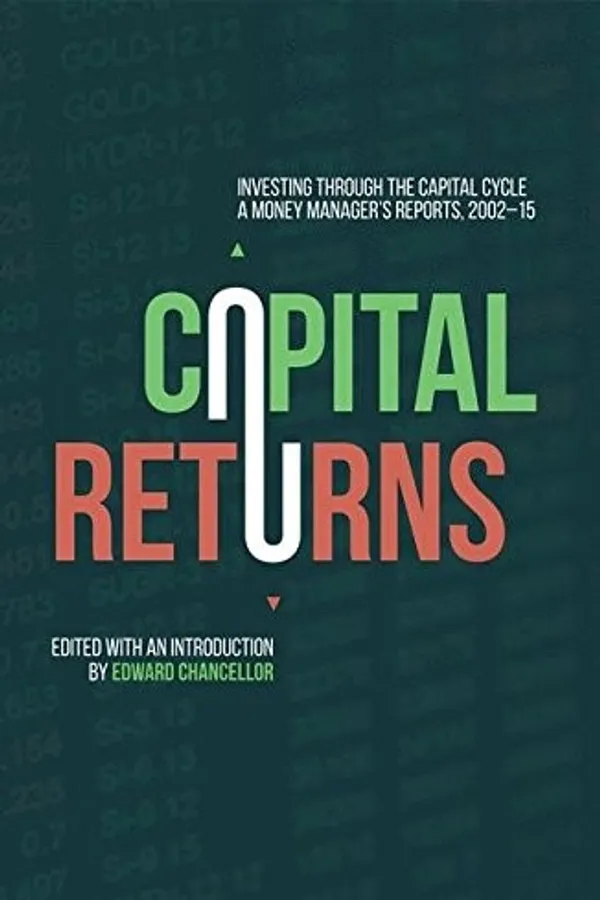
Book
Capital Returns
Edward Chancellor
Forecast the supply of capital, not the demand for product: money flooding into a sector writes its poor returns in advance, and money fleeing writes the good ones.
- TYPE
- Book
- SHELF
- Trading & Markets
- TIME
- 13 min read
- ADDED
- 2026 · 07 · 07
- STATUS
- Completed
- IDEAS
Markets · Business
Why it matters
It converted my sector work from demand guessing to supply counting, and supply is the one side of the ledger a patient man can actually verify.
Capital Returns collects the investment reports of Marathon Asset Management, a London firm, written between 2002 and 2015 and edited by Edward Chancellor, whose introduction turns the file into a theory. The theory is the capital cycle. High returns in a sector attract capital; new entrants and new capacity arrive together; competition drives returns below the cost of capital; capital flees; capacity is scrapped or consolidated; the survivors' returns recover, and the cycle turns again. Most analysis stares at demand, which is a guess about strangers; the capital cycle watches supply, which is announced, financed, and published. The cycle persists because it cannot be arbitraged on institutional timescales: analysts are siloed by sector, fund managers are benchmarked by the quarter, executives are paid for growth, and bankers are paid for issuance, so every actor is compensated to ride the cycle rather than resist it. The essays apply the frame in real time: the mining capacity ordered during the China boom, the loan growth of Irish banks before 2008, the sectors quietly consolidating while attention was elsewhere. The evidence is contemporaneous, and that is the collection's authority.
- Returns mean-revert through supply, not sentiment: profitability attracts capacity until returns fall, and losses retire capacity until returns recover. The mechanism is physical, financed, and slow.
- Demand forecasting is a crowded guess about the unknowable; supply is observable in capex plans, new entrants, and issuance calendars, and almost no one bothers to read it.
- Competition neglect is the cycle's behavioral engine: each firm judges its expansion against current prices while its rivals, holding identical spreadsheets, expand into the same future.
- A surge of IPOs and secondary issuance in a sector is the market's own disclosure that informed sellers have arrived; the prospectus is a weather report.
- Agency sustains the anomaly: analysts, managers, executives, and bankers are each paid to amplify the cycle, so exploiting it requires a time horizon institutions rarely fund.
- The buy signal is capital leaving: consolidation, capex cuts, and bankruptcy are how a sector's future returns are manufactured, disguised as its obituary.
- Judge management by the capital allocation record across a full cycle; operations explain this year, allocation decides the decade.
The argument
The book is a working file, not a treatise. Marathon Asset Management, a London firm of unusual patience, circulated investment reports to its clients for decades; Chancellor curated the 2002 to 2015 file into this volume and wrote an introduction that extracts the doctrine the essays practice. A predecessor volume, Capital Account, performs the same service for the decade of the dot-com bubble. The arrangement matters. The theory arrives with a time-stamped record of being used, which is rare in investment writing and is most of the book’s authority.
The doctrine begins where the textbook stops. Microeconomics teaches that high returns attract entry until returns fall to the cost of capital; everyone learns it, and almost no one invests as if it were true. The ordinary analyst builds a demand model: units, prices, penetration curves, and a terminal growth rate that quietly assumes the sector’s profitability is a birthright. The capital cycle inverts the gaze. It asks what capital is doing: how much capacity is being ordered, who is entering, what the issuance calendar looks like, how capex compares to depreciation. When returns are high, capital arrives in a herd, and because productive capacity takes years to build, the new supply lands after the prices that justified it have gone. The mine ordered in euphoria pours its first metal into the glut. Demand forecasts fail because the future is unknowable; supply analysis works because an industry’s future capacity is announced years ahead, in public, with financing attached.
Chancellor’s introduction is the best part of the book because it explains why so exploitable a pattern survives. The behavioral causes are extrapolation and competition neglect: managers project today’s prices forward and evaluate their own expansion as if rivals were not, at that same hour, approving identical projects from identical spreadsheets. The institutional causes are harder and more permanent. Analysts are organized by sector and compare companies within it, so an entire sector’s overcapitalization is nobody’s finding. Fund managers are measured quarterly and cannot carry a thesis that takes five years to resolve. Executives are paid for growth in scale, not for returns on capital. Investment banks earn fees on issuance, so the supply of capital to a hot sector is itself professionally manufactured. Every agent is rational; the aggregate is a machine for destroying returns; and the anomaly stays open because closing it requires a time horizon no one’s incentives will fund.
The essays then use the tool in the open. During the commodity boom of the mid-2000s, when the China narrative made demand look like destiny, the reports counted the other side: capacity announcements multiplying across the mining industry, capex budgets swelling in unison, each producer expanding as if it alone had noticed the prices. The Irish banking notes, written while the boom was still respectable, treated loan growth itself as the disease: a bank compounding its book at such a rate was manufacturing future losses regardless of what its management intended, because credit is banking’s version of capacity. And the quieter essays make the opposite case: sectors left for dead, where the weak had exited and the remaining firms had learned capital discipline, offering durable returns precisely because their story was over and no new money wanted to hear it.
The second thread is management. Marathon’s method ran on years of company meetings, and the essays are unsentimental about what a meeting is for: not guidance, which is a demand forecast wearing a suit, but character evidence on capital allocation. Where did the cash go, across a whole cycle: buybacks at the lows or acquisitions at the highs, capacity restraint or empire. The corollary is to read the pay scheme before the presentation. An executive compensated for scale will expand into the glut with perfect sincerity, and no hour of questions will surface what the incentive has already decided; the pay scheme is the honest forecast, and the meeting is where you learn whether anyone in the room has read it. The frame also dissolves the tired taxonomy of value and growth. A statistically cheap stock in an overcapitalized sector is not value; it is a claim on destruction, and its discount is a fair price for the capital about to be burned. A richly priced firm in a sector where entry is blocked can be the conservative purchase, because the supply response that grinds returns down to the cost of capital never arrives; the multiple is buying the absence of the cycle. Both labels stare at price while the mechanism moves through quantity. The question is never cheap or dear. The question is what capital is doing, and the price is only where the answer is paid for.
Working notes
The Outsiders is this book turned inside out. Thorndike’s CEOs ran the capital cycle from within the firm: issuing stock when it was dear, retiring it when it was cheap, starving expansion at the top and feeding it at the bottom. Marathon runs the identical discipline from outside, choosing among managers instead of acting as one. Read together they make a single claim: capital allocation is the whole game, and the operating business is the venue where allocation happens, not the other way around.
Kindleberger supplies the weather system this book farms in. Manias, Panics, and Crashes tracks credit as it floods asset prices; Capital Returns tracks the same water as it soaks into physical capacity, where the damage is slower and more honest. A bubble in prices corrects in a quarter; a bubble poured into concrete and shipyards must be depreciated, and the sector carries the corpse for a decade. Chancellor, who elsewhere wrote the history of speculation, chose in this volume to document its most durable residue.
Klarman’s Margin of Safety is the temperament the method requires. Capital-cycle positions are early by construction: the signal is a capacity announcement years from delivery. Without absolute-return patience the analysis is unusable; the fund manager who sees the top and is benchmarked quarterly will ride it anyway, fully informed. Knowledge without a mandate is commentary.
An old commodities adage says the cure for high prices is high prices. The book is that sentence given an institutional theory: why the cure works, why it is always administered late, and who is paid to delay it.
Depreciation is where the cycle hides in the accounting. In a long capex boom, reported earnings flatter, because the fleet is young and the replacement cost of capacity inflates beneath the depreciation schedule; the earnings are quietly borrowing from the balance sheet. The essays’ habit of comparing capex to depreciation across a sector is the cheapest x-ray in finance. Above one and rising, the sector is manufacturing its bust; far below one for years, and it is manufacturing its next boom.
Of the supply signals, the IPO calendar is the bluntest. An initial offering is the sale of a business by the people who know it best to the people who know it least, timed by the sellers. Clustered in one sector, such sales are the cycle publishing its own top. I did not learn this from the book first; the book explained why I had kept paying for not knowing it.
What the second reading shows is that this is not a stock-picking tool but an account of why capitalism self-regulates: returns to capital are governed by capital’s own migration, and the investor who profits from the cycle is paid a fee for carrying its unpopular leg, holding the exited sector while the crowd finances the hot one. The fee is real because the discomfort is real. And a severity note: most sell-side research is demand astrology with a spreadsheet attached. The supply side sits in the same filings, unread, because reading it pays on the wrong schedule.
Where I push back
The method has no clock, and the book does not say so loudly enough. Supply signals arrive years before their consequences; a sector can stay irrational past the life of the fund that shorted it, and being early on the capital cycle is indistinguishable, month to month, from being wrong. The essays could afford their earliness because Marathon’s mandate and clients allowed it; the reader’s employer may not. A method’s returns are inseparable from the institutional structure that can hold it, and the book undersells that dependency.
Second, the anthology form flatters the doctrine. These are reports selected after the fact by an editor who knew how they aged. However honest the intent, a curated record of contemporaneous calls is marketing wearing the costume of humility, and the reader never sees the file drawer. I believe the method; I discount the implied hit rate to an unknown degree, and so should you.
Third, the framework strains where capacity is code. The cycle’s spring is the cost and delay of physical capacity: mines, ships, and plants take years and billions, so supply overshoots and undershoots on a rhythm. When the marginal unit of supply is software, entry is instant and nearly free, and the constraint migrates to distribution, data, and habit, places the capital cycle’s instruments do not measure. The book gestures at intangibles without rebuilding the tool for them. And where capital is political rather than profit-seeking, the spring breaks entirely: subsidized capacity does not exit when returns die, and a cycle that assumes profit-seeking exits will misfire in every industry a government has decided to own. The doctrine is true where capital is honest and impatient. Much of the world’s capital is neither.
How it enters the work
Crypto is the fastest capital cycle ever run, and BlockHedge lives inside it. Token issuance is capacity with no construction delay: when a narrative heats, the supply of claims on it arrives in months, forked, cloned, and financed by venture rounds that cluster exactly as issuance calendars cluster in equities. The firm reads fundraising announcements the way Marathon read capex budgets. When capital floods one corner of the market, the future returns of that corner have already been spent, whatever the demand story says, because the supply of substitutes is being manufactured in plain sight. The discipline is to count it: unlock schedules, new protocol launches, venture deployment by sector. Supply in crypto is not merely observable; it is contractual, published on-chain, and still ignored, which tells you how durable Chancellor’s anomaly is.
The buy side of the cycle is harder there, and worth more. After a winter, when funding has fled, teams have dissolved, and issuance has stopped, the survivors operate in exactly the consolidated quiet the essays teach you to prize. The firm’s discipline of theses that must survive a full cycle is capital-cycle practice stated as mandate: the holding period is set by how long supply takes to leave, not by how long conviction feels comfortable.
On the capital formation side the book works as a mirror. Raising or deploying, the question is always which side of the cycle the money is entering: whether we are the entrant the cycle is preparing to punish or the survivor it is preparing to pay. Money is easiest to raise exactly when it should not be deployed; the terms on offer are a stage indicator, and the book taught me to read my own inbox as sector data. When capital is eager, sell it capacity. When it is absent, build.
None of this required new instincts, only a new ledger. Find the structure, then remove everything that isn’t it: in sector work the structure is the flow of capital, and nearly everything that isn’t it is the demand story. The book’s gift is permission to ignore most of what is said about an industry and to count what is financed instead. Talk is a forecast. Capacity is a confession.
- Count supply before forming any sector view: capex against depreciation, entrants, announced capacity, and the issuance calendar.
- Treat clustered IPOs and secondaries in a sector as a sell signal written by the sellers themselves.
- Buy where capital has left and management has stopped building; the turn is made of exits, not of demand optimism.
- Read a manager's history of buybacks, issuance, and acquisitions across a cycle before believing anything said in a meeting.
- Fund capital-cycle theses with patience measured in years; the mechanism is real capacity, and concrete moves slowly.
The capital cycle has no clock. Sectors stay overcapitalized for years, supply signals run early, and a position built on this logic alone can be right in the analysis and dead in the interim. Remember also what an anthology is: reports selected after the returns were known, by an editor who held the pen. The method is sound; the hit rate implied by the table of contents is not evidence.