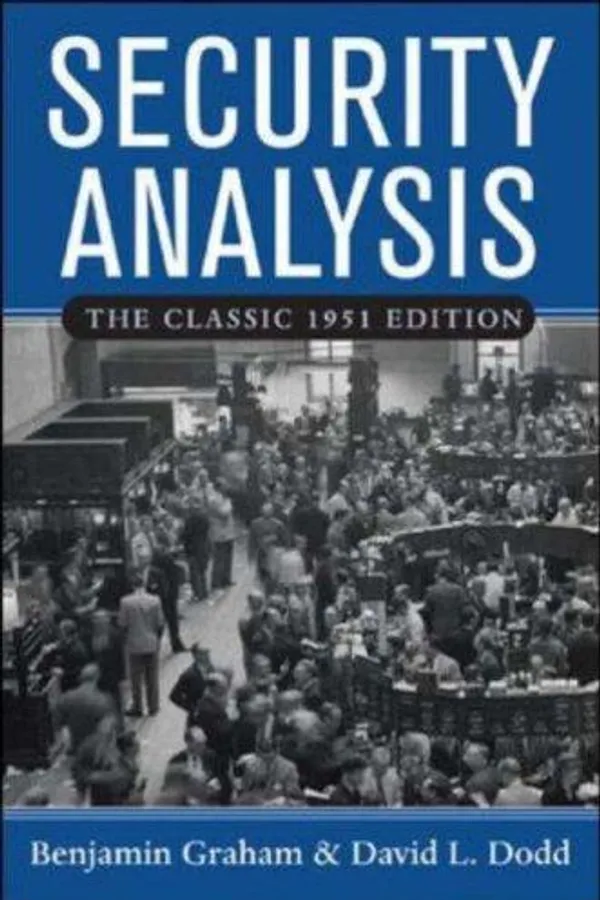
Book
Security Analysis
Benjamin Graham and David L. Dodd
An operation earns the name investment only when analysis can show, with a margin for error, safety of principal and an adequate return; everything else is speculation wearing the vocabulary.
- TYPE
- Book
- SHELF
- Trading & Markets
- TIME
- 14 min read
- ADDED
- 2026 · 07 · 07
- STATUS
- Completed
- IDEAS
Markets · Business
Why it matters
It is the founding constitution of the discipline BlockHedge tries to practice, drafted in the one decade when the cost of getting it wrong was still visible from the window.
Written in the crater of the crash, the book begins by drawing the line the 1920s had erased: an operation is investment when thorough analysis can show the principal secure and the return sufficient, and everything failing that test is speculation, whatever it calls itself. From that definition the discipline unfolds. Intrinsic value is a range, not a point; the analyst's task is not precision but the demonstration that price sits far outside the range. Earnings power is the average of demonstrated years, not the extrapolation of the latest trend, and the trend was exactly what the new-era doctrine had capitalized into ruin. A bond's safety lives in the enterprise's earning power held with a wide margin and tested against depression, not in the collateral pledged behind it. The balance sheet supplies floors: net current assets, liquidation values, the 1932 spectacle of companies priced below their own cash. Quantitative facts anchor the appraisal; qualitative judgments matter more and are audited less, which is where hope enters. Over all of it stands the margin of safety: the buffer that absorbs error, bad luck, and the time the market takes to weigh what it has been voting on.
- Investment is defined by the operation, not the asset: the analysis thorough, the principal defensible, the return adequate to the risk. The test is run on the act of buying, which means the same security can be an investment at one price and a speculation at another.
- Intrinsic value is a range, not a point. Analysis does not need to determine the exact figure; it needs only enough precision to show that the price is far outside the range.
- Earnings power is the average of demonstrated years, not the trend of recent quarters; the trend is where extrapolation smuggles the future into the accounts.
- A bond is safe because the enterprise can carry its obligations with a wide margin under depression conditions, not because of the lien behind it; inadequate safety is grounds for refusal, never for compensation by a higher coupon.
- The balance sheet sets floors under the appraisal: net current asset value and liquidation value mark the point where the market is pricing the business below its own dissolution.
- Quantitative facts anchor; qualitative judgments about management and prospects matter more and resist verification, so they are the entry point for hope, and hope is not an input.
- The margin of safety unifies the whole apparatus: a buffer between price and appraised value wide enough to absorb analytical error, bad luck, and time.
The argument
The book was published in 1934, with the market still standing in the wreckage of a collapse that had taken roughly nine tenths of the industrial average from its peak. Graham had lived the collapse as a practitioner; Dodd, his colleague at Columbia, had kept the record of the lectures that became the text. That timing is not biography, it is method. Every doctrine in the book is a depression doctrine, a rule that had just been tested against the worst outcome anyone then living had seen, and the book’s opening move is not a valuation formula but a definition. An operation counts as investment only when thorough analysis can demonstrate that the principal is safe and the return adequate; fail the test and the operation is a speculation, whatever the certificate says. The definition is operational, which is its genius. It tests the act, not the asset: a first-grade bond bought with borrowed money on a hunch is a speculation, and a despised stock bought below its net cash after careful appraisal is an investment. The sin the book prosecutes is not speculation itself, which it treats as a legitimate activity honestly labeled, but speculation conducted in investment’s vocabulary, by people who have not noticed which one they are doing. The 1920s had erased the line; the book redraws it in the ash.
The second load-bearing idea is that intrinsic value is a range, not a point. The analyst is not asked to compute the exact worth of an enterprise, an exercise the authors regard as beyond anyone; he is asked to establish that value lies far enough from price for the difference to matter. The appraisal need only be exact enough to expose the error in the quotation. This is where the famous distinction between the market’s short-run and long-run behavior does its work: from day to day the market registers opinion, and only across years does it weigh the underlying facts, so a wide and demonstrable gap between price and appraised value is a position with time on its side. Precision is not the standard; sufficiency is. Half of the bad practice I see in valuation descends from ignoring this one page: the model with four decimal places is not more careful than the range, it is less honest about what is knowable.
On earnings, the book’s doctrine is the average against the trend. Earnings power means what the enterprise has demonstrably earned across a period of years spanning good conditions and bad, and the analyst’s suspicion is reserved for the extrapolated trend, the assumption that the recent direction of earnings is itself an asset that can be capitalized. The new-era doctrine of the late 1920s had done exactly that: it held that a good company was a good purchase at any price because growth would ratify whatever was paid, and it moved valuation’s foundation from the record to the projection. The authors perform the autopsy without raised voices. When value rests on the future, the buyer has purchased an argument, not a business, and the seller wrote the argument.
The treatment of fixed income is the least read and most severe part of the book, and its central inversion still surprises: a bond’s safety does not live in the lien, the mortgage, or the collateral, but in the earning power of the enterprise held with a wide margin above its charges. Foreclosing on a failed railroad’s assets is a remedy of paper; what the bondholder actually needs is a business that never misses the coupon. From this follows the rule that safety must be tested under depression assumptions, not prosperous ones, since prosperity repays everything and proves nothing. And from it follows a harder rule: where safety is not clearly present, the security is to be refused, not bought at a higher yield, because in senior securities the extra coupon is never adequate compensation for a real chance of losing the principal. Bond selection is a negative art. The whole book is, at bottom; the analyst earns his keep by the commitments he declines.
The balance sheet supplies the floors. Net current asset value, the working capital remaining after every liability, marks a level at which the buyer pays nothing for the fixed assets or the future; liquidation value marks the market’s confession that it considers the business worth more dead than alive. In 1932 that confession was general: sound companies traded below their net current assets, some below their cash, a fact Graham documented at the time and the book treats not as an aberration but as evidence of how far opinion can detach from arithmetic in both directions. The same machine that paid any price for a trend in 1929 refused free assets three years later.
Around the quantitative core the authors build a careful fence. Qualitative factors, the character of management, the nature of the business, its prospects, matter more than the figures; they also resist verification, and so they are precisely where hope, optimism, and the salesman enter the appraisal unaudited. The method is therefore anchored in what can be demonstrated and admits the qualitative as modification, not foundation. And over the whole structure stands the margin of safety: the demand that the demonstrated value exceed the price by a buffer wide enough to absorb analytical error, ordinary bad luck, and the unknowable interval before the weighing begins. It is not a technique. It is a stance toward the future: act only where being substantially wrong still leaves you whole.
Working notes
Read this book next to Klarman’s and the division of labor becomes clear: Graham and Dodd built the instrument, Klarman wrote the operator’s manual for the incentives that prevent people from using it. The instrument has aged better than its screens. Nobody will hand you a net-net in a developed market now; everybody will hand you an occasion to run the definition, because the line between investment and speculation is redrawn or erased every cycle, and the erasing always uses the same solvent: a new era in which the record no longer binds the future.
The definition is the portable part, and I run it as a test rather than admire it as a sentence. Applied honestly it is expensive. It reclassifies most of what I have ever bought, and most of what everyone holds, from investment to speculation, and its value is exactly that cost: the reclassification does not forbid the position, it forbids the self-deception, and position sizing follows the honest label rather than the flattering one. Graham’s real subject is not stocks. It is the vocabulary a man uses about his own actions.
The depression conditioning reads differently after you have managed money through a drawdown. These tests assume the world can halve, because the authors had just watched it halve; that is not pessimism, it is memory. The modern models that assume the world cannot halve are not optimism either. They are amnesia with mathematics, and every cycle refreshes their confidence intervals from a history too short to contain the event that matters. Of the two errors I prefer Graham’s, which costs opportunity, to the other, which costs firms.
The range-against-point doctrine anticipates most of what is good in modern practice and indicts most of what is bad. A point estimate is a costume that false precision wears; a range is a confession of what is actually known, and the confession is the analysis. Munger’s correction, in Poor Charlie’s Almanack, completes the frame from the other side: quality is a component of safety, and a fair price for an excellent business can carry a wider true margin than a cheap price for a dying one. Thorndike’s Outsiders is the sequel on a different axis: Graham teaches the appraisal of the earnings record, and the Outsiders CEOs demonstrate that what management does with those earnings is a second appraisal the analyst cannot skip.
Near the end of his life Graham said publicly that he doubted elaborate security analysis still repaid its cost in markets grown efficient. The founder outlived his edge and reported the fact. I keep that next to the book, because it honors the method: the discipline was always honesty about what analysis can show, and he applied it, last of all, to the analysis itself.
Where I push back
The frame underweights quality to the point of distortion. In this book safety lives in the record and the balance sheet, and almost never in the character of the business itself; a strict Graham reading refuses nearly every great compounding enterprise of the last half century at nearly every price it ever traded at. Buffett needed Munger and Fisher to complete the education, and the necessity of the completion is a verdict on the original: price discipline without business judgment is half a method, and the book presents it as the whole.
Second, the balance-sheet floors have rotted where the economy went intangible. Net current assets mean little in firms whose value is code, brand, and network position, and liquidation value means less; the book’s anchors hold only in the shrinking territory where assets are things. The frame can be translated, and I translate it, but the book does not teach the translation, and readers who apply it untranslated become connoisseurs of the obsolete.
Third, the method trusts reversion more than the evidence entitles it to. The gap between price and value closes, the book assumes, given time; sometimes the gap is information, and the cheapness is the market correctly pricing a terminal decline the averaged record cannot see. The value trap is not a misapplication of Graham and Dodd. It is Graham and Dodd applied faithfully to a business whose past has stopped describing its future, and the text offers no instrument for detecting when that has happened. The book can teach a man to buy dollars for fifty cents and never once make him ask whether the currency is being withdrawn.
And analysis presumes the accounts describe the business, which is the assumption a determined liar attacks first. The method audits the arithmetic of the figures, never their honesty; against invented inventories and receivables that exist only in the filing, the margin of safety is computed from fiction, and a margin computed from fiction is fiction with a discount applied. Diligence narrows the exposure. Nothing eliminates it, because the instrument reads statements and cannot read men. The second unpriced risk is the money itself. Every margin in the book is denominated in the unit of account, and the whole apparatus assumes the unit holds still while price converges on value. A bondholder repaid in full in a currency worth half is whole by Graham’s test and injured by every other; depression testing guards the numerator and says nothing about the denominator. Some risks are not absorbed by any discount at purchase. They can only be refused, hedged, or carried knowingly, and the book teaches only the refusal.
How it enters the work
BlockHedge exists on the line this book drew. A firm bridging traditional finance and crypto spends every day among assets that fail Graham’s test, and the first discipline the book installs is naming that honestly in our own documents: most digital assets promise neither safety of principal nor a return grounded in analysis, and are therefore speculations, to be sized, hedged, and discussed as speculations. The minority with demonstrable earning power, fee streams, exchange economics, infrastructure with real cash flow, get the full apparatus: averaged records instead of annualized quarters, appraisal in ranges, and a demanded gap between price and value wide enough to survive being wrong. The vocabulary discipline sounds small. It is the whole risk culture; a firm that calls its speculations investments will eventually size them as investments, and the sizing is what kills.
In capital formation the book operates as contract law. A margin of safety that lives in the pitch is a mood; one that lives in the structure is a term. Seniority, collateral tested at depression values, covenants that trip while the enterprise can still be repaired: this is Graham’s fixed-income doctrine translated into documents, and his rule against reaching for coupon governs what we refuse. Where safety is not demonstrable, the answer is no, not a higher rate; yield never compensates for a real chance of losing the principal, in 1934 or now.
Every valuation memo the firm writes is a range with an action price, per the book. If the range must be narrowed to justify the transaction, there is no transaction; narrowing the range under deal pressure is the modern form of capitalizing the trend. And each position is tested against the market halving, which in crypto is not a stress scenario but a season. The test is Graham’s, the calibration is ours.
What the book finally enforces is the negative art. The refusal list, the record of what was declined and why, is reviewed the way other desks review their wins, because that is where the method lives. Analysis, practiced honestly, is mostly the discipline of saying no in writing.
- Run Graham's test on every position: if the analysis cannot demonstrate a safe principal and a sufficient return, call the operation speculation and size it as one.
- Appraise in ranges and act only when price sits far outside the range; a valuation that must be narrowed to justify the purchase is a warning, not an answer.
- Average the record before trusting the trend; pay for demonstrated earnings power and treat the projection as the seller's property.
- Test every credit under depression assumptions; prosperity repays everything and proves nothing.
- Practice the negative art first: the refusals, written down and reviewed, are the analyst's real track record.
The instrument was calibrated for an economy of tangible assets, dividends, and legible balance sheets; applied unmodified to an economy whose value lives in software and network position, it will keep you permanently cheap and permanently absent. Its famous screens decayed decades ago, and the net-net inventory is gone from developed markets. Cheapness without a catalyst is a warehouse, not a strategy. What survives is the frame, not the formulas, and a reader who cannot tell the difference will practice 1934 in costume.