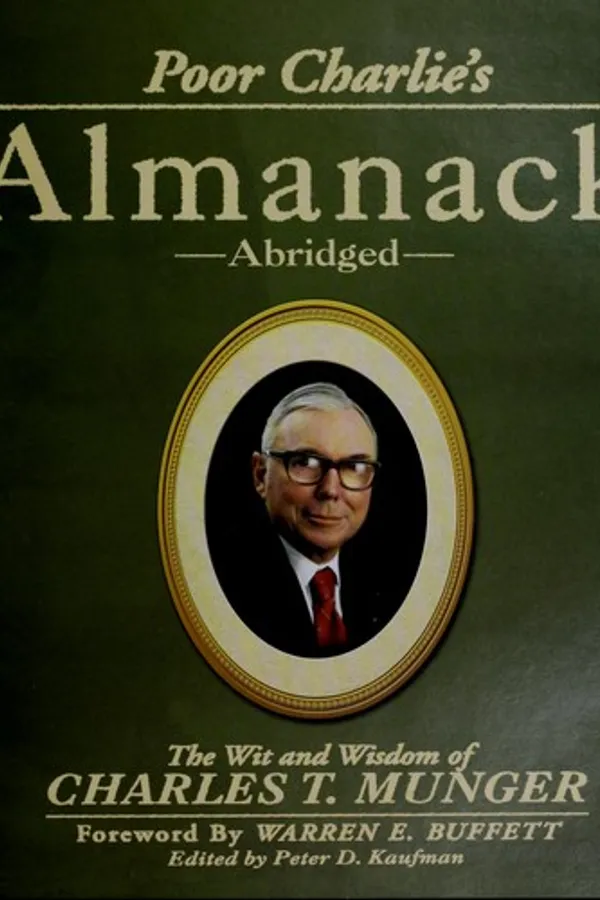
Book
Poor Charlie's Almanack
Charles T. Munger
Judgment is assembled, not bestowed: a latticework of models from the big disciplines, run forward and then inverted, with incentives checked first, beats brilliance through one lens.
- TYPE
- Book
- SHELF
- Business & Enterprise
- TIME
- 16 min read
- ADDED
- 2026 · 07 · 07
- STATUS
- Completed
- IDEAS
Business · Markets · Psychology
Why it matters
It is the working manual for multidisciplinary judgment, and the incentive check and the inversion habit it installed run daily at both of my desks.
The Almanack collects Munger's talks into the nearest thing his method has to a text. The argument: reality is not organized by academic department, so a mind using one discipline's models will not simplify a problem but mutilate it; the man with only a hammer treats everything as a nail. Worldly wisdom is a latticework of the big models from the big disciplines, compound interest and combinatorics from mathematics, breakpoints and backup systems from engineering, critical mass from physics, evolution from biology, and above all the psychology of misjudgment, which he catalogs as twenty-five standard tendencies with incentive-caused bias first among equals. The method runs in both directions: think the problem forward, then invert it, asking what would guarantee failure and avoiding that. Applied to capital it yields his heresies: real opportunities are rare, so bet seldom and heavily; quality at a fair price beats junk bought cheap; most activity is cost. Around the doctrine stands an ethic, deserved trust, envy refused, self-pity treated as poison, with Franklin as the household god. The book is repetitive, reverent, and overweight. The method inside it is sound.
- To the man with only a hammer, every problem looks like a nail. Single-discipline minds do not simplify reality; they mutilate it to fit the tool they have.
- A working latticework needs surprisingly few models: compound interest, combinatorics, breakpoints, backup systems, critical mass, evolution, and the standard tendencies of misjudgment. Owning them means using them daily, not naming them.
- Never accept an analysis that has not been inverted. Ask what would guarantee failure, then avoid it item by item; failure modes are enumerable in a way success paths are not.
- Incentives are the first check on every claim and every institution. Whoever is paid to reach a conclusion will reach it, and sincerity makes the bias stronger, not weaker.
- Psychological tendencies compound. When several act in the same direction on the same target, the lollapalooza result is behavior no single bias could produce.
- Opportunity is rare and activity is a compounding cost: wait with cash and attention, then bet heavily when the odds are plainly mispriced. Frequency of decision is the enemy of quality of decision.
- The ethic is load-bearing, not decorative. Deserved trust lowers the cost of everything it touches, and envy, resentment, and self-pity are instrument failures of the mind, not personality traits.
The argument
The Almanack is not a book Munger wrote; it is a book he gave. Peter Kaufman collected the talks, delivered across three decades to graduating classes, foundations, and business schools, and set them in a frame of Franklin homage and family testimony. The form matters. This is oral teaching, and it repeats the way drills repeat, because the teacher’s aim is not coverage but installation: he wants a handful of ideas wired in so deeply that they fire without being called.
The first idea is a claim about the shape of knowledge. Reality is not organized by academic department; problems arrive with their physics, their accounting, their psychology, and their incentives tangled together, and a mind trained in one discipline will not simplify such a problem but mutilate it. His figure for this is the man with a hammer, to whom everything looks like a nail. The remedy is what he calls worldly wisdom: a latticework of the big models from the big disciplines, held in one head and used on everything. Not many are needed. Compound interest and combinatorics from mathematics; breakpoints and backup systems from engineering; critical mass from physics; evolution and ecology from biology; cost and opportunity cost from economics; and, weightiest of all, the standard tendencies of human misjudgment from psychology. The catalog is finite and learnable. What is rare is not access to the models but the habit of running a live problem through all of them before trusting any conclusion.
The latticework answers what to think with; the next question is which way to run it. Munger takes from the mathematician Jacobi the instruction to invert, and turns it into a working method: many problems that resist a forward solution yield immediately when asked backward. Do not ask how to help the enterprise; ask what would reliably destroy it, and stop doing those things. His commencement address at the Harvard School is the set piece: a prescription for a life of guaranteed misery, delivered straight, so the graduates could refuse the recipe item by item. The device looks like a joke and is closer to an engineering practice. Failure modes are enumerable in a way that success paths are not, and a large share of wisdom turns out to be subtraction.
All of it comes to rest on the psychology, the book’s center of gravity. The final and longest talk catalogs twenty-five standard causes of human misjudgment, and it opens where Munger insists all analysis must open, with incentives. Incentive-caused bias is not the observation that people respond to rewards; it is the darker finding that cognition itself bends toward the payoff, so that the paid man honestly believes what his compensation requires, and sincerity makes the bias stronger, not weaker. His homely example is Federal Express, whose overnight sorting could not be made to finish on time until someone stopped paying the night shift by the hour and paid it by the shift. Around this anchor he arranges the others: social proof, the outsourcing of judgment to the herd at exactly the moments the herd is least reliable; commitment and consistency, by which a stated position hardens into identity; denial; envy; reciprocation; the misinfluence of authority; the availability tendency that mistakes the vivid for the probable; deprival superreaction, which makes small losses feel like amputations. The taxonomy’s payoff is the lollapalooza: when several tendencies act in the same direction on the same target, the result is not additive but explosive, producing outcomes no single bias could. The open-outcry auction is his standing example of a machine engineered to fire several tendencies at once against the bidder’s wallet.
Applied to capital, the models yield his heresies. Opportunities that are both understandable and mispriced are rare, so the correct frequency of major decision is low: wait with cash and attention, and when the odds turn plainly favorable, bet heavily. Quality bought at a fair price beats mediocrity bought cheap, the argument that moved Berkshire beyond Graham’s statistical bargains and toward businesses whose economics compound on their own. The circle of competence draws the boundary, because returns are not awarded for difficulty, and the expensive errors cluster just outside the circle’s edge where confidence outruns knowledge. Opportunity cost does the ranking: every commitment competes against the best alternative actually available, not against zero. And the two-track analysis governs the whole procedure: first, the rational factors that truly govern the interests involved; second, the subconscious influences operating at that moment on the analyst himself. The second track is the one the profession skips.
There is also a demonstration section, easy to skim and unwise to. In the talk on practical thought he sets himself the problem of designing a world-scale beverage business from nothing and solves it in a few pages using only the big models: conditioned reflexes from psychology, scale economics, autocatalysis borrowed from chemistry as his figure for self-reinforcing growth. The point is not the answer but the display of method: watch how few ideas, held firmly and combined, do work that whole departments of specialists fail to do. The same lesson stands behind his refrain that the wise people he has known were all continuous readers. The latticework is not an achievement but a maintenance schedule; the models decay in a mind that stops feeding them.
Under the method sits an ethic Munger refuses to separate from it. Deserved trust is presented as an economic asset: a web of earned reliability lowers the cost of every transaction it touches, and a life aimed at deserving what it wants is both the honorable strategy and the cheap one. Envy is dismissed as the one deadly sin with no upside; self-pity and resentment are treated as cognitive poisons that guarantee misjudgment. Franklin presides over all of it: commercial, curious, multidisciplinary, useful early so as to be independent later. The book’s deepest claim is that none of this is decoration. The ethics and the epistemics are one system, because a mind that permits itself envy, grievance, and unearned certainty has corrupted the very instrument it thinks with.
Working notes
The natural pairing is Kahneman. Thinking, Fast and Slow derives the catalog of error from controlled experiments; the Almanack derives it from invoices. Kahneman’s taxonomy is cleaner, better evidenced, and harder to use; Munger’s is cruder, overlapping in places, and attached at every joint to a cost somebody paid, which is why it operates better under pressure. One is the science of misjudgment and the other is field notes from a man who was betting his own money while he took them. I keep both, and I reach for Munger first and check the reach with Kahneman afterward, which is itself a two-track analysis.
The two tracks are easy to mistake for Kahneman’s two systems, and they are not them. The systems describe how a mind runs; the tracks prescribe how an analysis must run: first the real interests and the forces that govern them, then the tendencies at work on the man doing the analysis. One is a description of machinery, the other a rule of operation, and the rule is the rarer possession because it costs something every time it is applied.
Incentives have become, for me, the master model, the one that runs before any other. Most organizational mysteries are not mysteries; they are compensation plans working correctly. When a vendor’s architecture recommendation matches the vendor’s license model, when a manager’s forecast matches his bonus threshold, when an analyst’s rating matches his bank’s pipeline, no conspiracy is required and none should be inferred. The men are sincere. That is the finding: sincerity is not exculpatory, and the honestly biased are more dangerous than the corrupt, because they pass every integrity test while delivering the same wrong answer.
Inversion, practiced rather than admired, turns out to be ordinary engineering. Failure-mode analysis, the premortem, the kill memo: every serious discipline reinvents Jacobi eventually. What Munger adds is the insistence that the method be applied to one’s own conclusions, which is where it stops being pleasant. Inverting a design is a technique; inverting a conviction is a discipline.
The gap between citing models and owning them is the book’s real subject, visible only on a second reading. A model is owned when it fires involuntarily, when the pattern in the world summons it without being asked, the way a chess player does not decide to see a fork. The Almanack’s repetitiveness, the same stories and the same names across decades of talks, is not editorial laziness; it is what installation looks like from the outside. Drills repeat. That is what makes them drills. The test of ownership is retrospective: not whether the model can be recited on request, but whether it has ever interrupted a decision, mid-motion, when reciting was the last thing on the mind.
He is also the best available answer to the specialization trap that credentialing economies enforce. The institutional world pays for depth and punishes range, then wonders why its deepest men walk confidently into disasters any generalist would have smelled. Munger’s crossing of boundaries was not a style; it was risk management for the mind. The latticework is diversification applied to judgment.
Note what the Almanack shares with Grove and Drucker on this shelf: all three treat thinking as an operating discipline with procedures, audits, and maintenance, not as a talent to be admired. The difference is altitude. Grove instruments the organization; Munger instruments the man. Between the two instruments sits nearly everything I believe about work.
A last observation on temperament. The talks are funny, and the humor is load-bearing: it is the sound of a man holding strong opinions loosely enough to laugh at the species that produces them, himself included. Readers who inherit the opinions without the laughter become the thing the book warns against. They become hammers.
Where I push back
The packaging is worship. The Almanack arrives at coffee-table scale, wrapped in family testimony and editorial reverence, a shrine with an index. Munger’s method deserves a working edition at half the weight and a tenth the incense; the presentation invites exactly the discipleship the content forbids, and the contradiction is never acknowledged anywhere in the volume. A book about independent judgment should not feel like a reliquary.
Second, the industry it spawned. The latticework has become content: model lists, model newsletters, model courses, whole careers assembled from naming Munger’s tools without ever cutting anything with them. This is not entirely the readers’ fault. The book presents the models as a collection, and collections invite collectors; what it cannot transmit is the fifty years of priced feedback that turned Munger’s collection into judgment. Naming a bias is one motion; feeling it operate on you while it operates is another, and the second cannot be acquired in book form at any page count. The audit for whether a reader has crossed from collecting to cutting is unglamorous: name one decision reversed because a model fired against your own interest, at cost, before the outcome was known. Most of the latticework industry cannot produce one.
Third, the certitude. Munger’s dismissals, of academic finance, of most money managers, of the psychology departments that failed to teach what he had to assemble himself, are backed by his record and his reading, and they are rented by readers who have neither. The reader inherits the confidence faster than the competence, and concentration sized for Munger’s base rates will simply destroy a man without them. The dismissiveness costs Munger something too. His psychology is folk taxonomy, overlapping and unfalsifiable, workable as a checklist and weak as science, and the academics he sneers at are the people who could have told him which of his twenty-five tendencies are real, which are duplicates, and which are anecdotes wearing lab coats. He built a better tool than the academy’s and a worse map, and admitted neither.
Last, the ethic carries a survivor’s serenity. Deserved trust compounds beautifully when the early hands are playable and the institutions around you can recognize what you deserve. The counsel is true and incomplete: the book spends no time on the people who deserved what they never received, and a doctrine of desert with no chapter on injustice is a rich man’s theology. It travels badly to the man whose first hands were unplayable.
How it enters the work
At BlockHedge the incentive check is the first screen, before the chart and before the code. Crypto is incentive-caused bias with a blockchain attached: token emissions that pay for belief, yields that are marketing wearing arithmetic, foundations funding the research that praises them. The question of who is paid to believe this, asked of every protocol, counterparty, and published thesis, does more risk work in one minute than any dashboard we run. It is turned inward on the same schedule: when our own fee structure would prefer a conclusion, that preference goes into the memo as a named exposure, because the honestly biased analyst is the one I am most likely to be.
Inversion is institutionalized as the kill memo. No thesis goes on the book until someone has written the account of how the position destroys us: the regime that breaks it, the counterparty that fails, the liquidity that was never really there, and the tendency, named from Munger’s list, most likely to be operating on the author at the moment of writing. The two-track analysis, run in ink. Positions still go wrong. They go wrong less often in the ways we were capable of foreseeing, which is the only class of error the method ever claimed to address.
The cadence of the firm is Mungerian as well: few commitments, sized to matter, with long silences between them that are treated as work. Capital formation follows the ethic more than the models. Deserved trust is the cheapest capital there is; a firm willing to decline money when the opportunity set thins, to report its losses in the same font as its wins, and to let partners audit the discipline itself, borrows credibility at rates its balance sheet alone could never command. That is Munger’s claim tested against a market and found correctly priced.
The discipline extends past the desks. The daily reading is scheduled like infrastructure, across disciplines, because the latticework decays; the checklist of tendencies is run quarterly against my own largest commitments, professional and otherwise, and it has never once come back clean. The instrument being audited is the instrument doing the audit, and any quarter the report comes back clean, the audit has failed.
One more transfer, smaller and constant. Munger’s refusal of envy turned out to be an operating advantage in a market that runs on it. Crypto compresses other people’s sudden wealth into the field of view hourly, and envy is the tendency most precisely engineered by that exposure; a firm, or a man, that trades someone else’s outcome instead of its own thesis has already lost, whatever the entry price. I treat envy now the way he does, as an instrument failure rather than a sin to repent: count what is actually yours, work the process you actually have, and stay off the scoreboards you do not control.
- Run every serious decision twice: forward for the case, inverted for the failure modes. Do not proceed until the inversion has been survived.
- Before weighing any argument, price its incentives: ask who is paid, in money or status, to believe it.
- Keep a written checklist of the psychological tendencies and audit your largest commitments against it; the biases you can name are the ones operating on you now.
- Bet seldom, bet big, and treat the interval between bets as work, not waiting.
- Mark the boundary of your competence honestly; the expensive errors live just outside it, where confidence outruns knowledge.
- Read across disciplines daily. The latticework is a maintenance schedule, not an achievement.
The packaging is worship, and worship is the one stance the content forbids; readers who inherit Munger's confidence faster than his competence become exactly the hammers he warns against. His concentration doctrine is calibrated to a man with fifty years of priced feedback and a long runway, and it will simply destroy an imitator without them. And the psychology, workable as a checklist, is folk taxonomy, not science; treat it as a preflight list, never as a map of the mind.