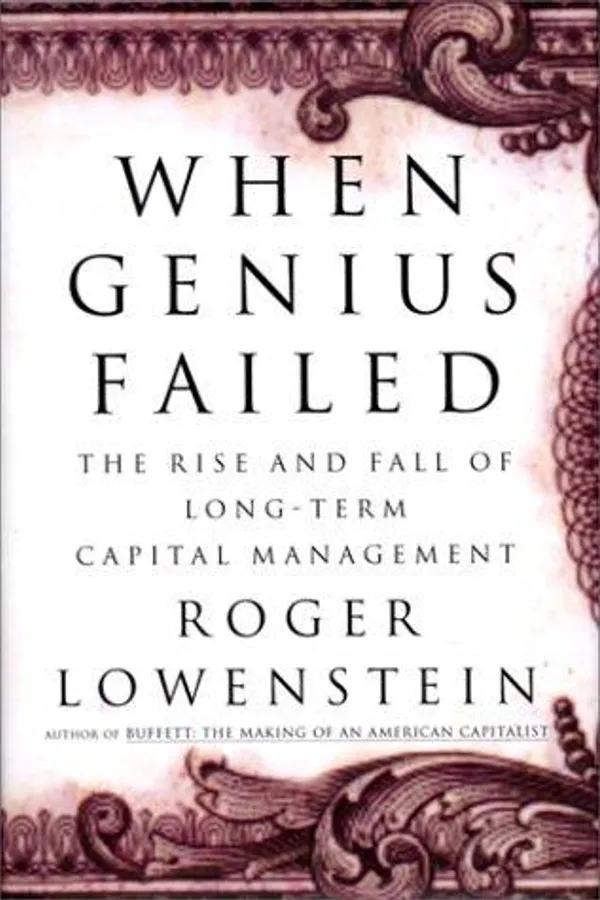
Book
When Genius Failed
Roger Lowenstein
The most credentialed minds in finance priced risk to the fourth decimal, funded it with borrowed money, and discovered that markets are made of people, not distributions.
- TYPE
- Book
- SHELF
- Trading & Markets
- TIME
- 13 min read
- ADDED
- 2026 · 07 · 07
- STATUS
- Completed
- IDEAS
Markets · History · Psychology
Why it matters
It is the standing autopsy of model confidence mistaken for safety, and every leverage rule I run a book under is written against its failure mode.
Long-Term Capital Management assembled the best pedigree finance had ever gathered under one fund: John Meriwether's bond arbitrage traders from Salomon Brothers, two future Nobel laureates in Robert Merton and Myron Scholes, a former Federal Reserve vice chairman, and the largest launch Wall Street had seen. The strategy was convergence: buy the cheap instrument, short its expensive twin, collect basis points as spreads closed, and multiply those basis points with extraordinary leverage, because the models said the positions were uncorrelated and the volatility was known. For four years it worked. Returns ran past forty percent, banks fought to lend without haircuts, and at the end of 1997 the fund returned outside capital while keeping its positions, which raised the leverage further. In 1998 Russia defaulted, every spread on earth widened at once, and diversification failed because the positions shared one hidden factor: the levered holders themselves. The fund lost most of its capital in weeks and was recapitalized by a consortium of banks convened by the Federal Reserve. Lowenstein's argument is that the mathematics was not the failure; the belief that mathematics had abolished uncertainty was.
- A convergence trade earns basis points; leverage manufactures the return. The leverage is therefore not a detail of the strategy but the strategy itself, and it should be judged as such.
- Diversification measured on historical correlations concentrates in a crisis, because the common factor across the positions is the marginal holder who must sell them.
- The models treated risk as volatility drawn from a stable distribution; the losses arrived through liquidity, crowding, and forced time, none of which the distribution contained.
- Returning outside capital while keeping the positions was framed as discipline and functioned as leverage; judge every capital decision by its effect on the balance sheet, not by its narrative.
- Secrecy bought good financing terms and guaranteed distrust in distress; counterparties who see only a slice of you will assume the worst about the whole at the worst possible moment.
- The banks that financed the fund without haircuts also copied its trades, so the exit was crowded by construction; envy is a correlation the models never printed.
- Intelligence concentrates risk when it persuades its holders that being right and being safe are the same condition.
The argument
Lowenstein opens where the fund’s mythology began: the Arbitrage Group at Salomon Brothers, where John Meriwether discovered in the 1980s that a trading desk could be staffed like a physics department. He hired academics, gave them capital and insulation from the shouting, and let them bet on the convergence of related prices; the desk became the bank’s profit engine. When a subordinate’s false bids in Treasury auctions forced Meriwether’s resignation in 1991, he rebuilt the desk outside the bank and improved on it. Long-Term Capital Management launched in 1994 with the largest raise a hedge fund had ever gathered, fees above the market’s standard, secrecy as policy, and a roster of partners that included Robert Merton and Myron Scholes, who would receive the Nobel Prize while the fund was still ascending. Investors were not buying a strategy; they were buying an aristocracy.
The strategy itself was almost humble. Convergence trading buys the cheap instrument and shorts its expensive sibling: the off-the-run Treasury against the on-the-run, Italian government debt against the instruments hedging it, the twin listings of Royal Dutch and Shell against each other. The spreads are small because the trades are nearly riskless, and nearly riskless is not a living; the living came from leverage. On under five billion dollars of equity the fund carried more than a hundred billion of assets and a derivative book whose notional value ran past a trillion. The models made this respectable: risk was volatility, volatility was measurable, correlations came from history, and thousands of positions across markets and continents were presumed independent bets whose errors would cancel. On those assumptions the leverage was not recklessness but efficiency. The fund believed it had diversified its way to safety and could therefore borrow its way to scale.
For four years the assumptions held. Returns after fees ran past forty percent in consecutive years. The banks competed to finance the fund on terms they extended to no one else, waiving the haircuts that are a lender’s seatbelt; imitators multiplied across the Street, and as they crowded in, the spreads compressed. The fund’s response to shrinking opportunity was the book’s pivotal act: at the end of 1997 it returned 2.7 billion dollars of outside capital, kept the positions, and thereby raised its own leverage, framing as shareholder discipline what was structurally an increase in risk. It also drifted, into equity volatility sold in a size that made its own book the market’s reference price, into merger arbitrage, into trades ever farther from the bond mathematics where the edge had been earned.
In 1998 the environment turned. Salomon shut the old arbitrage desk in July, and its unwinding pressed on the very spreads LTCM held. In August Russia devalued and defaulted, and capital everywhere ran for quality at once. The diversification failed completely, because the thousands of independent positions shared a single hidden factor: they were all owned by levered holders who now needed to sell them, and LTCM was the largest of those holders. The fund lost over half a billion dollars in one trading day and nearly half its capital within the month. Then the mechanics of leverage took over from the mathematics. Losses triggered collateral calls; meeting the calls required selling; selling moved prices against the remaining positions, because the fund was the market in its own trades; and counterparties who could finally see the distress marked their books against it. The models had classed events of this size as so remote the universe would not live to see them. The market produced them daily for a month.
The endgame took a week. A group led by Warren Buffett offered roughly 250 million dollars for the equity of a fund that had been worth 4.7 billion months earlier, on an hour’s deadline; the offer died on structure. The Federal Reserve Bank of New York then convened the heads of the major banks, who put in 3.65 billion dollars for ninety percent of the fund, less to save the partners than to prevent the simultaneous liquidation of a trillion-dollar book they were all on the other side of. Bear Stearns, the fund’s clearing broker, refused to join. The partners, several of whom had borrowed personally to enlarge their stakes, stayed on salary to unwind positions they had priced as riskless; some finished in debt.
Lowenstein’s thesis is easy to state and hard to hold. The mathematics was not wrong about history; it was wrong about what history is. Markets are not stationary processes; they are crowds with balance sheets, and when every member of the crowd must act in the same direction at the same hour, the correlations of the calm period dissolve and reform at one. Leverage converts that possibility into a death sentence: it guarantees that a wrong month can end the firm before a right decade arrives. The professors had converted uncertainty into risk by assumption, and the assumption itself was the position.
Working notes
Set this book against The Alchemy of Finance and Soros stops sounding theoretical. His reflexivity holds that prices are not passive reflections of fundamentals but forces that alter them; LTCM’s models assumed the opposite, that its own trading was a rounding error on an indifferent market. By 1998 the fund was so large that its distress was the fundamental: its selling produced the prices its models read as impossible. A firm can be the weather it is forecasting. That is the whole of reflexivity, demonstrated with other people’s money.
It also reads as a Kindleberger cycle compressed into a single organism. Displacement: an arbitrage method with academic certification. Credit expansion: financing without haircuts from banks whose envy had disabled their credit committees. Euphoria: imitators holding the same spreads across the Street. Distress, revulsion, and then the lender of last resort, performed by the New York Fed in its cheapest form: a conference room, no public money, and fourteen banks persuaded to rescue the counterparty they could not afford to bury. The anatomy holds at every scale.
Knight’s old distinction between risk and uncertainty is the book’s quiet spine. Risk is a distribution you know; uncertainty is the absence of the distribution. Models turn uncertainty into risk by assumption, which is often useful and always a position: the fund was not so much long bonds and short spreads as it was short the difference between the world and its dataset. Every quantitative system holds that position. The only question is size. LTCM’s answer to the question was the entire balance sheet, which is why the distinction lands here as a verdict rather than a footnote: the fund carried no line item for what it did not know, and the missing line item turned out to be the largest exposure on the books.
The returned capital of 1997 is the detail I have thought about most. It was applauded as restraint, shareholders first. Its balance-sheet effect was to make every position larger relative to the equity beneath it. I take from this a rule of reading: judge every capital decision by its arithmetic, never by its adjectives. The narrative said prudence; the denominator said leverage; the denominator was telling the truth.
And a note on secrecy. LTCM disclosed almost nothing, and each bank, seeing only its slice, financed a fund whose aggregate leverage existed in no one’s field of view. The opacity bought superb terms in fair weather and guaranteed panic in foul: counterparties who cannot see you will assume the worst about you at the exact moment the assumption matters. The rule I keep from it cuts both ways: any counterparty who will not show me the aggregate gets priced at the worst case the hidden part could contain, and any structure of mine that needs opacity to obtain its terms is carrying a debt no term sheet records. Opacity is borrowed trust, and repayment falls due in the crisis, all at once.
A basis point levered a hundred times is not a small edge enlarged. It is a large liability disguised, and the disguise holds only until everyone needs the same door.
Where I push back
The book’s defect is the tidiness of its arc. Hubris and nemesis make a Greek play, and Lowenstein tells it beautifully, but the frame flatters the reader into believing he would have seen it coming. For four years the fund was right, its critics were poorer, and most of the money that mocked it in October would have invested in March. The operational question the book never answers is the one that matters: how do you distinguish a strategy with hidden negative skew from a genuinely good strategy during the years when both look identical? Hubris is a diagnosis available only at the funeral. It is not a variable anyone can trade on, and a book that leans on it is narrating, not explaining.
Second, the anti-quantitative moral most readers extract is the wrong one. The option formula did not fail; the funding structure failed. Scholes’s mathematics priced instruments; it never promised that a levered portfolio of them could survive its own unwind. The discretionary trader who closes this book feeling superior has learned nothing except a slower route to the same cliff: his intuitions are also a model, trained on the same calm history, minus the honesty of being written down.
Third, the ending is a false resolution. The book closes with order restored and the system chastened. The system was not chastened; it was educated. 1998 taught every large institution that beyond a certain size, distress becomes negotiating power, and the put option written that September was exercised across the Street a decade later. Lowenstein could not have known, but the reader now does: the book is an autopsy that mistakes the funeral for the end of the disease.
How it enters the work
BlockHedge trades the one market that reproduces LTCM’s conditions on a loop: thin liquidity, crowded positioning, leverage available to anyone with a phone, and funding that evaporates at the worst hour. Crypto did not need Nobel laureates to converge its correlations to one; it does so in every panic, on schedule. The firm’s risk rules are written against this book directly. Leverage caps are set for the liquidation-cascade regime, not the average week. Financing is treated as a position in its own right: any funding that can be recalled overnight is counted as risk today, whatever its price. And no thesis is sized past the answer to the crowding question: who else holds this trade, what forces them out, and what does the exit look like if we all file through it together.
The habit generalizes to the journal. Before size, two questions in writing: what regime kills this position, and who sells first when it arrives. The first is Lowenstein’s mathematics lesson; the second is his sociology lesson. Both have paid for the book many times over.
The connection I did not expect on first reading runs through the AI work. An enterprise model in production is structurally an LTCM position: a bet, often levered by automation, that the world will keep resembling the data it was trained on. Its confidence is highest exactly where its history is thinnest, which is the regime boundary where the cost concentrates. So the systems Intelliblitz ships carry the controls the fund lacked: tripwires on inputs that drift from the training distribution, circuit breakers that route decisions back to humans when confidence and evidence diverge, and a standing review that asks the Lowenstein question of every automated loop: what assumption is doing the work here, and what happens on the day it stops. The fund had four years of proof that its assumption was safe. Proof of that kind is the most expensive asset a system can hold, because it compounds quietly until the day it detonates. I would rather operate a system that knows it is guessing than one that has been right too long.
- Size every position for its behavior in the worst regime, not the average one; the average regime does not issue margin calls.
- Know who else holds your trade; crowding is a risk factor no historical series will print.
- Never fund long-horizon convergence with financing that can be recalled overnight; liquidity is a loan the market calls precisely when you need it.
- When the edge is a few basis points, audit the leverage as the strategy, because it is.
- Treat a model as testimony from a witness with a perfect memory and no imagination; it has never seen the day that ruins you.
The cheap reading is smugness: fools with Nobel prizes, undone by pride. That reading will cost you, because the trades were good for four years and most of the fund's critics would have invested if allowed. The real lesson concerns funding, size, and crowding, and it applies with equal force to the discretionary trader who has never touched a model. Mock the mathematics and you will repeat the funding structure.