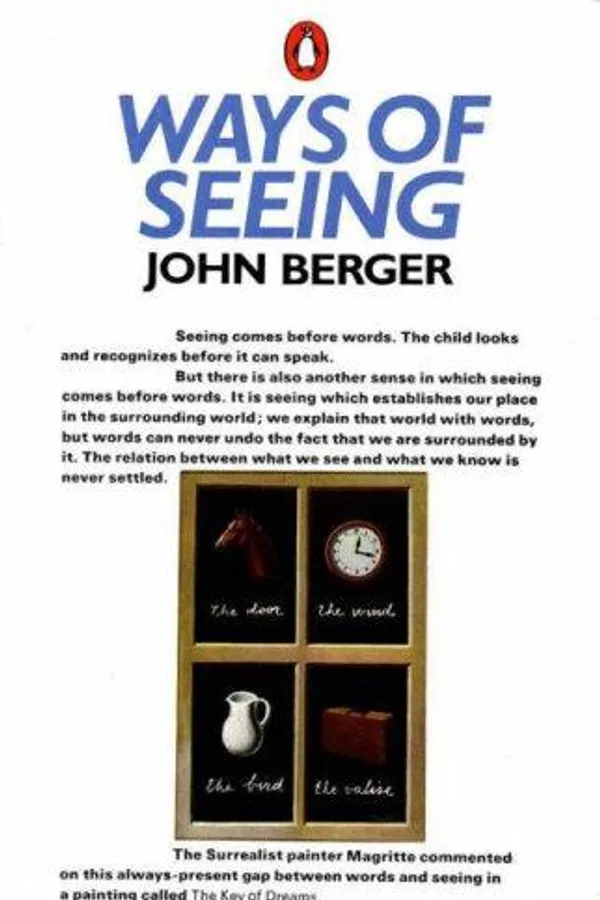
Book
Ways of Seeing
John Berger
Seeing is never innocent: every image trains the eye that receives it, and the training has owners; Berger names them, from the oil painting to the advertisement.
- TYPE
- Book
- SHELF
- Art & Aesthetics
- TIME
- 13 min read
- ADDED
- 2026 · 07 · 07
- STATUS
- Completed
- IDEAS
Art · Photography · Psychology
Why it matters
The book that told me my eye had been schooled by interests not my own; a photographer who has not answered Berger is composing inside someone else's frame.
Seven essays made from a television series, three of them wordless, arguing that seeing is learned and that the teachers have interests. Berger begins where Benjamin left off: mechanical reproduction strips the painting of its place and ritual, meaning scatters into new contexts, and what remains unique in the original is its price, around which the culture builds a substitute religion he calls mystification. The famous essay on the nude reads the European tradition as a machine for producing women who watch themselves being watched, arranged for a spectator and owner outside the frame; the conventions survived oil paint and moved into photography and advertising without losing a habit. The essay on oil painting reads the tradition, roughly 1500 to 1900, as the art form of property: a medium unmatched at rendering texture and lustre, employed to confirm possession, with the great painters as its internal dissidents. The last essay completes the genealogy: publicity inherits oil painting's language and reverses its tense, showing the spectator not what he has but what he lacks, running on envy and on a glamour defined as the happiness of being envied. The book's purpose is redistribution: images read plainly, by anyone, against their owners' instructions.
- Seeing comes before words and is never settled by them: what we see is shaped by what we know and by what we have been taught to expect, so perception is already interpretation.
- Mechanical reproduction strips an image of its place and purpose; the original keeps only its uniqueness as an object, and the culture converts that uniqueness, which is to say the price, into false mystery.
- In the European nude the woman is arranged for a spectator outside the frame; she is made to watch herself being watched, and the split becomes a permanent condition that outlived oil paint.
- Oil painting between roughly 1500 and 1900 was, in the main, the art form of property: a medium unmatched at rendering texture and surface, employed to confirm possession.
- Publicity inherits the oil tradition with the tense reversed: painting showed the owner what he had, advertising shows the spectator what he lacks, and envy is the engine.
- Glamour is not beauty but the condition of being envied; publicity must first manufacture the exclusion it then offers, at a price, to repair.
The argument
The book began as television and never stopped behaving like it. In 1972 Berger and four collaborators compressed a BBC series into a paperback of seven numbered essays, three of which contain no words at all, only sequences of images set against each other. The form is the first claim: an argument about images should be conducted in images, and a reader who can be persuaded by adjacency alone has just learned how much of his seeing was never verbal to begin with. Berger opens with the observation that seeing comes before speech, that the child looks before it talks, and that the relation between what we see and what we know is never settled. From there the book’s real premise follows: since seeing is learned, someone is doing the teaching, and the teachers have interests.
The first essay reworks Walter Benjamin’s argument about mechanical reproduction and sharpens its politics. A painting once lived in one place and meant through that place: an altarpiece meant inside the building it was made for, in the ritual it served. The camera detaches the image from its address and sends it everywhere, onto postcards, into living rooms, into lectures like Berger’s own, where music, cropping, and sequence rewrite it at will. What remains unique in the original is no longer its meaning but its status as an object, and around that status the culture builds a substitute religion: the hush of the museum, the pilgrimage to the authentic canvas, a reverence that is, examined closely, reverence for market value. Berger calls this mystification, the manufacture of false mystery around images whose evidence ordinary people could otherwise read for themselves. The essay’s purpose is redistribution: the meaning of images belongs to whoever learns to use them.
The essay on the nude is the book’s most famous and its most surgical. Berger takes Kenneth Clark’s distinction between the naked and the nude and turns it around: to be naked is to be oneself; to be a nude is to be seen naked by others and never recognized as oneself. In the main line of the European tradition the woman in the painting is arranged for a spectator outside the frame, the owner of the picture and of the looking, and her own attention is bent back on herself: she watches herself being watched. Berger presses on the tradition’s small hypocrisies: the painter who hands the woman a mirror and titles the picture Vanity, condemning her for the display the picture exists to provide; the story of Susanna and the Elders painted as an occasion for doing exactly what the elders are damned for doing. He allows exceptions, and their nature proves the rule: in a handful of paintings of a particular loved woman, Rubens painting his young wife among them, the convention breaks because a private gaze displaces the paying spectator. Then he closes the trap on the present: the conventions did not die with oil paint; they migrated intact into photography and publicity, where the surveyed woman still sells whatever stands beside her.
The property essay widens the frame. Oil painting, roughly 1500 to 1900, was a form whose particular genius, the rendering of texture, lustre, and solidity, matched the needs of a class that wanted its possessions confirmed. What oil could do better than any medium before it was make the thing on the wall as tangible as the thing in the vault. Berger reads the tradition’s typical products as inventory: the estate portrait, the still life of ownable abundance, the wife and the livestock given equivalent finish. Gainsborough’s Mr and Mrs Andrews pose not in nature but on their land, and Holbein’s ambassadors stand among the instruments of their power like men auditing their own accomplishments. The exceptional painters, and Berger concedes the first rank is nearly all exceptions, fought the tradition from inside it; the average of the tradition, the acreage of canvas nobody reproduces, is the norm the masters resisted.
The last essay brings the inheritance home. Publicity, Berger argues, is the late heir of the oil tradition: it borrows the poses, the props, the light, and the promises of painting, and reverses the tense. The oil painting showed its owner what he already possessed; the advertisement shows the spectator what he lacks. Its engine is envy: it proposes a transformed future self, glamorous, where glamour is defined precisely as the happiness of being envied, and it manufactures the deficiency it then offers to repair. Publicity can never keep the promise, since a kept promise would end the buying; it therefore addresses a daydream, and the daydream has a politics: a society that offers the choice among purchases as the working substitute for choices that matter. The book ends where it began: images are a site of power because attention is. Ways of seeing are made, and what is made can be remade.
Working notes
Berger, Benjamin, and Sontag form the critical triangle of this archive, and it took me years to see how the labor divides. Benjamin is ambivalent: he mourns the aura and half welcomes its destruction. Sontag prosecutes the camera itself. Berger is the political one: he does not want you to stop looking, he wants you to notice who profits from how you look. Of the three he is the easiest to read and the hardest to dismiss, because his examples hang on every wall and load in every feed, and testing his claims costs nothing but attention.
The reproduction thesis lands differently for a photographer, and the difference is worth stating exactly. The painting had an original that reproduction demoted. The photograph is born reproduced; there is no original until a print is made, and the fine-art edition is therefore the manufacture of originals after the fact, scarcity engineered where the negative contains none. Berger explains the print market to me better than the print market explains itself. The aura of a numbered print is real, and it is built, and the honest position is to know which part of the price is the image and which part is the relic, and never to confuse the two in conversation with a collector.
The surveyor and the surveyed have outgrown the nude. The split consciousness Berger diagnosed in painted women, the self watching itself being watched, is now the standing condition of anyone who publishes work, and the feed has installed the spectator inside the maker. I watch what this does to editing, mine included: the moment an image is chosen for how the imagined watcher will receive it, it has become publicity, whatever it claims about itself. Berger gave me the instrument for catching that moment early; nothing else on this shelf catches it earlier.
The three wordless essays taught me a craft lesson the worded ones only describe: sequences argue. Two images set side by side make a claim neither makes alone, which means an exhibition hang is rhetoric and a portfolio order is a paragraph. I sequence gallery walls knowing adjacency is a sentence, and I learned that from a book that proved it on cheap paper.
One habit came out of the book’s caution rather than its argument. A key this handy asks to be used everywhere, so I keep a private ledger of images it could not open: pictures I stood before with the property question and the envy question ready, and walked away from unanswered. The ledger is not a complaint against the method. It is the map of where my own seeing still has work to do, and it keeps growing, which I take as evidence that the looking is still alive.
Where I push back
The property thesis explains the tradition’s average and goes quiet before its summit. Berger concedes that the great painters worked against the tradition, then keeps arguing from the tradition’s mean as if the concession changed nothing. A theory whose exceptions are the entire first rank is a theory of the second rank: useful, even true, but not the theory of painting it presents itself as. Rembrandt is not a footnote to the inventory.
The method deserves its own suspicion. Montage persuades below the threshold of argument: crop, sequence, juxtapose, and conviction arrives before the checking faculties do. That is Berger’s own account of how publicity works, and the book does it to the reader on nearly every page. I do not think he was unaware; I think he judged the cause worth the technique. The reader should still name the technique, because a critique of manipulation conducted by manipulation trains the very reflex it claims to arm you against.
The politics also assumes a mechanism the book never demonstrates: that demystified seeing leads to changed action. Fifty years on, the audience is saturated with exactly the image literacy Berger wanted for it, and publicity absorbed the critique whole; it sells with irony now, flatters the viewer’s knowingness, and the buying continues. Seeing through the trick turned out to be compatible with obeying it, which is the one outcome the book’s hope cannot digest.
And the nude essay, right about its period, became a template in lesser hands: a totalizing key that reads every image of every woman in advance, evidence not required. Berger is subtler than his inheritors, and the essay itself keeps looking where the doctrine that descended from it stopped looking. He built the template anyway. The cost of a brilliant simplification is the army that arrives after it, and this book raised one.
How it enters the work
Architectural photography has an occupational disease Berger diagnosed before I contracted it: the skyline as inventory, the building rendered the way oil paint stroked silk, the frame in service of a prospectus. When I edit for Fineara I run his question against every frame: does this serve the building’s truth or its owner’s vanity. A long exposure can hold a tower’s weight and silence, or it can do a broker’s work and make glass look like money; the difference is not in the subject but in the allegiance of the frame. When the allegiance is wrong I cut the frame, and no quantity of craft buys it an appeal.
The reproduction split governs how the work is published. The files online are invitations; the prints are the work. An edition limit is engineered aura, and Berger taught me to say so without embarrassment. The honesty changes the conversations: what a collector buys is named plainly, image and relic, and the naming has never yet cost a sale. What it costs is the mystification, which was never mine to spend.
Publicity literacy runs the other direction too. The site, the gallery announcements, the images that present the work: all of it is publicity by Berger’s definition, and I audit it for envy mechanics the way I audit a contract for indemnities. Captions describe; they do not promise a transformed self. If an image of mine is selling a daydream, I want it to be the picture’s own and not one manufactured beside it.
The deepest entry is the audit of taste itself. An eye trained by feeds, markets, and inherited canons is a committee, and Berger’s first question, who taught this preference and for whose benefit, is how I take the committee’s minutes. Some of my instincts survived the audit as mine: the taste for structure did, and the black-and-white severity did. Others turned out to be the market’s voice wearing my accent, and they lost their vote. Seeing comes before words, but by the time it reaches judgment it has been schooled, and this book is where I learned to check the school’s funding.
- Ask of every image who made it, for whom, and what the looking is being used for; then look again with the answer in hand.
- Audit the trainers of your taste; an eye schooled by feeds and markets is a committee, and some members must lose their vote.
- Control the context of reproduction as deliberately as the frame; the setting rewrites the image every time.
- Inspect any image that sells, including your own, for envy mechanics; describe, do not promise transformation.
- Keep any single reading of an image from becoming the only one; a key that opens every lock is a picklock.
The book is a polemic that behaves like a demonstration, and its montage persuades faster than it argues; that is both its genius and its hazard. It hands the reader one key, property and ideology, that seems to open every lock, and a reader who stops here will explain paintings away instead of seeing them. Treat its readings as instruments to be tested frame by frame, not verdicts to be recited.