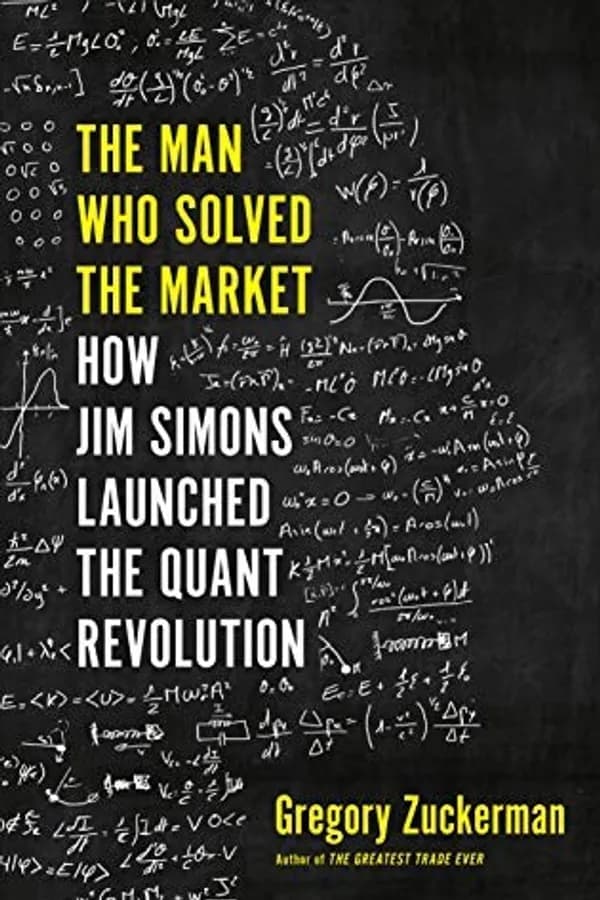
Book
The Man Who Solved the Market
Gregory Zuckerman
The best trading record ever printed belongs to a man who refused to hold market opinions; process, data, and the removal of human judgment beat every discretionary legend.
- TYPE
- Book
- SHELF
- Biography & Lives
- TIME
- 12 min read
- ADDED
- 2026 · 07 · 07
- STATUS
- Completed
- IDEAS
Markets · Technology · AI
Why it matters
It settles the argument about where durable edge lives, and it convicts my own discretionary instincts more efficiently than any single loss has.
Jim Simons was a prizewinning geometer and Cold War codebreaker who left a celebrated mathematics career to trade currencies, and spent his first decade proving how ordinary a brilliant man's market judgment is. The firm that became Renaissance Technologies found its footing only when it abandoned judgment altogether: short-horizon statistical signals, tested against decades of painstakingly cleaned price data, executed by machine at a scale no intuition could supervise. The Medallion fund, launched in 1988 and rebuilt after early failure, compounded at roughly sixty-six percent a year before fees for three decades, a record with no close second, and did it by staying deliberately small, capped and closed, while charging fees that would embarrass a casino. Zuckerman reconstructs the machine from the outside: the mathematicians and speech-recognition scientists who built it, the data obsession that preceded every model, the internal openness walled off by external secrecy, and the recurring drama of humans, including Simons himself, straining to override the system in bad weeks. The final irony is political: the firm that removed human bias from markets was nearly torn apart by Robert Mercer's spending, and the book is honest about what that says. The machine solved trading. It did not solve men.
- Edge can be microscopic if the sample is vast: signals barely better than a coin flip, compounded across millions of trades with disciplined sizing, produced the best record in market history.
- The moat was built before the models: years spent collecting and cleaning price histories nobody else valued. The decisive work was boring, and its boringness is why nobody copied it in time.
- Renaissance traded patterns it could not narrate. Requiring a story before acting is a human comfort the market does not pay for; statistical robustness, cautiously sized, outranks explanation.
- Discipline must be structural, not temperamental. The firm's worst moments came when humans overrode the models, and its response was to make overrides harder, not to find calmer humans.
- Capacity is part of the strategy: Medallion stayed small on purpose, returning capital and locking out outsiders, because a signal's size limit is a property of the signal.
- The talent architecture mattered as much as the mathematics: scientists instead of traders, one shared research codebase, pay tied to the collective pool, and secrecy enforced at the perimeter.
- Removing judgment from trading does not remove it from the firm. The Mercer rupture showed the machine's profits funding convictions no model vetted; governance remained a human problem at human quality.
The argument
The book’s first movement is a demolition, and it takes a while to notice whose. Simons arrives with the finest credentials intuition could ask for: a celebrated geometer with a theorem bearing his name, a codebreaker who hunted Soviet ciphers until his public opposition to the Vietnam War cost him the job, the builder of a legendary mathematics department at Stony Brook. When he turns to trading in the late 1970s, he trades the way brilliant men do: instinct, macro reasoning, conviction about currencies and commodities. The results are violent in both directions and unbearable in the aggregate; the stress is physical, and the record is unremarkable. Zuckerman lets the early years run long because they are the control experiment: here is one of the great minds of his generation, applying judgment to markets, and judgment does not work. Everything the firm later became is a response to that finding.
The construction of the machine proceeds through a sequence of men, each contributing a load-bearing piece. Lenny Baum, whose algorithm for hidden Markov models became a pillar of modern signal processing, brings the founding metaphor: markets as a noisy sequence emitting observable data from hidden states, no economics required. Sandor Straus builds what proves to be the deepest moat, a library of clean historical price data reaching back decades, gathered and corrected by hand in an era when nobody else considered old prices worth owning. James Ax turns models into a fund, Medallion, launched in 1988 and promptly humbled; the 1989 drawdown forces the reckoning from which the real firm emerges. Elwyn Berlekamp’s rebuild is the intellectual turn of the book: shorten the horizon, trade far more often, take positions so small and numerous that no single bet matters, and let a win rate barely past a coin flip do the work across millions of trials. Medallion’s 1990 vindication settles the argument, and Henry Laufer’s insistence on a single unified model, one integrated system rather than a federation of pet strategies, gives the machine its final architecture: every signal tested against everything, capital allocated by the system rather than by internal politics.
The second half belongs to the speech-recognition men. Peter Brown and Robert Mercer arrive from IBM, where they had treated language as a statistics problem and embarrassed the linguists; they treat equities the same way and, after years of failure, crack the problem that had resisted the firm, extending Medallion beyond futures into stocks at scale. Zuckerman is clear about what their success implied: explanation is optional. The firm learned to trade signals no one could narrate, provided the statistics were robust and the sizing respected how quickly such patterns decay. The cultural machinery gets equal weight: hire scientists rather than Wall Street men, keep one open codebase inside the walls, pay everyone from the collective result, and litigate ferociously when anyone carries the secrets out. Internal transparency and external secrecy are the same policy seen from two sides.
The stress tests supply the book’s honest weather. In the quant quake of August 2007, and again in 2008, losses arrived at machine speed, and the founder himself blinked: Simons cut positions rather than let the models ride, over the objection of colleagues who argued the system should be trusted precisely when trusting it hurt. Zuckerman does not resolve who was right, and the ambiguity is the lesson: the man who built the machine to remove human judgment reached for judgment the moment fear got loud, and the firm’s later fixes were structural, not motivational. Meanwhile Medallion stayed capped at a deliberate size, closed to outsiders, its capacity treated as a property of the signals themselves, while the funds Renaissance sold to the public behaved like what they were: ordinary products, statistically respectable, touched by none of Medallion’s magic.
The last movement is the irony the title cannot contain. Mercer’s fortune, minted by the machine, funded Breitbart, Bannon, and the 2016 upheaval; a researcher who protested publicly was pushed out; investors and employees revolted, and Mercer stepped back from the co-CEO role. The firm that had solved for the removal of human bias found itself governed, like every firm, by human conviction, loyalty, and anger. Zuckerman closes the loop quietly: the models never had opinions. The men always did.
Working notes
Read against Market Wizards, this book is the limiting case of Schwager’s finding. The wizards shared no method, only discipline; Renaissance took the discipline, removed the man carrying it, and poured it into code. The constant was never the trader’s system. It was the system’s protection from the trader, and Medallion is what that protection looks like when it is engineered rather than willed.
Read against Reminiscences, the rhyme is exact and a century deep. Livermore knew his enemy was himself and fought that enemy with rules he broke at every crisis; Simons reached the same diagnosis and chose a different treatment: he fired himself from the trade. The 2007 override shows the firing was never complete, and I find that detail more instructive than the whole record, because it prices the difficulty. If the man who built the best machine in history could not fully submit to it, the discretionary trader’s confidence in his own submission is worth exactly nothing.
Read against When Genius Failed, the control group snaps into focus. LTCM had a theory of markets; Renaissance had a record of them. Merton and Scholes derived how prices should behave and leveraged the derivation; Medallion measured how prices do behave and assumed the patterns would decay. One firm’s models contained beliefs, the other’s contained observations, and the two books together are the cleanest natural experiment finance has produced on the difference. Epistemic humility, it turns out, is worth about sixty points of annual return against epistemic elegance.
The note I underlined for myself: the data came first. Straus’s decades of cleaned prices preceded every model that mattered, and the pattern generalizes past finance. In every AI engagement I have run, the client wants the model and needs the data hygiene; the moat is always in the unglamorous layer, and it is always available years before anyone wants it. Renaissance’s founding advantage was not intelligence, which was abundant, but the willingness to do boring work early.
And the closing severity: the book documents the most successful removal of narrative from decision-making ever achieved, inside a firm whose own story, Mercer, Magerman, the founder’s overrides, was driven entirely by narrative. Models are a jurisdiction. Men live outside it.
Where I push back
Nobody solved the market, and the title’s exaggeration is not harmless. What Renaissance demonstrated is narrower and stranger: at short horizons, at a deliberately capped size, with near-zero costs and three decades of proprietary data, markets were persistently mispriced enough to fund the best record in history. That is a claim about one regime, not about markets, and the book’s mythologizing register invites readers, especially quantitatively flattered ones, to draw the general conclusion the evidence does not license. The graveyard of funds that drew it is large and unphotographed.
Second, the reconstruction problem. Zuckerman assembled the story against the firm’s active resistance, from former employees, court records, and reluctant principals, and it shows: the mechanism chapters go quiet exactly where the mechanism gets interesting, and several disputes, notably who deserves credit for the equities breakthrough, are adjudicated on testimony from interested parties. The book cannot be blamed for the secrecy, but it can be read with the secrecy priced in: this is the outside of a black box, well lit.
Third, the moral ledger is underworked. The book waves at the question of what Medallion’s returns cost and who paid, then moves on; a firm extracting tens of billions from price noise is extracting it from someone, mostly slower and worse-informed participants, and the social accounting of that transfer deserved more than the gesture it gets. And the Mercer chapters, the book’s best journalism, stop short of the hardest sentence: the greatest quantitative firm in history failed its most basic governance test, and no one inside it built a model for that.
How it enters the work
The book functions on my desk as a standing indictment, and I keep it there for that purpose. I am a discretionary thinker operating in a world where this record exists, which means every discretionary instinct I have must either survive the comparison or be systematized away. The practical division that came out of reading it: discretion is reserved for thesis selection, the long-horizon questions where data is thin and cycles are the sample unit; everything downstream, entries, sizing, risk limits, exits, is written as rules and executed as written. The urge to override, when it arrives, is logged as information about my state, not the market’s. That sentence is this book, compressed.
For BlockHedge the transfer is architectural. Crypto microstructure is young, fragmented, and inefficient, which is to say it is the environment Renaissance found in 1980s futures, and the lesson is to copy the sequence, not the mystique: data infrastructure first, funding rates, flows, on-chain records, cleaned and owned; execution and cost discipline second; models last. The firms hunting narrative alpha in a market this noisy are Simons in 1978, brilliance applied where brilliance does not attach. The boring layer is still available. It always is.
And for the AI practice at Intelliblitz, Renaissance is the proof case I cite when a client wants the algorithm before the hygiene: the best machine learning operation in commercial history spent its first decade on data collection and its advantage never stopped resting there. The other transfer is governance. The 2007 override chapters became a design rule: any system in which humans can intervene will be intervened with at the worst possible moment, so intervention must be a designed pathway with friction and review, not a heroic exception. Build the machine, then build the fence around the operators. Renaissance is the evidence for both halves.
- Build the process that makes the decision, then protect the process from yourself; the urge to override is data about you, not about the market.
- Collect and clean data no one else will bother with; the moat usually sits in the boring layer.
- Size your edge honestly: capacity is part of the signal, and returning capital is a trade like any other.
- Do not require a story before acting on tested evidence, and do not accept a story as a substitute for it.
- Judge a strategy by its full-cycle record, including the weeks the model looked broken, because that is where the compounding was defended or lost.
This is an outside reconstruction of a firm built on secrecy: the actual signals stay hidden, so the book can teach the culture but not the method, and every reader should distrust the inference from Renaissance made money on patterns to my backtest is money. Their edge included unrepeatable inputs: decades of proprietary data, execution costs near zero, a hiring pipeline of world-class scientists, and the discipline to stay small. The title is also a lie of scale: one firm, at one size, at short horizons, is not the market solved.