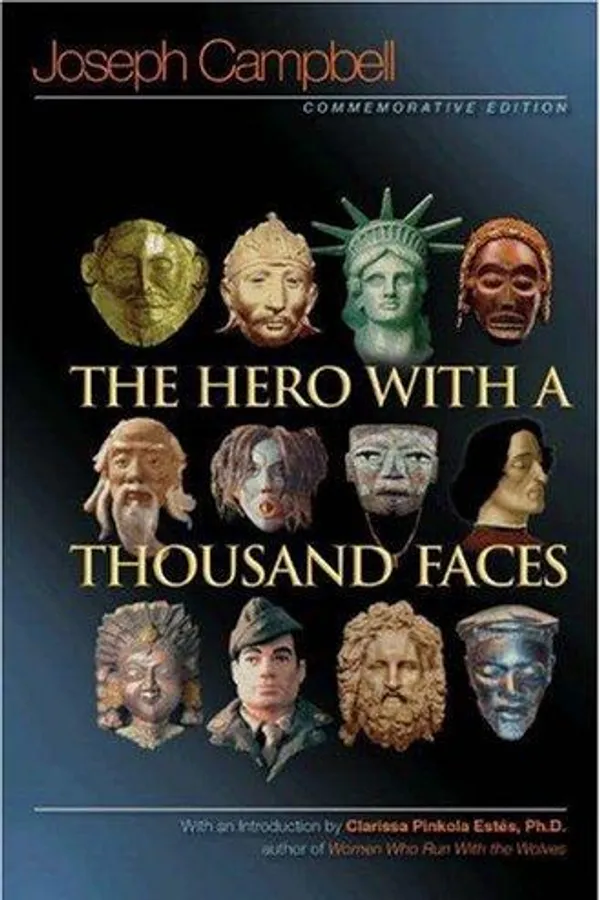
Book
The Hero with a Thousand Faces
Joseph Campbell
Under the hero tales of the world runs one round, separation, initiation, return, and Campbell reads it as the psyche's own procedure for dying to one life and coming back with another.
- TYPE
- Book
- SHELF
- Esoteric & Symbolic
- TIME
- 15 min read
- ADDED
- 2026 · 07 · 07
- STATUS
- Completed
- IDEAS
Esoterica · Psychology · Spirituality
Why it matters
It organized the myth shelf into a single map and then escaped into the culture as a formula; I keep it to remember what the formula amputated.
Campbell's claim is that the hero tales of every tradition rehearse a single round, which he names the monomyth, borrowing the word from Joyce: separation from the ordinary world, initiation through ordeal, and return with a boon. He walks the stations in order: the call to adventure and its refusal, the protective figure who appears once the path is accepted, the threshold and its guardian, the belly of the whale where the old self is digested; then the road of trials, the meeting with the goddess, atonement with the father, apotheosis, and the boon; then the return, refused, fled, or fought for, and the final competence he calls mastery of the two worlds. The reading is psychoanalytic throughout: myth is the collective's dream and dream the individual's myth, so the tales encode the psyche's own program for transformation. The book's second half sets the hero inside the cosmogonic cycle, the world's larger rhythm of emanation and dissolution. The closing diagnosis is modern: the rites that once carried people across life's thresholds are gone, the passage must now be made alone, and that is why the old stories keep returning in dreams and on screens.
- The monomyth is a round, not a plot: separation, initiation, return. The unit is transformation, and any telling that keeps the shape while dropping the death at its center is decoration.
- The refusal of the call has consequences: the life that declines its summons does not stay safe, it dries; what was meant to be a passage calcifies into a wall.
- Thresholds come with guardians. Resistance at the edge of the known is structural, the price of admission rather than a verdict on the traveler.
- The ordeal is a death: in the belly of the whale the old identity is dismantled, and initiation is exactly the part that cannot be simulated, only undergone.
- The return is the neglected half of the work: the boon must be carried back into a world that did not ask for it and translated for people who did not descend.
- Myth and dream share one grammar, myth the public dream and dream the private myth; where rites of passage vanish, the unconscious improvises its own, usually badly.
- The recurring figures, goddess, temptress, ogre father, guardian, are positions in an interior drama before they are characters in anyone's story.
The argument
The book was published in 1949 and belongs to a moment when comparative mythology, psychoanalysis, and the wreckage of two wars could still be held in one hand. Campbell’s proposal is simple to state and immense in scope: beneath the hero tales of every recorded tradition lies a single narrative unit, which he calls the monomyth, taking the word from Joyce. Its skeleton is a round. The hero leaves the ordinary world, undergoes initiation in a region of supernatural ordeal, and returns carrying something the ordinary world needs. Separation, initiation, return. The first half of the book walks the stations of that round; the second sets it inside the larger wheel he calls the cosmogonic cycle; and the whole is framed by a psychoanalytic wager: that myth and dream are the same substance at different scales, myth the public dream and dream the private myth, so that a morphology of hero tales is simultaneously a map of the psyche’s own procedure for transformation.
The evidence is assembled the way Frazer taught the previous generation to assemble it, from everywhere at once: the Buddha’s departure from the palace and the temptation under the tree; Prometheus and the stolen fire; Aeneas descending to the dead; tricksters, knights, shamans, and the household tales the Grimms collected. Campbell’s innovation is not the collection but the superposition: laid over one another, he claims, the tales align, and the alignment is the discovery. Where Frazer explained resemblance by the uniform workings of primitive thought, Campbell explains it from inside. The tales resemble each other because psyches do, and the deep structure of the adventure is the deep structure of transformation as such. Freud supplies the reading of the family drama, the ogre father and the fascinating goddess; Jung supplies the archetypes and the conviction that the unconscious is not only a cellar of the repressed but a spring; and Campbell, trained on neither couch, uses both with a collector’s freedom.
The departure stages are the most finely observed writing in the book. The call to adventure arrives as a blunder, an animal, a herald, often something dark or despised; Campbell opens with the tale of the princess whose golden ball rolls into the well and the frog that fetches it, the repellent messenger of the depths. The call may be refused, and the chapter on refusal is the sharpest psychology he ever wrote: the one who declines the summons is not left in peace; the flowering world dries into a maze of duties; what should have been a passage becomes a wall, and the refuser becomes a prisoner of the very safety he chose. Accepted, the call brings unexpected aid, the crone or the guide with amulets; then the first threshold, watched by figures whose menace marks the true boundary of the known; then the belly of the whale, Campbell’s name for the passage in which the hero is not tested but swallowed, annihilated as the person he was. He is exact about this: the whale’s belly is a death, and every temple gate flanked by monsters repeats the same sentence, that the one who enters must be prepared not to survive as himself.
Initiation proper is a road of trials, and Campbell reads its recurring encounters as an interior cast. The meeting with the goddess is the discovery of the world as bounty; the temptress is the same figure met by a consciousness still divided against itself; atonement with the father is the book’s deepest station, the confrontation with an ogre who turns out to wear the initiate’s own projected terror, so that the atonement is finally the abandonment of the self that needed the ogre. Apotheosis follows, the release from the pairs of opposites, for which Campbell reaches into Buddhist material, the bodhisattva who looks on the world with the calm of one no longer defending a position in it. Then the ultimate boon: fire, elixir, grail, the thing sought. His reading is severe here. The boon is always finally an enlargement of consciousness, and the myths themselves record how quickly it gets concretized, clutched as gold, immortality, or power, the symbol mistaken for what it symbolized.
Then the half nobody films. The return, Campbell insists, completes the round and defeats most heroes. Some refuse it and stay in the light; some must flee with the boon, powers in pursuit; some must be rescued from without, hauled back by a world that needs them. The returned hero faces the hardest ordeal last, the translation problem: how to carry a vision across the return threshold into a society organized not to hear it, how to live with one foot in each world without betraying either. Campbell’s name for the final competence is master of the two worlds, and its fruit is what he calls the freedom to live, action no longer poisoned by anxiety over outcomes.
The second half dissolves the individual adventure into the cosmogonic cycle: the world itself emanates, thickens into form, and returns to formlessness, and the hero appears along that arc in a graded series of roles, warrior, lover, emperor, redeemer, saint, each a different depth of the same penetration. The coda is a diagnosis of the present. The rites of passage that once walked people across birth, adulthood, and death have been dismantled; the cosmological images have been ceded to science; the community no longer carries the individual through his transformations. The modern passage must be made alone, in the dark, without a tribe waiting on the far side, which is why the analyst has inherited the mystagogue’s office and why the old stories, denied the temple, return through dreams, symptoms, and cinema. The hero with a thousand faces has not retired. He has gone private.
Working notes
Campbell is Frazer’s warehouse inherited by a believer. The Golden Bough stacks the material and disbelieves it; this book selects from the stack and stakes a life on the pattern. Reading them in sequence is an education in what belief does to method: the skeptic could not stop collecting, because nothing ever settled anything, and the believer could stop, because for him the alignment of a dozen tales was already the answer. Both postures carry a tax. Frazer’s is tedium. Campbell’s is that everything failing to align quietly leaves the room.
The book’s afterlife is the strangest of any on this shelf and the most instructive. Written as an anatomy of inner death and rebirth, it was swallowed by the screenwriting industry, first through Lucas, who acknowledged the debt, then through the story consultants who reduced the round to beats with the undergoing removed and the flattery retained. Read the book after the formula, as most people now must, and it looks like the formula’s source. Read it before the formula, as its first readers did, and it looks like what it is: a religious book about the cost of transformation, whose central station is annihilation. The industry kept the shape and cut the death, which is like keeping the recipe and cutting the fire.
The chapter on the refusal of the call converts directly into an instrument. When a life, a company, or a practice has gone flat, look for the refused summons before blaming the market: the drying Campbell describes, the future arriving as repetition, the walls of duty thickening, is the best short portrait I know of a certain kind of accomplished man in his forties, and the mechanism is stated honestly. Refusal does not preserve the old life. It embalms it.
The return is where the book earns its place beside the discipline shelf rather than the story shelf. Everyone rehearses departure; departure photographs well. The return is administrative: the vision must survive contact with schedules, payrolls, and people who did not descend and owe the descent nothing. Campbell’s master of the two worlds is not a mystic with a lighted face; he is a man who can sit in a Monday meeting with the abyss still in him and be useful. The round is only closed by reentry, and a transformation that cannot pass customs was tourism.
Against Jung, Campbell is easier and thinner. Man and His Symbols keeps the clinical brakes on: a symbol compensates a particular life, and the analyst checks the reading against the patient’s actual circumstances. Campbell removes the patient; the whole species is on the couch, and the interpretation can never be contradicted by a fact about anyone in particular. Maps of Meaning is Campbell re-armored with suffering and neurology; Eliade gives the round its sacred architecture. The shelf holds together, but this is its most seductive and least resistant book, and I read it wearing the seatbelt of the other three.
Where I push back
The monomyth is built backwards. Campbell begins with the round and then quarries the world’s traditions for confirming fragments, and the method never once meets a tale that could refute it: a story without a descent is an incomplete monomyth, a story without a return is a truncated one, and every exception is filed as a special case of the rule. Folklorists have made the point for decades and it stands. Propp mapped one bounded corpus of Russian tales and admitted his morphology stopped at its border; Campbell mapped everything and admitted nothing. A schema that fits all stories at this altitude is not a discovery about stories; it is a decision about how to summarize them, and the alignment offered as evidence is partly an artifact of the height.
The perennialism underneath is the more serious problem, because it corrupts practice rather than scholarship. For Campbell all traditions teach one thing in local costume, so the Buddhist’s extinction of self and the Christian’s resurrection of the person become one station seen from different seats. A practitioner knows they are not. The disciplines differ, the daily instructions differ, and the differences are the tradition; perennialism buys its unity at the one altitude where nothing binds anyone to anything, which is why it is the house metaphysic of people who practice nothing.
The book’s women are furniture. Goddess, temptress, prize: positions in a male initiate’s drama, never the one walking the round. Campbell reflects his sources and his decade, but the schema hardens the reflection into architecture, and a reader mapping actual lives onto it should notice who the map assumes is traveling.
And the misuse the book invites is the one it cannot police. The monomyth describes transformation; it is read, mostly, as permission. Founders, politicians, and adolescents of every age cast themselves as the hero at the threshold, converting an anatomy of self-loss into a license for self-importance, and the station they skip is precisely the whale’s belly, where the self doing the casting is what dies. Campbell handed the century a mirror and the century used it as a poster. Some of that is the century’s fault. Some of it belongs to a book so in love with the unity of all stories that it forgot to guard the one door every impostor uses.
How it enters the work
The round entered my working vocabulary as a model of resistance, and it has paid rent ever since. Every real change I have made, into building firms, into serious practice, into work that had no precedent in my life, announced itself with the same signature: friction exactly at the threshold, guardians in the form of reasonable people with reasonable objections, and a strong pull toward remaining competent at the old thing rather than becoming a beginner at the new one. Campbell names the pattern and supplies the prognosis: the guardian marks the threshold, the threshold marks the change, and the fear is structural, not diagnostic. Since reading him I treat friction at the start of a real undertaking as evidence of its reality, and I distrust any transformation that begins comfortably.
The discipline connection runs through the belly of the whale. Every capability worth holding was paid for with a stretch of dismemberment: the established competence dissolved, the daily humiliation of being bad at the new thing, no guarantee waiting on the far side. Campbell’s contribution is the reframe. That stretch is not the obstacle to the initiation; it is the initiation, and shortening it is not efficiency but refusal. The practical consequence is concrete: when I take up a discipline now, I budget the whale time in advance, name it, and do not negotiate with it. What broke earlier attempts was never the difficulty. It was interpreting the difficulty as evidence of a wrong turn.
For the spiritual inquiry, Campbell is the atlas, not the vehicle. The round locates practices: it tells me that a given exercise, Tomberg’s concentration, the Golden Flower’s circulation, sits at a particular station, preparation, descent, or return, and it warns me which station I am tempted to skip, which is always the return. But an atlas transports no one. The flattening that makes Campbell useful for orientation makes him useless for instruction, because instruction lives in exactly the tradition-specific detail he dissolves. So the working rule: Campbell to place the work, the tradition itself to do the work, and his coda as the standing caution, that nobody is coming to carry me across, because the rites that once did are gone and their replacements are private, deliberate, and maintained by hand.
One inversion was earned only by rereading: the round’s best application is not to the dramatic thresholds but to the small weekly ones. Every deep work session is a miniature departure, ordeal, and return; every reentry from solitude into the operating day is a return threshold with its own translation problem. Treating Monday morning as a station of the monomyth sounds like a joke until you count how many retreats, sabbaticals, and years of practice are annulled at exactly that crossing. The book taught me to guard the small returns. The large ones take care of themselves if the small ones are drilled.
- Read a flat, dried stretch of life as a refused call before reading it as bad luck.
- Expect the guardian: friction at the start of any real change is evidence of a threshold, not a reason to turn back.
- Budget for the return; the ordeal is half the work, and reentry into the ordinary is the half that fails silently.
- Never cast yourself as the hero; the round maps transformations, not rank.
- When a story grips you beyond its craft, ask which station of the round you are standing at; the grip is information.
The unity is purchased by selection: Campbell keeps what fits the round and discards the rest, and the differences between traditions, which are exactly what a practitioner needs, are the data he throws away. The perennialism underneath, all religions as one teaching in local costume, is a metaphysic, not a finding. And the book's afterlife is a warning in itself: swallowed by the screenwriting industry, it became a formula for flattering audiences, and read that way it will teach you to cast yourself as the hero of your own life, which is the precise opposite of an initiation.