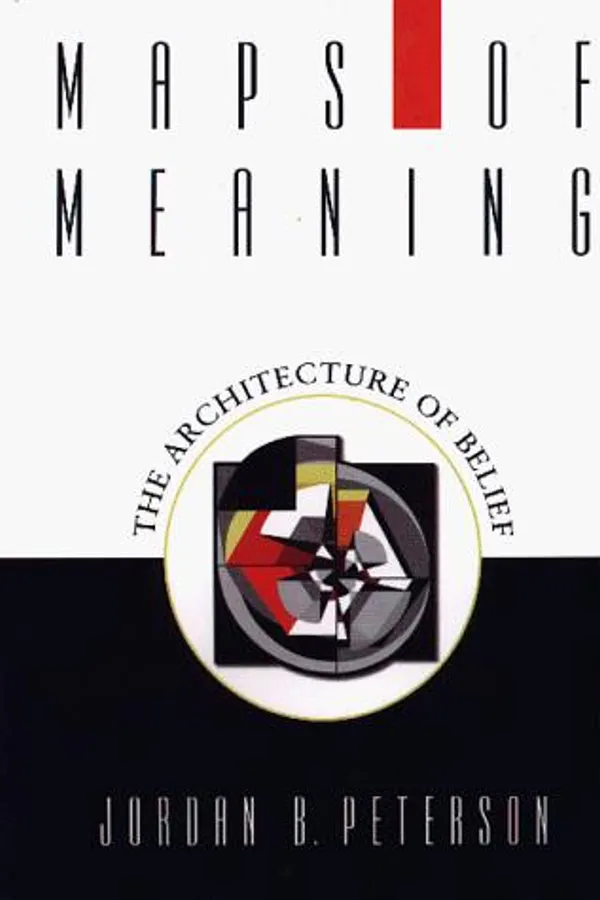
Book
Maps of Meaning
Jordan B. Peterson
Myth is not failed science but the compressed record of how humans act under mortal uncertainty; abandon it unread and it returns as ideology with a body count.
- TYPE
- Book
- SHELF
- Psychology & Behavior
- TIME
- 16 min read
- ADDED
- 2026 · 07 · 07
- STATUS
- Completed
- IDEAS
Psychology · Spirituality · Philosophy
Why it matters
It is the book that let me take religious narrative seriously without surrendering evidentiary standards; a working bridge between the laboratory and the scripture shelf.
Peterson wrote this book to answer a question the twentieth century made unavoidable: why ordinary men will torture and die for their beliefs. His answer runs through the architecture of belief itself. Humans inhabit two worlds at once, a world of objects that science describes and a world of meanings in which every object is a tool, an obstacle, or an omen. Myth is the accumulated map of the second world, and its permanent geography has three territories: explored territory, where behavior has known outcomes; unexplored territory, where anomaly floods the body with threat and promise before thought arrives; and the figure who mediates between them, consciousness itself, the hero. The great narratives, Mesopotamian, Egyptian, biblical, encode a single finding: order grows old and blind, chaos breaks through its walls, and the only durable response is voluntary confrontation and honest speech. Evil enters as the lie, the refusal to update the map when experience contradicts it, and totalitarianism is that refusal armed. The book is overgrown, repetitive, and diagram-mad, and underneath the overgrowth stands a serious structure that survives the clearing.
- The world presents itself twice: as a place of things to be described and as a forum for action in which everything carries valence. Myth maps the forum; science maps the place; neither can do the other's work.
- The unknown is emotionally valenced before it is understood: anomaly triggers threat and promise at once, and the double imagery of chaos in myth, the dragon guarding treasure, records that physiology honestly.
- Order and chaos are both dual: explored territory protects and tyrannizes; unexplored territory destroys and generates. The Great Father and Great Mother of mythology keep both ledgers.
- The hero is a process, not a person: attention that meets anomaly voluntarily, cuts new order from chaos, and rebuilds a map that admits what it learned.
- Evil is the lie: the willful refusal of anomalous information to protect a map already falsified. Totalitarianism is the social form of that refusal; decadence is its mirror, the abandonment of order altogether.
- Belief systems regulate emotion, which is why threats to a shared map are met with violence; men defend their maps because the map is what stands between them and mortal terror.
- Meaning is found on the border between order and chaos, where competence meets novelty; too far inside the walls is deadness, too far outside is panic.
The argument
The book was written against the twentieth century. Peterson describes, in the autobiographical preface, the obsession that produced it: the Cold War understood not as strategy but as psychology, two civilizations prepared to burn the world over a disagreement about how life should be organized, and behind them the camps, German and Soviet, where ordinary men did the unthinkable on schedule. The question that organizes the whole enormous book is what a belief is, that men will kill and die for it. His answer, assembled over more than a decade, is that a belief system is not a set of propositions but a map of how to act, and that the map does double duty: it makes action possible, and it holds mortal terror at arm’s length. Threaten the map and you threaten everything it contains. Men do not defend their opinions. They defend the wall between themselves and chaos.
The load-bearing distinction arrives early. The world presents itself twice: as a place of things, the world science describes, made of objects with properties; and as a forum for action, where everything encountered is promising, threatening, or irrelevant to what you are trying to do. The second world is the one anyone actually lives in. Myth, Peterson argues, is the accumulated cartography of that second world, and the Enlightenment reading of myth as botched early science is a category error: the creation stories were never trying to answer the questions geology answers. They compress, in image and drama, millennia of observed human action: what happens when order fails, what the unknown does to a man, what kind of conduct survives catastrophe. Following Piaget, he insists the knowledge came in the right order: acted first, then represented in ritual and story, then, very late, articulated as philosophy. We knew how to behave long before we knew what we knew.
Under the mythology he pours a footing of psychophysiology. The nervous system responds to anomaly before cognition arrives: the orienting reflex seizes attention, plans halt, and the body floods with a state that is neither fear nor hope but both at full amplitude. The unknown, in other words, is emotionally valenced prior to understanding. This is the book’s most useful empirical claim: it explains why the mythic imagery of chaos is always double. The dragon guards treasure; the flood precedes the covenant; the devouring mother and the birthing mother are one figure. That is not confusion. It is accurate reporting on what novelty does to an animal. Chaos in myth is not disorder as a physicist would mean it; it is the felt signature of a map failing while its owner still stands on it.
From this he builds the permanent geography. Explored territory, where behavior produces expected outcomes: order, the Great Father, protective and tyrannical at once. Unexplored territory, where anomaly erupts: chaos, the Great Mother, destructive and generative at once. And between them the knower, the process that voluntarily meets the unknown and cuts new order from it: the Divine Son, the hero, which Peterson insists is not a person but a way of paying attention. The Mesopotamian creation story carries the argument in miniature. Tiamat, saltwater chaos and mother of the gods, rises to destroy her offspring; the elder gods’ routines are useless; the pantheon elects Marduk, the young god with eyes encircling his head and speech as his weapon, and he meets her voluntarily, cuts the world from her body, and earns sovereignty by doing it. Read as psychology: when the standing order collapses, rank belongs to attention and truthful speech, and to nothing else.
The Egyptian material states the sequel: what happens when order itself decays. Osiris, the great king grown old, refuses to see the malice of his brother Seth; willful blindness, not ignorance, and it costs him his kingdom and his body. Isis, chaos in its generative aspect, gathers what remains and conceives Horus, who returns as the son to fight the usurper with open eyes. He loses an eye in the fight, recovers it, and gives it to his dead father, who revives. Peterson’s reading is exact and worth keeping: tradition cannot see its own corruption; sight is the son’s contribution; and the son’s obligation is not to demolish the father but to restore his vision. Between rigidity and revolution the myth carries a third instruction: redeem.
Genesis he reads forward rather than backward. Paradise is unselfconscious being, the animal’s easy membership in the world. The serpent is anomaly inside the walls, since no wall excludes everything. The fruit is the awakening of self-consciousness, and what the first couple discover in their nakedness is vulnerability and death, the future laid open. The expulsion is not punishment so much as description: a self-conscious creature can never again live as if the map were the territory. There is no way back to the garden. The way, in every mature mythology Peterson surveys, is forward and through: chaos entered voluntarily and made into an order that knows more than the order it replaced.
Then the moral turn, which is the book’s real destination. If the hero is one permanent human potential, the adversary is the other: the spirit that, having built a map, declares the map finished, refuses anomaly on principle, and treats every disconfirming fact as enemy action. Peterson names its instrument plainly: the lie. Not error, which is innocent, but the deliberate refusal to update, the decision to protect the model at reality’s expense. Scaled to the state, that refusal becomes totalitarianism, and he takes his testimony from Solzhenitsyn and Frankl: the camp as the architecture a society builds once the lie becomes constitutional. The opposite failure he calls decadence: the refusal to inhabit any order at all, nihilism wearing sophistication. Both are flights from the same border. The moral life, on this account, is neither obedience nor revolt but honest speech at the edge of what you know.
The book closes in stranger territory: alchemy, read through Jung as the projection of psychological transformation onto matter, the unknown treated as substance and worked until it yields gold. The chapter does not earn its place; what it shows is the scale of the ambition: a unified account of meaning, physiology at the bottom, ritual and narrative in the middle, ethics at the top, one structure. The claim that survives every objection to the details is the plainest one: humans are the animal that maps meaning, the maps fail on schedule, and everything depends on whether the failure is met with attention and speech or with the lie.
Working notes
The natural shelf-mate is Campbell, and the comparison clarifies both. The Hero with a Thousand Faces gives the monomyth its anatomy and its charm; Maps of Meaning gives it a nervous system and a body count. Campbell writes as though the pattern were an aesthetic inheritance; Peterson writes as a clinician who has seen what happens when the pattern is refused, and the twentieth century is his case file. Campbell invites you on the adventure. Peterson informs you that you are already on it, that declining is also a move, and that the declines aggregate into history’s worst events. One is a museum guide; the other is an emergency physician pointing at the same paintings.
The debt to Jung is total and the difference is structural. Man and His Symbols proceeds by authority: the old doctor points at an image and tells you what it tends to mean, and you believe him because he has watched ten thousand dreams. Peterson tries to build scaffolding under the pointing: why an embodied mind would generate such figures at all, what work the symbols do for a creature that must act under uncertainty. Where he succeeds, Jung becomes arguable in public for the first time, a theory with a mechanism instead of an oracle with a clientele. Where he fails, and he often fails, he inherits Jung’s vice of finding the archetype wherever he looks, now with citations attached.
Eliade supplied the third wall. The Sacred and the Profane describes archaic man founding a cosmos out of chaos around a consecrated center, and Peterson relocates that architecture from ancient ontology into current physiology: the center is wherever your competence holds, the chaos beyond the boundary stone is anomaly, and consecration is what a nervous system does to territory it has mapped. Read together, the two books are one argument at two altitudes. Eliade shows the pattern is universal; Peterson proposes why it must be.
About the reading itself, honesty is owed. The book is overgrown: the same circuit walked dozens of times, diagrams nested inside diagrams, every point made four ways. The method that works is machete work. First pass for the skeleton only; tolerate the repetition as a spiral rather than a circle, since each return adds one layer; mark the load-bearing pages. The second reading is better than the first because you stop waiting for economy and start using the redundancy as reinforcement. No book in this archive asks more and pays more unevenly.
It also matters that the book predates its author’s fame by nearly two decades, and it reads that way: no audience in view, no enemies list, one man grinding at a question he could not put down. The later noise is not the book’s fault, but it is the book’s problem.
What became visible with use is small and daily. Everyone runs a protocol for anomaly, and most protocols are denial with a schedule. The interesting discipline is not slaying dragons; it is noticing the moment, several times a week, when a fact arrives that the current plan cannot digest, and watching the hand reach, automatically, for the reclassification that makes the fact harmless. Peterson’s whole apparatus, the dragons and the diagrams, reduces in practice to one reflex worth training: when the map and the terrain disagree, the terrain is right, and it is right immediately, not after the quarter closes.
The border thesis survives contact too. The days that feel dead are the days spent entirely inside competence; the days that feel drowned are the days spent entirely outside it. Meaning is not a mood. It is a location.
Where I push back
The scheme cannot lose, and that is its deepest problem. A framework in which order, chaos, hero, and adversary can be found in any narrative will be found in any narrative, and Peterson never states what a counterexample would look like. When every story confirms the theory, the theory has stopped being about stories. The honest defense is that the book is hermeneutics rather than science, a way of reading rather than a set of predictions; but Peterson wants the authority of science, hence the physiology, and the wanting shows. The tell is the handling of countercases: a myth that fits is evidence, and a myth that resists is reread until it fits, because the method has no third verdict to give.
The physiology itself is a scaffold presented as a foundation. The orienting-reflex material is real and useful, but the distance between a startle response and the Enuma Elish is enormous, and he crosses it on a rope bridge of analogy while gesturing at the laboratory below. The neuroscience available to him has since been revised in its particulars; the mythology has not moved an inch. That tells you which part was carrying the weight, and it is not the part he advertised.
There is also a smuggling operation. The argument moves from the defensible claim that myths encode action patterns toward the metaphysical claim that the mythic categories are as real as the objective ones, and the reader is walked across that border without a customs check. You can accept the psychology entire and still refuse the theology it is quietly packaged with. The book does not make the refusal easy, and it never admits the package exists.
And the prose is a genuine failure, not a quirk. This is a long book carrying a much shorter argument, and the repetition is not depth; it is a manuscript that never met an editor with authority. I finished it because the structure was worth the labor. Most readers will not, and that fault belongs to the author. Severity was never the problem; waste is.
The misreadings run in both directions. Those who arrived after the fame read it as politics; it predates the politics and is contaminated by association. Those who read it as self-help flatten a psychology of civilization into a program for tidying. Both take the machete off the shelf and leave the forest standing. The book deserves harder readers than it received.
How it enters the work
The book’s function for me is permission with standards. A serious spiritual inquiry has two cheap exits: belief on command and the sneer. The first buys coherence by closing the eyes; the second buys sophistication by closing the heart; both end the inquiry, which is the one thing an inquiry must not do. Peterson closed both exits. If myth is compressed behavioral data, then scripture can be read with complete seriousness and no credulity at all: not what must I believe, but what did the generations who kept this text alive see about human action that they could not say any other way. That question turned the old books from museum pieces into instruments, and it travels. The same reading works on the Stoics, on the Gita, on liturgy, on any tradition old enough to have survived its own errors. What earned transmission across a hundred generations is usually load-bearing. The inquiry since has been locating the load, and it remains the most serious inquiry I run.
The discipline it installed is anomaly practice. The operating instinct I run everything on, find the structure and remove everything that is not it, is a Great Father instinct: it builds order, and order is where competence compounds. This book is the standing correction. Structure that stops admitting anomaly is already dying, however clean it looks, and the cleanliness is part of the disguise. So the subtraction is now paired with scheduled exposure: at a regular cadence, the deliberate question of which fact I most recently reclassified so that a plan could survive it. The answer is usually embarrassing. It is supposed to be.
The other half is voluntariness. The book’s most practical finding is that the same event is different met on purpose than met by surprise: the hero and the flooded man face identical dragons and have unrecognizable experiences. In practice that means the hard conversation initiated rather than awaited, the weakening thesis examined on a schedule rather than when it forces itself into the room, the flaw named before circumstance names it at a worse price. Chaos arrives on its own timetable either way. The only decision actually available is the posture, and posture, it turns out, is trainable. The training is unglamorous, calendars and standing reviews rather than dragons; the mythic vocabulary describes machinery that either runs on schedule or does not run.
None of this requires believing Peterson’s metaphysics, and I do not. It requires only the discipline the book teaches beneath all the mythology: keep the map, mistrust the map, and speak carefully at the border. Some days that is a spiritual practice and some days it is an operating principle. Most days I cannot tell the difference, which I have come to think is the point.
- Treat anomaly as information first and threat second; the error you refuse to see is choosing your future without you.
- Audit the small lies daily; the map fails at the seams where speech and experience diverge.
- Schedule voluntary confrontation; the unknown met on purpose is a teacher, and met by surprise it is a flood.
- Keep one foot in order and one in chaos; competence without novelty deadens, novelty without competence drowns.
- Read old stories as compressed behavioral data, not as doctrine and not as decoration.
The interpretive scheme is elastic enough to absorb any story, which means it can never lose an argument; Peterson never states what evidence would count against it, and a reader who inherits the method inherits that immunity. The neuroscience is a period scaffold, not a foundation. And the book's later fame invites two misreadings that both miss it: as a political weapon or as self-help. It is neither; it is a psychology of belief, and it should be held to psychology's standards.