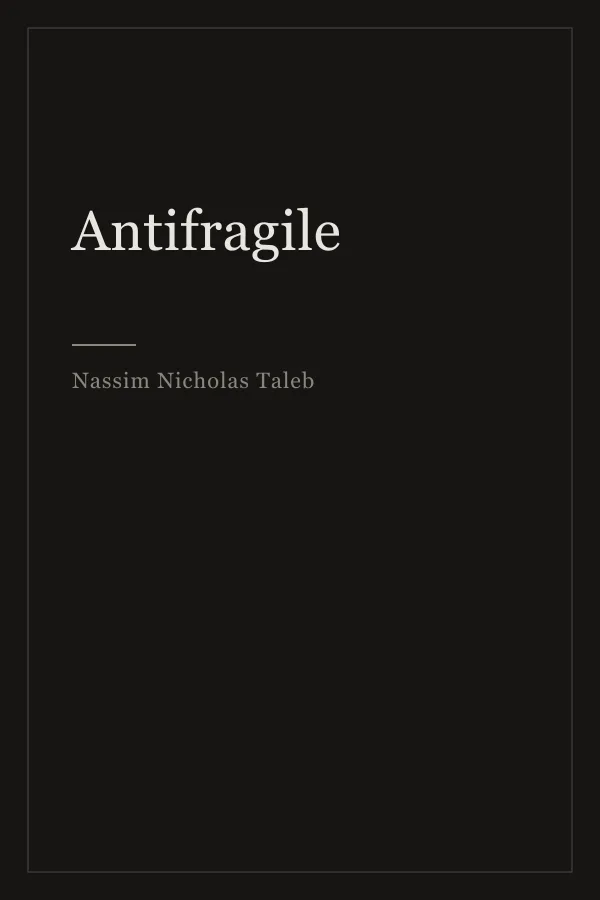
Book
Antifragile
Nassim Nicholas Taleb
- TYPE
- Book
- SHELF
- Trading & Markets
- TIME
- 1 min read
- DATE
- 2026 · 06 · 01
- STATUS
- Reading
- IDEAS
Markets · Systems · Philosophy
Why it matters
It named the property I want in every system I build: to gain from disorder, not merely survive it.
Some things benefit from shocks. Antifragility is beyond resilience — it's the property of systems that improve under volatility, randomness, and stress, and the design rules that produce it.
- Antifragile > robust > fragile: the goal is to gain from disorder, not just resist it.
- Via negativa: improve by removing fragilities, not adding features.
- Seek convex payoffs — small bounded losses, large open upside (optionality).
- Skin in the game aligns the forecaster with the risk.
“Wind extinguishes a candle and energizes fire. You want to be the fire and wish for the wind.”
“The fragile wants tranquility, the antifragile grows from disorder.”
What changed after reading this
Still reading. The early effect is a reflex to ask of any plan: what does this gain from a shock, and what does it lose?
Where I disagree
The rhetoric overreaches and the contempt for “fragilistas” can crowd out the argument. Antifragility is also expensive — optionality has a carry cost someone has to pay.
How it connects
- Blockhedge — convexity and optionality are the literal job: bounded downside, open upside, skin in the game.
- Intelliblitz — via negativa is how I harden systems: remove single points of failure before adding clever features.
- Design for optionality: cap the downside, leave the upside open.
- Prefer subtraction (via negativa) over addition when reducing risk.