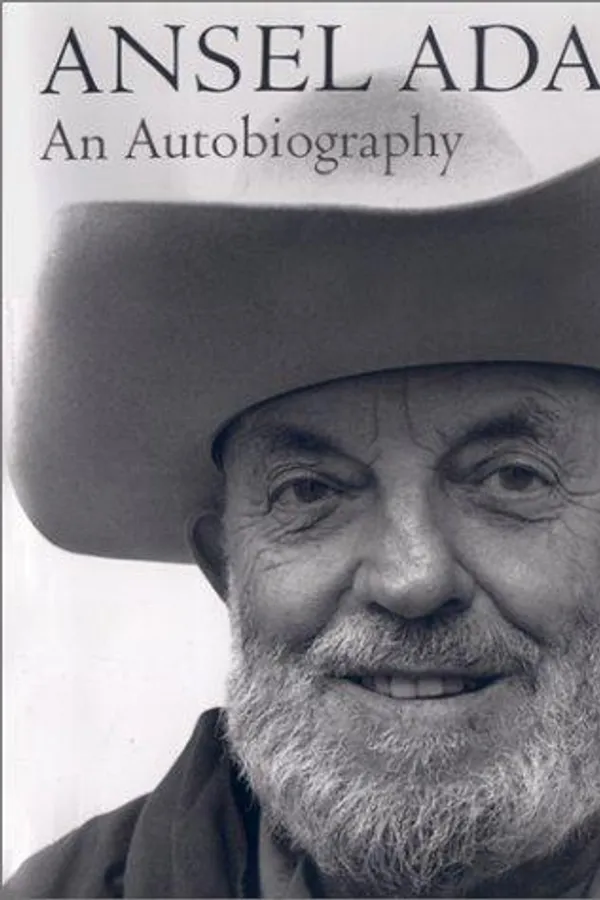
Book
Ansel Adams: An Autobiography
Ansel Adams
A photograph is finished before the shutter opens; this life is the record of what it costs to build a craft exact enough to make such seeing reliable.
- TYPE
- Book
- SHELF
- Biography & Lives
- TIME
- 13 min read
- ADDED
- 2026 · 07 · 07
- STATUS
- Completed
- IDEAS
Photography · Art · History
Why it matters
It documents the working method I have adopted nearly whole: visualization, calibration, and the print as performance; the biography is the manual's proof.
Adams assembled this account at the end of his life, and it reads as the testimony of a man who never doubted that craft and joy could be the same act. A hyperactive San Francisco boy, nose broken in the 1906 earthquake and never set straight, unfit for any classroom, is educated instead by a patient father, a year's pass to the 1915 Panama-Pacific Exposition, and a piano. The piano matters most: years of serious training toward a concert career give him the practice discipline that photography later inherits, along with his organizing analogy, the negative as score and the print as performance. Yosemite, first seen at fourteen with a box Brownie, supplies the subject, the marriage, and the cause. Then the elements arrive in order: Monolith in 1927, where his last usable plate, exposed through a deep red filter, renders the sky he felt rather than the one he saw, and the method gets its name, visualization; Group f/64 and the purist creed; the Zone System, codified with Fred Archer, converting sensitometry into a language for previsualized tone; Moonrise, exposed by calculation when the meter could not be found; and decades of commercial work, teaching, and conservation politics that paid for all of it.
- Visualization is the whole method: the print exists in the mind before the exposure, and the rest of the craft exists so that the mind can be trusted. The Zone System is bookkeeping for an act of imagination.
- The negative is the score and the print the performance. The same negative can be performed differently across a lifetime, and Adams reprinted his own for half a century, the interpretations darkening as he aged.
- Craft must be codified until it becomes reflex. Calibration exact enough to remove accident is not the opposite of intuition; it is the floor that makes intuition trustworthy.
- The piano preceded the camera and the piano's lesson transferred: scheduled practice buys the right to call intuition intuition rather than luck.
- Moonrise was earned twice, once in the seconds before the light left the crosses and once in the years of preparation that let him compute exposure from the luminance of the moon when the meter was missing.
- A photographer's politics can live in the prints without captioning them. Adams argued for wilderness with portfolios, board seats, and presidents, and the portfolios argued best.
- Commercial work funded the personal work for decades without corrupting it, because he held both to a single technical standard and reserved visualization for the work that was his.
The argument
The book was put together in his last years and published after his death, and it keeps the tone of a man telling stories at a long table, sure of his welcome. But under the geniality it makes a sustained claim, and the claim is architectural: a photographic life is not received, it is built, and the building is done with calibration, repetition, and a small number of decisions held for decades. The boyhood chapters establish the raw material. He is born in San Francisco in 1902; the 1906 earthquake throws him down and breaks his nose, which is never set and stays crooked for the rest of his life; he is too restless for any school that will have him. His father withdraws him from the classroom and gives him, in 1915, a year’s pass to the Panama-Pacific Exposition as a curriculum. The lesson Adams draws is not that institutions failed him. It is that attention, given something worth attending to, educates faster than instruction.
The piano is the book’s real foundation, and readers who skim the musical chapters miss the source of everything after. He trained seriously, for years, toward a concert career, and what the training installed was not musicianship but a moral structure: scales before repertoire, practice on schedule, the acceptance that mastery is metered out in small increments over long time. When photography displaced music, the discipline transferred intact, and so did the analogy that organized his whole practice: the negative is the score, the print is the performance. The formulation does more work than it appears to. It makes the exposure a composition rather than a capture, the darkroom an interpretation rather than a correction, and the photograph a thing that can be performed again, differently, for as long as the performer lives.
Yosemite enters in 1916, on a family vacation, through the viewfinder of a box Brownie his parents gave him, and it never leaves. The valley gives him his subject, his community through the Sierra Club, and his wife, Virginia Best, whose family studio in the valley became theirs. The conversion moment arrives in 1927 on the way to photograph Half Dome. He makes a conventional exposure with a yellow filter, and then, with one usable plate left, understands that the file of facts in front of him is not the picture. He wants the cliff as it feels, monumental and dark against a black sky, and he exposes the last plate through a deep red filter to get it. Monolith is the result, and the name he gives the method, visualization, is the book’s central term: the finished print seen complete in the mind before the shutter opens, with the craft existing to make that act of imagination executable.
The 1930s professionalize the conviction. Group f/64, founded in 1932 with Edward Weston and Imogen Cunningham among others, turns a temperament into a creed: sharp focus, full tonal scale, no soft-focus imitation of painting, the photograph valued as a photograph. Stieglitz gives him a show at An American Place in 1936, which Adams recounts as an anointing. Around 1940, teaching in Los Angeles, he and Fred Archer codify the Zone System: the tonal scale divided into zones from black to white, exposure placed for the shadows, development controlled for the highlights, so that the tone imagined at the tripod arrives in the print by arrangement rather than by luck. The point was never densitometry. The point was the removal of accident, so that visualization could be promised rather than hoped.
Moonrise, in 1941, is the system’s proof under fire, and he tells it plainly: driving back toward Santa Fe at dusk, the light already dying on a churchyard at Hernandez, the exposure meter nowhere to be found, and the exposure computed in seconds from the known luminance of the moon. One plate; before he could make a second, the light had left the crosses. His most famous photograph exists because the craft held when the tools failed. The rest of the life, as the book presents it, is infrastructure: decades of commercial assignments that paid for the personal work, the teaching and workshops, the Sierra Club years and the portfolio of Sierra photographs that helped argue Kings Canyon into a national park, the wartime photographs of interned Japanese Americans at Manzanar, and the late decades of fame, in which he reprinted the old negatives darker and more dramatic, an older man performing the same scores with heavier hands. Talent is the smallest part of the story the book tells. What it documents, chapter by chapter, is the deliberate construction of everything around the talent, so that a few seconds of light could be met with reflex.
Working notes
The archive holds two photographers named Adams, unrelated, and they correct each other. Ansel photographs the world before man; Robert photographs what man has done with it. Beauty in Photography and Why People Photograph are the quieter books, morally finer, suspicious of exactly the operatic sublime this autobiography celebrates. But Robert Adams could afford his restraint partly because Ansel had already won photography its standing as an art and built the technical language the restraint is written in. Read Ansel for how to build the instrument; read Robert for what deserves to be played on it.
The Leonardo connection is not decoration. The same fusion sits in both men: measurement in the service of wonder, the notebook and the vision as one faculty. Adams with a densitometer is Leonardo with a dissecting knife; in both cases the instrument is devotion wearing a lab coat, and in both cases the public remembers the images and forgets the arithmetic underneath them.
One more pairing, internal to the man. The confession missing from this book exists, disguised, in his technical trilogy: The Camera, The Negative, and The Print hold no anecdotes and no charm, only exactitude, and exactitude was the truest thing he ever said about himself. Read the manuals as the autobiography and the autobiography as what it is: a manual of good company.
What a second reading surfaces is how completely the cheerfulness conceals the severity. The book laughs easily, and the laughter reads at first as lightness. It is not. It is the surface of a work ethic that scheduled practice for sixty years, and the geniality is what that discipline looks like when it has stopped costing visible effort. I distrust brooding artists more since reading it. The ones who have actually paid tend to be pleasant at the table.
Visualization divides photographers into two species: those who know the picture before raising the camera and those who find it in the viewfinder, or later, on the contact sheet. Adams sits at the far pole of the first species, and the pole has a known pathology: nothing unplanned can enter the frame. His greatest pictures escape it because weather and light refuse to be scheduled, and the discipline of Moonrise is precisely readiness for the unplanned. The system was never a substitute for surprise. It was the condition for being worthy of one.
The late reprints deserve their own note. The same negatives, performed across five decades, grow darker, more theatrical, more insistent. Some critics prefer the earlier, gentler prints, and the debate misses what matters: the work stayed open as long as the man lived. A photograph, on his account, is never finished, only performed at intervals by whoever the photographer has become. I find that both liberating and a little frightening, which is the correct response to any serious idea about interpretation.
Where I push back
The autobiography is itself a print, and it has been dodged and burned. The interior life is withheld almost completely: the marriage appears as logistics, the children as cameo, doubt as weather that passed quickly. A man who taught the world that interpretation is everything has interpreted his own life into continuous sunshine, and the reader is entitled to notice the burned-in corners. An account that never doubts is a portfolio, not a confession, and the book’s warmth should not be mistaken for disclosure. The charm is real; it is also a curtain.
Second, the empty Eden. His Sierra contains almost no people, no economy, no history of the humans who were removed from it; the wilderness he photographed as primordial was already a managed park with a road to the vantage point. The aesthetic that made the case for conservation also taught the public that nature is elsewhere, pristine, and vertical, and that the ordinary inhabited earth is beneath photography. Robert Adams spent a career answering that error. The grandeur is real and I do not renounce it; but grandeur, imitated without his discipline, has filled every famous overlook with a line of tripods reproducing a picture that already exists. His genius is inimitable. His formula, unfortunately, is not.
Third, the codification invites its own fetish. The Zone System has produced generations of technicians whose negatives are perfect and whose minds are empty, men who can place a shadow on Zone III and have nothing to say about why the shadow matters. Adams is not responsible for his misreaders, but the book’s serene confidence that craft and vision grow together is false comfort. Craft compounds with practice. Vision does not compound; it must be renewed on other grounds entirely, and the book, so exact about the first, is nearly silent about where the second comes from.
How it enters the work
Long exposure is visualization enforced by physics. With a dense filter on the lens, the scene the eye sees is gone; the water will smooth, the clouds will streak, the crowds will vanish, and none of it is visible until the exposure ends. The print must therefore exist in the mind at the moment of commitment, exactly as Adams prescribed, because there is nothing else to trust. Standing before a lighthouse or a mountain range with minutes of exposure ahead, I am running his method without modification: see the finished tone, place the values, commit, and wait. The discipline did not need translating from 1927. It needed obeying.
The architectural work draws on the same doctrine. Photographing the Oculus or Lower Manhattan in black and white is a decision about meaning before it is a decision about exposure: which structure is the subject, what weight the sky must carry, where the darkness should pool. Digital sensors invert his arithmetic, protecting highlights where film protected shadows, and the inversion changes nothing. The transferable core is calibration: know the sensor as he knew the emulsion, so exactly that no surprise survives between visualization and file. My operating instinct, find the structure and remove everything that isn’t it, is his method restated: visualization is that subtraction performed in advance of the shutter.
Fineara runs on his other doctrine. The file is the score; the exhibition print is the performance; and a print that hangs in a gallery is held to performance standard, not documentation standard. Preparing work for the eight galleries that show it, I reprint, reinterpret, and occasionally darken with age, and I stopped apologizing for the revisions after this book. The work stays open while the maker lives.
And beneath both practices sits the piano lesson, which is the deepest thing in the book. Practice is scheduled; it is not inspired. The craft is drilled in advance so that the rare minutes of great light are met with reflex rather than fumbling. Discipline, in his account and in my experience, is not the enemy of the romantic moment. It is the only reason you are ready when the moment condescends to arrive.
- Decide what the print must be before the shutter opens; exposure is execution, not search.
- Calibrate until the materials hold no surprises; only then does instinct deserve the name.
- Treat the capture as a score: the performance is the print, and it may improve for decades.
- Practice on schedule, as a pianist practices; the light does not wait for the unprepared.
- Let paid work fund the personal work, and hold both to one standard.
The book is genial to a fault. The anecdotes are polished smooth by fifty years of telling, the interior life stays offstage, and the people around the work appear mostly as supporting cast; the man edited his account the way he dodged a print. Read it for the method, not for confession. And be warned about the aesthetic: his sublime, imitated without his discipline, produces the tripod line at the scenic overlook and a generation that waits for drama instead of light.