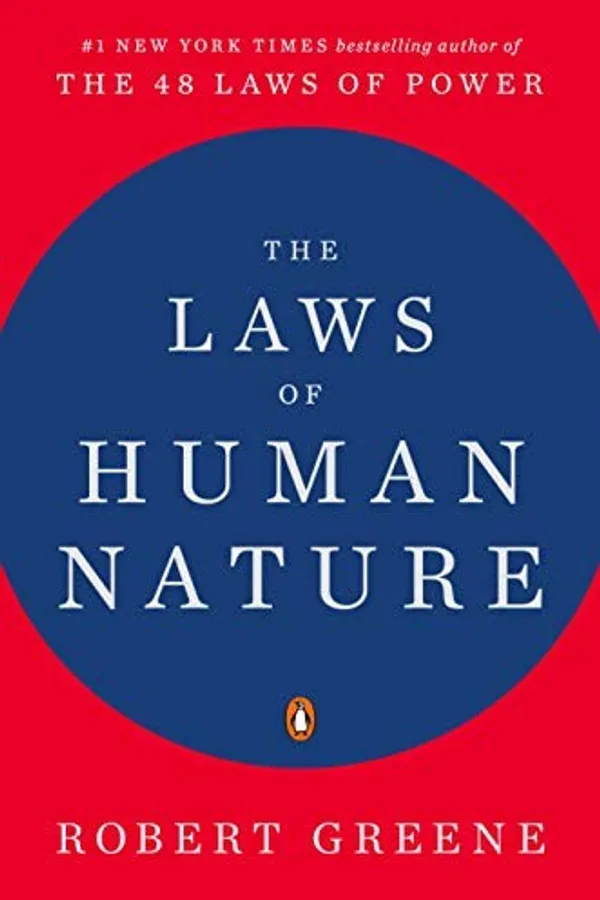
Book
The Laws of Human Nature
Robert Greene
People are governed by forces they do not see, envy, narcissism, aggression, conformity, and the study of others is worthless until it has first been conducted in the mirror.
- TYPE
- Book
- SHELF
- Psychology & Behavior
- TIME
- 12 min read
- ADDED
- 2026 · 07 · 07
- STATUS
- Completed
- IDEAS
Psychology · Strategy
Why it matters
It is the working checklist for reading motive in rooms where everyone performs; I use it as an instrument, not a philosophy.
Greene's longest and most mature study: eighteen laws, each a chronic force in human conduct, taught through a historical case and closed with strategies. Irrationality, narcissism, role-playing, compulsive character, covetousness, shortsightedness, defensiveness, self-sabotage, repression, envy, grandiosity, projection between the sexes, aimlessness, conformity, fickleness, aggression, generational myopia, and the denial of death: the list is the anatomy of every difficult room you have sat in. The method is double throughout. Each chapter teaches detection, the tells by which the force operates in others, and then turns the instrument around: you are irrational, envious, aggressive, and conforming, and your first case study is yourself. Pericles models rationality as a practice rather than a gift; Howard Hughes demonstrates that character is compulsion and repeats under pressure; the South Sea Bubble prices shortsightedness; Nixon's fall maps the shadow's revenge; Rockefeller anatomizes aggression as a constant rather than an outburst; Flannery O'Connor's dying carries the final law, that mortality held in awareness is the source of proportion. The book's quiet thesis is that human nature does not improve but can be known, and that the knower gains a margin: the delay between feeling and act in which judgment lives.
- Rationality is a practice, not an endowment: emotion arrives first and recruits reasons afterward, and the rational actor is one who has engineered a delay between feeling and act.
- Character is compulsion. Under pressure, people repeat their pattern regardless of stated intention; hire, partner, and trade against the pattern, never the interview.
- Envy does not announce itself. It arrives dressed as criticism, moral concern, or a sudden coolness after your success, and it concentrates among near-equals; track the trigger, not the vocabulary.
- The deep narcissist metabolizes everything as reflection and is not reformed by attention; the correct response is early detection and distance, not empathy.
- Groups run on emotional contagion: intelligence sinks toward the room's temperature, and conformity is experienced from inside as clarity. The defense is structural, not moral: decide alone first.
- Mortality held in awareness rather than repressed is the master discipline: the source of urgency, proportion, and the nerve to spend a life deliberately.
The argument
The 48 Laws of Power anatomized the moves; this book, twenty years later, descends a level to the movers. Greene’s premise is that beneath strategy sits temperament, and beneath temperament a set of chronic forces that operate in everyone, mostly below awareness: irrationality, narcissism, envy, aggression, conformity, and the rest of an eighteen-item list that reads like the manifest of every difficult meeting ever held. The method is constant across chapters. A historical life is told at length and allowed to demonstrate the force in motion; then the anatomy, how the force works, what it wants, the tells by which it surfaces; then strategies. And through all of it runs the double movement that makes this his most mature book: every chapter teaches detection in others and then rotates the instrument until it points at the reader. You do not study the envious; you study envy, and the nearest specimen is at your desk.
The first law sets the mechanics for the rest. Pericles is the case: not a cold man but a trained one, holding Athenian policy steady against an assembly that stampeded from confidence to panic and back inside a season. Greene’s model of the mind is blunt. Emotion arrives first and recruits reasons afterward; what we call thinking is, untrained, mostly advocacy for a feeling already seated. Nor is the problem the visible eruption. The normal state is low-grade contamination, mood tinting judgment all day without announcing itself, and the rational actor is simply the one who has engineered a delay between feeling and act, a gap in which the feeling can be seen as an event rather than obeyed as an instruction. Rationality, on this account, is not intelligence. It is latency, deliberately installed.
The chapter on character carries the book’s most useful sentence for anyone who hires, partners, or lends: character is compulsion. Howard Hughes is the case, a man whose pattern, the need for total control exercised through secrecy and micromanagement, repeated across decades and industries, shredding every stated intention and every fresh start. People announce their character constantly, in small actions, in past conduct, in how they treat subordinates and handle waiting; we ignore the announcements because words are cheaper to read. Greene’s instruction is to weigh the pattern and discount the interview, since under pressure the pattern votes and the interview does not.
The social laws form the middle of the book. Envy concentrates among near-equals and never travels under its own name; it arrives as pointed criticism, as moral concern, as a coolness that begins the week your success becomes public, and the diagnostic is the trigger, not the vocabulary. Conformity gets the book’s most frightening case, a memoir of the Cultural Revolution in which a school devours itself in months, students denouncing teachers and then each other, each escalation feeling from inside like moral clarity. Greene’s point is not that mobs exist but that groups as such run on emotional contagion, that intelligence sinks toward the room’s temperature, and that no one experiences himself conforming; the feeling from inside is simply that the obvious has become visible. The shadow chapter reads Nixon’s fall as the revenge of the repressed: the traits a man denies do not retire, they leak, through slips, through obsessions, through the vices he condemns most loudly, until they organize his ruin with a competence his conscious plans never had.
Two laws price the operator’s vices. Shortsightedness gets the South Sea Bubble, an entire political class discounting consequences that stood three steps away because the first step paid so well. Aggression gets Rockefeller, and Greene’s treatment is anatomy rather than sermon: aggression is not an event but a constant underlying energy, present in everyone, channeled by the sophisticated into acquisition, litigation, and control, and dressed for daily wear as the passive forms everyone recognizes and no one names. The portrait admires the channeling and tallies the wreckage, and the reader is left to hold both, which is the book’s ethic in miniature: see the force clearly before you judge it, and never pretend you are exempt.
The final law is the surprise. The book about reading people ends with a meditation on death, carried by Flannery O’Connor’s years of dying deliberately and well, and the argument closes its circle: the denial of mortality is the master repression under the other seventeen laws, and death held in awareness is the source of urgency, proportion, and the nerve to spend a life on purpose. Human nature, Greene concludes, does not improve. It can only be known, and the knower gains a margin. The margin is the book.
Working notes
I read Greene’s shelf as an instrument panel rather than a philosophy. The 48 Laws is the anatomy of moves, this book the anatomy of the movers, Cialdini the levers that work on anyone, Berne the dialogue the dispositions speak at the table. Of the four, this is the one I reread, because it starts nearest the operator’s own chair, and because the checklist format survives contact with an actual week: before a difficult room, one chapter, twenty minutes, and the relevant force is back in working memory.
The mirror discipline is the whole price of admission, and most readers dodge it. The envy chapter read with your own ledger open is an uncomfortable hour: the tightness at a peer’s raise, the criticism that arrived in you fully formed the week a rival shipped. Done honestly once, the exercise permanently changes what you notice in your own reactions, and the book’s outward-facing radar improves as a side effect, because you now know the signal from inside. Greene says this plainly and repeatedly. The readers who use the book as a targeting system have skipped its only real instruction.
Character-is-compulsion has been worth more to me than any valuation technique, because most diligence fails on people, not numbers. The pattern shows before the deal: how a counterparty treats the waiter, the junior analyst, the deadline that slipped by a day. Markets run the same exam with money attached; a drawdown interviews everyone, and the answers are compulsory. I have learned to treat a man’s conduct in his last drawdown as the disclosure document, and the pitch as the advertisement.
Most rooms are decided before the argument starts; the argument is the ceremony.
The death chapter is the one nobody expects from Greene and the reason the book outranks its siblings. The strategist ends as a memento mori preacher, and the sequence is right: read Becker for why the repression exists, Seneca for the ancient counter-practice, and Greene for the operator’s version, mortality as a scheduling instrument. Power studied without death in view curdles into games; the last law is the solvent for the first seventeen, and placing it last was the most honest structural decision in any of his books.
Where I push back
The word law is doing promotional work. What Greene documents are tendencies, strong ones, and the proof is curated anecdote: every case was selected after the verdict it illustrates, and history read backward always confirms the chapter it was hired for. The Pericles problem states it cleanly. The exemplar of rationality led Athens into the war that broke it, and the portrait Greene leans on is partly Thucydides’ literary construction; the book admires at exactly the altitude where the evidence thins. A reader who wants the tendencies as science should go to the primary literature, where the effects are smaller, noisier, and hedged.
The deeper fault is a contradiction the book never faces. If character is compulsion, formed early and repeated under pressure regardless of intention, then the reader’s transformation program, promised in every chapter’s strategies, is contraband by the book’s own law. Greene sells determinism about others and plasticity for you, on facing pages, and the sale works because flattery is a force he anatomizes in everyone but his customer. One of the two claims must give ground, and the book declines to say which.
And the training has a moral cost the book leaves unbilled. Suspicion installed as a default lens does not stay in the conference room; a reader who runs motive-analysis on every kindness becomes unable to receive one, and the hermeneutic that protects him in negotiations impoverishes him at his own table. Greene’s severity toward human nature is earned by the record, but a diagnostic manual for the species, read as a worldview, produces exactly the cold operator its final chapter warns against. The book is an instrument. Instruments do not tell you when to put them down, and neither does Greene.
How it enters the work
The rooms where I operate, enterprise sales, capital raising, partner negotiations, are performance-rich by construction: everyone present has rehearsed, and the stated agenda is rarely the load-bearing one. The book functions as a pre-flight checklist. Before consequential negotiations I reread the relevant chapter, and the narcissism check runs first on any new counterparty: does this person metabolize everything as reflection, do subordinates orbit or contribute, was the last partnership’s ending narrated entirely in the passive voice. Deep cases get distance, not empathy, and the position gets sized accordingly, because contracts do not reform character and neither will I.
Envy management became procedure after the book named the mechanism. Wins are published as the firm’s work, not the founder’s; credit is shared precisely, by name; and victories are not performed in front of the people they diminish. This is not modesty. It is maintenance of the relationships the next decade will run on, purchased at the cost of a little applause now.
The engineered delay is the core of self-command as I practice it, and nowhere more than trading. No order is placed inside the emotion that proposed it: the thesis is written cold, the trigger is set in advance, and the feeling that arrives with the price is treated as an event to be observed, not an instruction to be obeyed. After the thesis is set, the delay is most of what discipline means. The same latency governs difficult correspondence; the strong reply is drafted, dated, and sent the next morning or not at all.
And the conformity law is why solitude is structural in my calendar rather than recreational. Positions on anything consequential are drafted alone, in writing, before the meeting that will discuss them; the group hears a formed view it can attack, not a forming one it can steer. Greene’s room temperature is real and I have felt my own intelligence sink toward it. The defense he prescribes is the one I run: arrive with the thinking already done, and let the meeting be what it is, a ceremony where the deciding was checked, not performed.
- Before attributing a motive, write down three candidates and let repeated behavior vote; a single incident identifies nothing.
- Judge people by conduct under pressure, observed more than once; discount the interview, the pitch, and the apology.
- When you win publicly, manage envy as a known cost: share credit precisely, and do not perform the victory in front of the people it diminishes.
- In group settings, locate the emotional temperature before weighing the argument; ask what the room needs to be true, then subtract it.
- Set deadlines against mortality, not against quarters; the calendar that includes your death is the only honest one.
The word law flatters a set of tendencies, and Greene proves by curated anecdote: every case study was selected after the verdict it illustrates. Read as science the book is weak; read as a manipulation manual it corrodes the reader who came for that; the only reading that pays is the one Greene prescribes on nearly every page and readers skip on nearly every page, the audit of oneself. It is also a third longer than its content, and the padding is in the strategies.