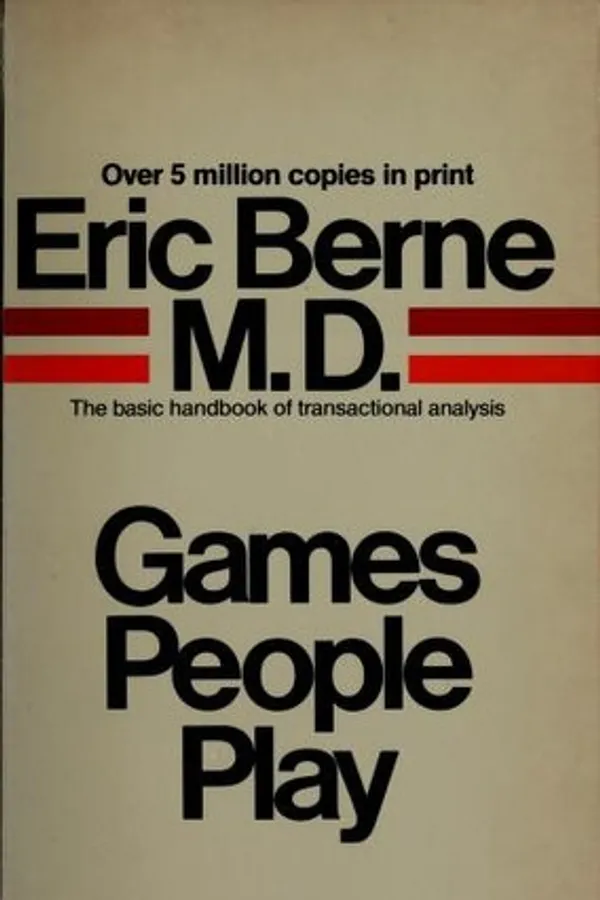
Book
Games People Play
Eric Berne
Beneath most conversation runs a rigged sequence of moves toward a concealed payoff, and the players prefer winning the game to the intimacy it replaces.
- TYPE
- Book
- SHELF
- Psychology & Behavior
- TIME
- 12 min read
- ADDED
- 2026 · 07 · 07
- STATUS
- Completed
- IDEAS
Psychology
Why it matters
It made meetings legible: the recurring maneuvers of clients, committees, and colleagues have names, and a named game loses most of its budget.
Berne's transactional analysis in its original clinical dress, published in 1964 and never really superseded by its own school. The theory comes first: every person operates from three ego states, Parent, Adult, and Child, observable in shifts of voice and posture; conversation is a sequence of transactions between states, and communication proceeds until a transaction crosses. Recognition is a hunger with the force of biology; people starved of positive strokes will arrange negative ones, since being struck confirms existence and being ignored does not. Time must be structured, and Berne ranks the methods by intensity and risk: withdrawal, ritual, pastime, activity, game, intimacy. A game is a recurring series of ulterior transactions with a concealed motive and a predictable payoff: one player solicits advice in order to defeat it; another outsources a feared ambition to a restricting spouse; a third stockpiles small grievances against the day they license rage. The payoff is always the same commodity, confirmation of a position adopted in childhood, and the game manufactures that proof on demand. Games substitute for intimacy, safer because rigged. The exit, sketched briefly at the end, is autonomy: awareness, spontaneity, and game-free candor, which Berne prices as rare and frightening.
- Each person carries three ego states, Parent, Adult, and Child, and the state that is speaking decides the transaction more than the words do; most quarrels are crossed transactions, not disagreements.
- Recognition is a biological hunger: people who cannot obtain positive strokes will provoke negative ones, because to be struck is to exist and to be ignored is not.
- A game is not play. It is a recurring, rigged sequence of ulterior transactions with a concealed motive and a predictable payoff, and the loser is a volunteer.
- The payoff of every game is evidence: confirmation of an existential position adopted early, about one's own worth or others' trustworthiness. The game exists to manufacture the proof.
- Games rank between pastimes and intimacy in the structuring of time: dramatic enough to fill a life, safe because the ending is fixed in advance.
- Autonomy means awareness, spontaneity, and intimacy: the capacity to stop playing. Berne prices it honestly; giving up a game forfeits the payoff, and the payoff was holding the personality together.
The argument
The catalog made the book famous, but the theory in the first third is the load-bearing part, and Berne builds it like the clinician he was. Observing patients, he noticed that a single person is not single: distinct, coherent systems of posture, voice, vocabulary, and feeling take turns at the controls, and the shifts are visible across a desk. He named three. The Parent is a recording of parental figures, replayed as judgment or nurture; the Adult is the data processor, testing reality and computing odds without ceremony; the Child is the preserved remainder of early life, source of spontaneity and invention as well as fear, compliance, and tantrum. Berne insists these are not roles or moods but phenomenological realities: you can watch a grown negotiator drop into the Child in the space of one sentence, and the drop changes everything that follows.
The unit of social life is the transaction: a stimulus from one ego state, a response from another. Complementary transactions, where the response returns along the expected line, can continue indefinitely; this is why small talk is stable. Crossed transactions break the exchange: address a man’s Adult with a question about the quarterly numbers and receive his Parent’s lecture or his Child’s sulk, and communication stops until someone changes state. The interesting species is the ulterior transaction, which runs on two levels at once: a social level that is respectable and a psychological level that is doing the business. Games are built entirely of these. The words discuss the agenda; the transaction pursues something else.
Why anyone bothers is answered by two hungers. Recognition first: Berne generalizes the infant’s need for physical contact into the adult’s need for strokes, units of acknowledgment, and makes the observation on which half the book rests: a negative stroke is preferable to no stroke at all. People deprived of affection will arrange contempt, provoke quarrels, collect injuries, because any transaction confirms existence and silence does not. Structure second: waking life is a long corridor of unassigned hours, and Berne ranks the available furnishings by intensity and risk. Withdrawal, ritual, pastime, activity, game, intimacy: each step up buys more aliveness and exposes more of the self. Games sit one rung below intimacy, and that placement is the book’s cruelest insight. A game delivers drama, contact, and meaning on a fixed script with a known ending; intimacy delivers more of all three with no script at all. Most people, Berne says flatly, cannot bear the second, so they fill their lives with the first.
Then the anatomy. A game is a recurring sequence of ulterior transactions, superficially plausible, with a concealed motivation and a payoff for both players. Berne dissects each specimen like a coroner, itemizing its advantages: biological, the strokes harvested; existential, the position confirmed; social and psychological, the structure and the discharge. The exemplary specimen is Why Don’t You, Yes But. A player presents a problem and solicits solutions; each is met with a reason it cannot work; the room eventually falls silent, and the silence is the win. On the social level, an adult asking for help; on the psychological level, a Child defeating a panel of Parents, proving once again that nobody can tell them anything. If It Weren’t for You runs on the same two levels in a marriage: the restricted spouse complains of the restriction, having chosen a restricting partner precisely so the feared ambition would never face a test. Now I’ve Got You stockpiles small grievances against the day one of them licenses a rage that was waiting for a permit. Wooden Leg converts a handicap into an alibi: what can you expect of a man with my burden. Alcoholic, in Berne’s coldest chapter, is a five-handed game whose point is not the drinking but the morning after, the harvest of remorse and forgiveness, with supporting roles, Persecutor, Rescuer, Patsy, that the players will recruit strangers to fill if the family tires.
Games, finally, are installments. Each is a scene from a larger script, adopted early and played toward its ending, and games pass between generations the way table manners do: children learn the family’s games as they learn its language. The last chapter, on what lies beyond games, is a few pages long, and the brevity is itself a finding. Autonomy, Berne says, is the recovery of three capacities: awareness, spontaneity, and intimacy. He does not pretend the recovery is likely. Giving up a game means forfeiting the payoff, and the payoff was structural; the player was using it to hold a position, and the position was holding the personality. The book ends closer to a warning than to a promise, and it is more honest for it.
Working notes
Cialdini and Berne divide the territory of manipulation cleanly. Influence is about what strangers do to you once, from outside, using levers that work on anyone; Games People Play is about what intimates do with you nightly, from inside, using a script only the two of you rehearse. Compliance is situational and games are structural, which is why you can inoculate yourself against a salesman in an afternoon and spend a decade failing to stop a game with a colleague. The salesman needs your ignorance. The game needs your participation, and participation is renewed at every round.
Greene’s Laws of Human Nature supplies the cast; Berne supplies the dialogue. Envy, narcissism, and aggression are dispositions, and a game is what a disposition does at the dinner table on a Tuesday. Of the two, Berne’s is the more operational book: you can watch a transaction cross in real time and change your next sentence, which no theory of character lets you do.
Consulting practice is a zoo of the catalog. Yes But is the house game of discovery workshops: a client team solicits recommendations in order to defeat them, and the defeat is not evaluation, it is proof that no outsider can help, filed by whoever owns the status quo. Courtroom appears in every escalation call where two managers address a judge instead of each other. Look How Hard I’ve Tried is the standing game of failing projects, effort displayed as a substitute for outcome, absolution as the payoff. The stroke economy explains the rest: a steering committee is a table where six people play different games with the same chips, and the meeting’s stated agenda is the social level of a transaction whose psychological level decides the program.
The negative-stroke doctrine explains more of the internet than most media theory does. Markets commentary, reply threads, trading chat: a stroke economy where being struck beats being ignored, and the participants arrange their daily contempt with the reliability Berne saw in his patients. Nothing about the technology is new except the latency.
Second reading: the book’s real subject is the fear of intimacy, and the catalog is a taxonomy of hiding places. Berne’s wit is anesthesia over a bleak finding, that most social life is the avoidance of contact conducted in its costume. The jokes make the book readable. The finding makes it permanent.
Where I push back
The anatomy is metaphor promoted to organ. Parent, Adult, and Child are a brilliant notation for observable shifts, but Berne treats the notation as structure, and the school he founded hardened it further, diagrams and all; transactional analysis has not held its standing in clinical psychology, and the games were never validated beyond the consulting room they were named in. The book’s evidence is the anecdote, and the anecdote is chosen by the man who owns the theory.
The period shows. The marital and sexual games carry 1960s assumptions about who stays, who works, and who may leave; several entries read as field notes from a world whose exits were locked differently than ours, and a modern reader has to do the conversion arithmetic himself. Berne describes the games of trapped people with great precision and spends little ink on the traps.
The sharpest defect is the chair the book seats its reader in. Diagnosis from above is a pleasant position, and Berne, who notes that patients can play a game called Psychiatry, never quite turns that lens on the framework itself: naming other people’s games at the dinner table is the game of having read Berne, and its payoff is the oldest one, superiority confirmed. The book teaches a way of seeing that is one move from a way of sneering, and it does not install the guardrail.
And the exit is asserted, not taught. Two hundred pages map the trap; a handful gesture at the door. Awareness, spontaneity, intimacy: named, priced, and left as an exercise. A clinician who shows you the disease in high resolution and the cure in silhouette has written a diagnostic manual, whatever the cover promises, and it should be read as one.
How it enters the work
Enterprise consulting is a game-rich habitat, and the vendor-client dyad has house games that Berne would have recognized on sight. The client’s opening is often Wooden Leg: what can you expect, with our legacy estate. The vendor’s is Rescuer: sign here and be saved. The two positions fit like gears, and the mesh is profitable and corrupt: a rescued client is a dependent client, the dependency renews annually, and the resentment compounds on both sides of the invoice. Much of the software industry has institutionalized exactly this transaction and calls it a subscription.
Intelliblitz’s standing doctrine, systems the client owns rather than rents, is among other things an anti-game contract. Ownership removes the Rescuer’s chair from the room: the engagement is scoped Adult to Adult, success criteria are written down where both parties can fail against them, and the exit ramp is designed in at the start, because a relationship that cannot end cleanly will be maintained by games instead of results. When a discovery workshop turns into Yes But, the counter is not better recommendations; it is naming the decision owner and asking, from the Adult, what evidence would change their mind. The game needs the panel of defeated advisors. Decline the seat and the psychological level surfaces, which is the beginning of actual work.
In negotiations the book pays for itself in one specimen: Now I’ve Got You. A counterparty storing small errors is not keeping records, he is accumulating a permit, and the defense is to correct errors loudly and early, deny the arsenal, and refuse the guilty flinch when the permit is finally waved. And the discipline runs inward, where it costs more. In escalations I answer from the Adult by procedure, not by temperament: state the data, own the miss, propose the correction, and decline the invitation to play Courtroom in front of the client’s judge. When any working conversation repeats with the same bad ending, the notebook gets one question in the margin: what is the payoff, and who is collecting it. The answer is sometimes me. That is the reading Berne intended, and the only one that improves anything.
- In any charged exchange, identify which state is speaking in you before you answer, and answer from the Adult even when addressed as the Child.
- When a conversation repeats with the same bad ending, stop debating its content and find the payoff; a pattern that survives years of resolutions is being maintained by someone.
- Stop supplying solutions to a Yes But; the request for advice is the opening move of a game whose object is the defeat of advisors.
- Refuse the Rescuer's chair in commercial relationships; rescue manufactures dependents, and dependency corrodes both parties on a schedule.
- Audit the complaint you have kept longest; a grievance maintained for years is not a wound, it is a trophy.
The evidence is anecdote and the anatomy is metaphor: Parent, Adult, and Child are figures of speech that Berne handles like organs, and transactional analysis has not kept its clinical standing. The sharper danger is in the reader: diagnosing other people's games is itself a game, played from the superior chair, and the habit can replace presence entirely. Berne's contempt was earned across a consulting career; borrowed without the clinic, it is just contempt.