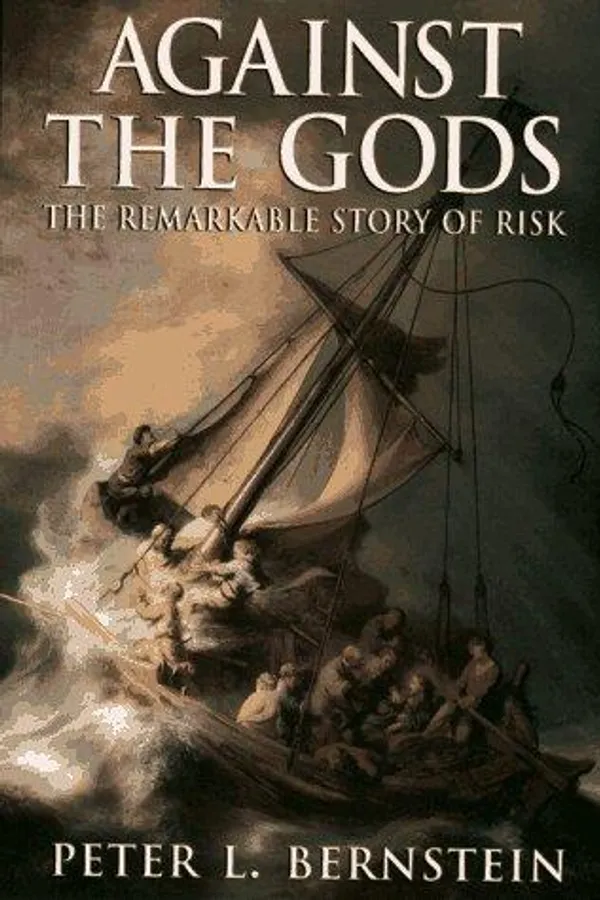
Book
Against the Gods
Peter L. Bernstein
Modernity begins when the future stops belonging to the gods and becomes a field of measurable choices; the measuring, told here as triumph, bred the hubris that runs every desk.
- TYPE
- Book
- SHELF
- Trading & Markets
- TIME
- 12 min read
- ADDED
- 2026 · 07 · 07
- STATUS
- Completed
- IDEAS
Markets · History · Psychology
Why it matters
It is the genealogy of every instrument on the desk with each instrument's original license attached; I keep it to remember what my tools were actually built to measure.
Bernstein's story runs from knucklebone dice to the derivatives desk, and its thesis is that the mastery of risk is the dividing line between the ancient world and ours. Antiquity gambled constantly and theorized never: without workable numerals, and with the future assigned to fate, probability had nothing to stand on. The machinery assembles across centuries. Fibonacci imports Hindu-Arabic numbers into European commerce; Renaissance gamblers pose the problem of dividing the stakes of an unfinished game; Pascal and Fermat solve it by correspondence and found the mathematics of expectation; Graunt reads London's death registers into the first mortality tables and makes insurance an industry; the Bernoullis add the law of large numbers and the idea of utility; Gauss and Galton supply the normal curve and regression to the mean. Then the modern turn, where the confidence cracks: Knight and Keynes separate measurable risk from unmeasurable uncertainty, game theory admits an opponent who thinks back, Markowitz turns diversification into arithmetic, and Kahneman and Tversky demonstrate that the measurer himself is miscalibrated. Bernstein ends among the derivatives, hedging instruments turned wagering instruments, with the tension unresolved: the tools grow more precise while the world they measure stays open.
- Antiquity gambled constantly and theorized never: probability required both workable numerals and the conviction that the future is a field of choice rather than the property of the gods.
- The theory of risk was born from a gambling dispute: Pascal and Fermat, dividing the stakes of an unfinished game, invented expectation and put a number on the future for the first time.
- Statistics was founded in death records: Graunt's tables from London's mortality bills turned dying into a regularity, and insurance turned the regularity into a price.
- Daniel Bernoulli's answer to the St. Petersburg paradox planted utility at the root of risk: the price of a gamble depends on who bears it, so risk is personal before it is mathematical.
- Galton's regression to the mean is counsel and trap at once: reversion governs until the regime changes, and the tool itself cannot tell you which is happening.
- Knight and Keynes drew the boundary the profession keeps erasing: risk is what can be measured, uncertainty is what cannot, and most of what matters in markets lives on the far side of the line.
The argument
Bernstein’s claim is large and he states it early: what separates the modern world from all the millennia before it is not science or technology in general but one specific mental act, the treatment of the future as something that can be studied, measured, and chosen among. The ancients lacked neither intelligence nor appetite; they gambled incessantly, with astragali cut from animal bone, and the Greeks who axiomatized geometry never took the step of counting the ways dice can fall. Bernstein’s explanation for the missed step has two parts. The arithmetic itself was hostile, since no one builds probability theory on top of Roman numerals; and the metaphysics was closed, since a future owned by fate or the gods is not an object of study but of sacrifice. Probability required both a notation and a permission, and antiquity had neither.
The permission arrives with commerce and the Renaissance, and the notation arrives through trade: Fibonacci’s book of calculation brings Hindu-Arabic numerals into European business, and merchants counting cargo and coin become the first constituency for a mathematics of the uncertain. The founding problem, when it comes, is a gambler’s bookkeeping question: how should the stakes of an interrupted game be divided between players partway to victory. Pacioli poses it, Cardano, a gambler who wrote down odds between scandals, circles it, and in 1654 Pascal and Fermat settle it in an exchange of letters, reasoning out the value of an unfinished future position. Expectation is invented there: the future priced by enumerating its branches. Pascal then carries the new instrument straight to the largest possible subject, wagering on God, and his colleagues at Port-Royal extend it to belief and evidence generally. Within a generation, an idea born at the gaming table is being used to weigh testimony and judge conviction, which tells you how starved the world had been for it.
The next movement founds statistics in the least likely ledger: the dead. John Graunt, a London tradesman, reads decades of the city’s mortality bills and finds regularity where everyone else saw providence, stable ratios, patterns by age and cause, an order in dying that no individual death discloses. Halley refines the work into life tables, and the regularity becomes a price: insurance, gathering in the coffee houses that would become Lloyd’s, converts mortal fear into a premium. This is the book’s pivot from mathematics to industry. Once risk has a price, it can be transferred, pooled, and sold, and a civilization that can sell risk can attempt things a fate-governed civilization cannot.
The Bernoullis deepen the theory in two directions. Jacob’s law of large numbers licenses inference from samples while quietly marking its limit: certainty is approached, never reached. Daniel, answering the St. Petersburg paradox, in which a coin game of infinite expected value commands only a modest entry fee from any sane player, relocates the whole subject: what a gamble is worth depends on the wealth and situation of the person bearing it. Utility enters, and with it the admission that risk is personal before it is mathematical. De Moivre and Gauss supply the bell curve and the machinery of deviation; Galton, breeding sweet peas and measuring heredity, finds regression to the mean, the gravity that pulls extremes back toward the ordinary and, misread, the source of a thousand bad trades since.
Then the twentieth century, where Bernstein’s cathedral develops its cracks. Frank Knight separates risk, which can be measured, from uncertainty, which cannot, and locates profit itself in the unmeasurable residue. Keynes refuses the frequentist comfort altogether: for the singular questions that matter most, there is no basis for calculable probability at all. Von Neumann’s game theory changes the opponent from nature to a mind that anticipates you. Markowitz makes diversification arithmetic rather than adage. And Kahneman and Tversky close the arc with the finding the whole edifice had deferred: the human being running the calculations departs from them systematically, weighting losses over gains, certainty over odds, story over sample. The book ends among derivatives, instruments built for hedging and traded overwhelmingly for speculation, and Bernstein, to his credit, leaves the tension standing: the instruments keep improving, and each generation mistakes its newest instrument for mastery of the thing itself.
Working notes
The way to read this book is as a genealogy of tools with their licenses attached. Every technique on a modern desk descends from a specific problem in this story, and each carries the assumptions of its birthplace: expectation comes from games whose rules are closed and printed; the actuarial tables come from populations where the deaths are independent and the dead do not read the actuary’s report. That last clause is the whole difference. Mortality statistics work because dying is not reflexive; markets fail the same mathematics because prices respond to the models that price them. The license question, what world was this tool built for, has saved me more money than any signal.
Daniel Bernoulli’s utility is the most underused idea in the book and possibly on any desk. The same position is a different risk at different wealth, in different liquidity, at a different point in a firm’s life; sizing in dollars is sizing for nobody in particular. Ruin is not a percentage, it is an event in a specific life. Every sizing rule I trust is the St. Petersburg answer restated.
Galton’s regression is counsel and trap in equal measure. Reversion to the mean is the sanest default in markets and the most dangerous, because the calculation assumes the mean is stationary and says nothing about when it is not. Regression works until the regime changes, and the tool is silent on which condition you are in. Kindleberger’s manias are what the silence costs at civilizational scale; Taleb’s Black Swan is the formal complaint. This book and that one are thesis and antithesis, the cathedral and the crack, and I reread them in alternation.
Bernstein records Leibniz’s warning to Jacob Bernoulli that nature’s regularities hold only for the most part, and the clause deserves its fame. The entire modern argument about risk is a dispute over the size of the exception Leibniz reserved: every model since is an attempt to shrink the clause, and every blowup since is the clause collecting. What the rereading turned up is the date. The objection arrived at the founding, in correspondence, before the law of large numbers had even been published; the limit was known to the men building the instrument, stated plainly by the best mind in Europe, and then spent three centuries being filed as a technicality. Institutions do not lose knowledge. They lose emphasis, which is worse, because the surviving footnote gives assurance that the matter was considered.
And history supplied the book’s epilogue without being asked. Two years after publication, the most decorated quantitative partnership of the age, Nobel laureates in the partnership and the era’s best mathematics in the risk engine, failed on exactly the confidence this book chronicles, and had to be unwound by a committee of its counterparties so the failure would not spread. The models that broke were direct descendants of the book’s closing chapters, and the assumptions that broke them, stationary correlations, exits that stay liquid, a mean that holds still long enough to be reverted to, were the assumptions the cathedral had made respectable. The timing was an accident. The lesson was not, and the book’s serene final pages read differently once you know what the next twenty-four months did to them.
Where I push back
The book is Whig history, and the frame distorts what it organizes. Every figure is conscripted into an ascent toward measurement, so the thinkers who concluded that the project has hard limits, Knight, Keynes, Kahneman, arrive as late complications, interesting turbulence near the summit. They are not complications. They are demolition notices served on the edifice the previous chapters built, and filing them as chapters in the same triumphant sequence is a category error with consequences: the reader closes the book believing the toolkit was refined, when the honest summary is that its jurisdiction was revoked for most of what matters.
Second, Bernstein is too kind to the finance theory of his own era. Portfolio mathematics is presented as arrival, derivatives as hedging with an asterisk, and the possibility that the whole quantitative apparatus might itself become a source of systemic risk is entertained only gently. He wrote at the exact moment the apparatus was preparing its most instructive failures, and the serenity has not aged well. It is a history of confidence written confidently; the subject deserved more fear.
Third, a book that teaches the narrative fallacy’s cousins commits a few of its own. Sweeping intellectual history means secondhand history, smoothed for the arc: the heroes get clean motives and tidy sequences, and the false starts, the cranks, and the centuries of dead ends are trimmed to keep the staircase rising. A story about the birth of rigorous inference should model more of the mess that rigorous inference was invented to handle.
None of this removes the book’s use. It removes its authority as a verdict. The genealogy is sound; the moral, that risk was progressively mastered, is the one claim the material cannot support.
How it enters the work
The book’s daily use on the desk is the license question, asked before any model is allowed to touch capital: is this risk of the insurable kind, where the sample is large, the events are independent, and the past binds the future, or is it Knightian, where the honest answer is that no frequency exists to estimate. The two kinds get different treatment in writing. Measurable risk is priced and sized; Knightian exposure is capped, because it cannot be priced, only limited. Most expensive errors I have witnessed in markets were category errors before they were calculation errors: Knightian uncertainty run through insurable-risk machinery, with the precision of the output mistaken for the validity of the input.
At BlockHedge the lesson lands with extra weight because crypto is a standing invitation to the category error. The quantitative toolkit arrives from casinos and actuarial tables, closed worlds with stable rules, and is deployed on an open, thin, reflexive market a decade old, where the participants read the models, the venues fail, and the rules themselves are renegotiated mid-game. The firm’s rule is Bernstein’s history condensed: models inform, models never absolve. A backtest is testimony about a regime, not a warrant for the next one, and any strategy whose case rests on a stationary mean carries a regime flag and a hard limit.
Bernoulli governs the sizing. Positions are set against the firm’s actual utility curve, the drawdown that would impair the firm’s ability to operate and think, not against dollar symmetry; the same trade is a different trade at a different treasury level, and the sizing sheet says so explicitly.
And the history itself does quiet work on the temperament. The founders of this field were gamblers, tradesmen, and heretics working out how to divide stakes and price death; the instruments are human artifacts with birthplaces and blind spots, not laws of nature delivered whole. I treat every model the way I treat an employee: useful, fallible, and audited, with its authority ending exactly where its license does.
- Before trusting any model, ask what world it was built for: closed games and mortality tables, or open markets where the players read the model.
- Size positions in utility, not dollars; ruin is personal before it is statistical.
- Treat regression to the mean as a hypothesis about the regime, never as a law of nature.
- Label every risk measurable or Knightian before pricing it; the unlabeled ones are priced by default, and wrongly.
- Distrust any instrument that began as a hedge and has started paying like a wager.
This is Whig history: every thinker becomes a stepping stone toward measurement, and the dissenters who said the project has limits are absorbed as refinements rather than read as demolition notices. Published in 1996, it was answered in spirit two years later, when the most credentialed quantitative fund of the era failed on the cathedral's own mathematics. Read it for the genealogy and distrust the triumph; the confidence it chronicles is the same confidence it should have warned against.